Fall 2019
Inside:
“In Memory of Nancy Hughes” “Architect Russell Smith Walcott”
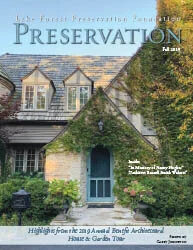
Highlights from the 2019 Annual Benefit Architectural
Cappy Johnston
Cappy JohnstonHouse & Garden Tour Photo by
From the President
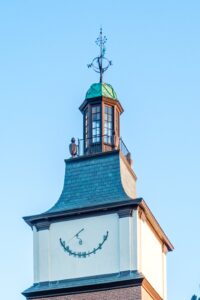
From several vantage points in downtown Lake Forest it’s easy to spot the white tarp-draped dome of Lake Forest Library. For almost two years the tarp has been in place as a temporary solution to stop moisture from infiltrating the building’s rotunda and impacting the large historic murals that surround the circulation room. Options for restoration of the dome were prepared by a consultant and presented to the Library board earlier this year. The fix will require replacement of the leaded-copper dome and significant restoration of the masonry substructure, according to library staff.
The 1931 Edwin H. Clark-designed building is not only an iconic landmark for Lake Foresters, according to historian Art Miller. “It’s one of the most architecturally significant small-city libraries in the U.S. for its composition, proportion and scale, and as one of the Chicago area’s most important museums of art and interior design.” Many residents may be unaware of just how important the combination of art and architecture is at our Library. On Sunday, November 17th, Mr. Miller will lead a tour of the main public rooms to explore the building’s interior art and architectural highlights. The event is free, but space is limited so reservations can be made through the LFPF office.
As the dome sits covered for another season, it’s hard not to be concerned for the future of this special building. No doubt addressing other important issues related to the building’s functionality as a library, its aging infrastructure, and how best to meet future programming needs will take careful planning, community input, and substantial fundraising to be successful. A process that will take time. But issues relating to historic building maintenance are immediate. Addressing the basic ongoing upkeep of the building envelope is the most important and cost-effective preservation treatment for extending the life of the building and protecting its collections.
The Foundation stands ready to assist and be a community partner in supporting the Library in the restoration of what is, perhaps, our most important historic public building.
PeterSincerely,
Peter Coutant, President
2019 Annual Architectural House & Garden Tour
A little rain couldn’t dampen the enthusiasm of nearly 200 LFPF members and friends as they enjoyed a September afternoon touring and learning about the history, architecture, and gardens of six beautiful historic homes. We are so appreciative of our homeowners, sponsors, docents and all who attended. You can read more about the history and homes on page 4 and 5.
L a k e F o r e s t ’ s
Early Estate Era New Growth
North and Lakefront
Lak e F or es t Pr eser v ation F oundation ’ s
2019 Annual Benefit Architectural House and Garden Tour
Special Thanks
The Preservation Foundation celebrated its annual benefit on the afternoon of September 22.
Many thanks to the homeowners featured in this newsletter.
Our Generous Sponsors:
Craig Bergmann Landscape Design, Inc.
DiVinci Painters, Inc.
Forest & Bluff – JWC Media Knauz Autopark
Kogen Friedman Development Lake Forest Bank & Trust Co.
Lynch Construction MBRE Healthcare
Northwest Vascular and Vein Specialists
SilverPepper Smith Capital Sunset Foods
The Organic Gardner
Tour Committee, House Chairs, and Docents:
Without their support and time this lovely event
would not have been possible.
Tour Chairs:
Elizabeth Abbattista and Natalie Reinkemeyer
And all of our wonderful patrons who enjoyed the day.
2019 Year-End
Help Us Make A Difference
Each year the Lake Forest Preservation Foundation dedicates your generous Annual Fund contributions to an important preservation-related project in the community. Past projects range from funding historic resource studies to actual brick-and-mortar restoration projects. This year we are excited to announce the first of a two-part project to raise awareness of our unique cultural heritage. The first part will be partnering with the City and private property owners to develop and install Historic Building Markers to call attention to architecturally significant buildings throughout the community with a focus first on the business districts. Selected buildings will be marked with a small bronze plaque listing the year of construction, the original architect, and the names of the original owner, where possible.
This idea developed out of a 2017 LFPF and City of Lake Forest program, titled “The Power of Uniqueness,” presented by renowned urban planner and Urban Land Institute Senior Fellow Ed McMahon. Mr. McMahon noted the incredible architecture and historic development of Lake Forest, but the lack of any interpretive displays to tell the story. He suggested finding ways to make the story of our community manifest in the landscape, using markers, plaques, and public art to foster greater appreciation and stewardship.
The second part, closely linked to the first, will be the long-awaited update of the Guidebook to Lake Forest, first published in 1994. This guidebook highlights important National Register historic properties and districts.
Neither of these projects can become reality without your help. We ask you to give to this year’s Annual Fund with a donation in support of these projects. Your year-end tax-deductible gift, of any size, will help us increase awareness of Lake Forest’s important cultural heritage.
For your support we are grateful! We can’t achieve our mission without you.
Annual Fund Launch
2019 Year-End
Help Us Make A Difference
Each year the Lake Forest Preservation Foundation dedicates your generous Annual Fund contributions to an important preservation-related project in the community. Past projects range from funding historic resource studies to actual brick-and-mortar restoration projects. This year we are excited to announce the first of a two-part project to raise awareness of our unique cultural heritage. The first part will be partnering with the City and private property owners to develop and install Historic Building Markers to call attention to architecturally significant buildings throughout the community with a focus first on the business districts. Selected buildings will be marked with a small bronze plaque listing the year of construction, the original architect, and the names of the original owner, where possible.
This idea developed out of a 2017 LFPF and City of Lake Forest program, titled “The Power of Uniqueness,” presented by renowned urban planner and Urban Land Institute Senior Fellow Ed McMahon. Mr. McMahon noted the incredible architecture and historic development of Lake Forest, but the lack of any interpretive displays to tell the story. He suggested finding ways to make the story of our community manifest in the landscape, using markers, plaques, and public art to foster greater appreciation and stewardship.
The second part, closely linked to the first, will be the long-awaited update of the Guidebook to Lake Forest, first published in 1994. This guidebook highlights important National Register historic properties and districts.
Neither of these projects can become reality without your help. We ask you to give to this year’s Annual Fund with a donation in support of these projects. Your year-end tax-deductible gift, of any size, will help us increase awareness of Lake Forest’s important cultural heritage.
For your support we are grateful! We can’t achieve our mission without you.
Annual Fund Launch
Honoring the Memory of
Nancy Hughes
Lake Forest is a city of joiners and doers. Volunteerism and philanthropy are at its
core. Giving back to the community through charity, basic acts of kindness, or by sharing one’s education, leadership, and talents is the Lake Forest way. Yet, even in a community of people who give so much, so often, there are those special people whose generosity seems to have no limits.
On September 15th, Lake Forest lost one of its most extraordinary philanthropists, Nancy Hughes, who passed away suddenly at the age of 68.
A long-time Lake Forest resident and the wife of the late director John Hughes, Nancy was the woman behind the man. Her influence and Midwestern roots are felt in the legendary movies that her husband directed, such as Sixteen Candles, She’s Having a Baby, The Breakfast Club, Ferris Bueller’s Day Off, and many others.
The impact of Nancy Hughes’s generous contributions is visible throughout Lake Forest and the surrounding area. Residents and visitors to the area will long enjoy and benefit from the John & Nancy Hughes Pavilion at Northwestern Lake Forest Hospital; the John & Nancy Hughes Clubhouse at Deerpath Golf Course; the Hughes Gateway to the beach; the Hughes Auditorium at the Robert H. Lurie Medical Research Center of Northwestern University; and the John and Nancy Hughes Theater at Gorton Community Center.
One of the great gifts that the Hughes gave to Lake Forest was the renovation of Gorton Community Center. John and Nancy knew that there was more to historical preservation than just maintenance, upkeep or renovation of old buildings, all of which are extremely important. They knew the importance of relevance, and future use, and storytelling, and strived to bring excellence to the Lake Forest community in a place to share their passion for the arts.
Blair Nagel recalls that “Receiving the Hughes donation to rename the theater the ‘John and Nancy Hughes Theater’ was a game changer for Gorton. It elevated the community center’s visibility to the public and dramatically raised the bar for the theater renovation. If you have the Hughes name on your movie theater, you better offer a world-class product, and that’s exactly what Gorton has achieved”. As described on the Gorton Community Center website, “The newly renovated John and Nancy Hughes Theater at Gorton Community Center hosts professional sound, light, video, and digital cinema technology. The Theater is a perfect venue for lectures, presentations, films, and performances.”
“Nancy Hughes understood the special things that define a sense of place and nurture the spirit. We are so lucky that Lake Forest was the beneficiary of her extraordinary care and attention,” said Deborah Fischer. She supported causes great and small to further the arts, preserve open space, advance health care, and enhance recreational opportunities within The City of Lake Forest. She most recently helped preserve Forest Park and the beachfront, our community treasures. Her leadership allowed the City not just to make repairs, but to provide a fitting entrance to the beach which is now known as the Hughes Gateway.
Nancy and John Hughes will be greatly missed by the community of Lake Forest, but they will always be remembered for their significant contributions.
About Woodland Road
By Rommy Lopat
The 2019 Preservation Foundation Annual Benefit House and Garden Tour explored opposite ends of the local expansion in and beyond the 1857 registered town plan by Almerin Hotchkiss, a St. Louis-based landscape gardener. This growth southeast and northwest of the plan followed the 1895 founding of the Onwentsia Club and 1896 opening of the 18-hole golf course there. An 1897 house by Howard Van Doren Shaw was one of the first built on the lakefront south of Schweppe estate. This 1897 Shaw house led toward further development within the 1857 plan south to and beyond the Shields Township line. This essay, written by a resident of today’s Woodland Road who has contributed to local history including excellent work on Lake Forest Cemetery in Find A Grave online, describes the neighborhood that pushed beyond the 1857 plan northeast ca. 1900 on what then was Sheridan Road–now Woodland Road west of today’s Sheridan to and north along Edgewood Road. That larger, northwest of the 1857 plan portion of the tour visited one more Shaw house overlooking the ravine at Woodland Road from Sheridan, three on the north side of Woodland between Wisconsin and Edgewood, and one on Edgewood. What follows is an excerpt, slightly edited, from a longer and more detailed essay that was summarized in the September 20, 2019, Tour booklet. The complete version (ca. 2,000 words) is available by reaching out to the Preservation office. A.M.
Imagine Lake Forest with virtually no development–no houses–on its land. In the 1830s there was only native savanna–oak and shagbark hickory trees, hazelnut and witch hazel bushes, and to the east, Lake Michigan. Long ravines, some over a mile long, cut through the land, making it difficult for early settlers to travel north and south along the lakeshore. This was the scene when 34-year-old Irish-born Thomas Cole bought 40 acres of land in Section 28 of Shields Township in 1844. To his south was the William Swanton 80-acre farm and to the west lay the 40-acre Atteridge family farm, all three part of one extended family that had settled across Green Bay Road from today’s West Park, in 1837.
Access to these second-wave farms would have come from dirt “roads” leading from Green Bay Road. The earliest road connecting Green Bay Road through these farms to Lake Michigan would likely have been Wisconsin Road, wiggling east along but not crossing the deeply incised Clark Ravine. Wisconsin Road1 followed the ravine all the way to the lake.
In 1857, shortly before the Civil War, the Lake Forest Association purchased ca. 2,000 acres of land in Shields and today’s Moraine
Townships and incorporated it as “Lake Forest.” The Association carved the terrain into ca. 300 lots for sale and began to build roads and bridges. The Cole farm was purchased and was subdivided into five lots: No. 22, 23, 23½, 24, and 47. The Association created University Avenue (now called Sheridan Road), a thoroughfare creating a north/south axis which would have necessitated building a bridge over the Clark Ravine at Wisconsin Road.
Lot 23 was the central site of LFPF’s 2019 Tour. It was once a 4.47-acre parcel, but the ravine limited access to it. It is thought that 420 E. Woodland is the earliest house in the neighborhood. It appears to be two houses joined together, with a side-loaded front door that may indicate that a dirt road led east through the Atteridge farm from today’s McKinley Road.
Opening Woodland Road to Sheridan Road and to Lake Michigan made this neighborhood desirable. The Atteridge Farm on the west was subdivided into thirty lots by 1895.
1 That section of Wisconsin Road east of Sheridan Road was later renamed Woodland Road.
410 East Woodland Road
UV
Original architect unknown, ca. 1900
Jerome Cerny, I. W. Colburn, John Drummond, and Ruggles Architecture,
renovation architects
This charming, commodious house dating from the period ca. 1900 of expansion by Onwentsia members represents restyling through Arts & Crafts and colonial-revival periods. The latter renovation with the prominent bow windows, illustrates a Cerny signature. The architect owner and his historian/ gardening spouse have harmonized the disparate features into a compatible whole, set in spacious grounds with an inviting dooryard garden.
410 East Woodland Road
UV
Original architect unknown, ca. 1900
Jerome Cerny, I. W. Colburn, John Drummond, and Ruggles Architecture,
renovation architects
This charming, commodious house dating from the period ca. 1900 of expansion by Onwentsia members represents restyling through Arts & Crafts and colonial-revival periods. The latter renovation with the prominent bow windows, illustrates a Cerny signature. The architect owner and his historian/ gardening spouse have harmonized the disparate features into a compatible whole, set in spacious grounds with an inviting dooryard garden.
420 East Woodland Road
UV
Thomas Cole, original owner, 1840s/50s
Attributed to Alfred H. Granger,
- 1920, two houses combined with additions
Craig Bergmann, landscape architect
This engaging house with its mid-19th century style piazza to the south appears to combine smoothly its many periods of development. The 1920’s owner was Granger’s daughter, and the architect also redeveloped during the same period the Church Street residence, directly south, on land owned by his father-in-law,
- & N.W. RR builder Marvin Hughitt. Granger’s 1902 Church of the Holy Spirit (Episcopal) anchors the south end of Church Street at Westminster.
255 Mayflower Road
UV
Little Orchard, 1897
Alfred L. and Mary Corwith Baker, Original Owners
Howard Van Doren Shaw, Architect
Ellen Biddle Shipman, Landscape Architect
This home is one of the earliest lakefront houses built south of the Larned/Schweppe estate following the opening of the Onwentsia Club, 1896. This Colonial frame house in the post 1893-World’s-Fair mode, has an asymmetrical façade with the service wing on the left. Modernized mid-20th century by James Speyer for banker Solomon Smith, it was restored by the previous owner ca. 1990. Ellen Shipman’s 1930 walled garden on the east side opens to the lake.
436 East Woodland Road
UV
Leslie and Rhoda Patten Wheeler, original owners Holabird & Roche, original architects, 1916-1921 Ruggles Architecture, renovation architects
This classic center-hall frame colonial was planned for and finally built after World War I for scions of two important Chicago business families, the parents of late LFPF board president Harry Wheeler. The house looks south over the little ravine, which was designed in 1925 by Warren H. Manning. The Wheelers liked their house and its scale and challenged David Adler to incorporate a version of its form into their much larger, but landscape-screened house on South Mayflower Road built in 1932-34.
1110
North Sheridan Road
UV
Frances Pratt and Edward Larrabee Baker, original owners, 1906
Howard Van Doren Shaw, architect
This remarkably-preserved English Arts & Crafts house perhaps best recalls Shaw’s own Ragdale (1898) in plan and interior design. Outstanding features of the exterior and landscape include the simple masonry columns of the pergola in the style of England’s
- H. Baillie Scott and the two fences that set off the service yard. The latter, with their eye-catching storybook copper silhouettes on concrete piers, keep visitors from noticing the avant-garde horizontal narrow slats just below and the repeating band of segmental arches on top.
1100 North Edgewood Road
UV
Russell Walcott, architect, late 1920s
Kurt Pairitz, renovation architect
Princeton-educated and European-trained Russell Walcott created this turreted Norman French traditional country manor, similar to the Stanley D. Anderson designed Norman manor, located on Verda Lane and viewed on the 2018 Tour. Walcott built many notable houses in his native Evanston, in Winnetka, and in Lake Forest.
eRussell smith Walcott
Russell Smith Walcott was one of the superbly trained and talented architects working in Chicago just after Howard Van Doren Shaw and before David Adler in the first half of the 20th Century. He was so prominent that the acclaimed designer Buckminster Fuller in 1928 referred to Walcott as “the best of residential designers in Chicago.”
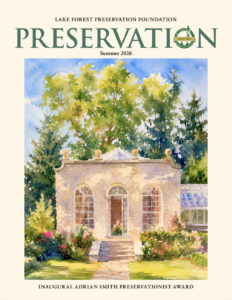
Though many of Walcott’s designs were built on the North Shore and especially in Lake Forest, he isn’t as well known here as Adler, Shaw, and other prominent architects of the day. The LFPF is giving Walcott a closer look and included his Tudor Revival house at 1100 N. Edgewood Road on our House & Garden Tour this past September. A photo of that house is on the cover of this newsletter.
Walcott was born and raised in Chicago. He graduated from Princeton University’s architecture program in 1912 during the era of instructor Aymar Embury II, who was a careful student of historic styles and author of books on churches (1914) and houses (1909,
1913, and 1917). Walcott served in
the armed forces in World War I, and after the war, like his brother Chester Walcott, he built a thriving architecture practice in Chicago. Russell Walcott’s work was frequently published in prominent trade magazines of the 1920s, including American Architect and Architectural Record. And one of his homes — the Charles S. and Mary McGill home at 505 N. Washington in Valparaiso, Indiana — is on the National Register of Historic Places.
Walcott’s Lake Forest portfolio includes 2000 Knollwood Road, built in 1929; the west wing and portions of the Owen Barton Jones estate at 10 West Deerpath; the Tudor Revival-style David Dangler house at 155 Mayflower Road; 160 East Onwentsia Road; and the Charles F. Glore House at 301 N. Sheridan Road (Tudor Revival), which won a LFPF Preservation Award for restoration in 2004. Other North Shore estates designed by Walcott include Winnetka’s shingle-style J.M. Dickenson Jr. house and 40 Indian Hill Road, overlooking the fairways of Indian
Hill Country Club, and Evanston’s Johnston A. Bowman house in the French Eclectic style.
According to the National Register of Historic Places application for his Valparaiso house, “Russell Walcott established a thriving, independent practice in the 1920s, specializing in the revival styles so popular at that time. Whether the style was Shingle, French Provincial, Colonial Revival, or Tudor Revival, Walcott’s designs were balanced, elegant, and showed an appreciation for fine craftsmanship. Despite his mastery of many of the eclectic styles in vogue, Walcott became most noted for his Tudor Revival designs.”
Many of Walcott’s Lake Forest homes are in the Tudor Revival style and were built in the heyday of the country house movement, which was centered in Lake Forest. Country houses were large homes built on spacious estates, and they represented the fruition of the American Dream by their owners – most of whom were titans of American industry. But not all country homes were on massive parcels of land.
“The property on which a country house sat only had to be big enough to create the illusion of self-sufficient landed life and independence from the outside world,” according to Clive Aslett, author of The American Country House.
In 1928 Walcott partnered with Robert Work, a former associate of David Adler, to form the firm of Walcott & Work. They worked together until 1936, when Walcott moved from Chicago to Tryon, North Carolina, to enjoy an early semi-retirement. He died there in 1959.
Walcott designed houses from top to bottom: 1100 North Edgewood Road (also on cover) 142 Stone Gate Road 2000 Knollwood Road
A Lake Forest Treasure
1857 Original Map Seeks a Safe Home
In 2014 while researching the train station location in the 1857 Almerin Hotchkiss-designed Lake Forest plan, former LFPF board member David Mattoon asked the City to hunt for early versions. One turned up in an old frame, and examination of its original autograph signatures led to further digging by Mattoon. City and County records showed that it was replaced in 1895 by a new drafting by County surveyor James Anderson, Jr., son of a town founder. The much-worn 1857 original was released to the City for display, a relic of the town’s founding. The frame dated from the 1890s and it may have hung in the 1899-completed City Hall until some point when it went into storage.
Summer Progams at their Best
The Directors of the
Lake Forest Preservation Foundation
Cordially invite members to attend our
Holiday Celebration
Sunday, December 8, 2019
3:00 – 5:00 pm
Advance Reservation Only Please RSVP by December 3, 2019
www.lfpf.org or 847-234-1230 Celebrating 150 years of Howard Van Doren Shaw
The Directors of the
Lake Forest Preservation Foundation
Cordially invite members to attend our
Holiday Celebration
Sunday, December 8, 2019
3:00 – 5:00 pm
Advance Reservation Only Please RSVP by December 3, 2019
www.lfpf.org or 847-234-1230 Celebrating 150 years of Howard Van Doren ShawTwo key aspects of Lake Forest’s distinctive garden
Further study in 2018 by map expert and Lake Forest College alumnus George Ritzlin, Evanston, determined that the map itself is a mid-19th century type of copy, to which were added the various autograph texts and signatures of County officials. Various local and Chicago fires of the period make it highly unlikely that any other copies of this first-generation surveyed version of this survive apparently the largest American railroad garden-city suburban, artistic-layout plan.
The map, worn out from use by 1895, was stabilized by Chicago conservators in 2014-2015 and returned to the City, in its frame and put on display in a City Hall conference room. But the lines of the plan already were very faint, and the exposure to light even in that sheltered location posed risk to this artifact of considerable local and national importance. With no local suitable fire and theft secure location, and no comparable strict temperature and humidity control, the decision to transfer the map to the Newberry Library will be determined by the City Council in November. If approved as LFPF is suggesting, the map will be housed with a nationally recognized collection that is supported by a center for cartography endowed by the late Lake Forest resident Hermon Dunlap Smith in the 1960s, and includes many other local maps.
Contributed by local historian Arthur Miller
and landscape heritage were highlights of Preservation’s June and August garden strolls: horticulture and design. In late June Cappy Johnson’s remarkable ravine-edge mostly shade garden was a symphony of hundreds of hosta varieties, from the grand to the tiny and delicate.
In late August Desmond LaPlace welcomed Preservation members to his early mid-century modernist styled formal gardens, designed by the firm founded by Franz Lipp and reflecting his ca. 1930’s style with Art Deco characteristics. These included masses of color bedding-out plants and varied geometric forms with some suggesting zigzag patterning. A large west garden in an oval form is echoed closer to the house’s south side, near the lake.
All occasions enjoyed beautiful summer weather, perfect for appreciating these special local legacies. We thank our hosts for opening up their incredible properties and all our guests who came to support and learn about our unique visual character.
All occasions enjoyed beautiful summer weather, perfect for appreciating these special local legacies. We thank our hosts for opening up their incredible properties and all our guests who came to support and learn about our unique visual character.In July our members and guests enjoyed the much anticipated, annual tour of the buildings, collections and grounds of Crab Tree Farm. Originally a commercial dairy operation, over the last thirty years the farm buildings, designed by Solon S. Beman in 1911, have undergone extensive restorations and now house the premiere collection of American and English Arts and Crafts furniture and decorative arts objects in the country.
LAKE FOREST PRESERVATION FOUNDATION
2019-2020
BOARD OF DIRECTORS
EXECUTIVE COMMITTEE
Peter Coutant
President
Tom Gleason
VP Communications
Laura V. Luce
VP Development
Elizabeth Abbattista Natalie Reinkemeyer VP Programs
Susan Rafferty Athenson
Secretary
Debbie Marcusson
Treasurer
Jim Opsitnik
Immediate Past President
DIRECTORS
Robert Alfe Liz Brandel
Ingrid Bryzinski Michelle Curry Adrienne Fawcett Angela Fontana Craig Fox
Trey Gonzales John Julian William McFadden Roger Mohr Elizabeth Moore
Monica Artmann Ruggles Denise Schlax
Jason Smith
HONORARY DIRECTORS
Gail Hodges Arthur Miller Pauline Mohr Shirley Paddock Linda Shields Lorraine Tweed
EXECUTIVE DIRECTOR
Marcy Kerr
Preservation
FALL 2019
VOLUME 12, NUMBER 3
Contributors:
Peter Coutant,
Adrienne Fawcett, Gail Hodges, Rommy Lopat, Marcy Kerr, Arthur Miller, Pauline Mohr,
Monica Artman Ruggles and Jason Smith
Editors: Peter Coutant and Tom Gleason
PhotograPhy:
Cappy Johnston
Lake Forest Preservation Foundation 400 East Illinois Road
Lake Forest, Illinois 60045 www.lfpf.org
NON-PROFIT ORG
U.S. POSTAGE
PAID PERMIT NO. 184 LAKE FOREST, IL
60045
NON-PROFIT ORG
U.S. POSTAGE
PAID PERMIT NO. 184 LAKE FOREST, IL
60045
ECRWSS
Residential Customer Lake Forest, IL 60045
Tour of
Architecture and Art of Lake Forest Library
Sunday, November 17, 2019, 2-4 pm
Lake Forest’s award-winning town library opened in 1931 in the depths of the Depression following the 1929 Crash. A memorial donation from the Reed and Schweppe families, the building is an exquisite example of conservative modernism, contemporary with Lake Forest’s Post Office, 1932, by Morphett & Milman, and Washington DC’s Folger Library, 1931, by Paul Cret. The Library recalls a classic country house in a Jeffersonian Federalist style. In an era when $10 could buy what
$100 had purchased in 1929, it was stocked with outstanding newly-bespoke and collected art managed with careful stewardship in recent decades as its significance has been appreciated. Notable are its 1931 rotunda murals by Nikolai Remisoff, its rare original early 19th century Audubon Havel elephant-folio water bird plates, and its ca. 1930 estate renderings and plans by the Foundation for Architecture and Landscape Architecture. Art Miller will lead a tour of the main public rooms on the Library’s main floor to point out these along with interior architectural highlights. Library Director Catherine Lemmer will share plans in progress for library program space renewal and for continuing stewardship.
This event is FREE of charge but space is limited.
Please reserve your spot by emailing info@LFPF.org or call 847-234-1230