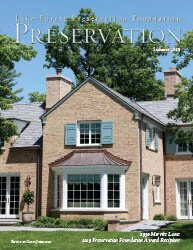
Summer 2019
Photo by CaPPy Johnston
1950 M5 EerarstitLt Lauarneel: 2019 Preservation Foundation Award Recipient
FROM THE PRESIDENT
Dear Lake Foresters and Friends of the Preservation Foundation,
It’s an honor to step into the role of President of the Foundation. It’s humbling to think of the long line of those who have held this office in the past, including our most recent president, Jim Opsitnik, whose leadership guided the successful rehabilitation of the downtown train station.
An important part of the Foundation’s mission in preserving the character of our remarkable community includes education. That’s why all our programs and publications include an educational component. The high quality of our programs wouldn’t be possible without the hard work and dedication of our Board of Directors and, most importantly, our Executive Director, Marcy Kerr. This year we have another wonderful line up of programs planned. Please join us for our next Friday Garden Stroll on August 23rd, which offers a rare opportunity to see an historic lakefront garden. Also, not to be missed is our Annual Architectural Home and Garden Tour, Saturday, September 22nd. This year’s tour will highlight a spectacular Howard Van Doren Shaw lakefront estate, as well as a very walkable collection of wonderful historic homes all situated around the Woodland and Edgewood Roads neighborhood.
Finally, congratulations to this year’s Preservation Award winners. This issue of Preservation honors the property owners who received Preservation Awards for exemplary stewardship, for honoring history while renovating for 21st century lifestyles, and for recognizing the importance of fitting new construction into its historic context. This is the 29th year that the foundation has presented its annual Preservation Awards. Since 1991, more than 240 awards have been presented to homeowners, businesses, organizations, architects, and landscape architects who have made a commitment to excellence in preserving Lake Forest’s unique historic visual character. Each of these awards demonstrates not only a significant investment in construction and preservation, but also the commitment to high quality, top caliber design, both architecture and landscape architecture, that continues to be made in this community year after year.
PeterSincerely,
Peter Coutant, President
Annual Benefit
Architectural House & Garden Tour
Sunday, September 22, 2019 1-5pm Tickets Available Online at www. LFPF.org
e e e e e e e e e
The Lake Forest Preservation Foundation’s September 22nd annual tour will focus on Lake Forest’s Early Estate Era New Growth, North and Lakefront.
The tour will include a lakefront estate as well as several homes within walking distance situated along Woodland and Edgewood Roads. There will be two early houses by Howard Van Doren Shaw in this 150th anniversary of his birth, 1869-2019; one house by Chicago architects Holabird & Roche (1921), one by Tallmadge & Watson (1896), and one by Russell Walcott (1929). Garden designs range from early Ellen Shipman to contemporary designers. The tour will highlight this fascinating early period as well as the modern stewardship and garden design.
The annual tour is the primary fundraising event for the Lake Forest Preservation Foundation and proceeds will be used to continue the educational, advocacy and preservation work of the Foundation. The tour is from 1-4 PM on Sunday, September 22, followed by an outdoor reception from 4-5 PM. Before September 18th, tickets are $100 or $150 for patrons. After September 18th, general tickets are $125. Tickets are available by visiting lfpf.org.
The Foundation’s fall benefit tours in recent years have focused on historically significant neighborhoods including Stanley Anderson, North Green Bay Road, the Old South Woods, upper Lake Road, Lake Road and Deerpath near Forest Park, Ridge Lane near the corner of Deerpath and Green Bay, “old” Lake Forest along Deerpath and on Sheridan from Deerpath to Walnut, highlighting houses from the 1850s to the early 1900s. As a group, these tours offered attendees a good understanding of the evolution of this remarkable, classically-derived town. This year’s tour will continue to enrich both new and long-term Lake Foresters, increasing their understanding and appreciation for this city’s unique heritage and the reason for the Foundation’s determined efforts to preserve the legacy. All proceeds benefit local preservation projects and programs.
Lake Forest’s Remarkable
Preserved Public and Semi-Public Buildings and Spaces
Lake Forest is notable to residents and visitors alike for its uncommon public and semi-public buildings and landscapes and the manner in which they have been maintained. While there have been some subtractions in the last half-century, there have been many more payings-forward. Even the losses like Barat College and the Stanley Anderson-designed Lake Forest Hospital have been balanced by the renewed Woodlands Academy and the spectacular new Northwestern Medicine-Lake Forest Hospital.
Our annual fund dollars, long-dedicated to the model effort of restoring the train station, will be branching out to support other projects. The 2015-re-discovered 1857 town plan registration document will be one. Discussions are underway to transfer this to the Hermon Dunlap Smith Map Center at Chicago’s Newberry Library. Smith lived on Stone Gate Road into the 1980s, and the Center he created is the Midwest’s leading preserver of important historic cartography. This 1857-registered plan by landscape designer Almerin Hotchkiss, with the county officials’ autograph markings, was the largest U.S. garden-city romantic layout at the time, funded by the 1856-organized Lake Forest Association. It was essentially a gated community, with roadways all converging
on the train station area, unique in such mid-19th century town planning. The Foundation will make available copies ready for display for City Hall and the History Center, while the rare original goes into highest-quality storage in Chicago.
But in general Lake Forest’s preserved legacies are the result of frequently renewed efforts to protect and enhance the usability of these fine places, for which the 1857 map is a little miniature. The new Municipal Building was occupied in 2009 next to restored marshland in west Lake Forest, with its previous site yielding to the Kelmscott Place development now approaching completion. The 2010s have seen an intensification of these stewardship efforts. The train station work began in 2011 and was completed in 2018. The Deerpath Inn rejuvenation and restoration occurred in 2015, overlapping with the nearby Market Square restoration and rehabilitation work that began ca. 2014 and is on-going. Forest Park was rehabilitated in 2015 and now is undergoing north-end bluff
road repairs. Mayflower Road’s north bridge has been repaired. Gorton Center recently underwent a major rehabilitation, as did the City-owned Ragdale house on North Green Bay Road. Lake Forest Library rehabilitated its historic 1931 original windows, with the process yielding a Preservation Foundation educational program on this model project for our community. The Library more recently has undergone an historic structure report process for preservation of its 1931 award-winning building and for the use of its spaces and site for changing programs. Lake Forest College’s Donnelley and Lee Library is re-arranging for more effective user space as internet access evolves. In 2018, the College completed its major renovation of its 1962 science complex, now the Lillard Science Center. And the Preservation Foundation gave the Lake County Forest Preserves a 2019 award for the new bike-trail/pedestrian bridge over the west side railroad tracks, accomplished with major local donations. This was built between the architect Arthur Heun–remnant abutments of the 1910s Mellody Farm (J. Ogden Armour) bridge, that earlier span designed by engineer/landscape architect O.
- Simonds. Now, too, Lake Forest High School, which was recognized last year as the
state’s most beautiful in its Stanley Anderson 1935 estate-recalling central building, has begun looking at its needs relating to updating classrooms, addressing its 1935 historic windows, and many other stewardship tasks. And each of our older church buildings has been updated and preserved in this decade.
The central business and cultural district, our educational and health care campuses, Lake Forest Open Lands’ 800 acres adjacent to Forest Preserve open space, Elawa Farm, the Grove Campus, and our parks from the beach to Northcroft and on to the Route 60 green belt all contribute to the unique Midwestern historic visual character of our city, along with our 8,000 individual households and their landscape settings. Our heritage of tax-supported, but mostly privately-funded shared community resources do much to define our remarkably stable and desirable community.
Art Miller
2019 Preservation Foundation awards
This year marks the 29th year that the Lake Forest Preservation Foundation has presented its annual Preservation Awards. The range and variety of properties honored since 1991, cover large and small homes and businesses, landscapes and public spaces all across Lake Forest. The eight awards presented this year represent four categories, Rehabilitation, Infill, Preservation and Heritage.
The standards for judging structures and landscapes for awards are those of the
Department of Interior. Our award winners include structures that have been 2019 Historic Preservation Award Winners
rehabilitated or renovated to meet the Department of the Interior standards for the Treatment of Historic Properties, and well-executed, newly-constructed buildings and structures that fit into their surrounding areas.
511 Rosemary Road
Rehabilitation awaRd
Owners: Patrick McGriff III and Lois McGriff
Renovation Architect/Builder: Scott Renken-Renken Architects & Builders
In 1928 Stanley D. Anderson, Anderson & Ticknor, designed this house. Located on the beautiful Rosemary Road in East Lake Forest, the home is accented by a long paved driveway and a most charming low, stone wall along Mayflower. A complete, three floor, interior preservation and restoration was done to cosmetically enhance, restore and preserve the original 1928 Stanley Anderson architectural design.
1950 Merritt Lane
Rehabilitation awaRd
Owners: Susie and Toby Lees
Renovation Architect: Diana Melichar
Lake Forest Academy 1500 West Kennedy Road
Built in 1936 and attributed to architect Ralph Milman, this two-story brick country home is tucked in a quaint street in the southwest corner of Lake Forest. The current owners sensitively expanded the home with an addition on the rear façade and a new detached garage in keeping with the home’s original character.
5 East Laurel Avenue
PReseRvation awaRd
Owners: Anna and Stephen Russo
This home is one of Stanley D. Anderson’s great Country Georgian houses from 1936. The all-Lannon Stone façade has a colonial revival front porch with Anderson’s classic triangular pediment with an oculus window. The house is evocative of Anderson’s then recently completed (1935) high school. The house had fallen into deep disrepair and was purchased by the Russos. They have extensively cleaned and tuckpointed the stonework, replaced the windows while keeping the dark color of the mullions and frames. Additionally, they extensively rebuilt and painted the original shutters, and repaired the roof.
new ConstRuCtion/infill awaRd
Owner: Lake Forest Academy
Project Architect: Peter Witmer
Lake Forest Academy’s campus since 1948 and growing from the ca. 1910 estate buildings of Mellody Farm, the J. O. Armour estate, is centered on the stunning and historic Armour mansion by Arthur Heun. Buildings north of this extensive main house have developed since the 1990s, and in this decade two impressive postmodern buildings are the Reyes Family Science Hall and the Reid-Anderson
Student Union, both by Peter Witmer, Witmer Associates who also has done the current master plan. The Reyes and Reid-Anderson buildings stand out as respectfully compatible with the former house (Reid Hall) and the 1970 modern addition by Walter Netsch, but postmodern in touch with current style and roof lines.
Middlefork Bridge
new ConstRuCtion/infill awaRd
Owner: Lake County Forest Preserves
Engineering: Phil Hurst, Civitech
This project reconstructed a modern pedestrian bridge in place of the long-removed bridge that once crossed the railroad tracks along the entry road to the J. O. Armour estate, now Lake Forest Academy. Construction of the bridge provides a link to development west of Lake Forest Academy with the Middlefork trail system. Spearheaded by Lake County Forest Preserves, the project was in partnership with the City of Lake Forest and multiple donors, including Elizabeth and Richard Uihlein, Lake Forest Academy, the Lake Forest Open Land Association, The Chicago Bears, Lake Forest Bank & Trust, and John and Paula Lillard. This project restored pedestrian connectivity. The new modern steel bridge fits within the remaining original Arthur Heun designed bridge abutments.
East Lake Forest Train Station
PReseRvation awaRd
Owner: Union Pacific, with lease to City of Lake Forest
Architects: Frost & Granger, 1900
Preservation Design & Oversight: Gunny Harboe
This decade-long preservation/rehabilitation effort was guided by an Historic Structure Report by architect Gunny Harboe and architectural oversight by preservation architect Douglas Gilbert. Exterior roof and related construction took place in 2011. A second exterior phase for the walls and painting occurred in 2016. A third partial interior renovation took place in the winter and spring of 2018, led by Jim Opsitnik.
1035 N. Sheridan Road
The Gorton-Heyworth House, 1894
heRitage awaRd
Owner: Carla Westcott
Architect (Attributed): John Todd Hetherington, 1894
This house was built for Mayor Edward F. Gorton, 1896-1902, for whom Gorton Center, formerly Gorton School, is named. Its Heritage Award reflects its many exterior changes over its 125-year history, while preserving its overall character. When the Gortons moved to Geneva, Illinois, in 1907 it was acquired by contractor James O. Heyworth, and then was lived in by his son and his family until World War II. The current owner has maintained and adapted the house for modern living. The pool was the first one locally.
408 E. Illinois Road
heRitage awaRd
Owner: Mr. And Mrs. David Waud
Architect (Attributed): Asher Carter, 1859
This home is a square Italian villa, reflecting the mid 19th c. type modeled on the two casinos at the Villa Lante near Rome, 16th c. Moved to this location in 1920, its porch has balustrades identical to those at 725 S. Sheridan–making it possible designer Alfred Granger adapted the house to its new setting. The original architect, most likely, was Asher Carter, who also designed the Old Hotel that was once located in what is now Triangle Park.
Lecture Leads to a Re-discovery
A standing-room-only crowd took in a lecture at Gordon Center on May 9, 2019, sponsored by the LFPF. The topic that drew so many into the Stuart Room that day was gardens and more specifically historic gardens.
Judith Tankard, an author and scholar, spoke specifically of Ellen Biddle Shipman. Shipman was one of the first female landscape architects in America. Her style of lush planting beds and elegant gardens both of large and small scale is iconic. She worked with many prominent clients all across the country while keeping a home base in Cornish, New Hampshire, and an office in NYC. Go to our website, LFPF.org to view the video of the May 9th Judith Tankard program, Ellen Shipman and the American Garden.
Shipman’s influence in Lake Forest is seen in a handful of commissions she did mostly in the 1920s. One of her commissions was at the newly constructed William McCormick Blair house, Port O’Call, in Lake Bluff. When the Blairs first occupied their house in the spring of 1927, the intimate and jewel-box-like space that Shipman would eventually design, simply had new sod. Multiple dated plans, beginning in August 1927 through January 1930, lay out and develop the signature Shipman style for the perimeter of the David Adler designed house. Also, and more importantly, the focal garden on the west side of the house is drawn in detailed planting beds and outlined in boxwood. This garden is what a visitor would be greeted with when walking in the entry arcade and shortly thereafter into the Blair residence.
A tragic accident would bring Shipman to design another work for the Blair family, this time in Lake Forest. Helen Blair, the oldest of four children, was injured on July 8, 1930, in a horse-riding accident at Onwentsia. Later that same day Ms. Blair passed away from those
Thank You
Thank you to Liz and Mark Readon, Lori Baker and
Peter Coutant for hosting our Annual Meeting Reception
Thank you to Cappy and
Dennis Johnston for hosting our Early Summer Garden Walk
injuries at the age of 17. In December 1930, Shipman submitted her designs for the planting layout for the family plot in LF Cemetery, along a ravine. In her very detailed style, the planting beds were packed with beautiful bulbs to have multi season blooming and arborvitae trees to provide screening. A curved bench, offset from the centerline of the plot would be a place for contemplation within this outdoor room.
On July 14, 1931, the landscape architect designed the slate headstone of the Blair daughter (the family has
used the same headstone design for subsequent family members). An undated drawing by Shipman, but believed to be December 1930 as well, shows a rendering for a statue, on a plinth, to be a central aspect in the serene and sacred space. The statue that is there today is of a winged angel. While it is different than what was originally sketched by Shipman, it was created by her artist friend from the Cornish community, Herbert Adams. The bronze statue is signed by Adams and was executed in 1932 by the Gorham Co. Foundry. As landscapes change and grow over time the artist’s original vision alters. While the Shipman plans were not completely unknown, it does add another level of appreciation to all that Lake Forest has to offer in historic design. It also leads one to wonder what other masters of design,
structures, and landscapes might have done work in the cemetery for families, clients, and friends to rest in that hallowed space along Lake Michigan.
Tom Gleason
Welcome to the Board of Directors
2019 New Board Members (L-R)
Trey Gonzales, Denise Schlax, John Julian, Adrienne Fawcett, Liz Brandel, Craig Fox, and Jason Smith.
Adrian and Jason in office
Photo by aPril Graves oF liGht drawn studios
Adrian’s Office
Adrian and Jason in office
Photo by aPril Graves oF liGht drawn studios
Adrian’s Office
Smith Family Interests Drive Restoration of Adler Estate, Part III
Currently, Adrian and Nancy Smith do not plan to live in the David Adler-designed Cudahy estate at 830 Green Bay Road that they purchased two years ago. Since then, they have been restoring it and have no specific timetable for completion. However, so very much has been transformed since their purchase that the whole family is using the property to pursue individual and unique passions and hobbies. Adrian has an office on the property and continues his research into the David Adler home and other architectural endeavors. Nancy hosts art classes for fellow artists, while son Jason manages the restoration process and uses the estate for his own family activities.
Reception Area
Nancy’s Studio
Reception Area
Nancy’s Studio
Adrian continues to restore 830 to as close to David Adler’s original design as possible, while making the estate appropriate for today’s lifestyle. Just recently, he was in search of photos of the interior during the original owners’ occupancy to restore it to that “look” as much as possible, while inserting his own and Nancy’s contemporary and artistic touches throughout the main floor.
“We are on our way to returning and in some cases improving this historic Adler house but not as a shrine. Restoration of historic properties entails bringing back the spirit, however, not compromising on the usefulness for modern purposes. It’s a balancing act, especially with kitchens and bathrooms,” said Adrian. “It’s a labor of love. We have left all of what exists as Adler intact. Where possible, we have brought back what our research shows it was during the early years.”
They have decided not to restore the original front entrance on the east side of the estate, choosing to keep the former reception area as an open, light-filled room. This room is paneled in rustic white oak, which is being restored, while adding matching wood to frame the new, divided light windows that look out onto the original entry area, now a new garden. Jason remarked that this area can easily function as a family room for future homeowners with young children, echoing his father’s desire to make the home livable for contemporary families.
Nancy’s Studio.
Nancy’s Studio.Nancy has transformed a few rooms to support her passion for mixed media painting, a style of painting that begins with a detailed drawing and then adds multiple layers of paint and glaze to create depth and luminescence. She enjoys her bright and airy studio on the first floor, which was W. Clement Stone’s office, and has converted several bedrooms into classroom space. Steve Jones, former curator of the College of Lake County and a master at Technique Mixte, teaches art classes at the “Art Atelier at 830 Green Bay.” Nancy is excited to have space for her craft and to share it with fellow artists. “These artists love to come to share their passion and experience camaraderie here,” said Nancy. “They are inspired by each other and by the exchange of ideas and critiques of their works-in-process.”
Jason continues expanding his horticulture hobby by filling the greenhouse and orangery with a plethora of flowering plants, fruit trees, vegetables and herbs. He also has a vision of building a professional kitchen in the main house and using his own produce to host chefs and friends for showcase dinners. Jason’s three sons make good use of the beautifully restored pool and large backyard. “Yeah, we’ve hit a few baseballs pretty far in that backyard,” Jason said.
All the Smiths are philanthropists and will use the space to host select events for their favorite non-profits, the first of which was the Citadel Theater’s annual benefit on July 13.
Peggy Pandeleon
See Spring and Summer 2018 issues for parts 1 and II at lfpf.org
LAKE FOREST PRESERVATION FOUNDATION
2019-2020
BOARD OF DIRECTORS
EXECUTIVE COMMITTEE
Peter Coutant
President
Tom Gleason
VP Communications
Laura V. Luce
VP Development
Elizabeth Abbattista Natalie Reinkemeyer VP Programs
Susan Rafferty Athenson
Secretary
Debbie Marcusson
Treasurer
DIRECTORS
Robert Alfe Liz Brandel
Ingrid Bryzinski Michelle Curry Adrienne Fawcett Angela Fontana Craig Fox
Trey Gonzales John Julian William McFadden Roger Mohr Elizabeth Moore Jim Opsitnik
Monica Artmann Ruggles Denise Schlax
Jason Smith
HONORARY DIRECTORS
Gail Hodges Arthur Miller Pauline Mohr Shirley Paddock Linda Shields Lorraine Tweed
EXECUTIVE DIRECTOR
Marcy Kerr
Preservation
SUMMER 2019
VOLUME 12, NUMBER 2
Contributors:
Peter Coutant, Tom Gleason, Marcy Kerr, Arthur Miller, Pauline Mohr,
Peggy Pandaleon
editors: Peter Coutant and Tom Gleason
PhotograPhy: Cappy Johnston and Trey Gonzales
Lake Forest Preservation Foundation 400 East Illinois Road
Lake Forest, Illinois 60045 www.lfpf.org
NON-PROFIT ORG
U.S. POSTAGE
PAID PERMIT NO. 184 LAKE FOREST, IL
60045
NON-PROFIT ORG
U.S. POSTAGE
PAID PERMIT NO. 184 LAKE FOREST, IL
60045
ECRWSSEDDM
Residential Customer Lake Forest, IL 60045
Upcoming Events You Won’t Want to Miss
d d d
Annual Tour of Crab Tree Farm
Saturday, July 27
10:00 AM & 1:00 PM
Late Summer Garden Stroll
Friday, August 23
5:30-7:30 PM
Annual Benefit–Architectural Home & Garden Tour
Sunday, September 22 1:00-4:00 PM – Tour
4:00-5:00 PM – Reception
Visit LFPF.org for more information and to buy tickets.