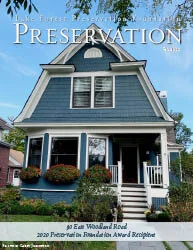
Fall 2020
90 East Woodland Road
2020 Preservation Foundation Award Recipient
Photo by Cappy Johnston
From the President
Dear Lake Foresters and Friends of the Preservation Foundation,
Congratulations to each of this year’s nine Preservation Award winners, which were officially announced at the October 5th City Council meeting. This issue of Preservation honors the property owners who received Preservation Awards for exemplary stewardship, for honoring history while renovating for 21st century lifestyles, and for recognizing the importance of fitting new construction into its historic context. This is the 30th year that the foundation has presented its annual Preservation Awards. Since 1991, approximately 250 awards have been presented to homeowners, businesses, organizations, architects, and landscape architects who have made a commitment to excellence in preserving Lake Forest’s unique historic visual character. Each of these awards demonstrates not only a significant investment in construction and preservation, but also the commitment to high quality, top-caliber design, both in architecture and landscape architecture that continues to be made in this community year after year.
A special thank you to our Programs Committee for assembling a season of stellar events and programs. Despite the challenges of the past eight months, the Foundation safely held three outdoor garden
stroll events, three virtual programs, and launched three self-guided walking tours of Lake Forest on the app PocketSites. The app is free and can be downloaded on either Apple or Android mobile devices through the respective app stores. One of the tours focuses on East Lake Forest and includes 34 points of interest that encompass historical or architectural locations within the East Lake Forest Historic District. A second tour explores the works of Howard Van Doren Shaw with eight points of interest including many of his most notable North Green Bay Road estates. A third tour highlights the wide-ranging influence of Stanley Anderson, one of Lake Forest’s most prolific architects.
I encourage everyone to get out and explore Lake Forest and learn more about the remarkable architectural heritage of our community with one of these tours, as you take advantage of the last remaining days of the fall season.
PeterSincerely,
Peter Coutant, President
Summer and Early Fall Programs
No occupation is so delightful to me as the culture of the earth and no culture comparable to that of the garden. ~ Thomas Jefferson
In September, Foundation members were offered a visit to Crab Tree Farm for a stroll through the gardens. There were two firsts for this program: It was postponed by one day due to rain, and, for the first time, guests were able to use QR codes to guide themselves. It proved to be a success as the QR codes allowed people to wander at their own pace and read about the designs by architects and landscape architects Hugh Garden, Jens Jensen, Solon S. Beman, Peter Wirtz, and John Vinci.
The Foundation sponsored three garden stroll programs this past Summer and early Fall, giving members the opportunity to delight in the incomparable culture of three extraordinary gardens. In August, Bob and Winnie Crawford graciously hosted us in their beautiful garden and pool area, designed by local landscape architect Craig Bergmann. Guests enjoyed a perfect summer evening including a presentation by Craig highlighting the transformation of the Crawfords’ garden over the years.
2
In October, the Foundation once again visited a garden designed by Craig Bergman. This time it was his personal garden, The Gardens at 900, in Lake Forest. Set adjacent to the historic original David Adler-designed entry to Elawa Farm, the gardens have been brought back to life by Craig’s creativity and expert design. Everyone attending appreciated the opportunity to visit the gardens during peak fall colors and enjoyed a presentation by Craig highlighting his inspiration for the landscape design.
do you think you might be living in a
mail-order home?
do you think you might be living in a
mail-order home?Curbside Delivery
Mail-order homes of the early 20th Century are still standing in Lake Forest
Many of us are shopping online a lot these days. From groceries to sofas to trampolines and outdoor fire pits, is there anything for the home that we’re not purchasing via Amazon or Instacart?
How about the house itself?
Original kit house for 90 Woodland Road
Original kit house for 90 Woodland RoadOrdering materials from a catalog to construct an entire house was common in the first half of the 20th Century. Mail-order homes were especially prevalent in communities with
a railroad depot, because manufacturers often delivered their supplies by train.
Several documented kit homes still stand in Lake Forest today, and though some have been renovated, their provenance is recognizable. Lara Solonickne edits Sears-Homes.com, which includes a database of mail-order homes in the Chicago area. She has identified several in Lake Forest, including one Wardway home at 161 Washington Circle and nine Sears Modern Homes. They include; 1302 Edgewood Road, 7 North June Terrace, 122 Wildwood Road, 40 Washington Circle, 641 Highview Terrace, 737
Northmoor Road, 685 Woodlawn Avenue, 147
Washington Road, and 1203 Griffith Road.
Solonickne said that to date, the Wardway house and all but two of the Sears homes have been authenticated. There are many other early 20th century kit homes in Lake Forest, and many owners might not even realize they live in a mail-order house!
Sears launched its first Book of Modern Homes in 1908 and sold 70,000 kit homes through 1940. The word “modern” referred to indoor plumbing, central heating and electricity. Other industry leaders included Montgomery Ward (Wardway), Gordon Van Tine and Aladdin Co., to name a few.
In addition to railroad proximity, another thing mail-order homes offered was affordability, providing tradesmen, small-business owners, and immigrants the opportunity to become owners of do-it-yourself houses.
The home featured on the cover of this issue is an early example of the mail-order phenomenon. Today the lot at 90 E. Woodland is across from the tennis courts in the beautiful West Park National Historic District. But in 1905, the neighborhood was brand new. Lake Forest estate owners had purchased a section of the Atteridge farm east of Green Bay Road to create the Howard Van Doren Shaw-designed “Green Bay Addition” with modest-sized lots designed to be affordable to
small-business owners. Local plumber C.B. Fitzgerald purchased
90 E. Woodland Avenue in 1907 and ordered plans from
J.H. Daverman & Son, a plan-book architecture firm.
“Built over 800 times for $1,200. Complete including plumbing except heating” reads an ad for the house Fitzgerald chose. “Full Blue Print Working Plans and Specifications only $10.00”
Fitzgerald was an early member of an organization called the Young Men’s Club, which made him eligible to bid on lots in the new subdivision and obtain an interest-free loan from the estate owners’ group.
Fitzgerald raised his family here and sent at least one of his sons to Lake Forest College. His son Chuck became active in civic affairs, including as a volunteer firefighter, Lake Forest alderman, assistant supervisor of Shields Township, and a member of the Lake County Board of Supervisors.
“It is a great story of local upward mobility and the establishment of a middle class here in Lake Forest,” says local historian Art Miller.
Fitzgerald’s pre-cut kit home was probably assembled by James Griffis, a son-in-law of farmer Atteridge, who lived three doors to the east of Fitzgerald’s lot.
Katheryn Grace and Brian Norton, the current owners of 90 E. Woodland, beautifully restored the Queen Anne-style home, including intricate shingle-work on the second-floor gable, plus a new addition and garage, earning it the 2020 Lake Forest Preservation Foundation Award for Rehabilitation.
The Cook Memorial Public Library maintains a database on mail-order houses in Libertyville, and it offers this guidance:
Look for numbers or words stamped on beams, joists, rafters or any other exposed wood structures in the attic or cellar
Look for blueprints or other paperwork tucked away in the attic or a closet
Check building permits, mortgages, deeds, or other public records that could indicate a connection with Sears or one of the other mail order companies
Look at online catalogs or print catalogs to compare your house with catalog houses. Look for similarities in the roof line, floor plan, or location and spacing of doors, windows, or chimney
Contact past owners or neighbors for their recollections
The Cook Memorial Public Library maintains a database on mail-order houses in Libertyville, and it offers this guidance:
Look for numbers or words stamped on beams, joists, rafters or any other exposed wood structures in the attic or cellar
Look for blueprints or other paperwork tucked away in the attic or a closet
Check building permits, mortgages, deeds, or other public records that could indicate a connection with Sears or one of the other mail order companies
Look at online catalogs or print catalogs to compare your house with catalog houses. Look for similarities in the roof line, floor plan, or location and spacing of doors, windows, or chimney
Contact past owners or neighbors for their recollections
On Highview Terrace is an example of “The Lewiston” by Sears Modern Homes.
On the cover is 90 East Woodland Road
Original Owner: C.B. Fitzgerald Current Owner: Katheryn Grace and Brian Norton
Original Architect: JH Daverman & Son 1910
Rehabilitation Architect: GTH Architects 2018-2019
This “quaint English cottage” on Washington Circle was originally a Wardway home called “The Maywood.”
3
2020 Preservation Awards
2020 Preservation Awards
This year the Preservation Foundation marks three decades of awards for outstanding preservation, rehabilitation, and restoration—following the Department of Interior Standards—with awards also for Infill, which is compatible new construction, and Heritage, which is defined as paying forward significant historic properties.
Lake Forest, a leading suburb of Chicago for one hundred and sixty years, has many hundreds of historic and architecturally significant residences and other buildings carefully maintained by
our community. For this stewardship by many, the Preservation Foundation is grateful. Our awards over these 30 years have highlighted almost 250 of the most outstanding properties for design, quality and condition. In many years the organization has also awarded landscapes, gardens, and parks. Lake Forest, uniquely for Chicago’s North Shore, protects the landscape context of its significant historic structures. The awards this year illustrate these characteristics. Additional details on these homes can be found at LFPF.org.
449 East Illinois Road -Rehabilitation Award
Original Owner: William J. Quigley
Current Owner: Debbie and Chris Jensen
Architect: Unknown 1893 | Rehabilitation Architect: Edward Deegan Architects 2018-2019 This 1893 Queen Anne residence was built in the same period that architects Pond & Pond were building a new Lake Forest Academy campus nearby, today Lake Forest College South Campus. The 1893 East House/Moore Hall there (demolished ca. 2008) employed a firm-characteristic diamond motif as found on the surviving windows at 449 E. Illinois. Renovated and expanded in the 1960s and 1980s, the current owners, working with Deegan Architects of Kenilworth in 2018-19, built a compatible replacement addition and new auxiliary building on the west side of the house, while replicating older windows that face the street.
1350 N. Green Bay Road -Rehabilitation Award
Original Owner: Mr. and Mrs. William C. Bartholomay
Current Owner: Nadine and Kirk Shepard
Architect: Ernst A. Benkert 1953 | Rehabilitation Architect: Muran Architects, Inc. 2009
The handsome, red brick, traditional, two-story, center-hall home is classic in form, with a forward central symmetrical portion and two recessed wings south and north recalls homes of the Country Place Era, 1893-1942. The current owner in 2009 with Muran Architects undertook a major rehabilitation, including the return of the original brick’s red color, typical of the period. At a moment when Midcentury Modern has captured the imagination
of many homeowners, this example of mid 20th century continuity with the earlier estate era is worthy of serious attention, representative of the large local impulse that was expressed also in smaller classic designs by locals Jerome Cerny and Stanley D. Anderson.
INNISFAIL II
830 N. Green Bay Road – Preservation Award
Original Owner: Joseph and Jean Morton Cudahy Current Owner: Nancy and Adrian Smith Architect: David Adler 1929-1932
Preservation Architect: Adrian Smith 2017-present
Few private preservation efforts have had more impact on whole neighborhoods than has the recent work to return this 1930 David
Adler-designed estate to its notable character of nearly a century ago. This 4 -plus-acre site was the original 1830s “old home place” of the Atteridge farm. In 1928, Joseph and Jean Morton Cudahy engaged David Adler a second time to create for them a new, down-sized “Innisfail II” across from West Park. The yellow limestone manor house and brick wall, both in the Normandy French manor house tradition, remained with the Cudahys until Mrs. Cudahy’s death in 1953. It was then owned by Philip D. Armour III. Then in 1970 it became the home of Barbara and W. Clement Stone Jr., who renovated the house with the assistance of Chicago decorator Richard Himmel.
After many years of neglect, the property was purchased by Chicago-based international architect Adrian Smith and his family, and has been restored by them. The beautiful north garden has been rediscovered, the work originally of Garden Club of America leader and president of the Morton Arboretum Jean Morton Cudahy with Ferruccio Vitale. The greenhouse and winter garden are whole once again. Flowers bloom on the parkway and the very private estate once again presents a cheerful visage to West Park, its neighbors, and to passersby.
4
443 East Illinois Road -Rehabilitation Award
Original Owner: Blanche and George Newcomb
Current Owner: Karen and Steven Mardjetko
Architect: Unknown 1875 | Rehabilitation Architect: Michael Bressman Ltd 2005-2010, ongoing
This commodious 1875 Queen Anne home is supposed to have been owned originally by attorney George Eddy Newcomb (1864-1928) and his wife Blanche Makepeace Newcomb. It is reported to have stayed in this family for at least two generations, being bought in the early 1950s by the Shields family, and then purchased in 2005 by the current owners, who undertook a major rehabilitation with architect Michael Breseman in 2018-19. This mansion-scaled house set back from Illinois on its deep lot remains after many years a prominent part of the Illinois Road streetscape. This third in a series of awards within a couple of blocks represents major reinvestments in this handsome, tree-lined, and park-like stretch of the original 1857 street plan near the town center.
472 East Illinois Road – Restoration Award
Current Owners: Emma and Mark Harris
Architect: Unknown 1872 | Restoration Architect: Custom Installations 2019
This residence dates from the early years of Lake Forest, built in the year following the Great Chicago Fire of 1871, and in the earlier 20th century it was known as the Grocer Gunn house. Queen Anne in style with its tower and wrap-around porch, it most likely reflects earlier waves of changes. Its present appearance though dates from earlier in the 20th century, with its façade protected by a previous owner with an easement granted by Landmarks Illinois. When it suffered from a fire recently it was restored by the current owners, though with upgraded materials—clapboard siding and copper gutters and downspouts. Its simple but dignified presence on its large lawn contributes significantly to the streetscape.
410 East Woodland Road – Preservation Award
Original Owner: John and Ellen French Gould
Current Owner: Rommy Lopat and John Drummond
Renovation Architects: Monica Artmann and Robert Ruggles 2002-2003
This ca. 1900-constructed house, its design attributed to Frost & Granger, is notable for its distinctive roof design, bow windows, center-hall façade, and front terrace. The roof plan’s origins are described in a 2019 book on Frank Lloyd Wright’s Penwern cottage. This roof, like Penwern, employs Japanese Shinto temple flared and partially hipped roof features adopted from the 1893 World’s Columbian Exposition, Japanese pavilion. This home of Rommy Lopat and architect John Drummond was painstakingly rehabilitated by them with Ruggles Architecture ca. early 2000s, preserving the exterior of the house as they found it, with the bow windows by Jerome Cerny and other changes by I.W. Colburn.
WESTLEIGH, 255 East Foster Place – Heritage Award
Original Owner: Louis F. Swift and Ida Butler Swift Current Owner: Laura and Edward S. Gillette II Architect: Howard Van Doren Shaw 1916 Rehabilitation/Adaptive Reuse: Stanley D. Anderson
LFPF’s Heritage designation recognizes the 1916 Howard Van Doren Shaw “entertainment” wing added to the 1899 Louis F. Swift summer place designed by William Carbys Zimmerman and razed in the 1950s. The demolition of the 1899
house and the adaptive reuse of the Shaw-designed wing was accomplished by local architect Stanley D. Anderson. The current owners, the second generation of second owners, have kept the house and 1950s reduced grounds in stable condition, paying forward one of the Green Bay Road Historic District’s most illustrious Country Place Era estate residences.
WILSON LODGE, Knollwood Club-Infill/New Construction Award
Original Clubhouse and Locker Room: Howard Van Doren Shaw 1925
Architect: Witmer and Associates 2018
This new paddle hut by local architect Peter Witmer is a compatible addition to the cluster of historic and New Classicist Knollwood Club structures, dating back to Howard Van Doren Shaw’s original clubhouse and later locker room. The 1925-organized club has an
eighteen-hole golf course originally laid out by C.H. Alison and H.S. Colt, with its surrounding neighborhood by planner Edward H. Bennett. The neighborhood includes outstanding residences on over two-acre plots by distinguished architects (e.g., Zimmerman Saxe & Zimmerman and Walcott & Work) and landscape architects (C. G. Wagstaff and Ralph R. Root). This new structure sympathetically adapts to the almost century-old heritage of this remarkable club and its distinguished enclave.
lakE FoREst aRchitEctuRE in 3 PaRts:
PaRt iii 1940-1970
Three main directions defined building, especially domestic design here, from the end of the Great Depression up to 1970, fifty years ago—the age defined for a structure or feature to be historic: modern, traditional, and updating and preserving local estate era houses from previous periods.
MODERN
Architect: Edward Dart Architect: Jerome Cerny
Architect: Edward Dart Architect: Jerome CernyA 2020 book, Modern in the Middle: Chicago Houses 1929-1975 by Susan Benjamin and Michelangelo Sabatino, includes images and treatment of the modern movement here. Perhaps the example, as seen in Benjamin’s
introduction, by the most notable architect here is 190 Mayflower, the Frank Lloyd Wright designed Charles Glore house. This is from Wright’s second Usonian career phase and greatest popularity and influence. Just north is 210
Mayflower, Edward Dart‘s Fairbanks house, Dart also the architect for Water Tower Place. These two typify often smaller, open-plan, elegant, and typically in natural settings works by others here, including, I.W. Colburn, Walter Frazier, Howard Raftery, and also Balfour Lanza, Edward Humrich, John Black Lee, and others.
TRADITIONAL
Building in Lake Forest in the post-Depression, post-war years was balanced also with traditional styles and layouts, for example the 1953 Bartholomay residence on N. Green Bay Rd., granted an award this year, by a Winnetka architect, and echoing in a scaled-down manner the classic country places since the 1890s here. Locally though two architects who flourished with traditionally styled houses here, though smaller, were Stanley D. Anderson and his junior partner William Bergmann, with a study forthcoming on this firm by Bergmann’s son Paul, and also Jerome Cerny. While
not novel in style, classic rather than modern, they often shared with modern houses a one-story across a wide lot plan of ranch houses, originated by Cliff May in California in the 1940s.
UPDATING AND PRESERVING ESTATE ERA HOUSES
While some phenomenal houses were lost to demolition in this period, a remarkable number of important estate period, 1890s-1940, houses survived, were well maintained, and even adaptively reused or subtly updated for a contemporary taste. Losses: the Cyrus H. McCormicks’ Walden on what now is Bluff’s Edge Rd.
and Villa Turicum, the Harold McCormicks’ Italian palace on today’s Circle Lane, among others. But preserved and adaptively reused, the
- Ogden Armours’ 1908 Mellody Farm by Arthur Heun and decorator Elsie De Wolfe, repurposed as Lake Forest Academy.
This opened in 1948 as Reid Hall, with new additions by former Shaw associate Bertram Weber. At the other end of the period, in 1970, the W. Clement Stone Jrs. working with decorator Richard Himmel, reorganized the entry, flow, and created a pool at 830 N. Green Bay Rd. This had been the 1930 Cudahy place by David Adler. It was to this 1970 period that architect Adrian Smith and family have restored the mansion in the last few years, rejuvenating the whole west side of West Park and the west side streetscape on
- Green Bay Rd. Jerome Cerny also was known for his 1950s and 1960s bow window additions to older houses, brightening small, dark rooms—as at 410 E. Woodland, both awarded this year. And many owners of Adler, Shaw, and other important architect homes hired the Anderson firm to supervise meticulously their painting, roofing, and other maintenance projects to preserve the quality and character of their significant structures.
Maps & Apps: Pocketsights ArchtecturalWalking Tour
When the Covid-19 pandemic hit and the Preservation Foundation had to pivot from in-person to virtual programming, Laurel Curry, daughter of board member Michelle Curry, offered an innovative solution. Laurel, a sophomore at Lake Forest High School and member of the Girls Varsity Cross Country team, presented the idea of creating walking tours that people could access with a phone app. The app she proposed, PocketSights, is a GPS guided
walking tour app that can be downloaded for free from either the Apple or Google Play stores. The PocketSights phone app allows the walker to start or stop their walking tour anywhere along the mapped route and track their specific location through the “Follow me” option on the map. During the summer Laurel taught herself how to create tours using
6
the app and created the first tour that is based on a previously offered in-person LFPF Trolley Tour. This walking tour, with 34 architecturally significant points of interest along a 5-mile route, begins and ends at Market Square. When creating each walking tour, Laurel selected the points of interest, located the photos and descriptions, and mapped out the best walking route (which sometimes differs from driving or biking past the points of interest.) She also considered which side of the street the sidewalks are located on which can impact the order of points of interest or the wording in the description. Laurel has completed two additional walking tours highlighting past Preservation Award recipients. One tour focuses on Stanley Anderson architecture and the other focuses on Howard van Doren Shaw projects. Laurel’s program suggestion has provided the Preservation Foundation with another opportunity to highlight Preservation award winners and celebrate the outstanding architectural designs that add to the beauty of Lake Forest.
Lake Forest Library, circa 2015
Rendering of a possible addition to the library
Lake Forest Library, circa 2015
Rendering of a possible addition to the library
Lake Forest Library:
Our Community’s Architectural Treasure
Library Seeks City Approval to Rehabilitate and Add to Classic 1931 Building
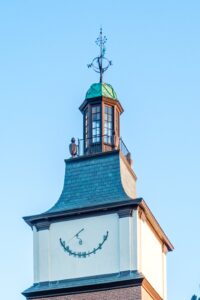
Among our City’s many nationally significant architectural landmark structures, only the Lake Forest Library offers every local resident the opportunity to experience an extensive estate-era interior of the finest quality. From its entry gallery and rotunda to its east, west, and north adjacent reading rooms, it offers an ensemble of five stunningly decorated tall rooms. Add to this both the remarkable art collections on display and also the modern access to books, media, and 21st century networked information, and the visitor finds an institution with few peers in the Chicago region, worthy in the mid 20th century and now as well of national recognition.
Tarped Dome awaiting restoration
Tarped Dome awaiting restorationChanging Needs in an Aging But Highly Significant Building Today, too, the Library finds itself between the crashing rocks of daunting challenges. The tarp covered great dome of recent years at the heart of the building’s exterior signals that rehabbing must continue as the building approaches its 10th decade. The 1931 Nicolas Remisoff tempura murals below the dome have suffered from moisture. In addition,
the building lags on facilities and access that have become standard since the Americans with Disabilities Act three decades ago—restrooms, doorways, ramps, and elevators. Also concerning is the lack of flexibility for accommodating new
technology of the digital age due to the heavy masonry structure’s lack of hidden passages for wiring and modern, now COVID-19 high-volume HVAC. From the time additions were made in 1978, information has experienced its greatest shift—from print to digital—since the invention of movable type printing in 1455-1500.
At the October 19, 2020 City Council meeting the Lake Forest Library, its director Catherine Lemmer, the Library Board, and architects HGA outlined plans to rehabilitate the 1931 classic, award-winning building with its leaking dome and other out-of-date features and to add new space to accommodate the electrical and HVAC needs of the digital age. The Library at the meeting announced the fall 2020 formation of the Lake Forest Library Foundation, a 501(c)3 organization to raise private funds for the project, chaired by Diana Terlato with other board members including Mark and Debbie Saran; both families are associated with preservation of distinguished local-area historic architecture.
Preservation with Compatibility in New Construction
The Preservation Foundation board in general supports the Library’s need to rehabilitate the 1931 building and to accommodate digital information requirements. But it has been concerned by proposed addition plans that would both upstage or overwhelm the 1931 building in its scale and also would lack design continuity, or compatibility, with the significant main Library and its similarly significant neighbors within the 1978 and 1998 National Register and Lake Forest Historic Districts.
The architects HGA have worked with the Library since 2018 on various ideas, though the renderings shared at the October 19 meeting showed interior views that implied a modernist, self-referential exterior that would be at odds with the City’s Historic Preservation ordinance and with the Department of Interior’s 2010 Preservation Brief 14: New Exterior Additions to Historic Buildings: Preservation Concerns. This document describes in detail and with illustrated examples additions that honor original buildings’ scale and character. The 1931 classic, symmetrical building’s character was honored with the “Chicago Architects Club’s Craftsmanship Award, 1931,” as highlighted in the Illinois WPA’s 1939 Illinois Guide, p. 411, and the 1949 American Guide, p. 526. The Library’s classicism was carried out in its regular window placement, its prominent dome, and the architect Edwin Hill Clark’s design of its walls of “pink Holland brick and white stone.”
We encourage local residents to follow with interest the progress in planning of improvements at Lake Forest Library and to communicate your views, impressions, and interest to the Library Board and to the City Council.
We encourage local residents to follow with interest the progress in planning of improvements at Lake Forest Library and to communicate your views, impressions, and interest to the Library Board and to the City Council.The 2010 Preservation Brief 14 provides ample guidance for creating an addition that respects not just the Library, but also the adjacent 1924 Howard Van Doren Shaw church to the west, the 1870 Quinlan/Southworth House to the east, and the two new Library Place classic buildings to the north. The Library’s near neighbors too include the early 1900s Gorton Center to the south, 1903 Anderson Block further west across the tracks, the 1900 train station, and Shaw’s internationally significant 1916 Market Square west across the tracks from the main station building with the Library dome in its line of sight. The mid 20th century modernist revival style has prevailed broadly elsewhere especially since 2000 and is represented by the classically organized 2018 Northwestern Medicine/Lake Forest Hospital complex and grounds in west Lake Forest. But this hospital by the firm of the late AIA Gold Medalist Cesar Pelli, in contrast to the Library, is sited on a very large parcel of ground, protecting by tall berms and extensive landscaping its neighbors west and north. The Preservation Foundation in 2018 granted the hospital an award for compatible new construction.
7
LAKE FOREST PRESERVATION FOUNDATION
2020-2021
BOARD OF DIRECTORS
EXECUTIVE COMMITTEE
Peter Coutant
President
Tom Gleason
VP Communications
Elizabeth Abbattista
VP Development
Liz Brandel Trey Gonzales VP Programs
John Julian
Secretary
Craig Fox
Treasurer
DIRECTORS
Robert Alfe
Susan Rafferty Athenson Michelle Curry
Jim Farrell Sr. Adrienne Fawcett Angela Fontana
Lauren Kelly
NON-PROFIT ORG
U.S. POSTAGE
PAID PERMIT NO. 184 LAKE FOREST, IL
60045
NON-PROFIT ORG
U.S. POSTAGE
PAID PERMIT NO. 184 LAKE FOREST, IL
60045
ECRWSS
Residential Customer Lake Forest, IL 60045
2020 YEAR END ANNUAL FUND LAUNCH
Help Us Make A Difference
Laura V. Luce Debbie Marcusson William McFadden Roger Mohr
Natalie Reinkemeyer Monica Artmann Ruggles Jason Smith
Courtney Trombley
HONORARY DIRECTORS
Gail Hodges Arthur Miller Pauline Mohr Shirley Paddock Linda Shields Lorraine Tweed
EXECUTIVE DIRECTOR
Marcy Kerr
Preservation
FALL 2020
VOLUME 14, NUMBER 3
Contributors:
Liz Brandel, Peter Coutant, Adrienne Fawcett, Gail Hodges, Marcy Kerr, Laura Luce
Arthur Miller, and Pauline Mohr
Editor: Tom Gleason
Photography: Cappy Johnston
Lake Forest
Preservation Foundation 400 East Illinois Road
Lake Forest, Illinois 60045 www.lfpf.org
The Lake Forest Preservation Foundation’s Annual Fund supports important preservation projects in Lake Forest. We fund and lead both historic studies and physical restoration projects. The renovation of the east Lake Forest Train Station is one of our
recent accomplishments.
Currently underway is our Historic Building Markers Project, an idea inspired by Ed McMahon, urban planner and Urban Land Institute Senior Fellow. In 2017, while speaking at a LFPF event, Ed suggested a“manifest in the landscape”
goal for Lake Forest, recommending we use markers and public art to demonstrate his theory “The Power of Uniqueness,” which fosters greater appreciation from our citizens and visitors as well as providing opportunities for local stewardship.
Approved by the HPC in June, the Historic Building Makers Project Phase I will include bronze plaques and a walking tour documenting historic details on notable buildings in downtown Lake Forest. Future phases will include additional buildings and neighborhoods.
A second project, slated to begin next year, is the long-awaited update of LFPF’s guidebook project. The 1994 book highlights select local National Register historic properties and districts, much expanded in the last quarter-century. Historic maps, aerial photos, and significant design features will be included.
Those interested in supporting this major undertaking with memorial, honorary, sponsorship, and other gifts are encouraged to speak with us. This will be a multi-year project.
In addition to our preservation initiatives, we
host fabulous programs at historic homes and gardens throughout the year, showcasing our beautiful town. Some of these events are purely for the enjoyment of our members and guests, others are fundraisers, but all are educational.
Due to Covid-19 restrictions in 2020, we were unable to host our biggest fundraiser, our annual home tour. This year more than ever, we need your support.
d
dPlease help ensure the Foundation’s mission to preserve Lake Forest’s unique visual character with a tax-deductible gift to our Annual Fund. Visit us at lfpf.org to learn more about our preservation initiatives, the annual fund, our programs, or to join, renew, and upgrade a membership.
The Lake Forest Preservation Foundation is a tax-exempt nonprofit 501(c)3 organization. You may donate directly to us at LFPF.org. In GuideStar and many corporate donation databases including Chicago United Way we are listed as Lake Forest Foundation for Historic Preservation. Gifts are tax deductible.