Summer 2021
Understanding Classicism,
1
1The Language of Lake Forest Planning and Architecture
Photo by Cappy Johnston
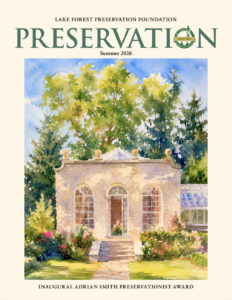
On The COver
FROM THE PRESIDENT
Welcome to summer!
We are so happy to be easing out of COVID restrictions and back to some normalcy in all our lives. The Lake Forest Preservation Foundation is busy planning events for the upcoming summer months that showcase our local architecture and gardens. Please join us at one of our beautiful events for some education and socializing – in person!
I am incredibly honored and humbled to be selected as the next President of LFPF. I have big shoes to fill following Peter Coutant, but I hope to be a good coach to our incredible team of Board members and staff.
As a 6th generation Lake Forest resident, I have been greatly influenced by the work of the LFPF throughout the years. I feel very
Chicago attorney Henry Nelson Tuttle, 1858-1918, and his wife, Fannie Farwell Tuttle, 1864-1953, were the original residents of 941 East Westminster, on part of her parents’ 1869 estate, the main house at 888 East Deerpath. Her father was John Villiers Farwell, 1825-1908, a pioneer Chicago wholesale merchant and entrepreneur, with his brother and neighbor Charles B. Farwell, working an 1885 swap of a new granite and marble state capital building in Austin for the state of Texas in exchange for nine counties in the Texas Panhandle, the famous XIT Ranch. Tuttle, born in Chicago, graduated from Yale in 1881 and the couple was married in 1888.
Their daughter, Grace Tuttle Chandler, 1895-1991, grew up in the house, and later lived there with her spouse, Kent Chandler. Her brother was Arthur
grateful to be continuing the advocacy and educational work of the founders, dedicated past Board members, and the many volunteers before me who advocated for preserving our special Lake Forest historic character. They introduced me to the significant architecture we are so blessed to live amongst in our unique town and helped me foster a love and appreciation of good architecture. Their work continues today as the LFPF advocates for the preservation of our significant historic streetscapes, buildings, and landscapes.
Our focus for this year is increasing our Advocacy efforts. There are several projects in our community that need some guidance to insure compatibility within existing historic neighborhoods.
As I’m sure most of you are aware, the most significant project to impact our community is the Lake Forest Library proposed expansion plans. We will continue to reach out to the Library Board and Administration offering to collaborate to ensure their expansion plans honor the original architecture of our beloved Edwin Hill Clark Library and are compatible with the surrounding historic neighborhood.
- 1889, Tuttle residence
Tuttle who built the John Hughes house
Another project we are very concerned about is The McKinley Road Phase 3 project on Westminster. We are offering our suggestions to this project (a third large condo building facing Westminster) to ensure it meets the 17 standards of the HPC, especially regarding the compatibility of mass, height, and design to the surrounding historic Westminster neighborhood.
Lastly, another big project we will continue to monitor is the development of the Midwest Bank property on Deerpath Road and Bank Lane in downtown Lake Forest. There is a proposal for a large mixed-use condo/retail building to go on this site. This is an iconic location and it will be critical that any design is compatible with our historic downtown.
We will continue to reach out to our membership to inform you of these projects and ask for your help as we advocate for sensitive, compatible design.
by Edwin Hill Clark, 1928, 855 East Westminster, on the site of the 1870 Farwell greenhouse.
The architects were Edward J. Burling, 1819-1892, and Francis M. Whitehouse, 1848-1938, also architects of the 1883 Nickerson mansion, Chicago, now the Driehaus Museum.
The estate-era classic renovation of the Tuttle house’s exterior was designed by Arthur Heun who formerly worked with Whitehouse after 1889, when his partnership with Burling ended. Heun, by 1893 took over the practice when Whitehouse retired.
East garden antique sculpture, current
Change is a sign that our City is growing and evolving. But it’s so important to manage that change so we don’t lose the historic character that makes Lake Forest so unique and special.
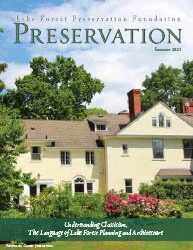
On the cover is 941 East Westminster Original Owner: Henry and Fannie Farwell Tuttle
Current Owners: Brian and Ingrid Bryzinski Original Architect: Burling & Whitehouse ca. 1890 Renovation Architect: Arthur Heun, ca. 1910s-20s Garden Designer: Craig Bergmann, current
I look forward to a successful year as we strive to preserve our community’s unique historic assets and manage the change of our evolving community.
Susan Rafferty Athenson
President
Understanding Classicism, the Language of Lake Forest Planning and Architecture
Classic design principles have prevailed in Lake Forest since 1856 with the organization in Chicago of the Lake Forest Association. These consist of a series of interlocking relationships among site selection and layout, arrangement or composition of principal features, proportions, hierarchy, repetition, symmetry or balance, and harmony. Buildings follow established plans: longitudinal hall (as at the High School, Gorton, or Ragdale), elemental (a group of buildings, such as Market Square), central hall (with rooms on the sides, as at Lake Forest College’s Patterson Lodge or Glen Rowan House), courtyard (as in Italian villas such as at 955 N. Lake Road and the Cuneo Museum, Vernon Hills), and cruciform (a cross, as at Lake Forest Library).
The column is a basic building block and organizing principle for classic architecture, both as employed as design elements as on the west building at Market Square and in a broader sense, in organizing the height of multi-story buildings. A good example of columnar organization is the 1903 Anderson Block designed by Paris-trained classic architect James Gamble Rogers, now with Walgreens on the first floor.
Other key elements include round-arched windows as in churches, St. Mary’s and First Presbyterian; pediments, as at the entries to the High School and Gorton; and domes, as at Lake Forest Library.
Classicism is a system that developed in ancient times, written down by Vitruvius in one surviving text from the Roman empire period. This system of relationships was discovered again for western Europe in the Italian Renaissance, notably in Andrea Palladio’s 16th century Four Books of Architecture. It traveled from Italy to France, Germany, Great Britain, and by the 18th century to colonial North America, from Virginia to New England. It was not until after the 1871 Chicago Fire, a century and a half ago this year, that it took root in that city. Architect Charles
- Frost, who lived in Eastover on the northwest corner of Westminster and Elm Tree Rd., referred to this as an “Awakening,” writing in 1910 a history of Chicago railroad terminals. Whether Renaissance or “rebirth” or “Awakening,” when Frost and his senior partner, Henry Ives Cobb, arrived in Chicago, trained at the classic architecture program at MIT near Boston, they began to apply this system.
A drive-by of the tall, red brick colonial at 880 Elm Tree at Westminster, Eastover, will show how Frost incorporated into his home the columnar form. This can be seen as well as item #14 in Preservation’s 1994 Guide to National Register Properties. As the Guide’s photo illustrates, the house at the basement level has a contrasting limestone belt course. This marks the base of the column. The two main stories represent the shaft of the column, with another belt course at the top, under the roof, the capital of the column. The attic forms the entablature supported by this columnar form, with dormers framed by chimneys.
When changes are to be made on any terrain and with any building or neighborhood, classicism provides useful guidance for maintaining harmony, or as in City preservation ordinance language, compatibility. New designs are guided so that they fit in with existing classic buildings and landscapes or streetscapes. This introductory article on classicism has focused on the way the column forms derived from antiquity help to organize buildings to lend to them a sense of solidity, order, and beauty. Harmony within and among buildings, compatibility, will add to the full picture after further articles in this series discuss more fully site selection and placement of the building, proportion, composition, hierarchy, and symmetry or balance.
Compatibility or harmony, fitting into a larger whole, is the essence of this approach, a codification of classic design principles. Classicism’s language for expression includes site selection and planning, hierarchy (of form, height, materials, and color), proportion, composition, repetition, and harmony. The last especially embraces symmetry or balance as well as transparency—the link between built and landscape elements. Howard Van Doren Shaw’s internationally recognized Market Square illustrates harmony, inserted between the 1900 Tudor single-story train station east, the 1899 two-story and towered Tudor City Hall west, two-story Gorton and Tudor Griffith blocks north, and the classic, columnar three-story Anderson block south. Its tall towers reflect its intended role of town center, with classic columns and columnar form expressed in Market Square’s west building with its Tuscan colonnade and in the columnar north tower, with its limestone and windowed base, plain running brick shaft, and entablature of a white stucco frieze with a cornice-like turret.
This classic heritage of compatibility and preservation informs LFPF’s advocacy priorities in the coming months:
Plans for restoration and preservation of the 1931 Lake Forest Library, urging (1) repair stabilizing the dome, (2) adhering to the essential cruciform symmetrical plan, and (3) ensuring that any outward changes reflect the classical tradition on this highly sensitive, limited site.
Ensure the proposed Library-adjacent Phase Three of the Library Place condo development facing Westminster of both residential and Library Place Georgian compatibility, including a harmonious plan for the proposed house just east.
For the proposed mixed-use building on the southwest corner of Deerpath and Bank Lane a style and mass are urged compatible with the three other corners’ “English village” high street style set by Stanley D. Anderson, 1925-30. The setting is highly sensitive between 1916’s Market Square and the 1920’s restored Tudor Deerpath Inn to the south.
In Memory of Gail Hodges
July 6, 1938 – July 1, 2021
Leading in preserving Lake Forest through the drafting of the 1998 Preservation Ordinance as well as many other contributions to the community. Gail was a true leader, intellect, and friend.
d
In Memory of Gail Hodges
July 6, 1938 – July 1, 2021
Leading in preserving Lake Forest through the drafting of the 1998 Preservation Ordinance as well as many other contributions to the community. Gail was a true leader, intellect, and friend.
dLake Forest Preservation Foundation advocates for the preservation of Lake Forest’s visual character, its core mission statement, while promoting changes to plans, buildings, landscapes, and streetscapes that are compatible. LFPF believes that residents have chosen Lake Forest as their home for this visual character largely that evolves though does not suddenly change direction around some major alteration in the middle of a developed area. In the City’s preservation ordinance for historic districts especially it employs guidelines and seventeen criteria to implement those in reviewing changes. These add up to promoting compatibility vs. dramatic new gestures in established historic areas.
Evolving History of the future Le Colonial Restaurant Building
Paul T. Bergmann has supplied this 1920s west elevation, facing Forest Avenue, of the Anderson & Ticknor firm’s substantial addition to the south, or right in the drawing, to the earlier evolved under Frost Tool House and fire and police structure. The double doors to the left were early access for horses and fire equipment.
Paul T. Bergmann has supplied this 1920s west elevation, facing Forest Avenue, of the Anderson & Ticknor firm’s substantial addition to the south, or right in the drawing, to the earlier evolved under Frost Tool House and fire and police structure. The double doors to the left were early access for horses and fire equipment.With the granting of City approval for the updating of the former Market House to accommodate the new Le Colonial Vietnamese-French fusion restaurant, the former fire station that dates back to the opening of the 20th century opens one more phase of its useful history. The building
began under architects Frost & Granger with a Mediterranean appearance. It was the mid 1920s expansion and re-styling of the building by Stanley D. Anderson’s firm that established the form of the building, except for a new wing pointing east to Bank Lane added in the 1990s and creating the garden dining setting overlooking Market Square and its park space. Le Colonial will bring new energy and variety to the Market Square and downtown area. At the same time, it will preserve the 1920s historic building as an anchor on its corner of Howard Van Doren Shaw’s widely known 1916 town center.
Shortly after the 1899 opening of City Hall, the ca. 1901 garage-sized City of Lake Forest “Tool House” for equipment for teams pulling fire engines was built on the east side of Forest Avenue, northeast of City Hall. The fire department had been incorporated into City Hall’s northeast corner, the great tower used for drying canvas fire hoses. By 1913 a first hook and ladder motorized fire truck was acquired, according to Edward Arpee’s town history (179), with funds “raised by personal solicitation” by Mayor C. Frederick Childs. Police functions and a small jail were added.
By the mid-1920s, David Mattoon has learned, the City chose third-generation Lake Forester architect Stanley D. Anderson’s firm to add substantially to this City auxiliary building, south of the Tool House/small fire and police structure. By 1929, according to Paul Bergmann’s 2020 book on Anderson and his
firm, the building’s size was more than doubled, with the police department taking over the north wing, with jail cells in the basement. Its new styling was consistent with City Hall and the adjacent Market Square development since 1916.
The style and outward appearance of the building has remained little changed on this side since the mid 1920s, with the fire truck doors on the right remaining in place after the fire station moved in the late 1960s to the Public Safety Building on Deerpath. In the 1970s the building served the recreation department, with ballet lessons given on the second floor above the 1920s fire truck space, the former living quarters for the firemen. The simpler north section was joined by Anderson’s handsomely half-timbered second floor, with half-timbering—as on the north and south buildings of Market Square and on City Hall. See Paul Bergmann’s The Architecture of Stanley D. Anderson…, pp. 38 and 47-48, especially.
The building received a ca. 1990s addition to the southeast reaching Bank Lane, in the Southgate Restaurant era that followed the rec department’s moving to its new building on Hastings Road, 1980s. By ca. 2010 the restaurant had been redecorated on the interior for the Market House, keeping the same English traditional feel.
With both the renewal of the 1920s Deerpath Inn two blocks south and the pandemic, the Market House closed and
the building’s character re-imagined for the Le Colonial high-profile elite dining brand, different than the Deerpath Inn. Since its 1920s Anderson redesign, it has been a bridge between the Arts & Crafts English traditional style of City Hall and the internationally known Market Square.
A new Chapter Begins for the Schweppe Estate
One of the most intriguing homes in East Lake Forest is about to undergo restoration and the town is thrilled about rejuvenating this historic gem. Mayflower Place, designed in 1914 by Frederick Wainwright Perkins and known locally in Lake Forest as ‘The Schweppe Estate’. This amazing 24,500 square foot brick and limestone mansion was originally listed for sale in 2007 and has been slowly deteriorating since then. In August of 2020 an out of state family were intrigued enough to purchase and revitalize this property to its fullest potential.
The Schweppe mansion’s northwest entry facade, with its walled courtyard by Pray, Hubbard & Co.
The Schweppe mansion’s northwest entry facade, with its walled courtyard by Pray, Hubbard & Co.
Located at 405 North Mayflower Road, the estate was designed as a wedding present for Laura Shedd and Charles Schweppe from
Laura’s father (the aquarium namesake and the Marshall Field & Company President, John G. Shedd). Shedd purchased the estate, then known as Blair Lodge and containing a large Victorian house, in February 1913, the same month as the Schweppe nuptials. Construction on the Perkins designed home began in 1915.
The Schweppes hosted lavish parties and even royalty from England and Sweden in their home throughout the roaring 20’s and 1930’s.
Laura Schweppe died of a heart attack in 1937 (at the age of 58) and equally tragic, her husband, Charles, died by suicide only four years later (at the age 60)—the house remained empty for almost 50 years following. Local rumors ensued about the Schweppe estate becoming ‘haunted’ which created an intriguing buzz for interested buyers.
Then, in 1987, a family member of Laura and Charles Schweppe sold the home to Howard Hoeper, a plastics engineer and businessman. Hoeper and his late ex-wife, Donna Denton, renovated the property and engaged many European artists and craftspeople. The couple divorced less than 2 years after buying the home at which point they began to split assets including the
Lakefront east facade of the 1915 completed Schweppe mansion designed by architect Frederick W. Perkins, with the overlook terrace by Pray, Hubbard & Co., Boston.
15-acre Schweppe property and (separately) the adjacent 10-acre mansion next door. In 2007, Denton put the home on the market.
According to the 2015 listing, “The superior construction and level of intricate hand-carved architectural details and finishes rival the grand estates on the east coast. Built of durable materials, this concrete and brick structure features hand-carved limestone, monumental limestone stairs, fountains and balustrades, exquisite plaster relief ceilings, a slate roof with decorative copper details and scuppers, and leaded glass windows with limestone surrounds.”
This 10-bed with 11-full 4-half bath and 11 fireplaces also boasts (an extremely rare) offering of 425 feet of private beachfront property.
The entire town (and especially the Lake Forest Preservation Foundation) is thrilled to learn about the vision of the new owners and their architects for Mayflower Place. Welcome to the Lake Forest community!
LFPF Scholarship 2021 Awarded to LFHS Seniors
In May we had the honor of attending the Lake Forest High School annual scholarship awards night and for the first time, gave awards to graduating seniors who submitted entries exemplifying the mission and sentiment of the Lake Forest Preservation Foundation.
We asked the students to communicate the importance of some component of our mission to safeguard Lake Forest’s architectural and landscape legacy or our city’s commitment to preserving the historic visual character of Lake Forest and to tie that message to some personal significance to them as part of growing up in Lake Forest.
We invited them to create a message that could be displayed in a visual image such as a poster or drawing or write an essay. Two-thousand dollars in monetary awards were gifted. The 2021 winner, Lauren Zarek, wrote a beautifully composed essay about the opportunity to study at the Lake Forest library and the experience of feeling comfort while studying amongst the historic surroundings, complete with a crackling fire. Kylie Perkins and Haley Zarek, tied for second place, Kylie with a poster-like image (pictured) and Haley with a beautiful pencil drawing of her home.
Some students wrote about growing up in historic homes and how the connection they created to the home instilled a bond. Some conveyed how the beauty of architectural details such as a front door, a public archway leading to a pretty courtyard, and the dome on the library instilled a feeling of contentment. Others conveyed through photographs and accompanying written commentary, a proud feeling when noticing details of city hall or reminiscing about events over the years that took place on the lawn of Market Square. All of the students conveyed a feeling of connection to Lake Forest through our visual historic assets. Components of the entries are displayed on our website.
Our intention was to find a group of the younger generation in Lake Forest that could help us advocate for our LFPF mission, recognizing that many of our citizens might feel the connection but are not always able to articulate its significance.
Congratulations to the 2021 Lake Forest Preservation Foundation Scholarship Winners: Andrew Clemmensen, Margot Curry, Andrew Fontana, Helene Gu, Kylie Perkins, Avery Robb, Haley and Lauren Zarek.
Or orange. Or purple. Or in these cases different shades of green and yellow.
Deteriorated condition of the 2011-removed historic baggage carts when found after the station restoration at the grounds of the City’s Municipal Services complex
Deteriorated condition of the 2011-removed historic baggage carts when found after the station restoration at the grounds of the City’s Municipal Services complexIn 1913, the U. S. government’s parcel post began to compete with the railroad express business that started some 70 years earlier and continued for another 60 years. The Amazon of its day (Sears Roebuck and other mail order catalog companies) used the Internet of its day (the railroads) to send and deliver packages. In addition, extended-stay luggage through the 1960s always included trunks—something that ships and railroads could handle, but airplanes could not.
Pacific. By contacting the children of the deceased donors, Mr. and Mrs. James W. Fenn, we learned Mr. Fenn acquired the cart when they were living in Denver in the late 1960s or early 1970s. The baggage cart pulled by a John Deere lawn tractor gave family and neighborhood “hayrides.” Taking space in the moving vans, it moved with the family first to Kansas City and then to Lake Forest before they donated it.
Railroad historian and the colors researcher for the carts project, David Mattoon, shown with the older of the two carts with new trunks as restored by Jim Opsitnik. The location is the north end platform of the west side of the 1900 station, with Market Square in the background.
Railroad historian and the colors researcher for the carts project, David Mattoon, shown with the older of the two carts with new trunks as restored by Jim Opsitnik. The location is the north end platform of the west side of the 1900 station, with Market Square in the background.
Carts restorer Jim Opsitnik with his wife Elaine shown with the “younger” of the two carts and new trunks now south of the west Lake Forest train station.
Carts restorer Jim Opsitnik with his wife Elaine shown with the “younger” of the two carts and new trunks now south of the west Lake Forest train station.One of the vulcanized tires on this cart was made by B. F. Goodrich, which did not manufacture solid industrials tires until 1911. But the B. F. Goodrich trademark on the tire sidewall was used from about 1900 until 1928 when the trademark was modified. The baggage cart was therefore built within this 17-year time span.
Railroad Baggage Carts Are Always Green and Red
Railroad Baggage Carts Are Always Green and Red
Baggage carts would transfer parcels from the baggage room at the east Lake Forest station (now converted into restrooms) to the baggage room on the north end of the warming shelter on the west side of the tracks by baggage carts. The carts also would carry loads that could be lifted aboard the baggage cars that rode next to the locomotives.
In 2011, the Lake Forest Preservation Foundation led the nearly $3M restoration and renovation of the east Lake Forest train station. Partnering with the City on this project, the baggage carts on display since 1984 were transferred off-site for safe keeping. But paint of at least 40 years and subject to side-blown precipitation had finally failed and bees or yellow jackets nesting in the original trunks gave City workers their morning cardio.
What color to repaint the trunks? What colors were they painted historically?
The style of wheels is the first clue. The wooden wheels on the cart displayed at the east train station indicate its early age. Based on the hubs and lack of patent dates, it was probably built no earlier than 1878. But the carving AM. EX. CO. and the fact that American Express was forced out of the express business by June 30, 1918, provides a “no later than” date. Board minutes from 1984 show it was donated by the Chicago & North Western to the LFPF, and that it had likely been used (but not certainly) at the Lake Forest station. This baggage cart was originally displayed near the south end of the main station but is now on display at the north end of the warming shelter near Market Square. Records from the C&NW Historical Society show that the railway painted its baggage carts green with yellow trim (wheels) until 1930. Therefore, the C&NW green and yellow colors have been chosen.
The “staggered iron metal wheel” baggage cart originally displayed north of the warming shelter has now been moved over to the south end of the west Lake Forest station on the Metra Milwaukee-District North Line. A metal tag on the cart indicates it was owned by the Union
Paint chipping when the cart was removed from storage revealed the original green and yellow which was replicated for the repainting.
Former LFPF president Jim Opsitnik was the project manager on the restoration of these baggage carts with the City providing transportation. Jim and a friend spray painted the running gear and hand painted the platforms and part above. David W. Mattoon did the historical work and used Mid-Continent Railway Museum’s known-to-be-C&NW-because-donated-by-a-former-employee baggage cart collection.
Remembering Roger Mohr
With heavy hearts, we say goodbye to Roger Mohr, who died on May 6, 2021, at the age of 89. Roger was a longtime Lake Forester and strong supporter of the Lake Forest Preservation Foundation for many years before he joined the board in 2015.
Roger got involved with LFPF years ago because his wife, Pauline, was an early board member and preservation advocate, and also because leadership, community service and love of Lake Forest were Roger to the core.
“Roger Mohr has been a guiding light for so many years in our community and beyond,” said LFPF Executive Director Marcy Kerr. “His thoughtfulness and ability to analyze a problem will long be remembered.”
For LFPF events and programs, Roger often could be seen behind a camera lens and taking photos of Preservation Award-winning homes and homeowners. He also loved working the check-in table at our events, using the opportunity to let people know their support was appreciated.
Roger and Pauline were married in 1958, moving to Lake Bluff in 1963 and Lake Forest in 1974. They raised their family in a circa 1930 home designed by Russell Walcott, landscaped by R. R. Root on the grounds of Knollwood Club. It is well known that Roger loved fishing and golf. He also loved gardening, especially with native prairie plants, and from the Mohrs’ beautiful two-acre property you could see golf carts slowly moving across the fairway like cows in an 18th century English countryside landscape.
Roger often said golf changed his life. Growing up in Milwaukee, he was a caddy at the Milwaukee Country Club, which sponsored him for the Evans Scholarship that enabled him to attend Marquette University. In 1953, he was the first Evans Scholar to graduate from Marquette. He supported and promoted this prestigious nationwide scholarship program for decades, serving as a director of the Western Golf Association, then as chairman of the WGA, and finally as a trustee.
Following graduation from Marquette, Roger served in the
U.S. Army and then returned to Northwestern University for postgraduate work in Radio and T.V., which launched his successful career during the golden years of advertising. He was president of Arthur Meyerhoff Associates, Inc., from 1965 until the agency was acquired in 1980 by BBDO Worldwide. He then was president of BBDO-Chicago until 1982; chairman until 1990; and vice chairman international until he retired in 1993. Roger also held several positions with the American Association of Advertising Agencies, served on the boards of the Chicago City Ballet and the Off the Streets Club, and was a governor of the Tavern Club and Knollwood Club.
Many municipal boards and committees and local non-profit organizations benefited from Roger’s calm leadership. He was chairman of the Plan Commission in Lake Bluff when Tangley Oaks was being developed; chairman of Lake Forest’s
Plan Commission; and City Councilman and Third Ward alderman. He held leadership roles in the Lake Forest Senior Resources Commission and the Lake Forest Lake Bluff Senior Citizen Foundation and was a member of Lake Forest Open Lands Association as well as being on the board of the LFPF. In recognition of their community service, in 2016 Roger and Pauline were presented with the Lawrence R. Temple Distinguished Public Service Award.
It was hard to miss Roger at LFPF events. For one, he often dressed festively in lederhosen. He would also make an effort to talk to guests — and not just talk, but to really listen. Roger’s family members said he made everyone feel like the most interesting person in the room, and if you were lucky, you would be privy to a good joke or two. If you were really lucky, you got a limerick or poem, which he was infamous for in his many professional addresses.
thank you
Many thanks to Paul Bergman who presented his fascinating new book, The Architecture of Stanley D. Anderson, to LFPF on April 11. If you missed the program you can view it on the LFPF YouTube channel under, LFPF presents The Architecture of Stanley D. Anderson. The book is also available through the Lake Forest Book Store.
thank you
Many thanks to Paul Bergman who presented his fascinating new book, The Architecture of Stanley D. Anderson, to LFPF on April 11. If you missed the program you can view it on the LFPF YouTube channel under, LFPF presents The Architecture of Stanley D. Anderson. The book is also available through the Lake Forest Book Store.
Welcome 2020 & 2021 New Board of Directors
L to R – Jennifer Durburg, Sarah Somers, Patti Poth, Jim Opsitnik, Lauren Kelly, Courtney Trombley, Brian Norton, Perry Georgopoulos.
Not pictured: Jim Farrell, Tim Knight, Scott Streightiff
Welcome 2020 & 2021 New Board of Directors
L to R – Jennifer Durburg, Sarah Somers, Patti Poth, Jim Opsitnik, Lauren Kelly, Courtney Trombley, Brian Norton, Perry Georgopoulos.
Not pictured: Jim Farrell, Tim Knight, Scott Streightiff
LAKE FOREST PRESERVATION FOUNDATION
2021-2022
BOARD OF DIRECTORS
EXECUTIVE COMMITTEE
Susan Rafferty Athenson
President
Michelle Curry
VP Communications
Elizabeth Abbattista
VP Development
Trey Gonzales Courtney Trombley VP Programs
John Julian
Secretary
Craig Fox
Treasurer
Peter Coutant
Immediate Past President
DIRECTORS
Robert Alfe Liz Brandel
Jennifer Durburg Jim Farrell Sr.
Adrienne Fawcett Angela Fontana Perry Georgopoulos Lauren Kelly
Tim Knight Debbie Marcusson Brian Norton
Jim Opsitnik Patti Poth
Natalie Reinkemeyer Jason Smith
Sarah Somers
Scott Streightiff
HONORARY DIRECTORS
Gail Hodges (deceased) Arthur Miller
Pauline Mohr Shirley Paddock Linda Shields Lorraine Tweed
EXECUTIVE DIRECTOR
Marcy Kerr
PRESERVATION
SUMMER 2021
VOLUME 15, NUMBER 2
Contributors:
NON-PROFIT ORG
U.S. POSTAGE
PAID PERMIT NO. 184 LAKE FOREST, IL
60045
NON-PROFIT ORG
U.S. POSTAGE
PAID PERMIT NO. 184 LAKE FOREST, IL
60045
ECRWSS
Residential Customer Lake Forest, IL 60045
summer is garden stroll time
Looking forward to:
late summer garden stroll
Friday, August 27
5:30 to 7:30 PM
visit lfpf.org.org/events for details and to buy tickets.
Enjoying the Memories:
early summer garden stroll
The Preservation Board along with members and friends enjoyed a wonderful Friday afternoon in June—beyond pleased to again hold live events together.
Our hosts, Ingrid and Brian Bryzinski, and 125+ attendees of the Garden Stroll were thrilled to get a peek into their perfectly-curated gardens. With rows of well-
Elizabeth Abbattista, Susan Athenson, Adrienne Fawcett, Marcy Kerr, David
manicured bonsai trees lining the house, to the expansive swale that flows
Mattoon, Arthur Miller, Pauline Mohr, Jason Smith, Courtney Trombley
Editor: Michelle Curry Photographer: Cappy Johnston
Lake Forest
Preservation Foundation
400 East Illinois Road Lake Forest, Illinois 60045 www.lfpf.org
through the property and creates such interesting topography
you really have to see to believe!
Guests were overjoyed in the simplicity of the two-hour outdoor event. The beautiful scenery and optimistic summer conversation was the perfect backdrop to our first post-COVID event. It was so nice to enjoy time with everyone again outside!
The Lake Forest Preservation Foundation is a tax-exempt nonprofit 501(c)3 organization. You may donate directly to us at LFPF.org.