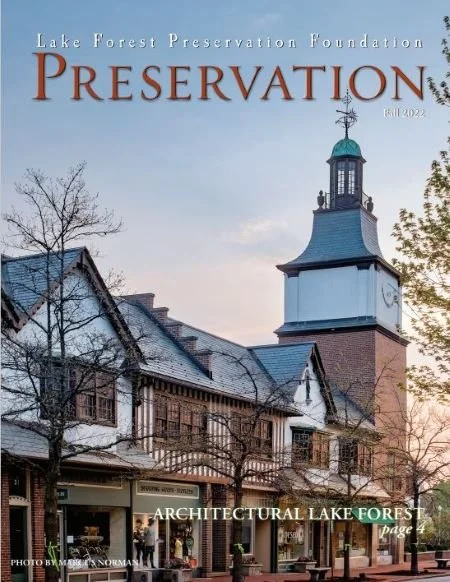
Fall 2022
FROM THE PRESIDENT
Dear Friends of LFPF,
Advocacy is defined as “public support for a recommendation of a particular cause or policy.” Lake Forest Preservation Foundation promotes the historic preservation of Lake Forest’s unique visual character and fulfills this mission through education, funding, and advocacy. We objectively evaluate each petition to the Historic Preservation Commission using the 17 standards of the City of Lake Forest’s Historic Preservation Ordinance. We also review various other petitions to City Boards and Commissions using their specific design standards and ordinances.
Our recent advocacy efforts reflect our commitment to upholding the City of Lake Forest’s nationally recognized Historic Preservation ordinance. This groundbreaking ordinance was developed in the late 1990’s by many concerned community members and City officials. Its intent was to preserve our community’s cherished historic built environment and ensure any development is compatible with the historic existing neighborhoods and surrounding environment in which it is built. This policy was created to make the city design review process more fair and equitable for all petitioners.
To ensure this policy is effective, it is imperative that every petition be evaluated using this same criteria and that no one petitioner receive preferential treatment.
LFPF avoids using subjective or personal opinions in our review of designs in an effort to fairly evaluate each petition. We use polite, patient persistence in our advocacy efforts to communicate our Foundation’s stance on various community projects because advocacy means speaking out and sometimes disagreeing with neighbors and fellow citizens. But we have learned that the disagreement, discourse, and compromise that results from our advocacy efforts results in the best outcome for a project and our community.
LFPF does not believe Lake Forest is a museum but rather a unique, nationally recognized, architecturally significant city that must be carefully and thoughtfully cared for through conscientious development that honors this historic character and is compatible with our neighborhoods, historic areas, and architecturally significant buildings. We all feel very fortunate to live in our special town of Lake Forest. We all have the same goal of maintaining the unique character of our community that we all treasure.
Advocacy is important in our community because it fosters discussion of various ideas and opinions. Let’s honor this American tradition of vigorous civic discourse and respect our friends and neighbors when we disagree. We can find better solutions to issues and reach our common goal by sticking to our established criteria and listening closely to differing opinions.
Thank you for your continued support!
Susan Rafferty Athenson
President
xxxxxxxxxxxxxxxxxxxx
library preservation, progress, and goals
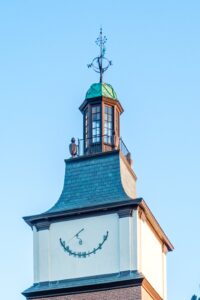
Lake Forest Library has completed its study for repair of the dome, including assurance of the stability of the rotunda on which it rests. The Library Board has sent the specifications out to bid, aiming to implement the rehabilitation in calendar year 2023.
As this urgent program is underway, the top priority as outlined by the Preservation Foundation in 2020, addressing other prioritized Library needs will return to the board’s agenda. It’s appropriate again at this time to reiterate Preservation’s two other points regarding Library physical planning:
Right sizing the building, concentrating additional programming north of the existing Library, and
Maintaining the stylistic integrity of Edwin Hill Clark’s 1931 building.
We hope a creative vision for increased square footage north of the rotunda and east and west rooms will be sought to accommodate the needs of a 21st century library while preserving the historic visual character of the building.
Finally, in thinking about the future of the 1978 wings, it should be noted that the landscape has evolved from the 1978 version that hid the wings with ivy and trees into one that highlights their bare expanses while obscuring the architecture of the 1931 core. This affects perception of the Library’s aesthetic strengths and weaknesses. But with the wings bared, it has allowed knowledgeable professionals to observe the high quality of the wings’ materials and design sophistication, hard to replicate in inflated 21st century dollars. Alternatives to demolition of these should be given serious consideration for careful stewardship of public and private funding.
The size of the building, interior and exterior, should not diminish or upstage in any way the 1931 building, following either the 1978 additions’ precedent of self-effacing simplicity or complementing Clark’s style palette. Changes should avoid creating grand spaces that would make the existing rotunda and adjacent rooms seem reduced in importance.
What is the Difference Between All These City Boards?
The City of Lake Forest has a variety of Boards and Commissions that oversee proposals for residential and commercial development. The Volunteers contribute a lot of time, energy and expertise to support the community and benefit us all.
COMMUNITY DEVELOPMENT DEPARTMENT
According to the City of Lake Forest’s website. . . “The Community Development Department strives to continue the tradition of careful planning and preservation that has served Lake Forest well in the past, to manage growth and change in the community, and to provide excellent communication and customer service to the business and property owners, architects, contractors, developers. Community Development Department staff are responsible for managing new development and infill development throughout the community from the initial planning stages through the issuance of a Certificate of Occupancy.
Lake Forest City Hall
The Community Development Department reviews and approves all construction plans for conformance with applicable building codes as well as conducting site inspections for all projects, including general construction, plumbing, electrical and HVAC mechanical systems. Community Development staff members work closely with the Fire Prevention Bureau to ensure conformance with life safety code requirements and with Engineering staff to ensure compliance with drainage, grading and steep slope requirements. Department staff members also work with property owners with respect to property maintenance.”
Community Development Staff work with various Boards and Commissions, including the Plan Commission (PC), the Building Review Board (BRB), the Historic Preservations Commission (HPC), and the Zoning Board of Appeals (ZBA) to ensure compliance with City ordinances. All Boards and Commissions are comprised of seven members recommended by the Lake Forest Caucus and appointed by the Mayor, with the approval of the City Council. All members are residents of Lake Forest and each member may serve three, two-year terms.
PLAN COMMISSION (PC)
In 1926, the Lake Forest City Council adopted an ordinance establishing the PC to oversee subdivisions of land and matters related to zoning. The PC also reviews and holds public hearings on requests for Special Use Permits for community institutions such as churches, schools and the hospital, and Special Use Permits related to development within the City’s Transitional and Business Zoning Districts. The PC also reviews proposed amendments to the Zoning Code, Subdivision Chapter of the City Code, and the Comprehensive Plan. In addition, the PC is often assigned special areas of study by the City Council.
BUILDING REVIEW BOARD (BRB)
BRB was established in 1962 and according to the City website “is responsible for carrying on the long tradition of Lake Forest by working to preserve the special character and uniqueness of various neighborhoods in the City and protect property values throughout the community.” The BRB reviews projects that are outside the boundaries of the City’s Historic Districts including all proposals for partial or full demolition of existing buildings, the architectural design of new buildings, building additions and alterations, requests for building scale variances, exterior lighting, signs, landscaping and overall site plans for new developments.
HISTORIC PRESERVATION COMMISSION (HPC)
The HPC was established in 1997 “as a continuation of the City’s long tradition of taking proactive steps to preserve the historic character of Lake Forest . . . The HPC is responsible for carrying on the tradition in Lake Forest by preserving historic buildings, gardens and streetscapes as well as the overall historic character of the community.” The HPC is governed by the Historic Preservation Ordinance and reviews projects inside the boundaries of the City’s Historic Districts and projects that affect individual Landmark properties located throughout the City. The HPC reviews proposals for complete and partial demolitions, for new construction and requests for Building Scale variances. The HPC is also responsible for reviewing and evaluating the design and compatibility of additions and alterations.
ZONING BOARD OF APPEALS (ZBA)
The ZBA’s major responsibility is to review questions and appeals which arise under the provisions of the City’s Zoning Code, as interpreted and administered by the Community Development Director. The Board also hears all requests for variations in zoning and requested updates to existing Special Use Permits. The Board’s recommendations go to the City Council for appropriate action.
More information about the City of Lake Forest’s Community Development Department, Boards, and Commissions can be found on the City’s web site at cityoflakeforest.org.
ARCHITECTURAL LAKE FOREST:
a new preservation foundation guide
In the early 1990s the Lake Forest Preservation Foundation published a guide to Lake Forest’s National Register Districts and Landmarks. Three decades later the organization again is publishing a guide, this time with more than three times as many sites in five Historic Districts. In the 1990s, Lake Forest had two historic districts on the National Register; today there are five districts cited, and many individually landmarked properties.
Green Bay Road Historic District
The 160-page, full-color book’s title varies only slightly from the 1990s original: Architectural Lake Forest: A Guide to National Register Historic Districts and Properties in Lake Forest, Illinois. Authored by local archivist, historian, and preservationist, Arthur H. Miller, it fills a niche in the ever-expanding list of books about Lake Forest since the 1980s: It is a history lesson, an elegant reference manual, a testament to the value of preservation, and a guide for touring on foot, by bicycle, or by car. While many of the sites are estate era and area properties, two of the historic districts specifically address middle-class residences.
East Lake Historic District
The book features 261 Lake Forest properties that are visible from the street, including houses, businesses, churches, institutional buildings, private gardens, and public parks. These points of interest are either in a district that is on the National Register of Historic Places or are themselves National Landmarks or locally designated Lake Forest Landmarks. It is divided into seven geographic chapters, with each including an introduction, an essay about a property, and an original line drawing by artist Alice Moulton-Ely. Chapters also include neighborhood maps and dozens of photos taken in the spring of 2022 by photographer Marcus Norman, with concise captions.
The main body of the book, about two-thirds, is followed by an address index also listing references to each by abbreviations, keyed to a bibliographic list of architectural sources. Some entries have fuller bibliographic listings, specific to them, as well. For more well-known places, this section pulls together the most recent sources, with references to locations of archived material.
The book also includes a glossary of architectural and landscape architectural styles, with information on the rationales for the dialectics between historicist or antimodern styles and modernist anti-historicist styles and directions, between national styles, and between formal and informal, exotic-plant and native species approaches to local landscapes and gardens. Examples from Marcus Norman’s photography are shown in smaller versions to illustrate the various types. A main point, though, is that most of the houses and gardens are one-off, bespoke designs, not so much aligning with standard French, English, and Italianate types, especially by the late 1880s. Instead, they are riffs on these styles by academically trained professionals, adapting to the sites and clients, and offering variations on broadly described style types.
Finally, there is an index of architects and landscape architects who are mentioned in the seven chapters.
West Park Historic District
The book will be available for purchase in early November, with a launch celebration in a historic home scheduled for Sunday, November 6, 2022. Architectural Lake Forest will be offered for sale through the Foundation. Visit our website www.lfpf.org or call 847-234-1230 for more details.
Historic East Lake Forest Garden
The publishing of this book has been made possible by donations from our generous members and Annual Fund contributors as well as Baker-McNicholas Real Estate Group, Deer Path Inn and Market Square. Thank you!
2022 ANNUAL FUND:
a drive to support larger preservation projects
Ravine Forest Drive historic gates
Each Fall the Board of Directors of the Preservation Foundation mounts a campaign to raise funds for special projects such as the 2009 train station Historic Structure Report and 2018 station interior rehabilitation, the blueprint for the rehab, and the 2022 Architectural Lake Forest guide book to over 260 local National Register sites. In one of three such and the last surviving. Jim Opsitnik, our gates whisperer, is working now on plans to rebuild both sides’ posts, with slate roofs and new woodwork. There is at least one other gate project in the pipeline, City owned, and of highest historic significance. These and other needs that will surface this year lead us to seek community and member support to keep our community’s estate era remnants still defining for the town.
We are proud of our community’s distinguished architecture, as our new guide book will show. Projects where the City’s addition, smaller though visible projects have seen the rehabbing of the Deerpath Hill and Castlegate gate structures. Also, completed earlier this year the restored historic luggage wagons, one for each station and our central business district recognition plaques, to be dedicated next Spring.
budget can be protected from high quality small maintenance projects like these very visible and neighborhood identity tasks
Restored historic luggage wagon
This Fall, in addition to replenishing our ready funds for small grants, we are working with neighbors and the City of Lake Forest to rehabilitate the Ravine Forest Drive gates, damaged in a storm by a falling tree limb. This pair of rustic stone posts with roofed lanterns on top declared the presence of a 1920s development,
Historic building marker
support our low property tax level and foster pride in our historic streetscapes.
Please join us in protecting our historic visual character in this way!
To learn more about LFPF’s impact, please take a moment to watch our new video Preserving the Uniqueness of Lake Forest presented this fall at the City’s Lake Forest 101, www.lfpf.org/videos.
Donations can be made using the attached remittance envelope or by going to our website under Donate.
McKinley Road Development, Phase 3 Tentative Settlement of Suit
As many of our members are aware, over a year ago the developer of Phase 3 of the McKinley Rd. Development ignored the 2016 Master Plan and proposed to extend the third condo building from behind Phases 1 and 2 all the way to Westminster. The Historic Preservation Commission (HPC) denied a certificate of appropriateness because the proposal did not comply with the standards applicable to the historic district, which decision the City Council affirmed. Afterwards, the developers filed a lawsuit against the City, the HPC and those who spoke at the meetings, asking the Court to reverse that decision.
Having failed to prevail on any claims for the past year, the developer and City have reached a tentative settlement agreement. The developer has agreed to build a new single-family house on Westminster, as the LFPF suggested over a year ago, but continues to deviate from the 2016 Master Plan, by proposing a condo building that is far larger than that identified under that plan. The City Council has approved the plan subject to approval by the Plan Commission and the HPC. More details are available on our website. But if you want your voice to be heard on this project you should attend the Plan Commission meeting scheduled for Wednesday, November 9, and the HPC meeting scheduled for Wednesday, November 16, with a possible City Council ruling by Monday, December 5. Interested residents are encouraged to follow the agendas and packets of these three commissions and share their views. LFPF will continue to advocate for compatible development in this sensitive site.
Two Longtime Preservation Foundation Interests:
Bridges and Gateposts
Walden Road foot bridge
Bridges Then and Now
In the 1990s the Preservation Foundation, working with neighbors, arranged to rehabilitate the Walden estate bridge between Walden Rd. and Bluff’s Edge Road for pedestrians. Guided by Wiss Janney engineers (the firm is now working with the Library on the dome) Cyrus McCormick’s century-old unique radiating supports were restored to serve a new steel and wooden bridge surface, declared “good parkitecture” by then Morton Arboretum landscape architect Scott Mehaffey. In the next decade this successful approach was repeated for Elm Tree Road’s passage over the historic Clark’s ravine just a block and a half from the lake. Both of these structures remain in fine condition.
Concurrently, the McClory bike path on the former eastside North Shore Line right-of-way replaced the bridges over the two-lane roads at Woodland Road and Illinois Road. These are metal bridge superstructures designed to rust into a warm, though rust-belt-connoting industrial chic character. Designed to last about a third of century, the Woodland Rd. version already has been replaced. The Illinois Road version is scheduled for replacement, like the nearby train station that in the 1980s was rehabbed, but for a shorter lifetime. The 2011-17 exterior rehab of the station, cheaper initially, it promises to need replacing once or twice more in the same time span as Harris’s bridge has lasted. It requires rehabbing, like Lake Forest College’s rehabilitation last year of its solid, five-story brick 1878 University Hall, now Brown Hall. The 1878 investors in the College left a built legacy that could be renewed but didn’t need to be replaced. In 1941 tax dollars built the North Shore Line Westleigh Road bridge that with little or no maintenance has lasted more than eight decades. If it simply can’t be saved, it should be replaced by a new permanent bridge, not a temporary one that lasts until everybody involved has retired.
The Preservation Foundation favors saving this historic structure, or if necessary replacing it with a similarly longer-term bridge, attractive at this entrance to the community.
Gate Posts, A Local Estate Era Remnant:
Part of Lake Forest’s Historic Visual Character
Lake Foresters are used to seeing gate posts of former estates or late estate era developments as they drive around town. Some are hidden behind fences, such as Miss Helen Culver’s 1900 Rookwoods gate posts on private property south of Ashlawn, near Waukegan Road. But many are visible and have been preserved by neighbors and with Preservation Foundation support, as at the entry to south King Muir Road from Deerpath and at Castlegate from Waukegan Road, both 1920s developments. Recently a tree limb though, was thorough enough to last eighty or a hundred years, if maintained, as had the 1900 station.
Gates at Castlegate Court
fell and demolished
the top of such a
Another bridge of interest is that of the North Shore Line over the four-lane stretch of Westleigh Road between Sheridan Road and Western Avenue. This bridge has shown signs of deterioration in recent years, with the neighbors at one point petitioning the City to clean it. Now it appears to be on a schedule for replacement, as well. The problems are two-fold. First, this 1941 bridge by state highway architect Ralph C. Harris is historic and of considerable architectural interest, in a conservative modern style and at the time compatible with the then visible Albert Cahn house, between Western and Green Bay Road. It represents a style much like that of the 1930s Post Office and 975 N. Lake Road residence. Architect Harris was the designer of Chicago apartment towers, from the 1920s to the 1950s, the last on Astor St., in a modern style with radiant floor heating.
The alternative would appear to be one of the rusting superstructure type bridges, designed to last a third of a century. While it may be
1920s pier at the northeast end of Ravine Forest Drive, west of
Sheridan Road. While the City hopes some insurance adjustment will help with rehabilitation, the century-old twin pier across the road also needs work, a project the Preservation Foundation and interested neighbors hope to pursue. Similarly, one for 747 E. Deerpath now belongs to the City, likely designed by landscape architect Rose Standish Nichols, 1910s, modeled on one at the Villa Madama, Rome, and apparently in need of rehabilitation.
Private owners of such remnants of former estates are to be commended for their stewardship of these, typically by noted architects. Significant existing ones that will appear in the new guide include those at 1435 N. Lake Road by Ambrose Cramer; 965 E. Deerpath by Delano & Aldrich; 880 Elm Tree Road and 735 E. Westminster by Charles S. Frost; and 1460 N. Lake Road by Harrie T. Lindeberg. These elements—in wood, iron, brick, or stone—represent fine design from an earlier age, a great asset to any property here.
“tools of the city”
lake forest and its comprehensive plan
Lake Forest is a unique and special place, very different from other communities in its approach to development, architecture, and growth. The Preservation Foundation, working independently, supports the 160 years of careful planning that began with the 1857 plan and continued in the 1920s with the Plan Commission and zoning.
What directs this is Lake Forest’s long-range planning through its Comprehensive Plan. Over the past several years, and roughly every 20 years, Lake Forest updates its Comprehensive Plan with an objective of reviewing current needs and exploring the future vision of a specific trade area within Lake Forest. This includes big picture projects that have a wide-reaching community impact, but also aids in defining the vision of Lake Forest in small developments alike.
Unique to Lake Forest, the completed and amended Comprehensive Plans are intended to be used as an advisory document to serve as a guide for future policy decisions. As stated in the City’s Comprehensive Plan, the Plan provides a framework to preserve and protect the existing built environment and to guide future growth so that it is compatible with the quality of existing development in Lake Forest.
Recently, Lake Forest completed updates to the Waukegan Road/Settlers’ Square Business District and the Route 60 Entrance Corridor. Currently it is working on the update to the Downtown Business District. This thoughtful approach allows Lake Forest to remain fresh with a future visionary outlook, but also looks out for the integrity of our community.
LFPF PUT ON A HOT SUMMER OF EXCITING PROGRAMMING
As we were treated with beautiful summer temperatures, the season was perfectly complemented by our array of fauna and flora in the locations we visited:
On Friday, June 24th, we returned to the Innisfail II estate on Green Bay Road for an early summer Garden Stroll curated by Nancy and Adrian Smith. The estate, built in 1930, was designed by David Adler and meticulously restored by the Smiths beginning in 2017. If you recall, this is where LFPF held its large holiday party; however, guests enjoyed a uniquely different experience from that in December.
December was quite cold, so our party ambience was kept indoors. Quite the opposite EXQUISITE June weather allowed guests to enjoy other extents of the 4-acre grounds including the large orangerie, walk the rose gardens and enjoy libations on the vast terraces surrounding the solid marble pool.
On Saturday, July 16th LFPF was appreciative to enjoy another annual Crab Tree Farm Tour in Lake Bluff. With guests walking the farm grounds in one-of-two collaborative sessions, LFPF recognized familiar faces and welcomed new lovers of architecture to intimately explore this local LB gem. Crab Tree Farm is the last operating farm in Illinois, located on Lake Michigan. Crab Tree Farm was rebuilt in 1910, original architect Solon Beman, after fire destroyed the original farm buildings.
Between the two elaborate tour times, each running 1 1/2 hours, guests were treated to a “backyard BBQ” outside the guesthouse, built in 2010 by Vinci Hamp Architects, which includes a modern swimming pool, pool house, and an observation tower. The BBQ was the perfect opportunity to relax and enjoy the summer sun and beautiful farm-life scenery, including two opulent blue iridescent peacocks!
In August, we found ourselves “soaking in” all that Lake Michigan has to offer in the magnificent views from Tom Fuller’s house on Bluff’s Edge Road for our late summer Garden Stroll. With waves of Lake Michigan crashing just below our party, this new construction, 2022 Preservation Award winner property was a picturesque backdrop for our garden stroll attendees to socialize and enjoy another beautiful summer day together.
LAKE FOREST PRESERVATION FOUNDATION
2021-2022
BOARD OF DIRECTORS
EXECUTIVE COMMITTEE
Susan Rafferty Athenson
President
Michelle Curry Tim Knight
VP Communications
Trey Gonzales
VP Development
Laura Luce Jim Opsitnik VP Programs
Patti Poth
Secretary
Debbie Marcusson
Treasurer
DIRECTORS
Elizabeth Abbattista Jennifer Durburg Jim Farrell Sr.
Craig Fox
Perry Georgopoulos John Julian
Brian Norton Peter O’Malley
Natalie Reinkemeyer Jason Smith
Sarah Somers Scott Streightiff
Courtney Trombley Gina Zisook
HONORARY DIRECTORS
Arthur Miller Pauline Mohr Shirley Paddock Linda Shields
EXECUTIVE DIRECTOR
Marcy Kerr
PRESERVATION
FALL 2022
VOLUME 17, NUMBER 3
Contributors:
Susan Athenson, Adrienne Fawcett, Marcy Kerr, Tim Knight, Laura Luce, Arthur Miller, Jim Opsitnik, Pauline Mohr, Jason Smith, Courtney Trombley
Editors: Michelle Curry & Tim Knight
Photography: Marcus Norman
Lake Forest
Preservation Foundation
400 East Illinois Road Lake Forest, Illinois 60045 www.lfpf.org
NON-PROFIT ORG
U.S. POSTAGE
PAID PERMIT NO. 184 LAKE FOREST, IL
60045
NON-PROFIT ORG
U.S. POSTAGE
PAID PERMIT NO. 184 LAKE FOREST, IL
60045
ECRWSS
Residential Customer Lake Forest, IL 60045
Annual Holiday Celebration
LFPF Members Annual Holiday Celebration Sunday, December 4 | 3:00-5:00 PM
Celebrate the season with fellow members and preservationists.
Advance tickets are required and limited.
For updated and complete event details, visit our website LFPF.ORG/Events
For Holiday Giving
Architectural Lake Forest
A Guide to National Register Historic Districts and Properties in Lake Forest, Illinois
Now available for purchase and pick-up at the LPFP office and select Lake Forest locations.
Please check our website for times and locations or call 847-234-1230.
$25
Watch our new YouTube video Preserving the Uniqueness of Lake Forest, Illinois on the LFPreservation YouTube station
The Lake Forest Preservation Foundation is a tax-exempt nonprofit 501(c)3 organization.
You may donate directly to us at LFPF.org.