2023 Summer Newsletter

2023 Summer Newsletter

Summer 2023

SPECIAL FOUR-PAGE PULL-OUT MAP,

Lake Forest’s Downtown Notable Historic Architecture Plaques

1

1PHOTO BY MARCUS NORMAN

From the President

Preservation teaches that the enemy of good is not always evil. Sometimes the enemy of good is better. How often have you gone into an historic structure only to find that the moulding and millwork, fixtures, or other defining architectural details were removed years ago in an effort to “modernize” and make the structure better? Believe it or not, at various times, plans were advanced in Lake Forest to demolish structures that are now regarded as public treasures – such as the train station, City Hall, and the Gorton Center – all in the misguided belief that replacing them would make our community better.

Thankfully, farsighted civic leaders and Lake Forest residents opposed such efforts and over 25 years ago adopted an historic preservation ordinance that recognized the need to preserve, restore and rehabilitate historic structures, sites and objects. That ordinance and residents of Lake Forest, who served on commissions and tirelessly voiced their opinions in favor of preservation and conscientious development, saved Lake Forest from the fate of some neighboring communities, which have lost their historic architectural heritage. We can fully appreciate the importance of that heritage when we consider that the recent Looking Forward Lake Forest poll reported that 92% of all respondents agreed that the overall character of Lake Forest’s Historic Central Business District is a defining element of our community.

In this issue, the LFPF celebrates all those who have promoted and maintained the historic visual character of Lake Forest in the most tangible way – by preserving, restoring, rehabilitating, or reconstructing historic homes, structures and landscapes. The LFPF celebrates them, especially this year’s winners identified in the following pages, through its Annual Preservation Awards. That homeowners and businesses in Lake Forest understand the value of preservation is amply demonstrated by the fact that since its inception, the LFPF has issued over 250 preservation awards in five categories.

The LFPF also celebrates Lake Forest’s rich architectural tradition by issuing plaques for historic structures in and around the Central Business District, which were recently showcased in the LFPF’s Tour of Plaques. The center insert of this issue features an iconic map by Mark McMahon, a favorite local artist, that highlights 18 historic buildings all found in our Central Business District.

The LFPF thanks its members and all who have played a role in maintaining the historic visual character of Lake Forest. Because of your contributions, Lake Forest remains a unique and special place and I look forward to serving as your President.

Brian Norton

President

Brian Norton

2023 Annual Meeting

April 30, 2023

At the annual meeting of the membership on April 30th, over 100 of our members and friends reflected on another successful year for the 47 year-old preservation advocacy organization. Several of our accomplishments of the past year are highlighted in this issue. We also welcomed 8 new directors, thanked the 5 who are retiring and awarded 8 properties the honor of an Historic Preservation Award. To cap the afternoon, we enjoyed the hospitality of Judy and Bert Krueger at their meticulously preserved 1860 home, The Homestead, original residence of D. R. and Ellen Hubbard Holt. To read more about the home, visit our InfoHub on the website.

Retiring Directors: Elizabeth Abbattista, Natalie Reinkemeyer, Debbie Marcusson. Not pictured, Scott Streightiff and Courtney Trombley

Annual Meeting Reception hosts Judy and Bert Krueger pose beneath a portrait of D. R. Holt

on the cover:

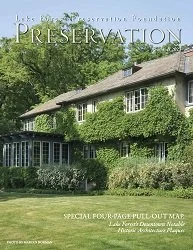
1298 NORTH GREEN BAY ROAD

Carry Playhouse, ca. 1915, 1918

Howard Van Doren Shaw, Architect Residence of Ned and Sigun M. Kimbrel

Original lantern slide c. 1930, Smithsonian

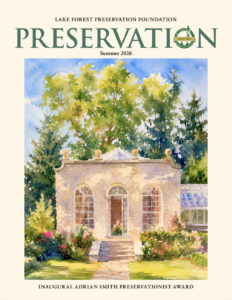
When Architectural Lake Forest was published by the Preservation Foundation late last year, it highlighted 261 local historic sites seen from the street. But Preservation Foundation awards are presented also for places not visible from the street or even known. This issue’s cover features one such hidden gem.

When Ned and Sigun Kimbrel first visited this 1915 and 1917-18 Howard Van Doren Shaw designed property in 1985, it was in great disrepair. Broken windows punctuated the beautifully paneled living room, originally built as a playhouse, 1915. While the Kimbrels were looking at the interesting character of the space, a feral cat flew through one of those windows, saw the visitors, and quickly bounded out another. The Kimbrel family, though, loved the house and could picture it four decades later as it appears today, charmingly rehabilitated and set in the spacious

2.64 acre, mature, and well cared for grounds extending west.

The 900 sq. ft. playhouse, located west of railroad car builder Edward Carry’s 1898 Shaw house, was designed and built for the

there of Mr. and Mrs. Harry Gordon Selfridge. Mr. Selfridge had founded the 1909-opened department store named for him in London, having worked earlier for Field’s in Chicago. But as U.S. entry into World War I became imminent, Ermina returned home. By July 1917 she was married to Fort Sheridan stationed Captain, later Colonel, William Corcoran Fenlon Nicholson (1883-1962, buried in Arlington Cemetery), son and grandson of military leaders and later a Pullman Co. vice president. The

playhouse was expanded by 1918

to 1917 designs by Shaw for the Nicholsons with a small country house scaled, 2,725 sq. ft., two-story addition,

with the original

Carry’s daughter, Ermina (1897-1932). She presumably acted in

Modern interior of playhouse

little theater

the title role of German author Hermann Suderman’s 1909 humorous one-act “Far-Away Princess,” presented there by neighbor Frances Wells Shaw (Mrs. Howard). The play’s setting

serving as the picturesque living room. Added were a dining room, kitchen, butler’s pantry, maid’s quarters, bedrooms, bathrooms, and two sleeping porches. The couple had two children.

in an 18th century rural German inn matched the character of                     

the space. The Shaw’s own second daughter, Sylvia, was the friend, perhaps Westover boarding-school mate two years ahead of Ginevra King, and fellow amateur actor with same-aged Ermina.

By 1916 railroad car “princess” Ermina was a debutante, soon leaving for London to help with wartime hospital work, a guest

Continued on LFPF.org/info-hub: with more on the Carrys and their main house, 1296 N. Green Bay, the Little Theatre Movement, and on Ermina’s younger sister, Peg, one of Ginevra King’s “Big Four” Chicago young Socialites, later Mrs. E.A. Cudahy, 904 N. Green Bay Rd. Included are details on sources, for further reading.

Three Lake Forest High School Graduating Seniors Awarded, May 25,2023

This year LFPF challenged graduating seniors to tell us how they have been influenced by preservation. All the entries were creative and inspiring but our team of 7 judges who blindly read them all, felt the following 3 were of special note:

1st place – Mary Bernadette Petty wrote a passionate photo-documented essay on the loss of Stonebridge, an important 1916 Howard

Emma Darling, Bernadette Petty, Amelia Fontana

school’s architecture in the community then and now.

2nd Runner Up – Emma Darling wrote a beautiful essay on her appreciation of her home, its style and how it was meticulously designed to fit easily into a neighborhood of historic homes. This heightened her appreciation of compatibility and good design.

Read entire essays on our InfoHub.

van Doren Shaw estate on Green Bay Road, demolished in spring 2023.

1st Runner Up – Amelia Fontana wrote about the architectural legacy of the Lake Forest High School. She expanded on Stanley Anderson’s belief in compatibility and the influence of the high

Thank you to all the seniors who shared their visions, understanding and love of the historic visual character of Lake Forest. Good luck on your future endeavors!

3

A Good Year for Lake Forest’s Historic Visual Character

The team at the Preservation Foundation—board members, staff, members, and donors—experienced a vibrant year in 2022-23.

Lake Forest Library Dome Restoration

Lake Forest Library Dome RestorationAs it has every year since 2007, the group sent out to local households three issues of its Preservation periodical. Issues such as for Spring 2022 made the “Case for Place” highlighting the challenge of creating a new Central Business District Comprehensive Plan which protects our unique downtown traditional character, led by urban planner and board member Perry Georgopoulos and local promoter/developer Jason Smith. We showed our 2022 award winning properties in the summer issue, and our fall issue announced our revised and expanded guidebook, Architectural Lake Forest, A Guide to National Register Historic Districts and Properties in Lake Forest, Illinois.

The new book, featuring 261 designated and protected locations visible from the street with beautiful new color photography by local professional Marcus Norman is in itself a valuable record. The group’s 1990s guide to 80 sites had been based on 1970s black and white photography, a base from the founding members of the Foundation. In addition, the little guidebook sized bundle is packed with brief captions and much new information, an address index with references to sources on each site, an

Le Colonial Adaptive Re-use

Le Colonial Adaptive Re-useindex to historic architects and landscape architects, and a guide to locally visible styles. A “coffee table book” for easy-reference glove compartment storage! The book is available for $25 from the LFPF office or from the Lake Forest Book Store.

Programs featuring the book included the November 4, 2022, launch at David Adler’s jewel at 255 N. Green Bay Rd., and presentations at the History Center and Lake Forest Place, one with Carol Summerfield of the History Center on garden history in Lake Forest and the Center’s new landscape plan reflecting this unique heritage.

Elsewhere in the community, the Lake Forest Library began restoring the dome on its significant 1931 Edwin Hill Clark building donated by the daughters of John G. Shedd, Mrs. Reed and Mrs. Schweppe, in memory of Mrs. Reed’s deceased spouse, Kelsey Coates Reed. The building with its art collections is a Chicago regional landmark of late estate era excellence.

LBLF History Center Garden Initiative

LBLF History Center Garden InitiativeThroughout 2022-23 the City of Lake Forest worked on its downtown comprehensive plan. The mayor appointed a broadly based task force, including LFPF board members Jim Opsitnik and Jason Smith (Smith played a key role in bringing Le Colonial to Lake Forest, preserving the 1904-26 former City building it occupies). This group’s report, still in Plan Commission-led refinement and incorporating resident and stakeholder input, makes clear a commitment to traditional character for future compatible downtown development.

With some 1,500 new households in town between 2020 and 2022, the many needs of this new cohort for services, being addressed in new high school and Deerpath Park upgrades, also has challenged preservationists. We are working to protect the balanced built, styled, and landscaped character unique here on the North Shore while welcoming their new vitality and perspectives. This continues a process that goes back a century, to when Grace Farwell McGann, writing in 1919 when Ginevra King’s generation was on the rise, lamented the loss of exclusive old Lake Forest!

On Bridge Grace Farwell Winston McGann with daughter Grace McGann in boat

On Bridge Grace Farwell Winston McGann with daughter Grace McGann in boat

lake forest preservation foundation

Lake Forest’s Notable Historic Downtown Architecture

celebrated in bronze plaques for eighteen buildings and sites

keyed numbered entries to map designed by mark mcmahon

keyed numbered entries to map designed by mark mcmahon

720 N. McKinley Rd. Chicago & North Western Train Station, 1900. Frost & Granger, architects, ALF, 45. Tudor style. Rehabbed by lessee from railroad, City of Lake Forest, 2011-18, architect Gunny Harboe, based on his 2009 Historic Structure Report and later involvement. Tudor styled building and interior partially rehabbed for passenger use, 2018. (Architectural Lake Forest, LFPF, 2022) ALF, 23.

630 N. Western Ave. Blackler Building 1895, architect not known. First three-story mixed use (including retail and apartments, still being rented) masonry designed building with a turret and bow windows west of the tracks. Italian Renaissance style, with Beaux Arts and Aesthetic Movement ornament in copper. ALF, 15.

284-296 E. Deerpath. Anderson Block, 1904, James Gamble Rogers, architect. Three story mixed use, including retail and apartments, by 1980s the latter offices, at the northwest corner with Western Ave. Classic Georgian style. On site of 1867 James Anderson frame two-story general store building, moved ca. 1903. At southeast corner of the first floor, Walgreens. ALF, 15.

684 N. Western Ave. Krafft’s Drug Store, 1917, Howard Van Doren Shaw, architect ALF, 11, 93. Small building significant architecturally for its stepping down from three-story Anderson Block south to south two-story and attic building of Market Square north. In 2023 Federal Savings Bank, with a classic addition west, 2005, by Peregrine Bryant, London. ALF, 14.

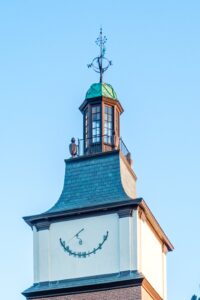
672 N. Western Ave., Market Square South Building and Tower, 1916. Howard Van Doren Shaw. Two-story English traditional, Arts & Crafts style. Balancing the block-long north building, both starting on Western Ave. and then bending west past a tower to Bank Lane. Features medieval and modern clock tower. ALF 11, 14.


Market Square Plaza, Fountain, and Park, 1916-17. Howard Van Doren Shaw, rehab 2000, Rodney Robinson, landscape architect. Garden evolving through three plans, 1912, 1914, and 1915, fountain 1917 with “Friends” sculpture by Sylvia Shaw Judson Haskins. Two rows of trees in park continue columns from east to west end of complex. Plaza east of fountain. ALF, 11, 14.

720 N. Western Ave., Market Square North Building and Tower, 1916. Paired with South Building, same features rearranged, with a taller contrasting classic Stuart, pre-Georgian English tower, Incorporated the ca. 1904 Gordon and Griffith Buildings north, part of Shaw’s design plan. ALF, 11, 13, and front cover.

768 N. Western Ave. The Lantern (O’Neill Building), 1905, architect not known. Three-story, mixed-use building atthe northwest corner of Westminster, the same scale and height as the Anderson Block one block south at Deerpath. Lantern tavern and restaurant a tenant since the end of Prohibition, mid 1930s.

682 N. Bank Lane, Former Marshall Fields (Market Square West Building), 1916, Howard Van Doren Shaw. In the complex’s third plan, 1915, the architect created the park space from the towers north to Bank Lane, in contrast to the English traditional style of the two long flanking buildings, this one’s design is Italian Renaissance derived from Andrea Palladio, mid-16th century. Marshall Fields, 1931-2006. ALF, 11, 17.

The illustrated map was created for the Preservation Foundation by well-known Lake Forest based artist, muralist, and illustrated mapmaker,

Mark McMahon. Mark is widely-known and his work, including beautiful prints, sought after for its animated and colorful impressions of urban,suburban(especiallyNorthShore), sports settings, and even a recent map of sculptures in Lake Forest and Lake Bluff.

B

s

2

�llM�—-,-���-�–�![     �
  1. e,AAK””

/J..l IN I

In the Spring of 2023 the Lake Forest Preservation Foundation affixed plaques to key downtown historic design landmarks, all more than fifty years old with the earliest, the Blackler Building, dating from 1895 and the latest, Lake Forest Library, from 1931. This period corresponds to the height of Lake Forest’s estate era that followed the 1893 Chicago World’s Fair and ended approximately with the start of World War II, 1941.

The buildings, with the 1917 park and fountain for the 1916-occupied Market Square, were designed by a cluster of leading architects, in the order of their first downtown Lake Forest work: Frost & Granger (Charles S. Frost and Alfred Granger), James Gamble Rogers, Howard Van Doren Shaw, Anderson & Ticknor (Stanley D. Anderson and James Ticknor), William C. Jones, Milman & Morphett (Ralph Milman, Archibald Morphett, and landscape architect Helen Brown Milman), and Edwin Hill Clark.

For more information on the architects and landscape architects, see the references to these buildings, listed in the address index to Architectural Lake Forest, A Guide to National Register Historic Districts and Properties in Lake Forest, Illinois, 2022, 146-55(ALF);availableatthe LakeForestPreservation Foundation Office and the Lake Forest Book Store. Thumbnail biographical sketches, also, appear in Classic Country Estates of Lake Forest… (2003), p. 295-301.

An exception is the Deerpath Inn’s architect, Cincinnati-born William C. Jones (1868-1930), a Chicago area architect, at one time practicing with Holabird & Roche during the 1893 World’s Fair and until 1895, then partnering for two decades with Gilbert Marshall Turnbull (1856-1919). See documented “Turnbull & Jones, Architects” entry, Nebraska State Historical Society, based in part on an Ancestry record. Jones—best known for his gothic and classic church buildings in places like Chicago, Elgin, and Rock Island–lived in Highland Park in the late 1920s. Soon after his work on the Deerpath Inn he passed away in Milwaukee.

This plaque project was conceived by Susie Athenson, LFPF advocacy committee chair, 2019-21, and president, 2021-23, texts and logistics orchestrated by executive director Marcy Kerr; plaque texts approved by site owners; and remediated and mounted by Jim Opsitnik.

230 E. North Gate, Post Office, 1933, Milman & Morphett. This simple, visually quiet conservative modernist building, constructed with Hoover Administration funds, fits into this corner of Market Square with good manners, even set back from the street. Its original Art Deco landscape was by Helen Brown Milman. ALF, 18.

655 N. Forest Ave., Former Police and Fire Station, 1904-1920s, Frost & Granger and 1920s Anderson & Ticknor. Initially a small building for the fire horses, it evolved as an annex to the City Hall, by 1970s, Rec Department use. By the 1980s it was adaptively reused as restaurant space, now Le Colonial. ALF, 18.

260-272 E. Deerpath, Anderson Trust Buildings. 1925-29, Anderson & Ticknor. Developed from east to west, with two-story and attic Georgian colonial revival unit west of Anderson Block, it reprised the Arts & Crafts style of Market Square further west to Bank Lane, with west end a theater, adaptively reused ca.1980 for commercial space and offices. ALF, 16.

265 E. Deerpath, Former 1st National Bank, 1930, Anderson & Ticknor. By the 1980s this Georgian and colonial revival building a branch of Chicago’s Northern Trust Co. On the southeast corner with Bank Lane, it expanded compatibly east in the 1960s and 1990s. In brick and limestone, it is the highlight of this stretch west of Western Ave. ALF, 16.

675 N. Forest Ave., Former Young Men’s Club, 1917, Howard Van Doren Shaw. Two stories, this Arts & Crafts style building housed on the first floor the Young Men’s club, and on the second a gymnasium, shared by the YWCA. The second floor of 682 N. Bank Lane, just east, with a bridge between. ALF, 18.


220 E. Deerpath, City Hall, 1899, Frost & Granger; 1998 addition, David Woodhouse, Doug Hoerr, landscape architect. English traditional, Arts & Crafts two-stories, with tower. West side addition in same style. ALF, 19.

255 E. Illinois Rd., Deer Path Inn, 1929, Jones & Jones, rehab after fire Anderson & Ticknor, 1938. Central half-timbered section modeled on Chiddingstone Old Manor, Kent, 16th century. Rehabbed 2016, Travel + Leisure top ranked Midwestern resort hotel. ALF, 19 and back cover.

300 E. Deerpath, Lake Forest Library, 1931, Edwin Hill Clark, architect. Cruciform plan with central rotunda below a dome. 1978 wings added by Danforth & Brenner, architects. Classic early National style and conservative modernist. Houses important artworks, on display. ALF, 43.

400 E. Illinois Rd., Gorton Center (former Gorton School), 1900, Howard Van Doren Shaw, additions Anderson & Ticknor, 1930s. Two story, classic and Arts & Crafts building, saved from demolition in 1972 to create the Gorton Center, a public-private partnership of board and City. ALF, 65.

Lake Forest Preservation Foundation, May 2023, map ©Mark McMahon.

Key Sources:

Architectural Lake Forest: A Guide to National Register Historic Districts and Properties in Lake Forest, Illinois, Arthur H. Miller (Lake Forest: Lake Forest Preservation Foundation, 2022), $25 at LFPF office at Gorton, 400 E. Illinois, lfpf .org, 847-234-1230; or Lake Forest Book Store, 662 N. Western Ave., 847-234-4420. ALF with page numbers and most entries here. References in the Address Index; Architects and Landscape Architects Index.

Market Square, Susan Dart (Lake Forest: LF-LB Historical Society, 1984). History Center of LF-LB, 509 E. Deerpath.

Downtown Lake Forest, Then & Now; Susan L. Kelsey and Shirley M. Paddock (Arcadiea 2009).

Lake Forest Preservation Foundation is a 1976-organized not-for-profit dedicated to protecting the historic visual character of Lake Forest. It uses a three-tier strategy of education, advocacy and celebration to safeguard the city’s exceptional architectural and landscape legacy for succeeding generations.

LFPF leads a coalition of some 500 members, donors and volunteers. It is managed by an executive director and board of directors. The directors regularly attend City of Lake Forest historic preservation, planning, zoning and City Council meetings, offering insight and counsel on issues of preservation.

Visit www.lfpf.org for more information about our mission, advocacy and events.

PROGRAM HIGHLIGHTS– MAY 2022 TO JUNE 2023

AUGUST

Late Summer Garden Stroll at a LFPF award-winning, new construction shingle style home on the bluff ’s edge overlooking Lake Michigan. Thank you to Thomas Fuller for hosting.

APRIL

FEBRUARY -MARCH

We hosted three additional programs highlighting Architectural Lake Forest: A Guide to National Register Historic Districts and Properties in LF– two with the LF/LB History Center and one at Onwentsia.

MAY

Lake Forest Forward: A Sensible and Sensitive Approach to Development in our Historic Center with Stefanos Polyzoides, and Thomas Norman Rajkovich presenting on how thoughtful development can preserve and protect our historic, architectural, and cultural resources. Available to view on our website under Explore/Videos.

JUNE

Early Summer Garden Stroll at the David Adler designed Innisfail II for the Joseph M. Cudahys on Green Bay Road. Thank you to the Smith Family for hosting.

JULY

Crab Tree Farm Tours. Thank you to Tom Gleason and the Bryans.

NOVEMBER

Book Release Party for our long awaited 2022 edition of Architectural Lake Forest: A Guide to National Register Historic Districts and Properties in LF. Big thanks to Kevork Derderian and the Casati Family who generously opened their family home which had been rarely seen in over 50 years.

DECEMBER

Holiday Celebration at the David Adler designed 1914 Joseph M. Cudahy house. Thank you to Barbara Cooper for hosting.

Architectural Lake Forest presented by Art Miller at Lake Forest Place.

Annual Meeting at Gorton and reception following at the Holt House hosted by members and owners Judy and Bert Krueger.

MAY

Hosted historic tours for the Traditional Building Conference at the Deer Path Inn led by Art Miller and Jim Opsitnik.

Tour de Plaques event highlighting the plaques in the Central Business District – If you missed this event, take the tour this summer using the pull-out map in the center of this publication.

JUNE

Early Summer Garden Stroll at Little Orchard, the Howard van Doren Shaw designed home on Lake Michigan. Thank you to the Moore Family for hosting.

if you really want to see lake forest from the inside out, become a member!

Our programs allow you to learn about historic preservation as well as experience beautiful and significant, large and small, Lake Forest homes, buildings and landscapes. Members always receive free or discounted tickets. Join or renew today LFPF.org.

LFPF Award Winners, 2023

Since 1991, Lake Forest Preservation Foundation has presented its annual Preservation Awards. The range and variety of properties honored cover large and small homes and businesses, landscapes and public spaces all across Lake Forest. The goal of the awards is to showcase best works and the owners and architects who made it happen.

1160 Griffith Road – Rehabilitation Award

Kristen Andersen, owner

Diana Melichar, rehabilitation architect

This 1915 one-story Craftsman bungalow was rehabilitated in 2015-16. As described by architect Melichar it is “tucked” onto a quaint street in town. The house is located within one of the support community neighborhoods developed by real estate entrepreneur John Griffith in the period he was helping shape Market Square. This street survives similar in character to the Ryan Place and Wildwood Road neighborhood, which is an equivalent distance south of downtown also laid out at the height of the estate era. The

cottage’s compatible addition and exterior living areas were designed to maintain the relevance of such a small though attractive contributing element of this historic neighborhood.

1078 Oak Grove Lane – Rehabilitation Award

Peach and Wayne Carr, owner

Combined stable and residence, converted 1960 and later Includes renovations, Jerome Cerny, architect

Owned before 1960 by an east Lake Forest family, it was bought by the E.V. Andersons then and adaptively reused as a residence and mother-in-law suite. Later owned by the Enz family, it has been further remodeled by the Carrs. Over time, this horse property evolved into a neighborhood, Oak Grove Lane. The home has been charmingly adapted and maintained anchor to its equestrian open country origins.

81 West Laurel Avenue – Rehabilitation Award

Linda and James Estes, owners Howard Van Doren Shaw, original architect, 1909 Michael Breseman, rehabilitation architect

linked new garage and rehabbed older garage

Local preservationists know well this significant Shaw designed house with its Rose Standish Nichols landscape and gardens, built on the old Atteridge farm developed by Shaw and his clients. Its previous owners and rescuers, Lyn and Bill Redfield, donated a 365-degree or all sides façade easement on the house, for which the original garage had been subdivided off mid 20th century to the

west, with a separate small two car garage built then. Working with Chicago’s Landmarks Illinois, holders of the façade easement, the Estes and architect Breseman developed a plan that linked with a glass enclosure the house and the new two-car, Arts & Crafts styled garage compatible with the house. The work included modification of the perhaps six decades old small garage to match the nearby new building. The result, along with much infrastructure investment by the Estes, is a unified whole that contributes significantly to this landmark’s ability to survive another century.

6

438 Heather Lane – Rehabilitation Award

Heidi and Jim Clifton, owners

Charles Page, original architect

Diana Melichar, rehabilitation architect

The mid-century modern character of this 1960s U-shaped one-story residence, unique on its cul de sac street, has been rehabilitated to recall well its late postwar origins. Its new period garage door and color, Benjamin Moore’s “Midnight Oil,” and

new north garden front patio by Apple Landscape, 2021, all restore the character and feel of that earlier era. The exterior room echoes too, the sunken living room of the interior.

366 Bluffs Edge Drive – Restoration Award

Dan and Julie Loeger, owners

The Loegers rehabilitated the brick-clad, poured-concrete Walden estate garden wall running north to south with two gates at the west end of their property facing Bluff ’s Edge Drive, across the road from Lake Michigan. The bricks were removed and relaid. This lot was the site of the 1932 Ralph Griswold designed walled garden for Cyrus H. McCormick. According to the 1933 typed The History of Walden by Warren H. Manning, McCormick’s landscape architect, 1896-1935, the formal garden, quoting from a statement by Griswold, “included a broad turf central walk terminated by the pool, lead fountain, steps, terrace, and on its westerly side a brick wall with gates” (p. 52). A 1942 photograph of this 1932 garden, from a vantage point near the south end of this wall and looking north, can be seen in Classic Country Estates of Lake Forest… Coventry et al., 2003, p. 82. The garden terminated north at the entry to the earlier created pergola, today on the next Bluff ’s Edge property.

1628 West Old Mill Road – Preservation Award

Jennifer M. McGregor, owner Stable, Old Mill Farm, Albert Lasker David Adler, architect, 1926

Ken Hite & Associates, architects,

and Craig Bergmann, landscape architect, 2021-22

The inventor of radio advertising in the 1920s, Albert Lasker, created his 480 acre estate in that same period, though by the late 1930s, after the death of his first spouse, he moved to New York and donated the estate to the University

of Chicago. The institution sold off the land in parcels, mostly before and right after World War II. This stable, part of a three elements farm group near the south end of the enclave, at Old Mill Rd., was converted superficially to a residence in 1947, when post wartime shortages and inflation made grander plans impossible. The present owner, an interior architect and licensed designer, recently set about creating more fully a treatment of the space and grounds worthy of a structure designed by Adler. She has preserved the original fabric of the building and its setting while adding polish and livability.

1421 North Lake Road – Preservation Award

Kristin and David Keenan, owners David Adler and Ambrose Cramer, architects, 1928 and 1938 Morgante-Wilson Architects and O’Brien Landscape, 2022

This unique locally Dutch-styled house resulted from Richard and Phoebe Bentley seeking out David Adler to design for them an Italian villa on this site. Adler opted instead for a Dutch styled house, having “done” an Italian villa a few blocks south at 955

  1. Lake Rd., 1916, for the Pikes. As described in the 2002 Art Institute book, David Adler, Architect: The Elements of Style, Adler drew on new documentation then of the

picturesque charm of Dutch Renaissance style. The Keenans and their consultants have worked within the envelope of Adler’s house and Cramer’s south addition to render the house livable and sustainable for a second century.

LAKE FOREST PRESERVATION FOUNDATION

2023-2024

BOARD OF DIRECTORS

EXECUTIVE COMMITTEE

Brian Norton

President

Laura V. Luce VP Advocacy Tim Knight

Arthur H. Miller

VP Communications

Jan Gibson Trey Gonzales VP Development

Tom Gleason Jim Opsitnik VP Programs

Michelle Curry

Secretary

Patti Poth

Treasurer

Susan Athenson

Immediate Past-Preseident

DIRECTORS

Stephen Bedrin Raymond Buschmann John Diefenbach Craig Fox

Perry Georgopoulos John Julian

Henry Kleeman Peter O’Malley Karla Schwartz Nadine Shepard Jason Smith Sarah Somers James Shearron Gina Zisook

HONORARY DIRECTORS

Pauline Mohr Shirley Paddock Linda Shields

EXECUTIVE DIRECTOR

Marcy Kerr

PRESERVATION

SUMMER 2023

VOLUME 18, NUMBER 2

contributors: Susan Banks, Marcy Kerr, Pauline Mohr, Brian Norton, Patti Poth

editors: Tim Knight & Arthur Miller

Photography: Marcus Norman

Lake Forest Preservation Foundation 400 East Illinois Road

Lake Forest, Illinois 60045 www.lfpf.org

NON-PROFIT ORG

U.S. POSTAGE

PAID PERMIT NO. 184 LAKE FOREST, IL

60045

NON-PROFIT ORG

U.S. POSTAGE

PAID PERMIT NO. 184 LAKE FOREST, IL

60045

ECRWSS

PROGRAMS TO LOOK FORWARD TO

h h h

ANNUAL CRAB TREE FARM TOUR

Saturday, July 15

10:00 AM and 1:00 PM

LATE SUMMER GARDEN STROLL

Friday, August 25

5:30 to 7:30 PM

FALL PROGRAMS & EVENTS IN THE PLANNING STAGES:

Author Review of Frances Elkins, Visionary American Designer

Stephen Semes – The Future of the Past

Fall Benefit Walking Tour Holiday Party, December 3rd

for additional information and to register go to lfpf.org/events

For Preservation news you need to know, visit our InfoHub at LFPF.org/info-hub

The Lake Forest Preservation Foundation is a tax-exempt nonprofit 501(c)3 organization.

You may donate directly to us at LFPF.org.

PROGRAMS TO LOOK FORWARD TO

h h h

ANNUAL CRAB TREE FARM TOUR

Saturday, July 15

10:00 AM and 1:00 PM

LATE SUMMER GARDEN STROLL

Friday, August 25

5:30 to 7:30 PM

FALL PROGRAMS & EVENTS IN THE PLANNING STAGES:

Author Review of Frances Elkins, Visionary American Designer

Stephen Semes – The Future of the Past

Fall Benefit Walking Tour Holiday Party, December 3rd

for additional information and to register go to lfpf.org/events

For Preservation news you need to know, visit our InfoHub at LFPF.org/info-hub

The Lake Forest Preservation Foundation is a tax-exempt nonprofit 501(c)3 organization.

You may donate directly to us at LFPF.org.Residential Customer Lake Forest, IL 60045


Share This Post
Recent Posts
The Art of Fine Gardening: Craig Bergmann Landscape Design

The Art of Fine Gardening: Craig Bergmann Landscape Design

Craig Bergmann and Russell Buvala presented The Art of Fine Gardening, showcasing four decades of landscape design that unites architecture and horticulture. Featuring twenty North Shore gardens—including the historic Gardens at 900—the book blends stunning photography, personal stories, and practical guidance for gardeners and design enthusiasts alike.

Read More »
2025+Fall

2025 Fall Newsletter

As we head into what we all hope will be another beautiful Fall in Lake Forest, I’m delighted to share with you some exciting initiatives that are underway at the Lake Forest Preservation Foundation.

Read More »
Lake Forest High School

Stanley Anderson Lake Forest High School 90th Anniversary

LFPF presents a 90th anniversary program celebrating Lake Forest High School with architectural historian Paul Bergmann. The talk explores Stanley Anderson’s 1935 design and the school’s lasting role in the community, launching a yearlong celebration of LFHS’s history, impact, and future.

Read More »