LAKE FOREST PRESERVATION FOUNDATION
Fall 2025
Fall 2025PRESERVATION
A PREQUEL TO OUR 50TH ANNIVERSARY
A PREQUEL TO OUR 50TH ANNIVERSARY
from the president
As we head into what we all hope will be another beautiful Fall in Lake Forest, I’m delighted to share with you some exciting initiatives that are underway at the Lake Forest Preservation Foundation.
Planning has already commenced on a myriad of activities next year to celebrate the 50th anniversary of the founding of the LFPF in 1976. We are all indebted to the civic minded citizens who recognized, and most importantly helped popularize and save many irreplaceable architectural treasures in Lake Forest. Our founders understood that Lake Forest was home to some of the most architecturally significant homes and buildings in the Midwest, where architects like Howard Van Doren Shaw,
David Adler, Harrie Lindeberg, Edwin Hill Clark, Charles Frost, Stanley Anderson, and others applied their profession. These historic buildings and structures tell a part of the story of our town providing tangible connections to the people, events, and traditions that shaped the unique “look and feel” of our community. The wisdom and foresight of the LFPF’s founders came shin-ing through in a recent City-wide survey in which a whopping 92% of respondents opined that the historic character of Lake Forest was important in choosing to live in our City. To put this in perspective, the City’s historic character ranked right up with schools and lower taxes in importance. Keep your eyes peeled for more information
on the educational programs, house and garden tours, and perhaps even a Gala as we plan to celebrate our Golden Anniversary all year!
In keeping with our theme of preserva-tion, I’m also delighted to note that every issue of Preservation, our newsletter, is now available on the LFPF website. If you want to know more about our efforts over the last fifty years, there is no better place to start than the archive of our past issues of Preservation. You can also purchase the two published guidebooks through the LFPF website.
Henry Kleeman, President
O
OLFPF Partnering in the Community
n Friday, August 22, the community gathered to walk the beautiful new gardens created at the History Center. We were proud to have so many members of LFPF present to celebrate this wonderful achievement. Congratulations to Carol Summerfield, the Board, staff and patrons
for making this happen!
The LFPF and members of the LF Library Board gathered at a presentation by Vinci Hamp Architects on their prelim-inary progress on the Library’s 1931 Rooms project. This project represents a steadfast dedication by the Foundation to support the Library’s enhanced preservation efforts. Lake Forest College’s Glen Rowan House Reopening Celebration on Sep-tember 30 was attended by an impressive representation of community leadership including several LFPF board members. We thank Susan and Scott Garrett for their commitment to leading the renovation efforts at Glen Rowan and to Art Miller for the delivery of impactful history on this
Howard Van Doren Shaw treasure.
LFPF Members at History Center Garden Event
Glen Rowan House Reopening Celebration
LFPF Board gathers to hear Library presentation
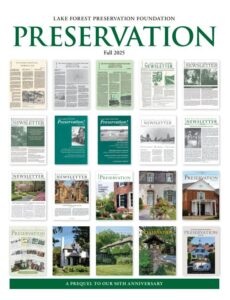
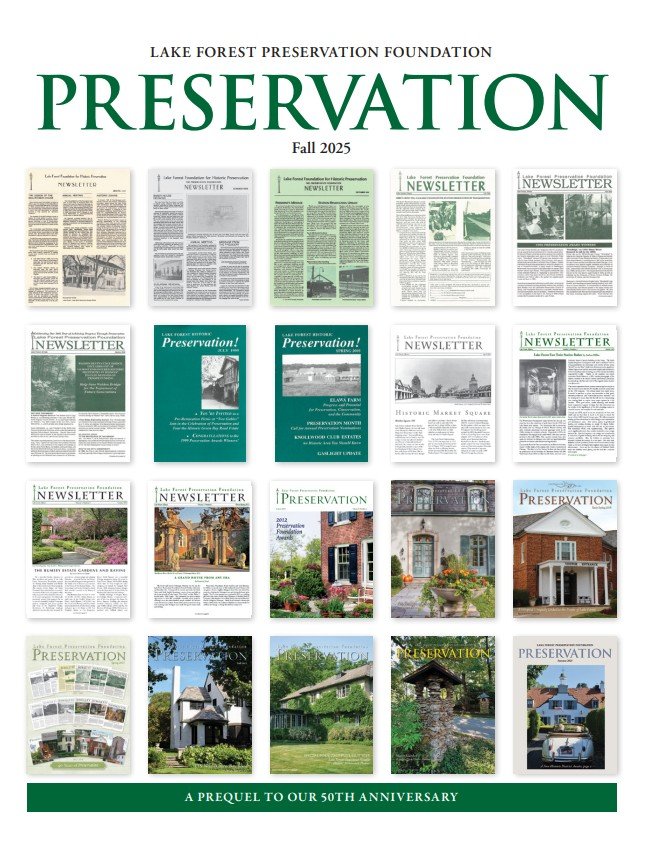
Cover Image: Select covers of our Preservation Newsletter mark the prequel of our 50th Anniversary. All past issues have been archived and digitized on our website this past year! Thanks to our staff and archivist team for making this dream a reality.
Preservation Foundation 2026 Semi-Centennial: The Prequel
L
Arthur Miller
ooking at LFPF newsletters from the first five years or so a half century ago
has started the organization on a journey to understand why and how the LFPF was organized and how this relates to the larger modern national and statewide preservation movement. That larger effort crystallized in the mid-1960s, with federal legislation creating the National Register in the Department of Interior. The 1963 demolition of NYC’s vast Penn Station, a landmark by McKim Mead & White, had aroused a nationwide wake-up call. Only a few earlier board members remain who were part of that subsequent mid-1970s founding effort for this organization.
Startling was a revelation in the very first newsletter, Winter of 1977. A new state preservation agency’s Historic Structures Survey, 1970–75, undertaken by Dr. Paul
Sprague, had identified Lake Forest as one of thirty communities across the state with outstanding historic architecture. The plan for Lake Forest in 1857, by a then misidentified Hotchkiss (later revealed as Almerin), became the outline for a proposed Lake Forest National Register Historic District, covering many of the east of the tracks villas and estate houses, fifty years old at the time, prior to the 1920s. Landscape was not part of the “Historic Structures” survey, though it helped define the estates area between the tracks and the shore. Dr. Sprague picked Lake Forest from his survey efforts as crucial to document, later consulting with the City.
But it was not locals who brought his-toric preservation to Lake Forest’s atten-tion, but outside architectural historian Sprague, early in 1976 — by then hired by the City of Lake Forest. He called on a group already working on Historic Sites to form this organization. The State pres-ervation agency in Springfield is sending LFPF a bundle of Sprague’s correspon-dence with the City, recently sent to that office by Sprague’s spouse, following his 2023 passing.
As shown at right from the first Pres-ervation Foundation newsletter, Winter 1977, the state approved, DC approval then pending “Lake Forest National Register Historic District” ran from the shore on the east toward the train station area and 1916 Market Square town center on the west.
An account of the origins of the
Lake Forest Preservation Foundation, Winter 1977 Newsletter
It defined the east side historic estate area, spread out across the 1857 pre-Civil War, pioneering railroad garden Chicago suburban plan for Lake Forest — a City by 1861 . The clipping above from the LFPF Newsletter, Winter 1977 is an account of the origins of the Foundation in 1976.
Lake Forest National Register Historic District
Architect Edward H. Bennett, Jr., inaugural LFPF President, 1976, a detail from a photo by Mary Lloyd Estrin in her 1979 book, To the Manor Born.
That April Dr. Paul Sprague, who had led the state’s survey of historic structures, 1970–75, as an academic and consultant called for this organization’s establishment for the “purpose of the preservation of the visual character of Lake Forest.”
This organization’s board of directors and executive director Jennifer McGregor have begun to gather material for celebrat-ing a half century of work preserving the historic visual character of Lake Forest. McGregor, working with archivist Davis Priest last spring, digitized the nearly complete file of 105 LFPF newsletters, 1977–2025, and made them accessible online. These have been sent out regu-larly to members and to all local resident households, informing them of developments and challenges facing the group’s efforts to manage gradual, sympathetic change locally, preserving the local historic character. These can be accessed on the LFPF.org website (https://www.lfpf.org
/publications). Then scroll down to the end, where the earliest issues are found, beginning in Winter 1977 (bottom row, left), only months after the August 1976 LFPF founding.
Celebrating Centennial Churches in Our Midst
Sondra D. Adam & Arthur Miller
S
September 2025 marked the 150th anniversary of the Church of St. Mary in Lake Forest. Located at the corner of Illinois and Green Bay Roads, the “church on a hill” received the Preservation Foun-dation’s Restoration Award in 2018. The church sits prominently atop the moraine that divides water flowing east to the Atlantic and west to the Gulf. It has served its parishioners since the earliest days of the city’s founding, beginning in an 1875 wood frame edifice and then an 1876 parish house. An exhibition at the History Cen-ter of Lake Forest Lake Bluff honors this 150th year for the Church St. Mary and will include sibling local heritage churches. The exhibition opening is October 14 and runs through November 10 at the History Cen-
ter, 509 E. Deerpath Road, in Lake Forest. The exhibit highlights six “centennial churches” which were foundational to Lake Forest and Lake Bluff. They are St. Patrick Church (1849), First Presbyterian Church (1859), Church of St. Mary (1875), Grace United Methodist (1887), the First Baptist Church (1900), and Church of the Holy
Spirit (1902).
Preservationists will appreciate a descriptive tour of the buildings that make up the campus of the Church of St. Mary today, which evolved from the 1875 first wood frame towered church here, with its rectory built a year later. This church was in service to the growing Catholic population
The white building is before the fire and the rebuild in 1910.
in the early days of Lake Forest (1856–61), which consisted mostly of Irish immigrants and their families. With its rectory and res-ident priest, the Rev. James J. McGovern, it oversaw the older St. Patrick Church rural congregation, southwest at Everett, from which the priest formerly had traveled across wetlands to offer mass in this newer community. This made the Everett church the “mission church,” reversing earlier roles. As Lake Forest grew with the 1895 founding of the Onwentsia Club, which
By 1910 the diocese of Chicago hired noted architect Henry Lord Gay to design a new church.
drew in more Chicagoans, so grew the needs of the church. By 1910 the diocese of Chicago hired noted architect Henry Lord Gay to design a new red-brick Beaux Arts Gothic and Romanesque church, with limestone trim in a Roman Renaissance pediment and other elements. Its hand-some towers echo that of the 1909 Frost & Granger Highland Park Presbyterian Church, with its round window, which also was used on the Philadelphia Statehouse. This direction, as at the former 1904–2015
Interior of the brick church built in 1910 (date of photo unknown).
Following Cardinal Blaise Cupich’s celebration mass for the 150th Anniversary of the Church of St Mary, he greets parishioners.
Church of St. Mary and Rectory First Presbyterian Church
Barat College building, reflected the Catholic Church’s efforts to emphasize their congregants’ Americanism.
The wood frame rectory was replaced in 1925 by the home we see today. Designed by architect Arthur Foster of Chicago, this pressed brick façade with a terra cotta tiled roof is sixty feet long and thirty feet wide, displaying a Prairie-style aesthetic. Today the century-old building includes private quarters for the clergy as well as offices and a reception area in the front of the build-ing. All rooms have been renovated over the years.
The original School of St. Mary was completed in 1917 at the instruction of then Archbishop, soon Cardinal, Mundelein and overseen by the pastor Francis J. Barry. The three-story building was constructed from interlocking fireproof hollow tiles, as
Market Square used a decade earlier, with stone trim and a red tile roof. The school contained eight classrooms, an assembly hall, school office, and music rooms. The third floor was occupied by the Sisters of Mercy, faculty for the school, until a convent could be built.
A convent for the sisters was finally built 33 years later in 1950, when the school enrollment necessitated extra space. This building was constructed under the guidance of Pastor Monsignor Thomas Shan-non, with a private chapel. Utilitarian in design on the exterior, it reflects the mid-century aesthetic of the time with a flat stepped-back facade.
In 1958, in response to ever growing enrollment, an eight-classroom addition, dubbed the “South Wing,” was added to the school along with a gymnasium,
cafeteria, and library. No longer needed as a convent, in 1985, the residence build-ing was converted to the Parish Center for meetings and activities. And, in 1997, the School of St. Mary expanded significantly, opening the Primary Grade Center (pre-K thru grade 3) off campus in west Lake For-est on Everett Road.
Each building on the campus of the Church of St. Mary has been updated over the years, yet all present a harmonious whole that is reflective of their mission and the eras in which they were constructed. The improvements and expansion over one hundred and fifty years have allowed the parish of the Church of St. Mary to serve generations of Catholics and their commu-nity friends while maintaining its import-ant place as an integral cornerstone of Lake Forest and Lake Bluff.
Church of the Holy Spirit St. Patrick Church
F
FAnnual Fund and LFPF’s Fifty Years of Preservation
ounded in 1976, the Lake Forest Pres-ervation Foundation has been dedi-cated to educating, advocating, and fund-ing efforts to preserve the historic visual character of our city. As we look ahead, we invite you to continue our nearly fifty-year legacy of generosity by supporting the next
fifty years of preservation and advocacy.
Thanks to the seed money from gen-erous and concerned donors over the past fifty years, the Preservation Foundation has raised more than $4 million in support of preservation efforts. None of this would have been possible without you. We’ve achieved major successes — both large and small — all for the lasting benefit of the City of Lake Forest.
In 1996, the Lake Forest Preservation Foundation recognized that the historic 1901 Walden-Bluff ’s Edge Bridge was at risk. Thanks to your support and the Foun-dation’s advocacy, the bridge was named one of the top ten most endangered historic sites in Illinois. With $10,000 in seed funding, we launched and led a successful $125,000 public-private campaign to restore this architectural treasure. For our leadership in
this effort, the Foundation was honored with the prestigious Driehaus Award.
Images from the soon-to-be-proposed Lasker Estate / Mill Road Farm District
Today, the Walden-Bluff ’s Edge Bridge is more than just a foot and bicycle path — it is a cherished destination that connects forest and ravine landscapes for residents, visitors, and students alike.
Walden-Bluff ’s Edge Bridge
Lake Forest Train Station
In 2008, the Lake Forest Preservation Foundation took action as the historic 1900 Lake Forest Train Station — designed by the renowned firm Frost and Granger
— began to deteriorate. The Foundation awarded a $50,000 grant to fund a Historic Structures Report (HSR), initiating a vital public-private partnership with the City of Lake Forest, Metra, and restoration architects Harboe Architects.
This report became the foundation for securing over $3 million in federal grants, which made the station’s restoration pos-sible. It stands as the largest public-private partnership the Foundation has under-taken since its founding — and your con-tributions made it possible.
As we celebrate our fifty years of pres-ervation in 2026, we would like you to help us in our shared preservation causes. Addi-tionally, we have future projects kicking off our fifty-year celebration.
We’re proud to support neighborhoods seeking designation as local historic districts to preserve their unique architectural char-acter — such as the soon-to-be-proposed Lasker Estate/Mill Road Farm District in our 4th Ward.
As part of our 2025 Annual Fund, we welcome donations at various levels, gifts of stock, and alternate methods described on the donations page of our website. For contributions of $1,500 or more, donors will receive a stunning watercolor image of either Ragdale or Market Square by commissioned California artist Glenn Vilppu. Alternatively, you may choose an original custom watercolor of your own home — such as the example shown of a historic West Park residence.
To make your contribution, scan the QR code on this page or call our office at 847.234.1230.
Watercolor of a house in West Park
Featured Programs and Events
Thank you to all our hosts, members, and patrons for supporting our events
this past summer! It is always a pleasure to see everyone and learn more about the wonderful and sometimes hidden treasures in the community.
For more information and updates, visit lfpf.org/events.
Paul Bergmann
Late Summer Garden Stroll/Stanley Anderson 100th Anniversary
Paul Bergmann, former LFPF Board Member and author of The Architec-
ture of Stanley D. Anderson, gave a presen-tation to a full house in August followed by a walking tour of Anderson homes in the 1920s Deerpath Hill Estates neighbor-hood. The event concluded with appetiz-ers, wine, the Stanley Anderson Signature Cocktail and cake at the architect’s former home.
Join us for a behind-the-scenes tour of the historic home of Ingrid and Brian Bryzinski. It was built in 1889–1890 for Fannie Farwell Tuttle and Henry N. Tuttle by architects Burling & Whitehouse (designers of Chicago’s 1883 Nickerson Mansion, now the Richard Driehaus Museum). The house was renovated in 1914 by David Adler. The landscape includes the original Deerpath entry to the beach and is attributed to O.C. Simonds, and in the 21st century to Craig Bergmann. Cohen & Hacker Architects were masterfully engaged for over a decade to complete extensive renovations and remodeling for this unique property. It is likely to be the oldest surviving estate-scaled residence near Lake Road and is a 2014 LFPF award winner. Space is limited to fifty guests, and tickets are $150. Hors d’oeuvres and cocktails will be served.
We are grateful for the generosity of Ingrid and Brian Bryzinski for hosting this special Lake Forest Preservation Foundation Fund-raiser to jumpstart our project initiatives for 2026.
The Lodge at Crab Tree Farm
Annual Crab Tree Farm Tours
In July, we held two tours of Crab Tree Farm and an exclusive “Art After 4” Tour
which included a new exhibit by Chicago metal worker Robert Jarvie and awine recep-tion in the welcoming and cozy Lodge at the Farm.
Burling & Whitehouse’s
941 East Westminster Fundraiser
Thursday, October 30
5:30 p.m. Arrival
5:50 p.m. Presentation by acclaimed architects Stuart Cohen and Julie Hacker, followed by tours of the house
7:30 p.m. Event Concludes
$150 per person
LFPF President Henry Kleeman,
Executive Director Jennifer McGregor, and Board Member Jim Opsitnik, current owner of Stanley Anderson’s former home.
LFPF Members Holiday Party
Sunday, December 7, 3:00 p.m. at a private historic home
NON-PROFIT ORG
U.S. POSTAGE
PAID PERMIT NO. 184 LAKE FOREST, IL
60045
NON-PROFIT ORG
U.S. POSTAGE
PAID PERMIT NO. 184 LAKE FOREST, IL
60045Lake Forest Preservation Foundation 400 East Illinois Road, Lake Forest, Illinois 60045 www.lfpf.org
ECRWSS
Residential Customer Lake Forest, IL 60045
More Upcoming Events!
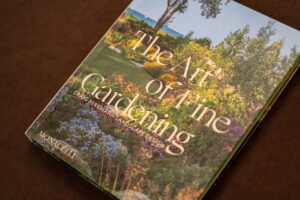
The Art of Fine Gardening
Program at Gorton
Thursday, November 13
6:30–7:30 p.m.
No Charge
Join us for a great program featuring our very own Craig Bergmann and help cel-ebrate his new book, The Art of Fine Gardening: Craig Bergmann Landscape Design. For more than four decades, Craig Berg-mann has been recognized for intertwining design, horticulture, and architecture, establishing a true dialogue between the garden and the architectural site. Revered as a plantsman, Bergmann layers his designs with vibrant blooms and textured foliage. The Art of Fine Gardening features twenty gardens that span his career and are located
in the North Shore of Chicago. A special chapter is dedicated to the Gardens at 900, the historic estate designed by architect David Adler, that he
developed and reimagined as a series of lush private garden rooms with hedges, towering topiary, perennial borders, and inter-spersed with classical figures and ornament. Featuring stunning garden images by noted photographer Scott Shigley and texts writ-ten by Bergmann, the book describes all the gardens in his own voice — a voice of true experience — offering anecdotes and practical tips to gardeners. Books will be available for purchase at the event.
2025–2026
BOARD OF DIRECTORS
EXECUTIVE COMMITTEE
Henry Kleeman
President
Brian Norton Immediate Past President and Secretary
Laura V. Luce Susannah Sullivan VPs Advocacy
Kelsey Kleinert Arthur H. Miller VPs Communications
Jan Gibson Patti Poth
VPs Development
Stephen Bedrin Gina Zisook VPs Programs
Timothy Knight
Treasurer
DIRECTORS
Raymond Buschmann Perry Georgopoulos Tom Gleason
Jennifer Karras Dawn Kimbrel
- Nicholas Loope Max Lynch
Robin Norkus Jim Opsitnik Ann Phillips Karla Schwartz James Shearron Nadine Shepard
HONORARY DIRECTORS
Pauline Mohr Shirley Paddock Linda Shields
EXECUTIVE DIRECTOR
Jennifer M. McGregor
The Lake Forest Preservation Foundation is a tax-exempt nonprofit 501(c)3 organization. You may donate directly to us at LFPF.org.
PRESERVATION
FALL 2025
VOLUME 20, NUMBER 3
contributors: Sondra Adam, Susan Banks, Jan Gibson,
Henry Kleeman, Jennifer McGregor, Arthur Miller, Nadine Shepard,
Carol Summerfield
editors: Arthur Miller,
Karla Schwartz
photography: Marcus Norman, History Center of Lake Forest-Lake Bluff
design: Robson Design, Inc.
2025–2026
BOARD OF DIRECTORS
EXECUTIVE COMMITTEE
Henry Kleeman
President
Brian Norton Immediate Past President and Secretary
Laura V. Luce Susannah Sullivan VPs Advocacy
Kelsey Kleinert Arthur H. Miller VPs Communications
Jan Gibson Patti Poth
VPs Development
Stephen Bedrin Gina Zisook VPs Programs
Timothy Knight
Treasurer
DIRECTORS
Raymond Buschmann Perry Georgopoulos Tom Gleason
Jennifer Karras Dawn Kimbrel
- Nicholas Loope Max Lynch
Robin Norkus Jim Opsitnik Ann Phillips Karla Schwartz James Shearron Nadine Shepard
HONORARY DIRECTORS
Pauline Mohr Shirley Paddock Linda Shields
EXECUTIVE DIRECTOR
Jennifer M. McGregor
The Lake Forest Preservation Foundation is a tax-exempt nonprofit 501(c)3 organization. You may donate directly to us at LFPF.org.
PRESERVATION
FALL 2025
VOLUME 20, NUMBER 3
contributors: Sondra Adam, Susan Banks, Jan Gibson,
Henry Kleeman, Jennifer McGregor, Arthur Miller, Nadine Shepard,
Carol Summerfield
editors: Arthur Miller,
Karla Schwartz
photography: Marcus Norman, History Center of Lake Forest-Lake Bluff
design: Robson Design, Inc.“Preservation After Disaster” Program at Gorton
Wednesday, February 25, 2026
6:30-7:30 p.m.
No Charge
8
8Please join us for a presentation by Alex Athenson and Cynthia Sigler, co-founders of The Foothill Catalog Foundation, about their innovative idea to use a vintage home building tool to preserve and reestablish historic neighborhoods that were destroyed by the catastrophic Eaton Fire in the com-munity of Altadena, California on January 7, 2025.
Alex and Cynthia will discuss using the vintage building tool of kit home catalogs from the early 1900s to help reestablish the architectural heritage and retain the residents of this devastated community. Lake Forest has an abundance of kit homes from the early 1900s throughout our com-munity, especially in the neighborhoods of West Park and South Park. Come celebrate our local connection to this effort to restore a community’s architectural character and historical assets after a devastating loss.