LAKE FOREST PRESERVATION FOUNDATION
PRESERVATION
Summer 2024
from the president
As the reign of Cicada Brood XIII comes to an end, preservation can take a lesson from its life cycle. Hatched in the warm summer sun of August 2007, they burrowed into the cool ground for seventeen years and emerged early this summer to see blue skies once more and fly(ish), if only for a few weeks. The first time I saw cicadas, I was a kid in the trees with them; the second time, I was married and
starting a career; the third time, I had three children; and this time, a granddaughter is on the way. Unlike us, cicadas see the world only in seventeen-year glimpses.
Granted, Brood XIII missed a few things, some good (the Cubs winning the World Series) and some not so good (Covid). But a seventeen-year perspective reveals change in ways we might miss.
Indeed, when they emerged a few weeks ago in some historic towns the cicadas likely would not have recognized them, so altered by unsympathetic development. Fortunately, Lake Forest would be largely familiar. The towers of Market Square and City Hall are still standing; historic homes are flourishing, and changes, with a few exceptions, are consistent with the historic visual character of the City.
So why do some communities preserve
their historic character while others lose it in such a relatively short time? It seems that there are three necessary ingredients for preservation, all of which are highlighted in this issue.
First and most important, while the stories about preserving historic areas differ, they invariably start in the same place—with a group of concerned and organized residents, much like those celebrated in this issue. These Lake Forest residents and prior Preservation Award recipients, among others, have preserved, restored, rehabilitated, or reconstructed historic homes, structures, and landscapes throughout Lake Forest. Led by our Executive Director, Marcy Kerr, concerned residents have advocated for and promoted thoughtful development that has preserved Lake Forest’s uniqueness. As detailed later in this issue, after seventeen remarkable years of leadership, Marcy is retiring, and Jennifer McGregor is taking on the role of Executive Director. The Foundation thanks Marcy for her tireless efforts and welcomes Jennifer who, the Foundation is confident, will further its mission to preserve the historic visual character of Lake Forest.
Second, preservation requires laws to
protect that character. To understand the importance of this requirement, look no further than a few miles south, where the iconic Clement Stone House on Sheridan Road is currently slated for demolition. Why? Because unlike Lake Forest, that community has no laws to stop it. Soon, the law will once again be in the forefront, as the City considers design parameters for the Historic Business District in connection with the Bank Lane streetscape project.
Third, as highlighted in the last issue, preservation requires vision. As the City begins the public planning process for redeveloping Bank Lane into a welcoming pedestrian corridor, vision is critical. The Foundation looks forward to working with the City on this project, but the best way to ensure that a redeveloped Bank Lane is compatible with the historic visual character of Lake Forest is for residents to participate in the process and make their views known.
With these three ingredients, we can be confident that when the cicadas return in seventeen years, they will find a still familiar and unique Lake Forest.
Brian Norton
A
Forty-Eighth Annual Meeting
t the forty-eighth annual meeting of the LFPF membership on May
5, 2024, over 125 members and friends reflected on another successful year for the preservation advocacy organization. We welcomed six new directors, thanked two retiring directors for their service, and awarded ten properties the honor of an Historic Preservation Award. To cap the afternoon, we enjoyed the hospitability of Karena and Ron Garriques at their beautiful Howard Van Doren Shaw designed bluff top home. To read more about the home, visit our website at www.lfpf.org
/infohub-blog.
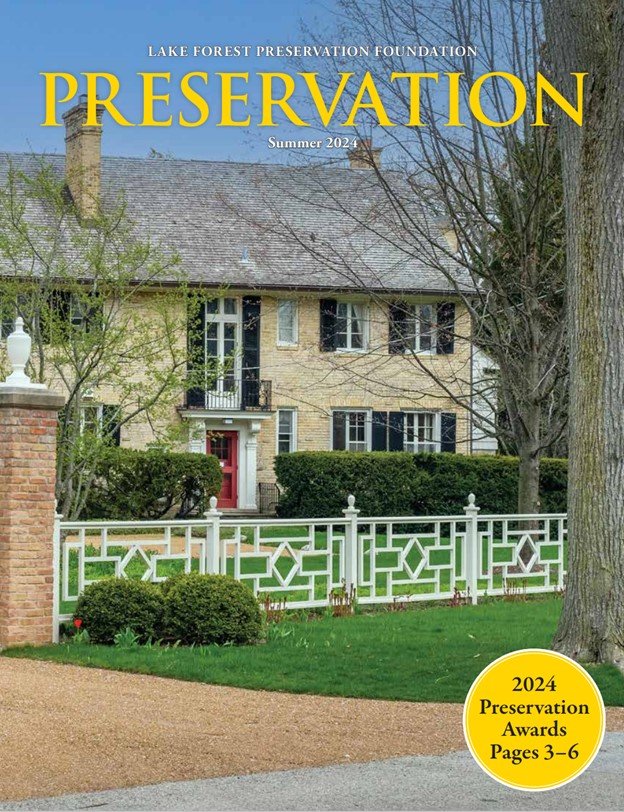
Cover: A detail of Marcus Norman’s 2022 photograph of the west facing entry façade and fence at 901 N. Church Road, designed by Alfred Granger. See story on p. 3.
Outgoing board: Michelle Curry and Susie Athenson
999 Lake Road, 1912 Clayton Mark Estate
James Shearron and Richard Bories
The Bank Lane Streetscape Enhancement Plan
T
The City is now embarking on the
long-discussed Bank Lane Streetscape Enhancement Plan. While Bank Lane is essential to providing service access for
the Business District, it is also a unique pedestrian corridor, linking the Deer Path Inn and residents from both the south and north with the shops, restaurants, and public buildings in the Business District. Bank Lane has great potential, but currently is uneven in appearance and function. It has an alley-like feel in some stretches, while having an inviting English village dynamic in others.
The stated purpose of the plan is to enhance Bank Lane so that it adds to the distinctive character of the Historic Business District and creates a “memorable experience” for residents and visitors
alike, while maintaining its functionality. Following the surveys taken last year, the
City is requiring that “[a]ll elements of the plan shall be considered in the context of
. . . [c]ompatibility with the historic visual character of the Central Business District and Market Square.” The plan is being developed by the Lakota Group, which has experience designing streetscapes in historic districts and is familiar with the unique character of Lake Forest’s Historic Business District.
The Preservation Foundation looks forward to working with the City on the plans for Bank Lane, as well as the design parameters for any private development in the Historic District to ensure that any new construction is compatible with the visual character of the Historic Business District. The Preservation Foundation encourages residents to participate in
the planning process through the public meetings set to occur later this month. For
Bank Lane looking north from Westminster to Wisconsin, with views of power poles, solid façades, and expansive hardscape.
more details on the Preservation Foundation’s ideas for the Bank Lane Streetscape Plan, visit our website at www.lfpf.org.
2024 PRESERVATION AWARDS
2024 PRESERVATION AWARDS
901 N. Church Road
Category: Preservation
Original architect:
Alfred Hoyt Granger (1867–1939), 1923 Playhouse architect: Frost & Granger, 1908 Rehabilitation and Additions: Stanley D. Anderson (1895–1960), 1931, 1935, & 1937
Current owner: Susan Bouma
Original owners:
Thomas Hooker Cowles (d. 1927) and Barbara Granger Cowles (Shepherd)
Front and rear façades, 901 N. Church Road
Barbara Cowles was a granddaughter of the Chicago & North Western Railway baron, Marvin Hughitt and daughter of architect, Alfred Hoyt Granger, formerly a partner in Frost & Granger. Thomas Cowles was a descendant of one of the founders of the Chicago Tribune. In the 1930s, north and east wing additions
and several renovation projects were completed by Stanley D. Anderson. Two notable features on the grounds include an eighteenth-century Georgian Chippendale revival-style gate and fence in the front and a children’s playhouse facing the garden.
The 5,200 sq. ft. century-old house is situated behind the ornate fence based on a gate dating to 1790 at Farmington,
Connecticut, for Admiral Cowles, a direct ancestor of Mr. Cowles. The original Chippendale gate was shown in a 1922 monograph for the White Pine series authored by Alfred Hopkins, the New York City architect who also designed the 1915 main barn at Elawa Farm for the A. Watson Armours.
At the east end of the property, facing west into the garden, is a children’s playhouse, moved to this site in ca. 1930s
for the Charlie Clark family. It came from
the now demolished 1908 Ezra Warner, Jr. estate, then on the west side of Washington
Frost & Granger 1908 playhouse
Road, between Deerpath and Westminster. The playhouse is modeled after the 1878 playhouse found at the Breakers, reprised here in a similar character, though reduced in scale. It had been built for the Warner daughters, the future Jane Warner Dick and Marion (Mimi) Warner Hodgkins, who became Lake Forest community leaders in the mid-twentieth century.
2024 PRESERVATION AWARDS
2024 PRESERVATION AWARDS
570 Crab Tree Lane
Category: Preservation
Original architect: William Carbys Zimmerman (1856–1932), 1896 Second architect:
- W. Colburn (1923–1992), 1982
Current owners: Loan and Norbert Riedel
Original owners of Crab Tree Farm:
Scott and Grace Garrett Durand
This property, including a not yet historic postmodern home designed by
I.W. Colburn in 1982, was built on the north side of Crab Tree Lane around a
silo that was originally part of Crab Tree Farm. The modest dairy farm, designed by William Carbys Zimmerman in the 1890s for Mr. and Mrs. Scott Durand, included a house and outbuildings. A few years later, Zimmerman became the Illinois State Architect. The farm outgrew its location and, in 1905, moved to its present site on Sheridan Road north of Lake Bluff. By the 1920s, the original farm became a boys’ school, Thorpe Academy. The former stable, now garage, survives alongside a small studio and more recent formal gardens.
190 North Sheridan Road
Category: Heritage
Renovation architect: Chester H. Walcott (1883–1947) of Brown & Walcott, 1912 Current owner: Pamela Kleinert
1912 Renovation Owners:
Leeds and Dorothy Day Mitchell
According to newspapers found inside the walls, this house dates to 1876 and represents the wave of new residences built after the Great Chicago Fire of 1871. The owners, Leeds and Dorothy Day Mitchell, modified the house in 1886, then again in 1912, when they worked with
Chester H. Walcott, partner of Brown & Walcott, to execute an estate-era upgrade. The Georgian east façade and sunken formal garden facing southwest reflect the highpoint of Beaux Arts estate houses and Arts & Crafts garden styles on the North Shore. Walcott graduated from Princeton University and studied in Paris and Italy before returning to Chicago in 1911. The firm also designed St. Chrystostom’s Episcopal Church on Chicago’s Gold Coast and Walcott taught at Lake Forest Academy.
1345 North Lake Road, Sturnoway
Category: Rehabilitation
Original architect:
Howard Van Doren Shaw (1869–1926), 1912
Rehabilitation architect:
David Anthony Easton (1937–2020), 1988 Rehabilitation architects: Northworks Architecture, Nate Lielasus, 2023
Current owners: Peter and Sofia Westmeyer
Original owners:
Donald and Katherine Noyes McLennan
Sited on a bluff overlooking the lake, this house was designed by Howard Van Doren Shaw in 1912. The Prairie Renaissance style features prominent Italianate
arches. The house survived seven decades of blustery lakeshore weather, economic Depression, war, and high taxes, but by the 1980s needed repairs. At that time, the property was subdivided and rehabilitated by New Classicist designer, David Anthony Easton of New York City, who emphasized the Italianate character of the house. In 2023, after an interval of forty years, Northworks Architecture rehabilitated the house and swept away some of Easton’s Italianate details. The east façade was fortified with stronger materials to withstand high winds and dampness.
2024 PRESERVATION AWARDS
2024 PRESERVATION AWARDS
237 East Onwentsia Road
Category: Rehabilitation
Original architects: Edwin Hill Clark and Chester Walcott, 1939
Rehabilitation 2022:
Architect–John Berta;
Contractor–Voytek Sobolewski, MV Homes
Current owners:
Justin and Shannon Engelland
Original owner: James Ramsey Minor
This stately home is well-known around town from the view across the
Country Day School playing field west of Green Bay Road toward its formal courtyard with a pollarded row of trees. The residence and its courtyard exhibit a classic French manner, a reflection of Walcott’s Paris training. The current
owners, recently and after many decades of deferred maintenance, have rehabilitated the exterior of the house. They also added an attached garage on the north side, though it is set back from the main façade along the entry drive off Onwentsia Road.
877 Woodbine Place
Category: Rehabilitation
Original Architect:
George Scott Hodgkins (1935–1967), 1965
Rehabilitation designer:
Mary Murnane Lukas
Current Owner:
John Liapes and Mary Murnane Lukas Original Owner: George Scott Hodgkins and Constance Goldsmith Hodgkins (Addington)
The New Formalist and International Style residence at 877 Woodbine Place, was designed by George Scott Hodgkins.
A graduate of Yale University and Yale Architectural School, he started his own firm in Chicago, then died suddenly at age
- He was the stepson of Mimi (Marion Warner) Hodgkins, for whom, with her sister, the little playhouse at 901 Church was built in 1908. His wife, Constance, remarried and lived in the house until 2019. The current owner, Mary Murnane Lukas, completed a recent major east addition with new formal garden while preserving the 1960s original west entrance façade.
425 N. Sheridan Road
Category: Rehabilitation
Original Architect:
John McKecknie (1862–1934);
Architect associated:
Nelson Max Dunning (1873–1945), ca. 1915
Restoration Architect:
Design Studio 24, 2018–20
Current Owner:
Mark DiGanci and Lisa Wolfe
Original Owner:
Robert J. and Katherine B. Sterrett Thorne
The English Arts & Crafts gates, gate posts, adjacent walls, and gate house for the Robert J. Thorne estate, have been rehabilitated with commendable restraint
by the current owners. The main house was demolished after Thorne’s death in 1955 and the property was subdivided. These structures are the only surviving elements in original condition.
John McKecknie of Kansas City, Missouri designed the original house. McKecknie was the architect for over 120 buildings, many of which are now on the National Register of Historic Places.
Associate architect, Nelson Max Dunning, who specialized in large-scale commercial and educational buildings, supervised the construction of the gates, gate posts and walls, and cottage.
2024 PRESERVATION AWARDS
2024 PRESERVATION AWARDS
360 E. Deerpath Road
Category: Rehabilitation
Original Architect:
Edwin Hill Clark (1878–1967), 1931
Additions architects:
Brenner, Danforth, Rockwell, 1978 Dome Rehabilitation engineers: Wiss, Janney, Elstner & Associates, Inc. 2023 Original and Current Owner:
Lake Forest Library
Edwin Hill Clark designed the Lake Forest Library in 1931. The Library dome stands out as a distinctive roof element and was repaired and restored by Wiss,
Janny, Elstner, & Associates Inc. with
- Marshall Roofing & Sheet Metal. Installation of copper panels, decorative elements, and new inlay gutter system was completed in 2023. This project corrected a serious moisture problem and allowed for the subsequent restoration of twelve significant murals by Nikolai Remisoff depicting the ancient authors inside the rotunda. The architecture and engineering firm also worked with the Preservation Foundation on the Walden Bluff ’s Edge bridge in the 1990s and Market Square fountain in 2000.
61 Sequoia Court
Category: Infill
Architect: Northworks Architects, 2018
Built at 61 Sequoia Court in 2018, the house relates to a nearby postmodernist property in the West Onwentsia Road neighborhood. A mature landscape sets the residence apart from its immediate neighbors. The design represents a revival
of the New Formalist style of the first years after the Midcentury Modern single-story, low-pitched roof houses. It combines modernist simplicity, rustic stone forms, wide chimneys, dark zinc roofing, a shed dormer, and expansive fenestration with traditional steeper roof pitches and balance in composition.
810 Barberry Lane
Category: Infill
Architect: Erik Johnson, 2017
Owners: Richard and Elizabeth Hoffman
Chicago architect Erik Johnson designed this house, just a block west of Lake Road. It is near a restrained, modernist house designed by architect, Ralph Milman, commissioned by Sterling Morton
in 1939 and later owned by the A. B. Dick,
Jrs. also near David Adler’s second Clow house built in 1927. The house on Barberry Lane reprises the simplified forms and symmetrical ideas of the Art Deco era from the 1910s–1920s. Its warm, off-white or cream wall color contrasts with the polished dark stone of the entry drive and motor court. The use of reflection in Art Deco gardens was pioneered by the Vera brothers in Paris and on the Riviera.
Programs to look forward to:
Annual Crab Tree Farm Tour ›
Saturday, July 20
10:00 a.m. and 1:00 p.m.
Late Summer Garden Stroll
Friday, August 23
5:00-7:00 p.m.
Fall Programs and Events in the planning stages:
Fall Tour Book Reviews
Holiday Party and more
Go to LFPF.org/events for additional details and to register.
Gratitude for Marcy Kerr, Executive Director, Retiring After Seventeen Years
I
Art Miller
n 2007, LFPF’s president, the late Jim Herber, hired Marcy Kerr as executive director to assist the incoming president,
Art Miller. As cicadas hummed in the background seventeen years ago, she took up her duties, working ten hours a week at the Foundation’s office in Gorton. As the job grew, Marcy presided over the unprecedented growth of the organization. She reviewed and expanded the Foundation’s celebration of its stately homes and gardens, expertly spoke at City meetings, and has served on the City’s Civic Beautification Committee. Marcy has inspired and refreshed the community’s interest in its extraordinary legacy.
With Marcy’s tenure came the production of the three times yearly Preservation periodical of articles about Lake Forest heritage conservation sent to every local household, some fifty-one issues. Over
a decade of these issues are archived on the Foundation’s website. Also on the website is a record of awards given to local buildings, gardens, parks, etc. since 1991, added during her tenure. She also oversaw
and contributed to Adrienne Fawcett’s production of the 2022 book, Architectural Lake Forest, a revision of the early 1990s Preservation Foundation Guide to local National Register Historic Landmarks and Districts.
She saw to fruition as well the decade-long, 2008–2018 advocacy, fundraising, and “elbow grease” for the Foundation,
City, and partners over $3 million effort that rehabilitated the 1900 Frost & Granger train station, a benchmark
example of such work in this region. The
station, the fourth side of Shaw’s Market “Square,” survives as an essential historic visual character element of Lake Forest’s downtown.
Marcy has been a calming and gracious leader, managing evolving boards of directors made up of building huggers and developers, architects and advocates, quiet gardeners and too-outspoken experts. She has managed an around-the-season calendar of office routines, programs, parties, and publications. Marcy was on the job twelve months of the year, even on summer vacation she made daily trips from a Lake Huron cottage to the local library to connect to the internet to continue guiding volunteers through the processes of responding to queries and City petitions, writing articles, awards judging, setting up signs, baking cookies, etc.
Marcy has made a significant contribution to the quality, reach, and polite tone of local preservation advocacy and constructive conversations of local historic visual character now for seventeen years. Her legacy will be the town around us, if—to paraphrase Benjamin Franklin—“we can keep it.”
Welcoming Executive Director Jennifer M. McGregor
A
Assuming the role of executive director of the Preservation Foundation
on July 1, 2024, Jennifer M. McGregor, brings to the organization a wide range of strengths. A graduate of Lake Forest
High School, she has served as chair of the Alumni Wall of Fame and trustee of the High School Foundation.
Ms. McGregor has also served on the Board of the Benjamin Marshall Society for over a decade. Marshall was the architect of the Drake Hotel, 1921, and East Lake Shore Drive Chicago apartment buildings, as well as of Lake Forest’s
original 1904 J.T. Pirie residence, a century later Camp Rosemary. Ms. McGregor won a 2023 Foundation Award for her artful, respectful rehabilitation of a former Lasker estate stable turned residence, originally adapted by David Adler.
A graduate in interior design from Abilene Christian University, Texas,
Ms. McGregor has a quarter century of experience in interior architecture, design, marketing, public relations management, and global business development. This work has included a vice presidency with Legat Architects, a group that contributed to the rehabilitation design of the 1900 Lake Forest train station in the mid 2010s. For several years she was employed by Holabird & Root, notably the oldest Chicago architectural firm responsible for the design of the Board of Trade, Soldier Field, and the Palmolive Building.
The Board of Directors is pleased to welcome Jennifer M. McGregor to this leadership role for the Lake Forest Preservation Foundation.
For Preservation news you need to know, visit our InfoHub at lfpf.org/infohub-blog
NON-PROFIT ORG
U.S. POSTAGE
PAID PERMIT NO. 184 LAKE FOREST, IL
60045
NON-PROFIT ORG
U.S. POSTAGE
PAID PERMIT NO. 184 LAKE FOREST, IL
60045Lake Forest Preservation Foundation 400 East Illinois Road, Lake Forest, Illinois 60045 www.lfpf.org
ECRWSS
Residential Customer Lake Forest, IL 60045
Even Lake Forest High School Seniors Are Into Preservation: LFPF Awards Scholarships
to Graduating Seniors
Scholarship winners with presenting LFPF board members, Kelsey Kleinert and Trey Gonzales.
2024–2025
BOARD OF DIRECTORS
EXECUTIVE COMMITTEE
Brian Norton
President
Ray Buschmann Laura V. Luce VP Advocacy
Arthur H. Miller Karla Schwartz VP Communications
Jan Gibson
VP Development
Tom Gleason Nadine Shepard VP Programs
Tim Knight Secretary Patti Poth
Treasurer
DIRECTORS
Stephen Bedrin Nicole Curcio John Diefenbach Craig Fox
Perry Georgopoulos Trey Gonzales
John Julian Jennifer Karras Dawn Kimbrel Henry Kleeman Kelsey Kleinert Max Lynch Peter O’Malley Jim Opsitnik James Shearron Jason Smith
Susannah Sullivan Gina Zisook
HONORARY DIRECTORS
Pauline Mohr Shirley Paddock Linda Shields
EXECUTIVE DIRECTOR
Jennifer M. McGregor
The Lake Forest Preservation Foundation is a tax-exempt nonprofit 501(c)3 organization. You may donate directly to us at LFPF.org.
PRESERVATION
SUMMER 2024
VOLUME 19, NUMBER 2
contributors: Susan Banks, Stephen Bedrin, Dawn Kimbrel, Marcy Kerr, Jennifer McGregor, Arthur Miller, Brian Norton,
James Shearron
editors: Arthur Miller and Karla Schwartz
design: Robson Design, Inc.
2024–2025
BOARD OF DIRECTORS
EXECUTIVE COMMITTEE
Brian Norton
President
Ray Buschmann Laura V. Luce VP Advocacy
Arthur H. Miller Karla Schwartz VP Communications
Jan Gibson
VP Development
Tom Gleason Nadine Shepard VP Programs
Tim Knight Secretary Patti Poth
Treasurer
DIRECTORS
Stephen Bedrin Nicole Curcio John Diefenbach Craig Fox
Perry Georgopoulos Trey Gonzales
John Julian Jennifer Karras Dawn Kimbrel Henry Kleeman Kelsey Kleinert Max Lynch Peter O’Malley Jim Opsitnik James Shearron Jason Smith
Susannah Sullivan Gina Zisook
HONORARY DIRECTORS
Pauline Mohr Shirley Paddock Linda Shields
EXECUTIVE DIRECTOR
Jennifer M. McGregor
The Lake Forest Preservation Foundation is a tax-exempt nonprofit 501(c)3 organization. You may donate directly to us at LFPF.org.
PRESERVATION
SUMMER 2024
VOLUME 19, NUMBER 2
contributors: Susan Banks, Stephen Bedrin, Dawn Kimbrel, Marcy Kerr, Jennifer McGregor, Arthur Miller, Brian Norton,
James Shearron
editors: Arthur Miller and Karla Schwartz
design: Robson Design, Inc.
A
Again, this year, LFPF challenged graduating seniors to tell us how
they have been influenced by preservation. Using blind evaluation, a committee of preservationists reviewed and honored the following students at LFHS’s annual Senior Scholarship and Awards Night.
Brady Gamrath created a CAD Architecture III senior project recognizing and celebrating the rich history of Market Square. Inspired by the illustrations of Van Doren Shaw, his projects’ building façades mimic many of the design choices found in Lake Forest. He wrote that “following similar designs when creating new buildings is a form of preservation in its own right.”
8
8Sydney Kirages wrote about Lake Forest’s striking architecture and picturesque parks, but especially focused on the Sylvia Shaw Judson Friends sculpture in Market Square. Sydney stated that the statue and fountain were “created and curated to bring people, friends, and family together.”
Sophie Gauthier highlighted the water fountain in the children’s section of Lake Forest Library, which is often overlooked. She wrote, “I’m sure there is some cool history about that water fountain, something significant in the realm of Lake Forest history and I think that should be preserved, but, more than that, all the cool little details that make our town are full of our personal history … it takes me back to the summers of my childhood.”
Hollis Marie Blume wrote an essay about her family road trips and what she learned about appreciating old structures, architecture and interesting details as well as the contrast in many uninspiring communities and roadside stops. Hollis shared, “… although I love a good Waffle House breakfast, I know exactly where I am when I am in Market Square!”
Congratulations!
Read entire essays on our website at
2024–2025
BOARD OF DIRECTORS
EXECUTIVE COMMITTEE Brian Norton
President
Ray Buschmann Laura V. Luce VP Advocacy
Arthur H. Miller Karla Schwartz VP Communications
Jan Gibson
VP Development
Tom Gleason Nadine Shepard VP Programs
Tim Knight
Secretary
Patti Poth
Treasurer
DIRECTORS Stephen Bedrin Nicole Curcio John Diefenbach Craig Fox
Perry Georgopoulos Trey Gonzales
John Julian
Jennifer Karras Dawn Kimbrel Henry Kleeman Kelsey Kleinert Max Lynch
Peter O’Malley Jim Opsitnik James Shearron Jason Smith Susannah Sullivan Gina Zisook
HONORARY DIRECTORS Pauline Mohr
Shirley Paddock
Linda Shields
EXECUTIVE DIRECTOR Jennifer M. McGregor
The Lake Forest Preservation Foundation is a tax-exempt nonprofit 501(c)3 organization. You may donate directly to us at LFPF.org.
PRESERVATION
SUMMER 2024 VOLUME 19, NUMBER 2
contributors: Susan Banks, Stephen Bedrin, Dawn Kimbrel, Marcy Kerr, Jennifer McGregor, Arthur Miller, Brian Norton, James Shearron
editors: Arthur Miller and Karla Schwartz
design: Robson Design, Inc.