LAKE FOREST PRESERVATION FOUNDATIONLAKE FOREST PRESERVATION FOUNDATION
Fall 2023
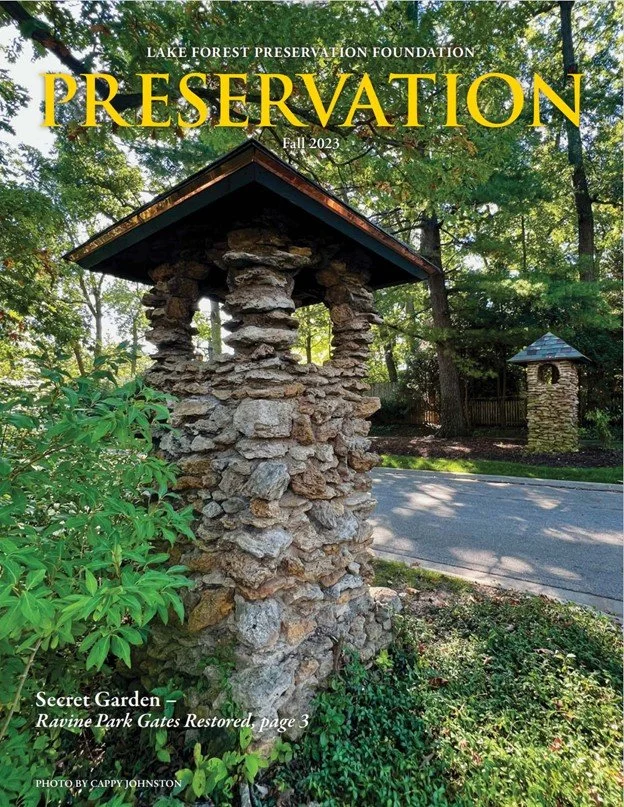
Secret Garden –
Ravine Park Gates Restored, page 3
Secret Garden –
Ravine Park Gates Restored, page 3
PHOTO BY CAPPY JOHNSTON
PHOTO BY CAPPY JOHNSTON
from the president
Brian Norton
As set forth in greater detail below, a few weeks ago, the Lake Forest Preservation Foundation hosted Steven Semes, the Director of Preservation, Resilience, and Sustainability at the University of Notre Dame’s School of Architecture and an internationally renowned historic preservation author, architect, and speaker. His topic—achieving sensitive development in historic districts—could hardly be more timely for Lake Forest and future development of its Central Business District. And, after spending a day revisiting our community, Professor Semes offered this simple and sage advice: “Build More of Lake Forest.”
Lake Forest is blessed with a rich architectural heritage. The Central Business District alone boasts iconic structures by Howard Van Doren Shaw, David Adler, Stanley Anderson, Frost & Granger, William Mann, and, more recently, Peregrine Bryant, among others. While designed by many architects at different times, these treasured buildings collectively form a unique, intimate and cohesive space.
Maya Angelou famously observed that “people will forget what you said, people will forget what you did, but people will never forget how you made them feel.” The same can be said of spaces; we remember how they made us feel.
Indeed, when asked about Lake Forest’s Central Business District, Professor Semes responded that it “feels” like an old friend, who warmly invites you in and encourages you to explore and “turn
the next corner.” It is hard to imagine a
more genuine compliment of the Central Business District.
This is the “more of Lake Forest” that the Preservation Foundation believes should be built. We as a community should settle for no less than requiring any new construction in the Central Business District to be visually compatible with the heritage structures that make the Central Business District so unique, intimate and inviting. Anything less will diminish the historic visual character and feel of the Central Business District.
Building more of Lake Forest starts with all of us. Your contributions to the Lake Forest Preservation Foundation enable us to bring in speakers like Professor Semes and continue to advocate for responsible development that is consistent with Lake Forest’s rich architectural heritage. We thank you in advance for your consideration and continued support.
Brian Norton, President
O
OOur Annual Fund Needs Your Support
ur mission is to preserve the unique visual character of Lake Forest. We’ve
had major achievements this past year.
One notable success is the publication of Lake Forest: A Guide to the National Register of Historic District and Properties in Lake Forest, Illinois.
We have just completed this year’s
brick-and-mortar restoration project of tuckpointing and restoring the gateposts at Ravine Park Drive and Sheridan Road. As with so many gateposts in Lake Forest, the Ravine Park posts form the visual entrance to the 1920s subdivision. With the city’s participation along with private partnerships and with your help, the Foundation has restored them.
Our advocacy programs this year will be extended to educate and support Lake Forest residents as we did when Steven Semes, preservation author and Professor of Architecture at the University of Notre Dame, spoke to us in September. His insights on the value of sensitive development in Lake Forest have only strengthened our resolve to protect our beloved community.
Market Square north tower
In the coming year, our primary focus will be on promoting the importance of preserving the historic character of the Central Business District (CBD).
We hope that you will contribute to our 2023 Annual Fund as we thank you for
your interest, generous contributions, and stalwart stewardship in supporting our unique community.
Please feel free to use our enclosed envelope or donate online at www.lfpf.org
/donate. Thank you for supporting us.
Secret Garden: Ravine Park Gates Restored
Ravine Park Drive Gates, 1920s, Restored, 2023 (Featured on cover)
FFoundation member David Mattoon noticed last year that the top of one of
F
F
the gate structures at Ravine Park Drive, had collapsed. A large limb from an oak tree had fallen and destroyed the roof and stone work. Mattoon notified the Foundation. VP Jim Opsitnik investigated and contacted the City.
The City of Lake Forest and the Preservation Foundation partnered to provide funding for the reconstruction. The asphalt roof of the matching gate was seriously deteriorated from time and weather and also needed to be replaced.
The stone and masonry work was donated by Brugioni Construction of Lake Bluff, and the new roof construction and slate finishing was contracted out. The work, overseen by Opsitnik, was completed in September of 2023. Small as the project was, it required careful planning and decisions on materials, settling then on a more permanent slate roof, followed by intricate execution.
The handsome almost century old gates marked the east entry to the 1920s
Ravine Park subdivision, with which few Lake Forest residents may be familiar. It is located northeast of the Lake Forest High School, south of Lake Bluff, and a half block west of Sheridan Rd., with access from Spruce and Edgewood. The development was planned for about sixty-five houses on smaller suburban lots—a traditional neighborhood, as it came to be recognized. It was not far from McKinley Rd., a few blocks, with access at Noble Ave. then to the North Shore Line. This was the still memorable interurban light rail service, 1899–1955, parallel to the Metra North Line today, with six stops in Lake Forest at the time.
The plan for the Ravine Park subdivision was completed in 1924. At the time, Evanston was enjoying a building boom of apartment houses and hotels, impinging on neighborhoods of single-family residences. The developer, Ernest Mayer, urged Evanstonians to move into his Ravine Park in Lake Forest, through a full page ad by the North Side Realty Co., in the Evanston News-Index for April 20, 1925. Today, houses reflect waves of building, from the late 1920s through the 1960s. The accident that damaged the top of
Tony Stasieluk and a co-worker are shown carefully deconstructing a derelict Ravine Park pier this year. The restored state of the two 1920s piers appears on the front cover.
a pier has led to a restoration of a classic Lake Forest amenity and recognition of a fine neighborhood of houses, part of the historic local residential fabric. This is a great example of a public/private partnership in our community.
Rehabilitation Work Completed on Dome of Historic Lake Forest Library
L
Lake Forest Library, celebrating the 125th anniversary of its founding this
year, is a semi-autonomous City body with its own board. The Library recently completed the rehabilitation of its dome, the central exterior feature of architect Edwin Hill Clark’s award-winning 1931 design. The project was carried out by Marshall Roofing and Sheet Metal Inc., which completed similar repair work on the dome of Chicago’s 1893 Museum of Science and Industry.
This project followed an extensive 2022 engineering study, by the well-known firm of Wiss, Janney, Elstner, Associates
damaged murals is now possible. Funds raised at the Library’s 125th anniversary event on November 3rd
will be dedicated to this restoration.
Clark’s 1931 Lake Forest Library is one of the most significant classic buildings in the Chicago region, certainly on the
Lake Forest Library with newly restored dome
Inc., commissioned by the Library board to determine how to prevent dome leaks or moisture buildup. This mid 2010s issue had imperiled the rotunda and its 1931 murals of ancient authors by Russian emigre artist Nicolai Remisoff. This 2023 project replaced the dome’s temporary coverings that had been in place for several years. Conservation work on the
North Shore. It won the 1931 Architects Club Craftsmanship Award, featured in the 1939 Illinois Guide WPA comprehensive state survey. This building was augmented in 1978 by three wings given by Helen Reed’s son, John Shedd Reed, and designed by architects Brenner Danforth of Chicago in a self-effacing modernist style, originally with new landscaping
designed by Franz Lipp. The Preservation Foundation looks forward to supporting the Library and its programs as they turn to address pressing updating of program needs in a manner compatible in scale and style with the stellar existing facility.
To view the Library’s Dome Roof Replacement Project video https://player
.vimeo.com/video/861329688
The Value of Sensitive Development in the Central Business District
T
The Lake Forest Preservation Foundation hosted Steven Semes to a packed
house on Sunday September 17th for a discussion on Sensitive Development in Historic Lake Forest.
Professor Semes focuses on promoting
harmonious new development in historic settings that allow for change and growth without sacrificing historic character.
Semes prefers to use the term “Heritage Conservation” to describe today’s historic preservation efforts which aim to maintain the unique character of an area or place as a whole.
Semes praised Lake Forest for “being among a small number of towns in the US gifted with a distinctive local identity, history, and character expressed through architecture and urban form.” He discussed the merits of our Historic Preservation Ordinance and how it focuses correctly on visual qualities in evaluating new projects, by asking whether such a project is “visually compatible with structures to which it visually relates,” as opposed to abstract concepts.
Semes’s presentation discussed improper examples of compatible new construction around the world and the history of historic preservation in this country. He reviewed the history of preservation practices and debates before discussing the specifics of how Lake Forest should manage new growth.
The first recommendation Semes made regarding new construction in historic districts is “only build what you want to see more of . . . we want more of Lake Forest.” A forward-looking aspect of preservation regulation is not only about
The Future of the Past, Steven Semes
preserving the past but also shaping the future of a place. Well-designed new buildings can inspire others to copy the design and continue the historic character.
Semes said here in Lake Forest we have an inheritance of visual character that must be treasured, but we also have the tools to ensure its future with our Historic Preservation Ordinance. Today, historic preservation has become more holistic and comprehensive about conservation. We are no longer talking about individual buildings, but about the buildings, landscape, streets, blocks, squares, trees, flowers, ravines. All of this goes into what the United Nations
describes as our “Urban Landscape” that must be preserved in order to conserve our community heritage and visual character. Semes said historic preservation of community is a quality of life issue and quoted Pope Francis who said the care for our home, which includes our own homes and the earth, promotes the quality of life for everyone. Put simply, we should build places where people want to live.
In closing the presentation, Semes was asked what are the “good and the bad” he saw in his tour of Lake Forest. “Nothing makes it bad” was his first reaction. His noted positives include the intimate scale of the downtown buildings—two to three stories create a “village-like feel”; the width of the sidewalks, planting beds, and streets that encourage pedestrians to linger; the small volume of manageable traffic; streets which are pedestrian scaled, not wide;
“an intimacy in architecture” which is not large or oppressive but draws you to want to see more; architecture that’s “like a
Lake Forest Bank & Trust – 1998 compatible addition by Peregrine Bryant
Fountain in Market Square
friend and makes you feel at home”; beautiful building materials with architectural elements like bay windows, dormers, and gabled roofs.
Semes suggested that Lake Forest consider creating a document “Building with Lake Forest in Mind” modeled after Nantucket’s similarly-titled building guide. He believes it would be a valuable exercise for the community to document all the unique building elements that define Lake Forest. This would be the first in a two-step process towards developing a Form Based Zoning Code. First determine what you have in your historic districts that is unique and valuable. Second,
make decisions about what you build in the future that respect and continue this building legacy.
Semes also suggested that the best process for making these decisions is for Lake Forest to initiate a charette. A charette involves gathering all stakeholders (the city, neighbors, developers, landscapers, health people) or whoever has an interest in a project, around a table to decide how an area is going to move forward. Ask people from the beginning, “What are you looking for?” With goodwill, a civic sense of belonging, and a sense of wanting to be at home in a place, the group usually can meet the needs of all the stakeholders around the table while still protecting
the town.
Semes ended his lecture with the assurance that Lake Forest is one of the least troubling historic towns he has seen due to the work of our public and private historic preservation organizations and ordinances. He looks forward to visiting again in the future.
Downtown Architectural Resources to Protect:
I
ITwo Recently Published Resources
Arthur Miller, Marcy Kerr, and Jim Opsitnik
Arthur Miller, Marcy Kerr, and Jim Opsitnikn publications and projects undertaken in 2022 and 2023, the nearly half century old Preservation Foundation highlighted the key architectural resources to protect in Lake Forest’s Central Business District, including and mostly north of the Deer Path Inn. The first project resulted
in the 2022 publication of Architectural Lake Forest, its first chapter in part highlighting the most significant of the CBD buildings. The second project saw the 2023 production of eighteen brass plaques that recognize downtown historic architectural landmark buildings that should be protected and preserved. The visual sight lines around these buildings also require safeguarding.
In the summer issue of this LFPF newsletter, distributed to all 8,000 Lake Forest households, there was a removable graphic map-like two page illustration by local artist Mark McMahon showing each of these landmarks. That issue (and all previous editions) of Preservation is
available digitally on the Foundation’s website, under Explore/Publications. The plaques went up in the spring
Illustration by Mark McMahon
Brass plaque recognizing the Young Men’s Club
of 2023 and were rolled out at the “Tour de Plaques” event in May. The summer newsletter with the map followed soon after, a self-conducted tour. Between the 2022 guidebook and the 2023 plaques and map, this organization with its expertise in architecture, city planning, history, and
heritage conservation, laid out for the City Council, the Plan Commission, and City staff what the LFPF urges them to protect, along with residents’ and visitors’ ability
to see, unimpeded, these as anchors to our historic visual character.
At the May 2023 Traditional Building Conference at the Deer Path Inn, well respected local designer Mark Knauer discussed his approach to revitalization of that almost century old hotel. He first hired an expert to tell him what aspects of the building to protect. Then he hired
another expert to tell him what needed to be upgraded. He then put these together and produced his own plan to breathe new life into the landmark. By 2016 the project was completed, a success of national interest and significance. These projects by the Foundation, in effect, provide the first of these two steps by Mark Knauer for the CBD, what to protect.
Now, as the leaves are falling from the deciduous trees in places like Market
Square and Lake Forest Library, as well as all over the city, residents can see best and appreciate the uncommon architectural achievements here. These survive from the 1890s through the 1960s, typically designed by nationally known and valued architects. This is a great time to purchase a copy of the year-old in November Architectural Lake Forest, at the LFPF office, Lake Forest Bookstore, and a few upcoming holiday markets. The deceptively glovebox-sized
$25 volume contains over 240 sites around town, buildings and landscapes, a guide to local styles, and references to other modern books on key buildings and landscapes.
What should we protect and save? It’s no mystery. Rather it is provided by the Foundation’s expertise extending back through decades, more than on any City board or commission today. Is the Foundation on the right track for upgrading Lake Forest’s downtown? Professor Steve Semes recently told us how to do this: Just build more Lake Forest. Don’t try to be something else or allow others to sell us on something else, in effect.
Matted and frame-ready signed versions of Mark McMahon’s downtown plaque landmarks map also are available at the LFPF office in Gorton, 847-234-1230 or [email protected].
Development in the Central Business District – Keep It on Your Radar
T
The City Council recently approved the Central Business District Chapter
of the Comprehensive Land Use Plan for the City of Lake Forest. What does this mean to preservationists and all residents? For nearly a year, the Plan Commission, city staff, and an ad hoc working group chaired by current mayor Randy Tack and including two LFPF board members met to discuss the forward looking needs of our downtown (the CBD) and to suggest priorities for enhancement, redevelopment, and most important preservation.
Several of the chapter’s conclusions are obvious, others less so. In general, the chapter incorporates the overwhelming public sentiment that the historic visual character of the CBD is a defining element of our community that must be preserved. However, there are some gaps and areas of concern.
First, the chapter seems to draw too sharp a distinction between the “core” (that portion of the CBD bounded by Deerpath, McKinley Rd., Westminster, and Forest Ave. ), and the “inner ring” (the remainder of the CBD), suggesting that, while the former must be preserved, the latter may be subject to less exacting standards. As many have noted, the problem
is that if the historic character of the inner ring is not preserved and restored as part of any development, the core itself will not be preserved. Consider the City parking lots in the Inner Ring right across Forest Ave. from the core. Developing these lots with buildings that are unsympathetic to the historic character of the core, just 30 feet away, would not preserve and enhance the character of the core.
Second, while much of the CBD is part of the East Lake Forest Historic District and, as a result, subject to protection under the Lake Forest Historic Preservation Ordinance, other areas like the Bank Lane corridor between Deerpath
and the Deer Path Inn, is not. The chapter proposes to protect these areas through the adoption of “development parameters.” While in principle this might work, the chapter is vague on the details of how acceptable and binding parameters would be developed and implemented.
Third, the chapter points out that retail can no longer be relied on to support the CBD so, a “mix of uses” must be considered. What might be an appropriate “mix of uses” to sustain the vitality of the CBD in the long run while preserving and enhancing our architecturally significant buildings and spaces? How would adaptive re-use or outright new development in the “core” and the “inner ring” affect neighbors of the CBD? There are adjacent neighborhoods which don’t have the protection of the existing East Lake Forest Historic District boundaries. Would expanding those boundaries, for example, safeguard neighbors from incompatible development?
In sum, we encourage all members and residents to remain engaged in this process to ensure that any new development in the CBD will be visually compatible with the heritage structures within that district.
A
ASix-Month Trial of Southbound Only Traffic, Bank Lane, Deerpath to Illinois
t the September 18th City Council meeting, the Council approved a
six month trial-only study of allowing only south bound traffic on Bank Lane between Deerpath and Illinois Rd. (The meeting is viewable on YouTube). The trial was proposed to run November 1 to April 30. Council questions prior to approval perhaps highlighted a possible conflict between (1) traffic through the Central Business District (CBD) moving west to east with (2) destination Illinois Rd. restaurant parking and valet activity. This one-way change to be studied would eliminate, though, the blind corner for north bound traffic on that block turning left onto Deerpath. In the future this could be an issue for any turn for north-
bound traffic on that possibly redeveloped southwestern corner.
The trial is a first step in the CBD follow up to the recently approved comprehensive plan that projects redevelopment
on the 1857 designed street grid in this section of town. Originally, Bank Lane was a narrow alley between Western and Forest Ave., its character elevated in
1915–16 as part of architect Shaw’s Market Square development. Bank Lane was developed south in the 1920s by former Shaw associate Stanley D. Anderson, in part on Anderson Trust land—the 1860 farm deeded to the architect’s grandfather.
There are some gaps and incompatible, outdated structures along Bank Lane from Illinois Rd. north to Wisconsin Ave., about five blocks, and this test will help to shed light on the practicality and extent
of redevelopment along this now valuable and useful corridor. In total, Bank Lane runs from the Deer Path Inn, through Market Square, by the Post Office, and on to both the Home Town Coffee & Juice and Lake Forest Bank drive-through at Bank Lane and Wisconsin. North
of Deerpath traffic is one-way north to
Southgate, one way south to Northgate, and then one-way north again up to Wisconsin. How much vehicular traffic is practical across this Old World scaled main artery paralleling a block west Western Avenue with its problematic Deerpath and Western Ave. railroad crossing intersection? As a first step in preparing
to upgrade this block, this six-month trial and its results will be crucial for the future of the CBD.
Programs
Upcoming events
June: Garden Stroll
August: Garden Stroll
The LFPF had another wonderful summer season of programs in Lake
Forest for its members and their guests. Seeing the importance and special nature of these programs, nearly all were sold out in advance. We thank everyone for the great turnout showing the deep roots of preservation and interest in these functions in our community.
In June we welcomed in the summer at the spectacular property of Diana and David Moore. One of Howard Van Doren Shaw’s earliest lakefront homes, Little Orchard sitting atop the bluff on a perfect summer afternoon was bursting with color and contrast from the formal walled garden to whimsical planted beds and natural paths.
July brought us to Lake Bluff and our annual Summer Tour of the collections and buildings at Crab Tree Farm. A capacity crowd was shown some of the best items in the Arts & Crafts design period. Attendees saw first-hand the preservation work being done onsite on our tour day, of the original 1912 red concrete roof tiles
July: Crab Tree Farm
September: Steven Semes
further preserving these historic buildings. Our final garden stroll of the season on August 25th was another enchanting night
at the home of Julie and Dan Loeger. The weather and our hosts’ hospitality could not have been more perfect. Seeing one of the few built remnants of the Walden estate, a large red brick garden wall,
showed the dedication to preservation the homeowners had in restoring and keeping this gem well maintained.
The Value of Sensitive Development in Lake Forest was the lecture in early September by Steven Semes. Highlighted in this issue, Professor Semes reflected on the need for harmony with new development in historic settings. If you missed this presentation, visit our website, LFPF.org
/videos or YouTube channel to view this informative talk as it relates to our community.
Arthur Miller provided insight and information on sculptor and author Sylvia Shaw Judson and her Ragdale home on October 16th at a lecture at Lake Forest Place.
November 9: Scott Powell on Frances Adler Elkins
December 3: Members Holiday Party
Tradition Meets Modernity: The Chicago-Area Interiors of Frances Adler Elkins Thursday November 9th at 7:00 p.m.
Presented with the LFLB History Center, author Scott Powell discusses his new book on designer Frances Elkins, sister of David Adler and mid-century taste-maker, highlighting her works both in the Lake Forest area and beyond. This program is sold out but will be available for viewing at lfpf.org/videos after the event.
Members Holiday Party, Sunday December 3rd, 2:00–4:00 p.m. Celebrate the season with members and friends at this beautiful historic property. Make sure to reserve early as this event always sells out.
For events updates and to make reservations, visit LFPF.org/events.
For Preservation news you need to know, visit our InfoHub at LFPF.org/infohub-blog
NON-PROFIT ORG
U.S. POSTAGE
PAID PERMIT NO. 184 LAKE FOREST, IL
60045
NON-PROFIT ORG
U.S. POSTAGE
PAID PERMIT NO. 184 LAKE FOREST, IL
60045Lake Forest Preservation Foundation 400 East Illinois Road, Lake Forest, Illinois 60045 www.lfpf.org
ECRWSS
Residential Customer Lake Forest, IL 60045
Celebrating a Supporter of Preservation, Conservation and Sensible Development:
I
IJanet Gibson
n our community, Jan Gibson is a shining example of someone deeply passionate about architecture and dedicated to preserving the visual character and heritage of our historic town.
With a diverse background in education, entrepreneurship, travel and a love of opera, Jan brings a unique perspective to preservation. She is on a lifelong learning journey, currently pursuing a Master’s degree in Design Studies in Historic Preservation at Boston Architectural College, and will write her thesis in 2024.
Jan’s intellectual pursuits have led to several notable papers, offering invaluable insights into architectural and land development topics relevant to Lake Forest and the surrounding areas. Through meticu-
2023–2024
BOARD OF DIRECTORS
EXECUTIVE COMMITTEE
Brian Norton
President
Laura V. Luce VP Advocacy Tim Knight
Arthur H. Miller
VP Communications
Jan Gibson Trey Gonzales VP Development
Tom Gleason Jim Opsitnik VP Programs
Michelle Curry
Secretary
Patti Poth
Treasurer
Susan Athenson
Immediate Past-President
DIRECTORS
Stephen Bedrin Raymond Buschmann John Diefenbach Craig Fox
Perry Georgopoulos John Julian
Henry Kleeman Peter O’Malley Karla Schwartz Nadine Shepard Jason Smith James Shearron Gina Zisook
HONORARY DIRECTORS
Pauline Mohr Shirley Paddock Linda Shields
EXECUTIVE DIRECTOR
Marcy Kerr
The Lake Forest Preservation Foundation is a tax-exempt nonprofit 501(c)3 organization. You may donate directly to us at LFPF.org.
PRESERVATION
FALL 2023
VOLUME 18, NUMBER 3
contributors: Susie Athenson, Michelle Curry, Jan Gibson,
Tom Gleason, Marcy Kerr, Laura Luce, Arthur Miller, Pauline Mohr, Brian Norton, Patti Poth
editors: Tim Knight and Arthur Miller
design: Robson Design, Inc.
photography: Cappy Johnston, Marcus Norman, Jim Opsitnik
2023–2024
BOARD OF DIRECTORS
EXECUTIVE COMMITTEE
Brian Norton
President
Laura V. Luce VP Advocacy Tim Knight
Arthur H. Miller
VP Communications
Jan Gibson Trey Gonzales VP Development
Tom Gleason Jim Opsitnik VP Programs
Michelle Curry
Secretary
Patti Poth
Treasurer
Susan Athenson
Immediate Past-President
DIRECTORS
Stephen Bedrin Raymond Buschmann John Diefenbach Craig Fox
Perry Georgopoulos John Julian
Henry Kleeman Peter O’Malley Karla Schwartz Nadine Shepard Jason Smith James Shearron Gina Zisook
HONORARY DIRECTORS
Pauline Mohr Shirley Paddock Linda Shields
EXECUTIVE DIRECTOR
Marcy Kerr
The Lake Forest Preservation Foundation is a tax-exempt nonprofit 501(c)3 organization. You may donate directly to us at LFPF.org.
PRESERVATION
FALL 2023
VOLUME 18, NUMBER 3
contributors: Susie Athenson, Michelle Curry, Jan Gibson,
Tom Gleason, Marcy Kerr, Laura Luce, Arthur Miller, Pauline Mohr, Brian Norton, Patti Poth
editors: Tim Knight and Arthur Miller
design: Robson Design, Inc.
photography: Cappy Johnston, Marcus Norman, Jim Opsitniklous research, she illuminates aspects of our local heritage that might have gone unnoticed and proposes how best to preserve and develop them.
Beyond academics, Jan played a pivotal role in safeguarding our community’s architectural treasures and historic character as a member of the City of Lake Forest’s Historic Preservation Commission. Jan believes Lake Forest has the most beautiful Central Business District in the
country and is dedicated to ensuring future development upholds its tradition of fine architecture and quality construction.
8
8Currently, she is a member of both the Friends of the Library Board and the Lake
Jan Gibson (L ) receiving Historic Preservation Commission award from Chair Maureen Grinnell (R )
Forest Preservation Foundation Board. Jan is committed to preserving not only physical structures but also nurturing our community’s intellectual and cultural heritage. As the Grant committee chair, she is leading efforts to identify, catalogue,
appraise, restore, and exhibit extraordinary art pieces within the Lake Forest Library.
Jan’s passion and dedication ensures that future generations can revel in the beauty of Lake Forest’s architectural legacy.