9/1/2021 Statement to the City Council Regarding Phase 3 of the McKinley Road Project:
The mission statement of the Lake Forest Preservation Foundation (“LFPF”) is to protect the historic visual character of Lake Forest. The Board of Directors of LFPF submit this statement in response to the appeal of 361 Westminster LLC from the 6-1 Decision of the Historic Preservation Commission (“HPC”) on July 11th, 2021, denying its request for a Certificate of Appropriateness in connection with Phase 3 of the McKinley Rd. Development. LFPF hopes that the Lake Forest City Council will consider the following comments – as well as a previously accepted alternative – in connection with that appeal in an effort to maintain and enrich our community through conscientious development.
The Proposed Construction Is Not Visually Compatible With the Surrounding Homes
Members of the Board of Directors of the Lake Forest Preservation Foundation have reviewed the petitions submitted to the HPC and the appeal and agree with the HPC’s conclusion that the proposed Phase 3 condominium does not comply with Lake Forest City Code Chapter 155.08, which incorporates the Standards for Review of Application for Certificates of Appropriateness. Principally, as explained below, it does not comply with Standards 1 (Height), 8 (Roof shapes), 10 (Scale and Mass), and 14 (Style Compatibility). In addition, LFPF believes that the proposed condominium does not comply with Standards 2-6, 8, 9 and 11. While these Standards deal with different features of any new construction, each, like Standards 1, 8 and 10, requires that those features “shall be visually compatible” with the properties, structures, sites, public ways, objects or places to which the proposed construction is “visually related.”
And therein lies the fundamental problem with the proposed construction. LFPF finds that it does not meet many of these standards due to its visual incompatibility to the neighboring single family, homes that surround it. While the address of the new construction is 715 McKinley Rd., it fronts and is most visible from Westminster Ave., which is one of the two main corridors to the East Lake Forest Historic District and Forest Park Beach. It is lined with some of that District’s most historically and architecturally significant homes and structures. By any objective standard, as demonstrated below, the proposed construction simply does not visually relate to any of the surrounding homes within the East Lake Forest Historic District.
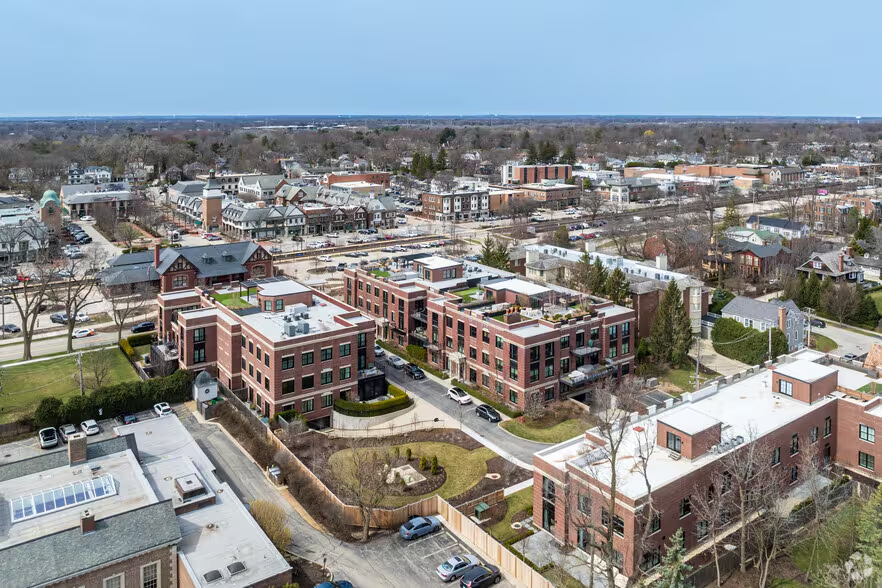
To satisfy these Standards, 361 Westminster LLC took a different approach. It presents Phase 3 as a bridge or transition between the first two phases of the McKinley Rd. Development and the adjoining single family homes in the East Lake Forest Historic District. It does so, in their view, by visually relating the new construction to those earlier condominium phases – not the single family homes that surround it – but reducing the scale by just one floor to better physically relate to those homes.
LFPF does not believe this approach is consistent with the purposes and terms of Lake Forest’s Historic Preservation ordinance for three basic reasons:
1. The first two phases of the McKinley Rd. Condominium Development are not within the East Lake Forest Historic District and were not subject to the Standards for Review of Application for Certificates of Appropriateness required by Chapter 155.08. To have new construction – that is within the East Lake Forest Historic District – visually relate and pay homage to structures outside the District that are not historically significant or consistent with the character of that District is at odds with the purposes of the Historic Preservation ordinance. Those purposes include “[s]afeguarding the city’s historic and cultural heritage, as embodied and reflected in such areas, properties, structures, sites and objects determined eligible for designation by ordinance as landmarks and historic districts.” Chapter 155.01(B). Permitting this sort of visual and architectural creep from the outside in could undermine historic districts throughout the City. Indeed, it appears that the western border of the East Lake Forest Historic District was drawn carefully to include the subject property in order to protect and insulate the neighboring homes from development along McKinley Rd.
2. The predominant view of the new construction is from Westminster Ave. From that perspective, the site is visually related to the single family homes that surround it, not the first two phases of the development. There are beautiful historic single family homes directly to the east, nearby to the west and across the street to the north. The first two phases of the McKinley Rd. Development Project are behind and to the west of the proposed construction and do not abut Westminster. From that proper perspective, those four-story condominiums do not visually relate to the proposed site within the East Lake Forest Historic District.
3. There is already a “bridge” that transitions the condominiums on McKinley from the single family homes on Westminster. It begins with the 2½ story, single family home at 351 Westminster directly to the west of the proposed site. That house resets the tempo of the Westminster streetscape to a single family residential setting, which continues to the lake. The proposed construction, which is directly to the east of that home, instead of providing a transition interrupts the streetscape by reintroducing condominiums and visually drawing the first two phases of the McKinley Rd. Development onto Westminster.
The Proposed Construction Does Not Comply with the Required Standards
Against this backdrop, the proposed construction is not visually compatible in many regards with the single-family homes to which it is visually related. See Standards 2-5, 9 and 11. Put simply, it looks like it is – a modern condominium building dropped in the midst of single family homes in a historic district. More specifically, the proposed construction does not comply with the following Standards for Review of Application for Certificates of Appropriateness:
Height (Standard 1) and Roof Shape (Standard 8):
The height of the proposed building is not visually compatible with properties, structures, and sites, public ways, objects, and places to which it is visually related on Westminster.
The appellant specifies the proposed building will be two stories in height. However, with the addition of outdoor living space and a 12-foot tall, screened porch on the roof, the building will be three stories high, which is incompatible with the 2 and 2 ½ story single family homes to the east, west, and north.
As indicated, the transition from a 3-story condo building to the residential homes to the east begins with the 2½ story, single family home at 351 Westminster. If the proposed condo building has roof top living space, it will disrupt this transition down to the residential homes.
In addition, the flat roof of the proposed structure is not visually compatible with the single family homes on Westminster. They are all pitched roof constriction which makes the proposed construction visually stand-out and interrupts the streetscape.
Finally, contrary to Appellant’s position, this is not an objection to the use of the property, but to the height and roof shape relative to the structures to which it is visually related. Both of these Standards are within the purview of the Historic Preservation Commission and are not satisfied.
Scale and Mass (Standard 10):
The size and mass of the proposed building in relation to the adjacent homes on Westminster is visually incompatible with the properties to which it is visually related.
This is a solid, massive, rectangular brick building that will dominate the smaller, lighter, more traditionally detailed residential homes on the block. It will be visually incompatible next to the historic, single family homes and disrupt the residential streetscape and character of the historic Westminster neighborhood. If a home was proposed on this lot, it could be no more than 5,000 square feet. At 21,000 square feet, this building will dominate the block.
Style (Standard 14):
As indicated, this building will be on Westminster, not McKinley Road, and should relate visually to the single family, historic homes on Westminster. The proposed style relates to the two condo buildings on McKinley, but it is incompatible with the residential streetscape and character of Westminster.
The proposed style should be refined to include more compatible, delicate, and traditional residential features of the surrounding homes such as clapboard, stucco, pitched roofs, porches, detailing, double hung windows, etc.
A good example of a condo development that attempts to relate in style to its next-door residential neighborhood, is this developers own Regency Row, with its 2½ story, hipped roof townhomes backing up to the residential neighborhood of Atteridge Road.
Alternative
While the structure as proposed does not meet the required Standards for a Certificate of Appropriateness for the reasons set forth above, there is an alternative. Appellant can build a single family home on the portion of the lot facing Westminster that is visually compatible with the surrounding homes and otherwise complies with the applicable Standards and build the condominium behind it, provided it responds to the objections on height, roof design, and scale and mass noted above. That house could be moved forward consistent with the line of other homes on that side of Westminster, leaving adequate room for construction behind.
It should be noted that this alternative, in addition to solving a significant objection to the proposed construction, is consistent with the 2016 Master Plan for this development approved by the Plan Commission in 2017. That plan – which was drafted following input from the neighbors and the community – showed a 10,000 SF single family home/duplex on the portion of the site facing Westminster. Assuming the other Standards are met, this would reduce the appearance of scale and mass and be visually compatible with the surrounding homes.
Conclusion
The City of Lake Forest has been on the national forefront of developing ordinances to protect our community’s historic character, and to ensure new infill is compatible with existing neighborhoods. The Historic Preservation Commission, the Building Review Board, and the Plan Commission have spent decades reviewing petitioners’ building plans, considering the concerns of surrounding neighbors, and asking many families to compromise their home plans to meet our Historic Preservation standards.
Overturning the HPC decision on this property, which is fundamentally grounded in criteria included in our preservation ordinance, will have profound negative implications for the future growth and development of our City. By overturning this HPC denial – the second HPC denial of this proposed project – the City Council could nullify and weaken our nationally recognized Historic Preservation ordinance. Once a precedent is set, any future developer will have grounds to overturn any future HPC decisions.
We respectfully ask that City Council hold the appellant to the same standards that thousands of homeowners have been held to, by (1) adhering to our City ordinances and process, and (2) addressing the neighbors and community concerns. This proposed new construction must meet the Historic Preservation ordinance standards and be “visually compatible with properties, structures, sites, public ways, objects, and places to which it is visually related.”
For these reasons, we ask that you deny the appeal and uphold the 6-1 Decision of the HPC denying the Certificate of Appropriateness.