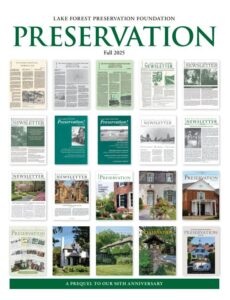
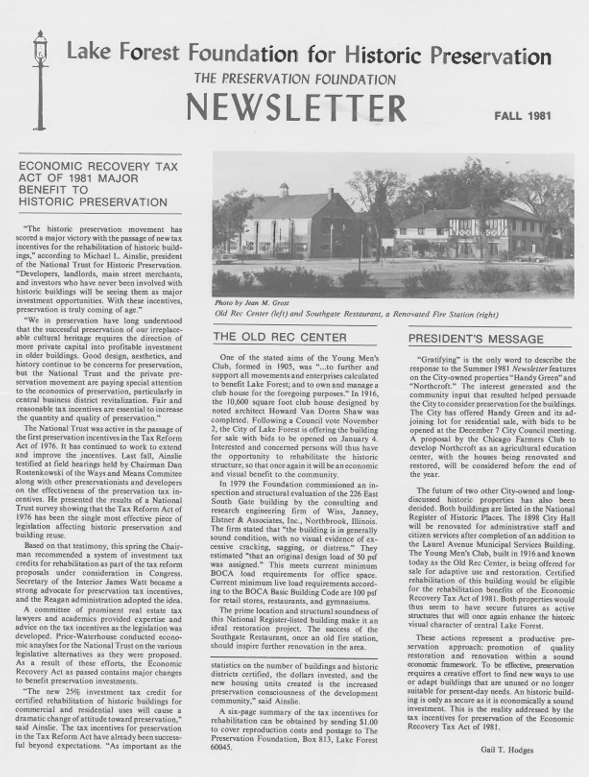
NEWSLETTER FALL 1981 opens with the headline ECONOMIC RECOVERY TAX ACT OF 1981 MAJOR BENEFIT TO HISTORIC PRESERVATION, quoting Michael L. Ainslie, president of the National Trust for Historic Preservation, that the preservation movement scored a major victory with new tax incentives for rehabilitation of historic buildings and that developers, landlords, main street merchants, and investors will see historic buildings as major investment opportunities so preservation is “coming of age,” and it explains that preservation success requires directing more private capital into profitable investment in older buildings, that the National Trust helped pass the first preservation incentives in the Tax Reform Act of 1976 and continued to extend and improve them, that Ainslie testified at field hearings held by Chairman Dan Rostenkowski about the effectiveness of the incentives and cited a National Trust survey showing the 1976 Act was the single most effective legislation for historic preservation and building reuse, and it notes that Secretary of the Interior James Watt became an advocate and the Reagan administration adopted the idea, that real estate tax experts advised as legislation was developed, and Price-Waterhouse conducted economic analyses for the National Trust, resulting in the Economic Recovery Act containing major changes benefiting preservation investments, including a new 25% investment tax credit for certified rehabilitation of historic buildings for commercial and residential uses that Ainslie said would dramatically change attitudes toward preservation, and it offers that a six-page summary of the rehabilitation tax incentives can be obtained by sending $1.00 to The Preservation Foundation, Box 813, Lake Forest 60045, then THE OLD REC CENTER section provides the historic context of the Young Men’s Club formed in 1905 with the aim to benefit Lake Forest and own and manage a clubhouse, noting that in 1916 a 10,600 square foot clubhouse designed by Howard Van Doren Shaw was completed, and that following a Council vote on November 2 the City of Lake Forest is offering the building for sale with bids to be opened January 4, presenting this as an opportunity for interested parties to rehabilitate the historic structure so it again becomes an economic and visual benefit to the community, and it references a 1979 inspection and structural evaluation commissioned by the Foundation for 226 East South Gate by Wiss, Janney, Elstner & Associates in Northbrook stating the building is generally sound with no visual evidence of excessive cracking, sagging, or distress, estimating an original design load of 50 psf meeting minimum BOCA load requirements for office space but noting current minimum live load requirements are 100 psf for retail stores, restaurants, and gymnasiums, and it argues that the prime location and National Register status make it an ideal restoration project, suggesting the success of the Southgate Restaurant, a renovated fire station, should inspire further renovation, with photos credited to Jean M. Grost showing Old Rec Center and Southgate Restaurant, then PRESIDENT’S MESSAGE by Gail T. Hodges calls the community response to the Summer 1981 newsletter features on City-owned properties “Handy Green” and “Northcraft” gratifying and says the interest and input helped persuade the City to consider preservation, reporting that the City offered Handy Green and its adjoining lot for residential sale with bids to be opened at the December 7 City Council meeting, and that a proposal by the Chicago Farmers Club to develop Northcraft as an agricultural education center with the houses renovated and restored would be considered before year-end, and it adds that the futures of two other City-owned historic properties listed on the National Register have been decided: the 1898 City Hall will be renovated for administrative staff and citizen services after completion of an addition to the Laurel Avenue Municipal Services Building, and the Young Men’s Club / Old Rec Center is being offered for sale for adaptive use and restoration, noting that certified rehabilitation of the Old Rec Center would be eligible for the rehabilitation benefits of the Economic Recovery Tax Act of 1981, and the message frames these actions as a productive preservation approach that promotes quality restoration within a sound economic framework, emphasizing that preservation requires creative adaptive reuse because a historic building is only as secure as its economic soundness, and it ties that reality to the new tax incentives, then AMENITIES ENHANCE CITY’S CHARACTER defines amenities as attractive or desirable features of a place and explains that beyond Lake Forest’s natural amenities such as the shoreline, ravines, and trees, the city has decorative features that contribute to its special character, pointing out that preservation should also include gateposts, bridges, sundials, walls, fountains, and statuary that help set buildings apart, and it includes a QUIZ asking readers to recognize seven amenities located in the Lake Forest central business district with answers on page 3 and photos by Jean M. Grost, then A REQUEST FOR HELP explains that Dr. Paul Sprague, Chairman of the Art History Department of the University of Wisconsin, Milwaukee and an expert on preservation, was commissioned in 1978 by the Foundation to survey Lake Forest buildings and amenities of historic significance and that the survey was donated to the City for the Residential Historic Preservation Ordinance and includes walls, gateposts, and similar features visible from streets plus amenities known from records, but notes many historic structures remained unknown and unrecorded, including amenities moved from historic estates into newer yards or features hidden on vacant properties that could be destroyed by developers, and the Foundation asks residents to help compile a more complete record by lending photographs for duplication to the Foundation at Box 813 or calling 234-1582 to request a volunteer to photograph the feature, with the goal of adding pertinent structures to the survey and the City’s photographic file, then NORTH WESTERN RAILROAD STATION RENOVATION UPDATE announces Save the Date for Sunday, January 17, 1982, “THE WORK OF HOWARD VAN DOREN SHAW,” a benefit for restoration of the North Western Station, and reports that on September 14, 1981 the Lake Forest City Council voted unanimously to approve the concept of the Station Restoration project subject to staff review and approval of parking and traffic circulation, noting that plans had earlier received approval from the Building Review Board and the Public Works and Buildings Committee, and it states that the completed Station Restoration Project will involve approximately $500,000 in funds, materials, and labor so donations of any amount or materials or services are welcome, adding that the Economic Recovery Tax Act of 1981 makes contributions to tax-exempt projects like the Station Restoration more valuable to many taxpayers as a deduction if made before December 31, 1981, then it describes a landscaping plan boost from area garden clubs, stating the plan was developed by Anthony Tymik, Superintendent of the Morton Arboretum, that Woodlands Garden Club contributed 12 trees for the Market Square side of the platform, and that the Garden Art Club of Lake Forest–Lake Bluff and the North Shore Horticultural Society contributed to the general landscaping fund, with other clubs considering the plans, and it invites other groups or individuals interested in contributing to contact Foundation President Gail Hodges at 234-1582 to view the plans, listing plan elements such as plantings for both sides of platforms, a raised garden on the Market Square side, plantings around the main station building, ground covers and additional trees in parking lot dividing islands, and an entry garden at the McKinley Road entrance, then it thanks other community groups noting the Lake Forest Women’s Club contributed toward benches for the restored platform and the Lake Forest–Lake Bluff Newcomers contributed to the general station fund, and it reports tuckpointing will be done in fall to make both station buildings weather-tight by replacing missing, damaged, or mismatched mortar with properly matched new material funded by contributions, and it lists future work still needing contributions including interior and exterior refinishing and repainting of both buildings, replacement of roofs, repair and replacement of gutters, downspouts, and other metal work, reconstruction of hipped roofs on platform shelters, restoration of original brick platforms including installation of period lighting and benches, and renovation and landscaping of the entire station site, followed by a contribution form and statement that the Foundation is a tax-exempt public charity [501(c)(3)], then the QUIZ ANSWERS appear in the text as a numbered list of the seven amenities, and the issue includes a “Preservation Is Progress” membership/volunteer interest section with checkboxes for ways to participate and a membership form listing Sustaining Fund annual dues Member $25/year and Sponsor $100/year and Revolving Fund Patron $1000 and up, with the mailing address P.O. Box 813 (M), Lake Forest, Illinois 60045.
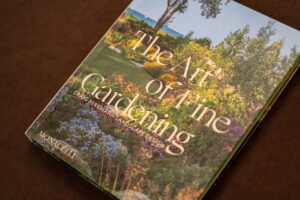
The Art of Fine Gardening: Craig Bergmann Landscape Design
Craig Bergmann and Russell Buvala presented The Art of Fine Gardening, showcasing four decades of landscape design that unites architecture and horticulture. Featuring twenty North Shore gardens—including the historic Gardens at 900—the book blends stunning photography, personal stories, and practical guidance for gardeners and design enthusiasts alike.