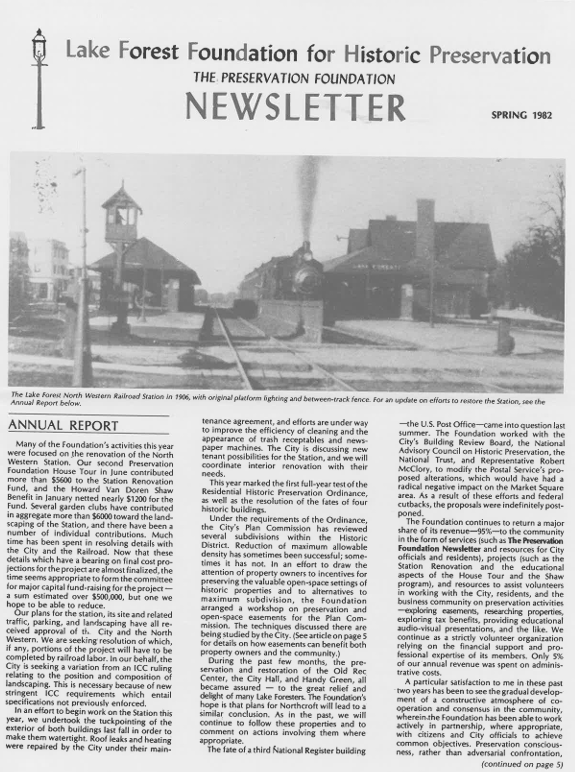
Lake Forest Foundation for Historic Preservation THE PRESERVATION FOUNDATION NEWSLETTER SPRING 1982 opens with a historic photo captioned The Lake Forest North Western Railroad Station in 1906, with original platform lighting and between-track fence, and notes that for an update on efforts to restore the Station readers should see the Annual Report below, then the ANNUAL REPORT explains that many of the Foundation’s activities that year were focused on the renovation of the North Western Station, reporting that the second Preservation Foundation House Tour in June contributed more than $5600 to the Station Renovation Fund and the Howard Van Doren Shaw Benefit in January netted nearly $1200 for the Fund, that several garden clubs contributed in aggregate more than $6000 toward landscaping of the Station along with a number of individual contributions, and that much time was spent resolving details with the City and the Railroad, adding that now that those details affecting final cost projections are almost finalized the time seems appropriate to form the committee for major capital fund-raising for the project with a sum estimated over $500,000 though they hope to reduce it, stating that plans for the station, its site, and related traffic, parking, and landscaping received approval of the City and the North Western, and that they are seeking resolution of which portions if any must be completed by railroad labor while the City in their behalf is seeking a variation from an ICC ruling relating to the position and composition of landscaping because new stringent ICC requirements entail specifications not previously enforced, then noting that to begin work on the Station that year they undertook tuckpointing of the exterior of both buildings the prior fall to make them watertight, that roof leaks and heating were repaired by the City under their maintenance agreement, and that efforts are underway to improve cleaning efficiency and the appearance of trash receptacles and newspaper machines, adding the City is discussing new tenant possibilities for the Station and the Foundation will coordinate interior renovation with tenant needs, then broadening beyond the station to say the year marked the first full-year test of the Residential Historic Preservation Ordinance and the resolution of the fates of four historic buildings, explaining that under the Ordinance the City’s Plan Commission reviewed several subdivisions within the Historic District and that reduction of maximum allowable density has sometimes been successful and sometimes not, and that to draw attention to incentives for preserving valuable open-space settings of historic properties and alternatives to maximum subdivision the Foundation arranged a workshop on preservation and open-space easements for the Plan Commission and those techniques are being studied by the City, referencing an article on page 5 for details on how easements can benefit property owners and the community, then stating that during the past few months preservation and restoration of the Old Rec Center, City Hall, and Handy Green became assured to the relief and delight of many Lake Foresters and that the Foundation hopes plans for Northcroft will lead to a similar conclusion and that as in the past they will continue to follow these properties and comment where appropriate, then describing that the fate of a third National Register building, the U.S. Post Office, came into question the previous summer and that the Foundation worked with the City’s Building Review Board, the National Advisory Council on Historic Preservation, the National Trust, and Representative Robert McClory to modify the Postal Service’s proposed alterations that would have had a radical negative impact on the Market Square area and that as a result of those efforts and federal cutbacks the proposals were indefinitely postponed, then noting the Foundation continues to return a major share of its revenue, 95%, to the community in the form of services such as the Preservation Foundation Newsletter and resources for City officials and residents, projects such as the Station Renovation and the educational aspects of the House Tour and Shaw program, and resources to assist volunteers in working with the City, residents, and the business community on preservation activities such as exploring easements, researching properties, exploring tax benefits, and providing educational audio-visual presentations, emphasizing they remain a strictly volunteer organization relying on financial support and professional expertise of members and that only 5% of annual revenue was spent on administrative costs, then continuing (noted as continued on page 5) with a reflection by Gail T. Hodges that a particular satisfaction in the past two years has been the gradual development of a constructive atmosphere of cooperation and consensus in the community where the Foundation has been able to work actively in partnership with citizens and City officials to achieve common objectives and that preservation consciousness rather than adversarial confrontation has become the basis for preservation action and is a precious commodity essential to the future of historic preservation in Lake Forest, and she says her experience as President has been educational and often gratifying because it involved working with exceptional people eager and able to contribute to a special community, and she welcomes Herbert Geist as the new President describing him as having a wealth of experience in preservation, being the owner of the historic Pike house on Lake Road, an elegant Italian Renaissance mansion designed by David Adler which he and his wife Millicent have lovingly and expertly restored, and noting he was instrumental in saving the historic Lake-Woodbine bridge and has other projects and skills that make him uniquely qualified to lead, then the PRESIDENT’S MESSAGE by Herbert Geist states that Lake Forest represents to most residents not only a very nice place to live but an undefinable pleasantness made up of architecture, open spaces, and general ambiance and that the Preservation Foundation’s task is to protect this atmosphere and uniqueness for today’s residents and future generations, warning that destruction of irreplaceable landmarks and the City’s overall visual character will irreparably change the community and eliminate the very reason so many residents enjoy living there, then noting the Foundation’s dedication to restoration of the Railroad Station and the Old Recreation Center exemplifies community spirit at work toward this goal but that restoring historic buildings is only one aspect and modifying the effects of intrusive technology is another, introducing the issue that resident interest in “television receive-only antennas,” also known as “dish” antennas, prompted the City Council to consider an ordinance dealing with construction of these structures, acknowledging the desire to enhance television reception but warning that proliferation of dishes would be a rude intrusion upon the visual appearance of the City, giving an example that if ten percent of residents desired dishes currently being manufactured more than 500 devices measuring 10 to 12 feet in diameter would be constructed at an investment of $2500 to $12,000 each and many would be in full public view to obtain the line of sight required for reception, then arguing that because the technology is still developing and size requirements may soon be reduced so dishes may be constructed inside the house and probably at substantially less cost they strongly urge the City Council to take action to ensure installation where permitted is done without disruption of the visual environment, and he urges readers to watch developments and make views known to City officials, signed Herbert Geist, followed by EASEMENTS: PRESERVATION TOOL OFFERS TAX BREAK FOR PROPERTY OWNERS which explains easements designed to preserve historic properties have been in use for more than 20 years and recent tax-law changes have made them more attractive and used increasingly in Illinois, and that in Lake Forest where studied by the Plan Commission easements could help preserve the open space and landscaping contributing to the community’s visual character, defining an easement as an agreement in which a property owner restricts future use to preserve important features with restrictions typically covering future changes in a building and/or its grounds and auxiliary structures, stating the easement is donated in perpetuity to a municipality or suitable nonprofit and in exchange the property owner becomes eligible for federal income, gift, and estate tax benefits based on the value of the easement, explaining value must be determined by a qualified appraiser who calculates the difference between original value and the value after restrictions and that amount becomes a charitable deduction on the federal income tax return and the easement can also reduce gift and estate taxes and may reduce real property taxes, explaining that subdivision provisions in Lake Forest’s Residential Historic Preservation Ordinance of 1981 provide a basis for determining value of open-space or conservation easements that restrict subdivision below density allowed by zoning code and giving an example that if an owner of a 10-acre estate in a 1-acre zoning area agreed to restrict subdivision entirely or to two 5-acre properties the easement value would be the difference between the value of the ten 1-acre properties allowed and the value of the number permitted under the restrictions, stating given high land cost the easement value can be substantial and offer an attractive alternative to subdivision and sale while ensuring preservation of important features and that the income tax benefit can free up resources for renovation of an historic property, then detailing eligibility that easement incentives are available for both buildings and open space for properties listed on the National Register, included in a National Register Historic District, or certified as important in a certified local historic district and that in Lake Forest such properties are Ragdale and properties included in the Lake Forest and Vine-Oakwood-Green Bay Road National Register Historic Districts, adding that the incentive is available solely for open space for other historic properties included only in the local Lake Forest Residential Historic Preservation District because the local district and ordinance are not certified and that these include the Green Bay and Ridge Road estate areas and other properties in the local district located from Green Bay Road west, noting that should any become listed on the National Register they would become eligible for easement tax incentives related to buildings, and parenthetically noting similar criteria relate to preservation tax incentives of the Economic Recovery Tax Act of 1981 though that act relates only to income-producing retail or residential properties, then explaining certification requires meeting U.S. Department of the Interior criteria to ensure the ordinance will substantially achieve preservation and rehabilitation of buildings of historic significance and stating the local ordinance as written is not certifiable according to the Illinois Department of Conservation primarily because it is limited to subdivision and special use and does not provide for a qualified review board or authority or criteria for reviewing proposed alterations to historic buildings, noting these were provisions the Preservation Foundation recommended consistently and were included in Plan Commission drafts but City Council voted to omit them in March 1981, so actions involving historic properties are reviewed only when called for by existing City Code criteria that apply to all properties, then concluding an effective easement program could preserve vast amounts of open-space landscaping important to the community’s historic visual character and provide resources for preservation of architecturally and historically significant buildings with the tradeoff being valuable tax benefits to property owners donating easements and that resulting maintenance of community character would contribute positively to property values throughout the community, followed by Additional Suggested References listing Historic Preservation March/April 1982 pp. 32-39, Landmarks Preservation Council of Illinois Preservation Easements in Illinois, Richard J. Roddewig and Jared Shlaes “Appraising the Best Tax Shelter in History” The Appraisal Journal January 1982 pp. 25-42, and “Robert H. Thayer and Virginia Thayer vs. Commissioner” decision on fair market value of easements in the U.S. Tax Court CCH Dec. 34,708 (M), then FOUNDATION ELECTS NEW OFFICERS AND DIRECTORS listing officers and directors elected at the Annual Meeting April 14, 1982 including President Herbert Geist, Vice President Daniel J. Kelly, Vice President Mrs. Robert Salzwedel, Secretary Mrs. James M. Skarecky, Treasurer Mrs. Robert E. Tweed, Directors Mrs. E. F. Heizer, Jr., Susan Walker, Mrs. Robert Williams, and continuing terms including Immediate Past President Mrs. James A. Hodges, Jr., Directors Mrs. Richard Christensen, Mrs. Richard K. Dompke, Mrs. William N. Morell, Jr., Mrs. Ronald J. Polster, Daniel M. Riess, and Honorary Director Edward H. Bennett, Jr., followed by RESTORATION PROJECTS ENHANCE LAKE FOREST CITY HALL which recounts that Lake Forest City Hall and Library at 220 East Deerpath was designed by Lake Forest architects Frost and Granger and completed in 1898 at a cost of $10,234 with $10,000 coming from franchise money from the North Shore Railroad Company, describing original uses including Police and Fire Departments and city administrative offices on the first floor and horse-drawn fire wagons entering through a door on the north end of the east side, and that the second floor large room housed the Lake Forest Public Library which opened with a collection of 1,149 books and was where City Council meetings were held, with the Episcopal Mission holding Sunday services there and for a few years high school classes conducted there, describing the bell tower and how the bell was used to warn of fires and hoses hung to dry, noting dedication June 24 1898 with Mayor Edward Gorton addressing a crowd of 500 and asking citizens to make good use of the facility, then describing changes over years including the original belfry being different and that on Armistice Day 1918 the bell was rung so hard and continuously it became disengaged and broke and likely caused major damage resulting in radical alteration of the top of the bell tower, that in 1931 the Library moved to its present location east of the tracks and perhaps then the second-floor interior was changed to current council chambers office and storage, noting exterior second-floor windows were not altered, describing removal of double doors for fire wagons replaced by windows, that only the south side of the ground floor remains true to original construction, and that in 1956 a major one-story addition was built on the west facade and the chimney raised, then stating City Hall needs repair and government needs additional space and that after study the City Council decided to build additional office space at the Municipal Services Building on Laurel Avenue and restore existing City Hall over years in phases, outlining first phase including repair and restoration of Council Chambers and south stairway, repairing leaking roof and replacing broken and missing tiles with matching slate, stripping paint and finishing woodwork wainscoting ceiling beams and window frames with natural stain with a test area visible in the hall, replastering walls, addressing ceiling currently covered with acoustical tiles, examining original flooring under linoleum to determine if it can be restored though carpeting may be needed for acoustics, adding electrical work and replacement of 1950 style ceiling fixtures with appropriately designed chandeliers and adding wall fixtures, replacing the window screen with a roll-up screen to allow more light and restore balanced design, making a new table for council and staff possibly on a raised platform, considering opening the center of the balustrade and adding a raised speakers podium, noting that per an 1898 City Council order photographs of all past mayors will continue to be displayed, and stating hope the first phase will be completed that summer dependent on costs and second phase to begin next winter when Laurel Avenue facilities are available, closing with gratitude to early citizens and present citizens who take pride and protect heritage, then MUNICIPAL EDUCATIONAL COLLEGE HALL describing Lake Forest College undertaking a major restoration of the oldest campus building, College Hall, opened September 1878 as the center of college activities and when reopened will be classrooms administrative offices and a computer center, recounting that plans were instigated after the New Hotel used as headquarters burned in December 1877, that designer is unknown but assistance came from Mrs. C. B. Farwell, noting College Hall built of yellow bricks made on the spot from local clay baked in nearby kilns, describing original structure with stoop entrance, open porch across west facade with wide stairs, four and a half stories topped with a mansard roof, detailing original uses including library and reading room on north end of main floor, chapel for 150 on south end, president’s office near library for Rev. Daniel S. Gregory, classrooms for Latin and modern languages, lower level for heating plant bookstore chemistry lab and classrooms, and dormitories on top floors, then describing restoration features including cleaning yellow brick with corn-cob meal rather than sand-blasting, repairing flat roof, repairing intricate metal scrollwork along roofline by a Chicago sheet metal company in business since 1892, keeping windows looking the same but covering wooden framing with matching white metal, adding a porch to the west facade resembling original with stairs at each end and noting fire codes require the new porch be metal, removing the east-side fire escape and installing wide doors with canopy, maintaining load-bearing walls and refinishing floors, restoring moulding and heavy wood trim, opening an eighteen-foot square area between first two levels and adding a large circular staircase with large windows to bring light and remove basement-like quality, installing an elevator, air conditioning first two floors, installing fire alarms and sprinklers in every room and fire shutters on stairwell windows, and listing future uses including Dean of Students office, classrooms including computer studies, secretarial offices, conference room, and lounge, concluding preservation of College Hall saves heritage and will be a useful part of the future, then COMMERCIAL RESIDENTIAL RECREATION CENTER UPDATE describing the west facade of the old Recreation Center as it will appear when restoration is completed with ground floor windows lowered and two entrances opened for access and visibility to shops, second floor windows opened to appear similar to Howard Shaw’s 1916 plans, and the interior being gutted and rebuilt to accommodate retail and office space requirements, with captions referencing the southeast facade showing new work and before renovation, then 333 EAST WESTMINSTER describing restoration of a turn-of-the-century clapboard house by a local contractor, providing local history that sometime between 1883 and 1888 James P. and Mary Dewey built a house on the corner of McKinley Road and Westminster with a small barn behind housing farm animals until 1914 when barn doors were moved so it could serve as a garage for a new automobile, noting that in 1900 Ollie Nielsen a local carpenter built the house at 333 Westminster just east of Mr. Dewey’s barn and that it was rented to the Episcopal Church for three years, and that in 1903 John Mathew Dewey and his wife Catherine moved into the house and raised six children and the house remained in the Dewey family for 47 years, then explaining the house was in disrepair and in danger of being torn down when the contractor decided to restore it, describing changes including extending the south side to incorporate a sleeping porch and pantry, adding a chimney on the east facade, installing Victorian double doors on the west, restoring porch railings and moving steps to the west end of the porch, keeping most old windows, adding a new wood shingle roof, modernizing the working interior with new electrical wiring plumbing and heating while maintaining old mouldings hardwood floors doors heating registers and old glass where possible, describing upstairs with the front retaining cozy old farmhouse feeling while two new rooms added at the back and main floor with a small sitting room off the entry hall and rear opening into a large family living center, then noting the barn now stands just west of the house and both buildings painted dark grey with white trim, stating that despite major changes to the back the attractive roofline and overall charm have been maintained and that the house and adjacent barn once eyesores now are vital additions to the Westminster streetscape and should help maintain the residential quality of one of Lake Forest’s few remaining turn-of-the-century in-town neighborhoods, with a caption The barn before renovation, and concluding pages include repeated volunteer-interest checklists under the line Preservation can only be realized with active volunteers with options such as hosting membership teas, assisting with historic house tours, observing City government meetings, telephoning, clerical activities, posters activities, and professional skills including architectural history, graphic design, photography, and public speaking, followed by the phrase Preservation Is Progress and a membership form for the Lake Forest Foundation for Historic Preservation P.O. Box 813 (M) with Sustaining Fund annual dues options including Member $25/year, Sponsor $100/year, and Revolving Fund Patron $1000 and up, with fields for name, street, city, telephone, state, zip and the statement that the newsletter is published as a community service and distributed without charge and that the Preservation Foundation is open to all who share its goal of progress through preservation.
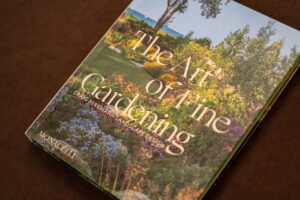
The Art of Fine Gardening: Craig Bergmann Landscape Design
Craig Bergmann and Russell Buvala presented The Art of Fine Gardening, showcasing four decades of landscape design that unites architecture and horticulture. Featuring twenty North Shore gardens—including the historic Gardens at 900—the book blends stunning photography, personal stories, and practical guidance for gardeners and design enthusiasts alike.