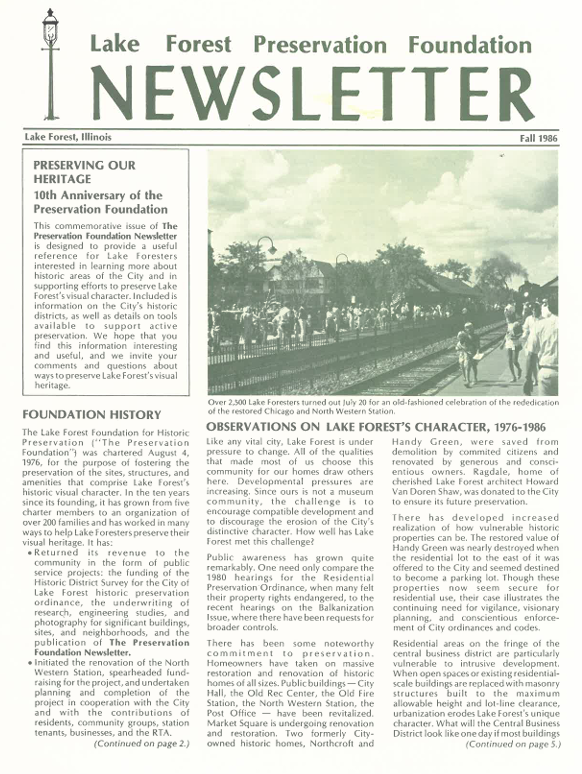
Lake Forest Preservation Foundation NEWSLETTER, Lake Forest, Illinois, Fall 1986, PRESERVING OUR HERITAGE, 10th Anniversary of the Preservation Foundation: this commemorative issue of The Preservation Foundation Newsletter is designed to provide a useful reference for Lake Foresters interested in learning more about historic areas of the City and in supporting efforts to preserve Lake Forest’s visual character, including information on the City’s historic districts and details on tools available to support active preservation, with an invitation for comments and questions about ways to preserve Lake Forest’s visual heritage (repeated), FOUNDATION HISTORY: The Lake Forest Foundation for Historic Preservation (“The Preservation Foundation”) was chartered August 4, 1976, for the purpose of fostering the preservation of the sites, structures, and amenities that comprise Lake Forest’s historic visual character, and over 2,500 Lake Foresters turned out July 20 for an old-fashioned celebration of the rededication of the restored Chicago and North Western Station, and in the ten years since its founding the Foundation grew from five charter members to an organization of over 200 families and worked in many ways to help Lake Foresters preserve their visual heritage, returning its revenue to the community through public service projects including funding of the Historic District Survey for the City of Lake Forest historic preservation ordinance, underwriting of research, engineering studies, and photography for significant buildings, sites, and neighborhoods, and publication of The Preservation Foundation Newsletter, initiating the renovation of the North Western Station, spearheading fund-raising, and undertaking planning and completion of the project in cooperation with the City and with contributions of residents, community groups, station tenants, businesses, and the RTA (Continued on page 2), OBSERVATIONS ON LAKE FOREST’S CHARACTER, 1976–1986: like any vital city, Lake Forest is under pressure to change as qualities that draw residents also draw others and developmental pressures are increasing, and since Lake Forest is not a museum community the challenge is to encourage compatible development and discourage erosion of distinctive character, asking how well Lake Forest has met this challenge, noting public awareness has grown remarkably from 1980 hearings for the Residential Preservation Ordinance where many felt property rights endangered to recent hearings on the Balkanization Issue where requests have been made for broader controls, and noting noteworthy commitment to preservation with homeowners undertaking massive restoration and renovation of historic homes of all sizes, public buildings—City Hall, the Old Rec Center, the Old Fire Station, the North Western Station, the Post Office—revitalized, Market Square undergoing renovation and restoration, two formerly City-owned historic homes Northcraft and Handy Green saved from demolition by committed citizens and renovated by generous and conscientious owners, and Ragdale, home of cherished Lake Forest architect Howard Van Doren Shaw, donated to the City to ensure its future preservation, alongside increased realization of vulnerability of historic properties such as Handy Green nearly losing restored value when the adjacent residential lot seemed destined to become a parking lot, illustrating the continuing need for vigilance, visionary planning, and conscientious enforcement of City ordinances and codes, and warning that residential areas on the fringe of the central business district are particularly vulnerable to intrusive development when open spaces or residential-scale buildings are replaced with masonry structures built to maximum allowable height and lot-line clearance, eroding Lake Forest’s unique character, posing questions about what the Central Business District will look like if buildings fill lots and rise to legally allowable three stories, how McKinley Road will appear if redeveloped per office and general residence zoning with massive blocks replacing existing homes, and what will happen to the residential character and property values on Westminster east of McKinley if the Masonic Lodge property is developed incompatibly, stating that if ordinances are found lacking only when an historic building or landscape is endangered the opportunity to arrest attrition has been missed, citing loss of Edward Ryerson’s magnificent estate Havenwood because the local preservation ordinance was not in place and subsequent subdivision planned per City codes dictating destruction of Jens Jensen landscaping because the formal garden was legally designated as a buildable single lot only if destroyed, and stating inharmonious and destructive subdivisions will continue until there is a means to ensure more compatible subdivisions, and out-of-proportion homes and auxiliary structures will continue until there is a mechanism to control mass and bulk, with issues raised in the Plan Commission’s study of the Balkanization Issue to protect Lake Forest from development that changed forever other North Shore communities and urging prompt action across all areas before more fine buildings, charming neighborhoods, and valuable landscapes are affected, PRESIDENT’S MESSAGE: Henry P. Wheeler says residents increasingly aware of changes ask what they can do, and one step is to join the organization dedicated to preserving community character, urging readers to send in the membership coupon with a check for their chosen category so the Foundation can be a voice at meetings where preservation issues are discussed and continue other preservation efforts, and History (Continued): the Foundation encouraged renovation of historic buildings such as the Old Rec Center, the Old Fire Station, City Hall, the Post Office, Northcroft, and Handy Green, added to its Revolving Fund for endangered properties, encouraged establishment of preservation easements, advised owners of historic properties on restoration and renovation resources, sponsored and co-sponsored public forums, workshops, and programs to disseminate information about Lake Forest’s historic resources and ways to preserve them, observed City meetings and commented on issues related to preserving the City’s character, and provided consultants and recommendations to City bodies and staff, and HISTORIC DISTRICTS—WHAT ARE THEY? WHERE ARE THEY?: Lake Forest’s historic significance is recognized by two National Register Historic Districts and a local district designated by the City of Lake Forest, with the Benefits of the National Register of Historic Places described as election to the National Register being the highest national honor for an historic place, with properties in a National Register District or individually listed eligible for federal and state tax benefits and possible protection from adverse effects of federally funded or licensed projects while placing no restriction on property owners, and the Lake Forest National Register Historic District including most of the original City of Lake Forest as shown on the map, while other historic areas are not included because they are not contiguous, and the Vine/Oakwood/Green Bay Road National Register Historic District including the area shown on the map below, and other Lake Forest National Register Properties including Ragdale (the home of Howard Van Doren Shaw on Green Bay Road) and Mellody Farm (now the site of Lake Forest Academy on Kennedy Road), and the Lake Forest Residential Historic Preservation District including both National Register Districts plus additional properties in designated areas throughout the City, and FOUNDATION PROGRAMS PLANNED: the Preservation Foundation will sponsor several public programs during the coming year with newspaper announcements and Foundation members receiving individual invitations (repeated), followed by the membership form for LAKE FOREST FOUNDATION FOR HISTORIC PRESERVATION, Box 813, Lake Forest, Illinois 60045, categories Member $25, Contributing Member $50, Sponsor $100, Sustaining Member $250, Patron $500, Life Member contribution $1,000+ with no annual dues, plus an option to actively work with the Foundation, and TOOLS FOR PRESERVING / NORTH WESTERN STATION RENOVATION NEWS: Project Receives Awards with the North Western Station Renovation project recognized June 10, 1986 by two Governor’s Home Town Awards—first place in youth involvement and second place in general category for population 8,000 to 16,000—with plaques displayed in the donor’s case in the south waiting room of the station, and Memorial Landscaping Project Planned with funds solicited for landscaping of the platform extension north of Westminster in memory of former Chamber of Commerce members and Lake Forest businessmen Stanley Francis Bonk, Le Roy Thomas Gregory, and Le Roy Roman Gregory, spearheaded by donations from the Gregory family and Chamber members and involving planting three Bradford Pear trees and extensive groundcover plus grading, a large retaining wall, and mulching, with approximately $2,600 of the $4,000 needed contributed and inviting tax-deductible contributions to The Preservation Foundation, Box 813, Lake Forest, and including a perspective from Mark Q. Rhodes in the August 13, 1986 issue of The Wall Street Journal about the “American national suburb” and the comfort of familiar franchises but the problem of blurred regional identities and erosion of cultural inheritance, arguing efforts to preserve cultural traditions are necessary and not mere nostalgia, and applying that to Lake Forest’s visual character as essential to maintaining and enhancing the quality of life and preserving its 125-year-old heritage, plus For Sale: small used coach lights, call Lorraine Tweed, 295-3199 (repeated), and LAKE FOREST’S VISUAL CHARACTER / Easements Offer Tax Break for Property Owners: easements designed to preserve historic properties have been used for more than 20 years and certain tax-law changes have made them more attractive and increasingly used in Illinois, and in Lake Forest, where studied by the City’s Plan Commission, easements could help preserve open space and landscaping contributing to visual character, defining an “easement” as an agreement restricting future use to preserve important features with restrictions typically covering future changes in a building and/or related grounds and auxiliary structures, donated in perpetuity to a municipality or suitable nonprofit in exchange for eligibility for federal income-, gift-, and estate-tax benefits based on the value of the easement, with value determined by a qualified appraiser calculating the difference between original value and value after restrictions, becoming a charitable deduction on the federal income tax return and also potentially reducing gift and estate taxes and real property taxes, and citing the subdivision provisions in Lake Forest’s Residential Historic Preservation Ordinance of 1981 as a basis for determining the value of open-space or conservation easements restricting subdivision below zoning density, giving the example of a 12-acre estate zoned for 1½ acres where restricting subdivision entirely or into two 6-acre properties yields easement value as the difference between the value of eight 1½-acre properties allowed and the value under the restriction, and noting that given high land cost such easements can be substantial and offer an attractive alternative to subdivision and sale while preserving important features and freeing resources for renovation (Continued on page 6), followed by LAKE FOREST HISTORIC DISTRICT SITES AND STRUCTURES OF SPECIAL SIGNIFICANCE listing numerous properties (historic significance cited when taking precedence over architectural significance or where the latter is negligible) including Finley Barrell House II (747 E. Deerpath, 1916, Frederick Perkins), J. V. Farwell House & Barn (888 & 920 E. Deerpath, 1869, Leonard Double; hand-poured concrete with cement and contractor imported from England), Charles S. Frost House “Eastover” (880 Elm Tree, pre-1899, Charles Frost), Residence 990 Illinois, Dexter Cummings House (1460 Lake, pre-1933, H. T. Lindeberg), David Dangler House (155 Mayflower, 1924, Russell Walcott), Coachhouse (333 Mayflower, pre-1908, Spencer & Powers), Charles H. Schweppe Estate “Mayflower Place” (405–429 Mayflower, 1915), Edward L. Ryerson Estate II (955–1075 Ringwood, 1914, Howard Van Doren Shaw), William O. Lindley House & Levi Yaggy Garage “Bowood” (901 Rosemary; house pre-1916 and garage 1890, Arthur Heun), Devillo R. Holt House “The Homestead” (570 N. Sheridan, 1860), Harvey Thompson House (660 N. Sheridan, 1860), Cyrus McCormick III house (614 E. Spruce), J. V. Farwell, Jr. House “Ardleigh” (121 Stone Gate, 1896, Arthur Heun), Arbrose Cramer House “Rathmore” (61 Stone Gate, 1896, F. W. Stickney), Dr. C. F. Quinlan House “The Evergreens” (404 E. Deerpath, 1869–70) and Dr. C. F. Quinlan House (334 E. Westminster, 1862), Jelke Estate (645 E. Westminster), Bernard A. Eckhart (950 E. Westminster, 1908, W. C. Zimmerman), Donald McClennan House “Sturnoway” (1345 Lake, 1912, Howard Van Doren Shaw), Garage 1490 Lake (part of D. Mark Cummings Estate “loka,” manor demolished), 1903, Frederick Perkins, Chicago & Northwestern Railroad Depot (McKinley & Market Square, 1899, Frost and Granger), Finley Barrell House I (855 Rosemary, 1912, Howard Van Doren Shaw), Alfred Granger House (907 N. Sheridan, 1899, Frost and Granger), Henry Calvin Durand House “Linden Lodge” (605 E. College, 1903, Frost & Granger), J. D. Hinckley House (440 Wisconsin, 1923, Howard Van Doren Shaw), Lake Forest City Hall (220 E. Deerpath, 1898, Frost & Granger), Lake Forest Library (360 E. Deerpath, 1931, Edwin C. Clark), Market Square (700 N. Western, 1916, Howard Van Doren Shaw), Young Men’s Club (Forest at Market Square, 1916, Howard Van Doren Shaw; historical significance), 1st Presbyterian Church (700 N. Sheridan, 1887, Charles S. Frost), Deerpath Building and Theater (260–72 E. Deerpath, 1928, Stanley D. Anderson), Lake Forest Consolidated Bank (now Marshall Field’s) (Bank Lane at Market Square, 1916, Howard Van Doren Shaw), Academy of the Sacred Heart/Barat College (760 E. Westleigh, 1903, Egan & Prindeville), Henry C. Durand Art Institute (Lake Forest College campus, 1891, Henry Ives Cobb), multiple Lake Forest College campus buildings including Lois Durand Hall (1897, Frost & Granger), Patterson Lodge (1878), North Hall (1880), College Hall (1878), Arthur Somerville Reid Memorial Library (1899, Frost & Granger), Durand Commons (1907, Howard Van Doren Shaw), North Gymnasium (1890, Henry Ives Cobb), Lily Reid Holt Memorial Chapel (1899, Frost & Granger), Chapel Ferry Hall School (541 Mayflower, 1870), Clifford Barnes House & Outbuildings (500 N. Sheridan, 1908, Howard Van Doren Shaw; historical significance), A. E. Hamill House & Outbuilding (1115 Illinois & 51 N. Mayflower, 1928, David Adler; historical significance), Edward F. Gorton School/Gorton Community Center (400 Illinois, 1894, James Gamble Roger; enlarged 1907 by Howard Van Doren Shaw), D. J. Lake House “Forest Lawn” (644 E. Deerpath, 1860; historical significance), Sylvester Lind House (550 E. Deerpath, 1859; historical and architectural significance), Clayton Mark House (999 Lake, 1914, Howard Van Doren Shaw), Blackler Building (630 Western, 1895; historical significance), Ezra S. Barnum House (797 N. Sheridan, 1867; historical significance), Residence 855 E. Westminster, Robert G. McGann House (965 E. Deerpath, 1893; historical and architectural significance), Louis Laflin House “Ellslloyd” (1007 Hawthorne, 1907, Robert Kohn; historical significance), Walter Kirk House “Vallombrosa” (1000 Illinois, 1914, Edwin H. Clark; historical significance), Kerrigan House (approx. 1200 N. Sheridan, ca. 1840; oldest house and only predating original city plat; historical significance), Misses Colvin House “Halcyon Lodge” (1350 Lake, 1916, Howard Van Doren Shaw), Leverett Thompson House (788 Woodland, 1907, Howard Van Doren Shaw), and Mrs. Cyrus McCormick, Sr., House with outbuilding, gatehouse, and garage (45 S. Sheridan and 925 Illinois; 1916, Dwight Perkins; historical and architectural significance), and Preservation Tools (Continued): noting easement incentives for buildings and open space for properties on the National Register, in a National Register Historic District, or certified as important in a certified local historic district, and that for properties only in the local Lake Forest Residential Historic Preservation District (since the local district and ordinance are not certified) the incentive is available solely for open space, including Green Bay and Ridge Road estate areas and other properties west of Green Bay Road, with possible eligibility expanding if listed on the National Register, and explaining certification requires meeting U.S. Department of the Interior criteria to “substantially achieve” preserving and rehabilitating historic buildings but the local ordinance is not certifiable because it is limited to subdivision and special use and lacks a qualified review board and criteria for alterations, with actions instead reviewed only when called for by existing City Code criteria applying to all properties, and stating an effective easement program could preserve vast open-space landscaping and provide resources for preservation of significant buildings, trading community benefit for valuable tax benefits to donors and contributing positively to property values, followed by Additional Suggested References including Historic Preservation (March/April 1982, pp. 32–39), Landmarks Preservation Council of Illinois, Preservation Easements in Illinois, Roddewig and Shlaes “Appraising the Best Tax Shelter in History” The Appraisal Journal (January 1982, pp. 25–42), “Robert H. Thayer and Virginia Thayer vs. Commissioner” U.S. Tax Court decision CCH Dec. 34,708 (M), and Property Tax Abatement Available for Rehabilitation: state legislation PA-82-1023 providing an eight-year property tax freeze in valuation for single-family, owner-occupied historic homes substantially rehabilitated, effective January 1, 1983, with forms for landmark and rehabilitation certification available from the Illinois Historic Preservation Office, Old State Capitol, Springfield, IL 62701, (217) 785-4512, advising owners to check plans with SHPO before work and requiring rehabilitation cost including architect’s fees to equal 25% of fair market value as determined by the assessor at the time rehabilitation begins, plus NON-PROFIT ORG. U.S. POSTAGE PAID PERMIT NO. 184 LAKE FOREST, ILL. 60045, The Preservation Foundation Newsletter published by the Lake Forest Foundation for Historic Preservation and distributed without charge to residents and businesses of Lake Forest, The Preservation Foundation, Box 813, Lake Forest, Illinois 60045, CAR-RT.