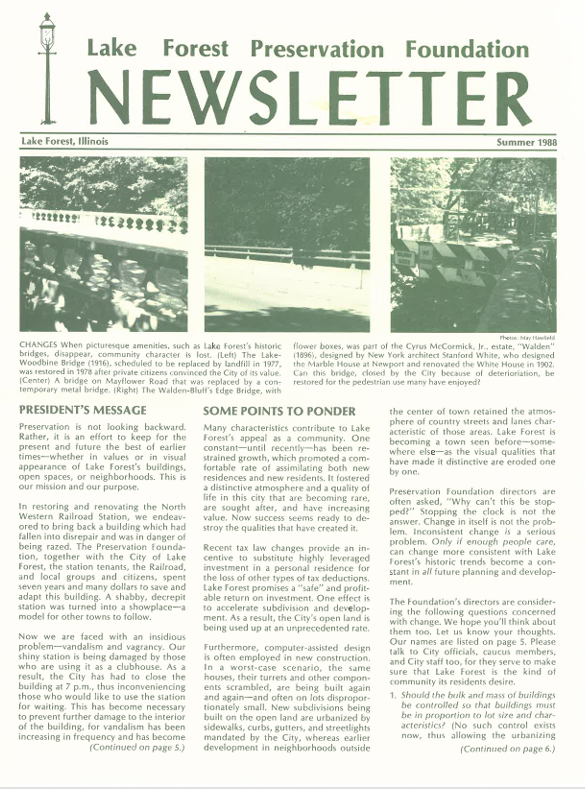
Lake Forest Preservation Foundation NEWSLETTER, Lake Forest, Illinois, Summer 1988, CHANGES: when picturesque amenities such as Lake Forest’s historic bridges disappear, community character is lost, as illustrated by the Lake-Woodbine Bridge (1916), scheduled to be replaced by landfill in 1977 but restored in 1978 after private citizens convinced the City of its value, a bridge on Mayflower Road replaced by a contemporary metal bridge, and the Walden-Bluffs Edge Bridge with flower boxes, part of the Cyrus McCormick, Jr., estate “Walden” (1896), designed by New York architect Stanford White, who designed the Marble House at Newport and renovated the White House in 1902, raising the question of whether this bridge, closed by the City because of deterioration, can be restored for pedestrian use, Photm: May Hawfield, PRESIDENT’S MESSAGE: preservation is not looking backward but an effort to keep for the present and future the best of earlier times—whether in values or in the visual appearance of Lake Forest’s buildings, open spaces, or neighborhoods—and in restoring and renovating the North Western Railroad Station, the Preservation Foundation together with the City of Lake Forest, station tenants, the Railroad, and local groups and citizens spent seven years and many dollars to save and adapt a building in danger of being razed, turning a shabby, decrepit station into a showplace and model for other towns, yet now facing vandalism and vagrancy as the station is misused as a clubhouse, forcing the City to close the building at 7 p.m. to prevent further interior damage, an insidious and costly problem (Continued on page 5), and SOME POINTS TO PONDER: many characteristics contribute to Lake Forest’s appeal including restrained growth which fostered a distinctive atmosphere and quality of life, yet recent tax law changes incentivize highly leveraged residential investment, accelerating subdivision and development so that open land is being used at an unprecedented rate, while computer-assisted design in new construction results in repeated house forms with turrets and components scrambled on disproportionately small lots, and new subdivisions urbanized by sidewalks, curbs, gutters, and streetlights mandated by the City contrast with earlier country lanes, eroding distinctive visual qualities and making Lake Forest resemble “somewhere else,” prompting questions about controlling bulk and mass of buildings relative to lot size and characteristics and about standardized engineering requirements in multilot subdivisions (Continued on page 6), and Two Buildings By Howard Van Doren Shaw—One With Its Future Secure, One With Its Future Uncertain: Howard Van Doren Shaw, “Lake Forest’s Architect,” designer of Market Square and many architectural treasures, is represented by two buildings drawing Preservation Foundation attention, one through charming and authentic restoration, the other at a crossroad in its history, and CARRY PLAYHOUSE: NEW LIFE FOR A LAKE FOREST TREASURE: once a little theatre designed by Howard Van Doren Shaw in 1914 or 1915, with vaulted ceiling of dark pine boards, geometric designs in french grey and old red, carved beams, bird’s eye maple floor, iron chandeliers encircled by brass deer and ram figures, fireplace with dark red brick hearth, stepped bookshelves flanking french doors, former dressing rooms and stage cables, illustrating Shaw’s imaginative references to architectural styles influenced by E.L. Lutyens and European travel, possibly inspired by sketchbook designs of English church woodwork, built during the “little theatre” movement, with Margaret and Mary Ermina Carry as intended young patrons, later converted into a residence with an addition by Shaw including hidden stairway, bedrooms, bathrooms, sleeping porches, dining room, butler’s pantry, kitchen, and servant’s quarters, and when present owners acquired the neglected property they undertook careful restoration, engaging European carpenters, salvaging hardware, importing single-slotted brass screws from West Germany, stripping and staining woodwork to match beams, excavating crawlspace to correct water problems, installing new drainage and foundation, replacing windows in original style, upgrading electrical and plumbing systems, modifying interior spaces, replacing wood shake roof with graduated slate roof collected from varied sources, enhancing gardens with surviving peonies, grapevines, orchard, raspberry and rhubarb patches, and ultimately attributing the playhouse definitively to Howard Van Doren Shaw, Dawn Kimbrell, with note correcting earlier dates and ownership information, and FOUNDATION ELECTS NEW OFFICERS AND DIRECTORS: officers elected April 17, 1988 include President Sarah Wimmer, Vice Presidents Elaine Hughes and Linda Shields, Secretary Pauline Mohr, Treasurer Allen Bartine, Directors May Hawfield, Henry Preston, Patricia Riess, Anthony Ryerson, Dan Sutherland, Lorraine Tweed, with additional directors George Burrows, Suzanne Christensen, William Emerson, Gail Hodges, Daniel Kelly, Charles Lynn Knutson, Patricia Morell, Henry Wheeler, Honorary directors Edward H. Bennett, Jr., and Herbert Geist, and recognition of outgoing president Henry Wheeler and retiring directors Molly Heizer, Kitty Lansing, William Marwede, and Nancy Salzwedel, and PROPERTY TAX ABATEMENT AVAILABLE FOR REHABILITATION: state legislation PA-82-1023 provides an eight-year property tax freeze for substantially rehabilitated single-family, owner-occupied historic homes meeting certification standards, with forms available from the Illinois Historic Preservation Office, Old State Capitol, Springfield, IL 62701, (217) 785-4512, and rehabilitation costs including architect’s fees must equal 25 percent of fair market value at time work begins, and HELP PRESERVE LAKE FOREST’S CHARACTER—BECOME A FOUNDATION MEMBER: membership open to all sharing concern for preserving visual character of Lake Forest’s homes, streetscapes, landscapes, with dues supporting newsletter publication, station renovation and improvements, preservation advocacy, donations to the City for studies and research, directors observing City meetings and testifying on preservation matters, consulting with property owners, working with community groups, no paid staff, annual membership meeting and programs planned for 1988-1989, contact Membership Chairman Elaine Hughes, 234-3850, membership blank with categories Member $25, Contributing $50, Sponsor $100, Sustaining $250, Patron $500, Life Member $1,000 or more to Revolving Fund, LAKE FOREST FOUNDATION FOR HISTORIC PRESERVATION, Box 813, Lake Forest, Illinois 60045, and LITTLE ORCHARD: SUBDIVISION CHANGES OLDEST SHAW PROPERTY: Little Orchard, designed by Howard Van Doren Shaw as estate for Alfred L. Baker around 1897 or 1898, possibly Shaw’s oldest Lake Forest building, charcoal grey two-story summer house with hip roof, recessed entrance, dormers, side wings, later owned by Vaughn Spaulding, John A. Appleton, and Mr. and Mrs. Solomon B. Smith, renovated by architect A. James Speyer to accommodate art collection, with stable also designed by Shaw converted to residence and garage added, and distinctive addition “Smith Mountain,” a hill fountain inspired by Villa d’Este in Italy with thirty-three steps, arborvitae rows, lighting, built with earth from Tri-State Tollway construction, later moved ten feet north due to neighbor concerns, fountain disused by 1973, plumbing failed, hill sold in January 1988, leveled by contractor who built house on lot, arborvitae redistributed, dirt reused for berms at Evergreen development, electrical and plumbing salvaged, marking passing of a remarkable sight and symbolizing pressures on historic properties, Peter J. Shrock, and EASEMENTS PRESERVE OPEN SPACE, OFFER TAX BREAK FOR PROPERTY OWNERS: Preservation Foundation and City encourage historic/conservation easements within historic districts to preserve facades, character, open space, landscaping, with substantial income tax value offering alternative to subdivision and sale, freeing resources for renovation, over thirty properties in Residential Preservation District could benefit though only three owners have donated conservation easements, broader participation could slow “bulkanization,” contact Charles E. Crook, Director of Planning and Development, 234-2600, and FOR SALE approximately 25 used top-mounted coach lights from Depot renovation, make offer, call Lorraine Tweed, 295-3199, and CENTER FOR HISTORIC HOUSES OFFERS AID FOR PROPERTY OWNERS: division of National Trust for Historic Preservation assisting private homeowners through advice, publications, conferences, lobbying for tax incentives, coordinating with preservation groups, affiliated with International Union of Historic Houses, contact 1785 Massachusetts Avenue, Washington, DC 20036, (202) 673-4025, and Points to Ponder (Continued): questions regarding control of building bulk and mass relative to lot size, standardized engineering requirements in subdivisions, strengthening Preservation Ordinance beyond subdivision regulation and one-year demolition delay to provide greater incentives and disincentives, noting North Shore communities’ strengthened ordinances after losses and Glencoe’s lack thereof, quoting Winston Churchill, “We shape our buildings, and afterwards our buildings shape us,” Gail T. Hodges, Editor, and the Preservation Foundation Newsletter is published by the Lake Forest Foundation for Historic Preservation and distributed without charge to residents and businesses of Lake Forest.