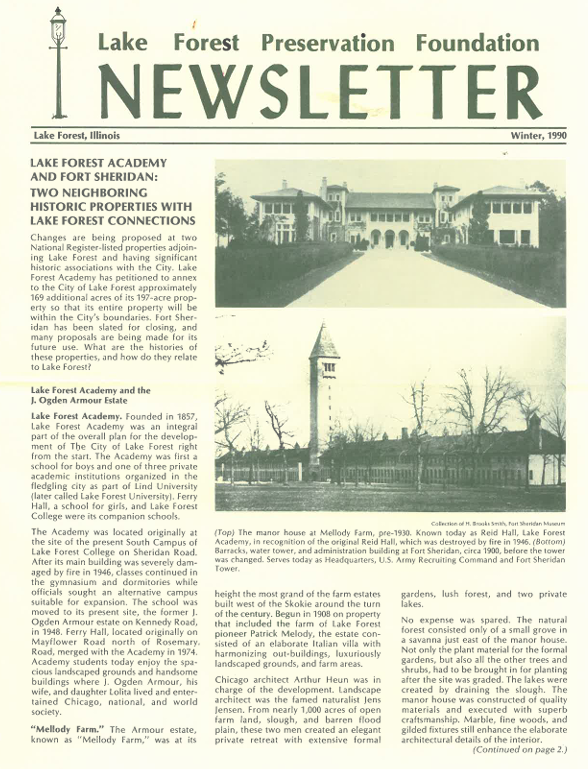
Lake Forest Preservation Foundation NEWSLETTER Lake Forest, Illinois Winter, 1990 LAKE FOREST ACADEMY AND FORT SHERIDAN: TWO NEIGHBORING HISTORIC PROPERTIES WITH LAKE FOREST CONNECTIONS Changes are being proposed at two National Register-listed properties adjoining Lake Forest and having significant historic associations with the City, Lake Forest Academy has petitioned to annex to the City of Lake Forest approximately 169 additional acres of its 197-acre property so that its entire property will be within the City’s boundaries, Fort Sheridan has been slated for closing, and many proposals are being made for its future use, what are the histories of these properties, and how do they relate to Lake Forest? Lake Forest Academy and the J. Ogden Armour Estate Lake Forest Academy, founded in 1857, Lake Forest Academy was an integral part of the overall plan for the development of The City of Lake Forest right from the start, the Academy was first a school for boys and one of three private academic institutions organized in the fledgling city as part of Lind University (later called Lake Forest University), Ferry Hall, a school for girls, and Lake Forest College were its companion schools, the Academy was located originally at the site of the present South Campus of Lake Forest College on Sheridan Road, after its main building was severely damaged by fire in 1946, classes continued in the gymnasium and dormitories while officials sought an alternative campus suitable for expansion, the school was moved to its present site, the former J. Ogden Armour estate on Kennedy Road, in 1948, Ferry Hall, located originally on Mayflower Road north of Rosemary Road, merged with the Academy in 1974, Academy students today enjoy the spacious landscaped grounds and handsome buildings where J. Ogden Armour, his wife, and daughter Lolita lived and entertained Chicago, national, and world society, Collection of H. Brooks Smith, Fort Sheridan Museum (Top) The manor house at Mellody Farm, pre-1930, known today as Reid Hall, Lake Forest Academy, in recognition of the original Reid Hall, which was destroyed by fire in 1946, (Bottom) Barracks, water tower, and administration building at Fort Sheridan, circa 1900, before the tower was changed, serves today as Headquarters, U.S. Army Recruiting Command and Fort Sheridan Tower, “Mellody Farm.” The Armour estate, known as “Mellody Farm,” was at its height the most grand of the farm estates built west of the Skokie around the turn of the century, begun in 1908 on property that included the farm of Lake Forest pioneer Patrick Melody, the estate consisted of an elaborate Italian villa with harmonizing outbuildings, luxuriously landscaped grounds, and farm areas, Chicago architect Arthur Heun was in charge of the development, landscape architect was the famed naturalist Jens Jensen, from nearly 1,000 acres of open farm land, slough, and barren flood plain, these two men created an elegant private retreat with extensive formal gardens, lush forest, and two private lakes, no expense was spared, the natural forest consisted only of a small grove in a savanna just east of the manor house, not only the plant material for the formal gardens, but also all the other trees and shrubs, had to be brought in for planting after the site was graded, the lakes were created by draining the slough, the manor house was constructed of quality materials and executed with superb craftsmanship, marble, fine woods, and gilded fixtures still enhance the elaborate architectural details of the interior, (Continued on page 2.), Mellody Farm (Continued) The Armour estate encompassed most of the land from Bradley Road east to Waukegan Road and north from Mellody Road to the area of the Lake Forest tollway oasis, the gate house, now a separate property, still stands west of the entrance on Waukegan Road, a road lined with elm trees originally extended from the gate house to the present main Academy building, crossing a concrete bridge over the Milwaukee Railroad line, the estate had its own railroad siding, constructed for delivery of the original building materials, a long wall was built along the track to mitigate the noise from passing trains, both still exist, Mr. Armour was rumored to be one of the two wealthiest men in the America of his time, he lost his vast fortune in the 1921 post-World War I business depression, forfeiting Mellody Farm in the subsequent bankruptcy proceedings, and died in London in 1927, his widow inherited an investment he had made in a method of cracking oil to create gasoline (which had been rejected as worthless by the bankers) and with new wealth generated by this investment commissioned architect David Adler to design a new estate for her on Green Bay Road in 1934, over 800 acres of Mellody Farm were purchased for a reported $2.5 million in 1928 by a syndicate of 26 Chicago executives headed by Samuel Insull, intending to convert the estate into a fashionable golf club, the group had completed an 18-hole golf course, laid out an airport, and added a locker room wing to the manor house when the stock market crash of 1929 rocked the country, the project was never finished, the estate passed to the Continental Illinois Bank and Trust Company of Chicago, in 1946 several hundred acres were sold to Frank J. Lewis, who first offered the property to the United Nations and then sought to use it for a new religious institution, with the help of many Lake Forest citizens, the Academy purchased the house and about 200 acres of the property from the Frank J. Lewis Foundation in 1947, the school was formally transferred to this site in 1948, over the years, there has been a continuing public fascination with the estate, resulting in its being the setting for everything from elegant parties and weddings to movies, 1The bridge was partially demolished when the railroad raised the roadbed, Collection of H. Brooks Smith (Top) The manor house at Mellody Farm during construction, (Center) The main entrance road of Mellody Farm shortly after completion, note bridge over Milwaukee Railroad tracks and sapling elm trees, (Bottom) A portion of the rose garden and other formal gardens at Mellody Farm in early years, PRESIDENT’S MESSAGE The past year was one of growth – and perhaps, a coming of age – for the Preservation Foundation, the value of the Foundation’s work, its dedication, and its effectiveness were recognized in several ways, last month Mayor Strenger appointed Gail T. Hodges, Director and past President of the Foundation from 1980-82, to the Building Review Board, we commend her selection to this key Lake Forest board and welcome this opportunity given her to serve the public, our membership has continued to increase, and we are reassured in our efforts by local leaders who joined us for the first time and former members who renewed lapsed memberships, we also were encouraged by members new to the community who recognized the work of the Foundation, we welcome all who share our values for Lake Forest, the Foundation maintains a continuing interest in the restored Northwestern Railroad Station, each year we ask the City staff to evaluate needs at the Station, and we make a contribution to fund an improvement, every Christmas, the ever-green decorations on the exterior of the main station building and at the cross-over are donated by the Foundation, members dues support these, as well as other, Foundation activities, while we have not been engaged in a new physically visible project in town, we have been active in many other areas of preservation – attending City meetings and giving testimony on preservation-related agenda items, responding to requests for information, conducting research on historic properties, working with the City on revisions to the Preservation and Open Space Ordinance, and trying in other ways to spread the message of the value of preservation, recently the Foundation joined other suburban historic preservation groups in the formation of a Suburban Committee of the Landmark Preservation Council of Illinois, designed primarily as a vehicle for sharing mutual concerns and solutions, participation on the Committee is expected to broaden our Directors’ perspective on preservation issues, as well as help them bring new ideas to the community, Citizens response to the City Survey conducted last fall makes interesting reading, the City has received high marks for its services and for the quality of life here in Lake Forest, we are grateful to note that physical beauty and open space, both key to maintaining the historic visual character of the city, were mentioned by the majority of respondents as being valued, while concerns about growth and density were also expressed, we concur, also receiving acclaim is the newly-restored railroad station in Lake Bluff, all of us interested in preservation and restoration should take the time to stop by and walk around the station – and admire another example of a structure rescued from decay and saved for the future, hats off, Lake Bluff! In January the Foundation’s Board voted to support the work of the Advocates for the Public Interest in Fort Sheridan, we agreed that this group – composed of representatives of the Illinois Audubon Society, Landmark Preservation Council of Illinois, Illinois Association of Park Districts, Lake Michigan Federation, the Sierra Club (Illinois), Open Lands Project (Chicago) – is doing important work in determining the best possible reuse of the Fort in the event of its closure, our representative to the Advocates is Pauline Mohr, a long-time member of our Board, we would welcome your thoughts about Fort Sheridan, as we would regarding matters pertaining to Lake Forest and preservation broadly, we look forward to hearing from you in 1990, Sarah Wimmer, POINTS TO PONDER Following the devastation caused by Hurricane Hugo and the October 17 California earthquake, Charlestonians and Californians were among those evaluating the effects of natural disasters on their cultural heritage, in Charleston, the damaged historic buildings are being restored, some with international assistance in the form of Les Compagnons du Devoir, a French crafts guild established during the Middle Ages, dealing with the destruction of vast portions of the historic landscape is more difficult, the sense of place created by centuries-old trees and historic gardens will suffer the aftershock of Hugo for a long time, in San Francisco and surrounding areas, Californians had to endure a loss of history when landmarks that had suffered quake damage were razed swiftly as “public hazards.”, preservationists coalesced rapidly to win communities over from the quick fix of demolition to cordoning off buildings until damage could be assessed, still, the sense of place has been changed forever in some areas, in Lake Forest, it would be highly unusual for natural disasters of such magnitude to occur, the threat to our sense of place comes instead from demolition and development, it’s worth reminding ourselves that many of the streetscapes and properties regarded as being particularly beautiful in our community have taken ninety years or more to evolve to that beauty, a sense of place takes a long time to develop, as can be seen from the early photos of “Mellody Farm” shown elsewhere in this Newsletter; but it can be destroyed very quickly, there is a compulsion by some to take the quick-fix route of demolition rather than the more time-consuming – and, yes, sometimes but not always more expensive – route of trying to maintain a structure’s place in the fiber of the City’s historic streetscape, though many have made a commendable commitment of time and resources to historic and older properties, there appear to be increasing numbers without such motivation, as land available for subdivision and development has become scarce, Lake Forest has become more vulnerable to “infill.”, large parcels of open space have been subdivided and developed, small houses, of all ages, are being demolished and replaced with much larger ones, existing houses are being greatly enlarged, in older neighborhoods, diversity of scale and design, as well as open space, are disappearing, (Continued on page 6.), TOUR MARCH 25 FOR FOUNDATION MEMBERS Members of the Lake Forest Preservation Foundation have been invited to tour “A Renovation in Progress,” Sunday, March 25, featured will be the magnificant Astor Street residence of Joseph T. Ryerson, who spent his boyhood summers at “Havenwood,” the grand Lake Forest estate of his father, Edward, the five-story 18,000-square-foot, Louis XVI house was designed in 1921 by David Adler, it is Adler’s only town house in the French style and was built by Ryerson in 1929, many consider this to be one of the most significant homes in Chicago, the Ryerson residence was sold in 1949, and was converted to 22 apartments, the present owner, John P. Regas, purchased the home 2 1/2 years ago and is restoring it as a single-family residence according to the original specifications of Adler’s plan, the restoration is approximately 80% complete, Foundation members will have the rare opportunity not only to hear Mr. Regas’s story of how such a major restoration takes place, but also to see the on-going work firsthand, Mr. Regas’s work includes the restoration of the former Clow estate in Lake Bluff, seating will be limited, so watch your mail for program time and reservation instructions, for further information, call Linda Shields, 234-0257 or Dan Sutherland, 234-1996, Fort Sheridan The founding of a military installation at Ft. Sheridan was the direct result of efforts by prominent Chicago businessmen, including Lake Forest residents, to provide permanent military protection for the City of Chicago during the industrial turmoil of the late 1800s, having witnessed the effectiveness of federal troops brought in to maintain order following the fire of 1871 and the railroad strike of 1877, members of the Commercial Club of Chicago began discussing the location for an army post in 1885, rising labor discontent, culminating in the Haymarket Riot of May 1886, brought the issue to a head, acting decisively following an address by Marshall Field, the Club in June appointed members John A. Doane, Senator Charles B. Farwell, and Alexander P. Mcclurg to petition the Secretary of War for acceptance by the United States government of a tract of land near Chicago for a permanent military installation, this request coincided with a new military policy of replacing frontier outposts with permanent garrisons at strategic locations throughout the United States, by July the Army had selected a site, and by March of 1887 the land, which had been subsequently purchased by the Commercial Club and donated to the government, had been accepted by joint congressional resolution, the deed, signed October 6, 1887, lists Commercial Club members Adolphus C. Bartlett, Charles L. Hutchinson, and John J. Janes and their wives as grantors, since the Commercial Club could not legally own or donate real property, Chicago’s captains of industry, including many Lake Foresters, had made generous donations to enable representatives of the Commercial Club to purchase over 600 acres of land from the original owners, J.S. Prall, a realtor, and Mr. and Mrs. Frank Gilgare, farmers, the first troops arrived at the undeveloped site called “Camp at Highwood” on November 8, 1887, and were quartered in canvas Sibley tents, the site was renamed “Fort Sheridan” in February 1888 in honor of General Philip H. Sheridan, who had effectively brought order to Chicago in the desperate days following the 1871 fire and was himself a member of the Commercial Club, in 1889 Congress approved $300,000 for permanent buildings, the planning and construction of Fort Sheridan took place “during the interlude between the establishment of a series of permanent military installations and the issuance of standardized building plans from the Office of the Quartermaster General.”, this fact is important in evaluating the Fort’s architectural merit, these circumstances set the stage for the commissioning of a private architect, William Holabird, who happened to be the son of Quartermaster General Samuel B. Holabird, the Chicago architectural firm of Holabird and Roche later attained national significance, primarily for its pioneer work in the use of the skeleton frame and in the construction of the early skyscrapers that characterize the Chicago school of architecture, the work at Fort Sheridan was done early in the firm’s career, the work of O.C. Simonds, who did the landscaping at Fort Sheridan, includes Graceland Cemetery, (and he) was well known in the Chicago area, the use of gradual curves and the preference for the natural over the formal landscape were characteristics of Simonds work, and both are apparent in his design for Fort Sheridan, very few military installations were designed by notable architectural and landscaping firms, this, combined with the unusual scope and size of the surviving building inventory, makes Fort Sheridan an architectural and historical resource of exceptional value, the excellent design, good engineering, and highly competent workmanship of the construction have made it possible to retain, adapt, and reuse all but a few of the buildings to the present time, the circumstances that led to the development of Fort Sheridan as we know it – the establishment of permanent garrisons, the civil unrest that motivated influential citizens to donate the land, and the use of what became a highly respected private architectural firm – coexisted only briefly at the end of the 19th century, similarly, current circumstances drawing together many factors from governmental, public, and private sectors will determine the future of this unique place as we approach the end of the 20th century, PRESERVATION BOOKSHELF Home Restoration, Historic Preservation, January/February 1990, published by the National Trust for Historic Preservation, focuses on home restoration, case studies, tips, and other interesting information for property owners interested in restoration are included, also see the November/December 1989 issue for “Tips for Restorers.”, available at the Lake Forest Library, in March 1990, Preservation Press will publish Landmark Yellow Pages: Where to Find All the Names, Addresses, Facts and Figures You Need – an updated, expanded version of its invaluable 1983 listing of national, state and local preservation organizations, included are such useful tools as a glossary and lists of historic districts, relevant court cases and legislation, educational programs, and tax incentives, Conservation Easements, references available from the Land Trust Exchange, 1017 Duke St., Alexandria, VA 22314., provide resources for property owners interested in conserving their land and reducing taxes, the Exchange has just published the Supplement to The Federal Tax Law of Conservation Easements, the standard reference for persons working with donated easements, WHAT IS THE NATIONAL REGISTER? The National Register of Historic Places is the nation’s official schedule of cultural property worthy of preservation, election to the National Register is the highest national honor that can be awarded to an historic place, properties within a National Register District or individually listed on the National Register are eligible for federal and state tax benefits and may be afforded protection from adverse effects of any federally funded or licensed project, no restriction is placed upon the owner of a National Register property, listing on the National Register does not protect a property from demolition, Lake Forest has two National Register districts, one includes most of the original City of Lake Forest, extending roughly from Market Square east to Lake Michigan and from the Lake Forest Cemetery south to Westleigh Road, the other district is comprised of most of Vine Avenue and properties on Green Bay Road and Oakwood Avenue north of Vine Avenue and south of St. Mary’s Church and School, two other local properties are individually listed on the Register – “Ragdale,” the home of Howard Van Doren Shaw on Green Bay Road, and “Mellody Farm,” the former J. Ogden Armour estate on Kennedy Road that is now the site of Lake Forest Academy, other nearby properties include the Lester Armour estate manor home in Lake Bluff and a 205-acre section of Fort Sheridan, which is also listed as a National landmark, LAKE FOREST FOUNDATION FOR HISTORIC PRESERVATION Box 813, Lake Forest, Illinois 60045 I/We want to help preserve the historic character of Lake Forest, please enroll me/us in the selected membership category, (Contributions are tax deductible, please make checks payable to the Preservation Foundation.) Member – Annual Dues $25.00, Contributing Member – Annual Dues $50.00, Sponsor – Annual Dues $100.00, Sustaining Member – Annual Dues $250.00, Patron – Annual Dues $500.00, Life Member – Contribution to the Revolving Fund in the amount of $1,000.00 or more, no annual dues required, □ I/We would like to actively work with the Foundation, please call me/us to discuss areas of interest, The Preservation Foundation is open to all who share its goal of progress through preservation, Points to Ponder (Continued) Of course, not every building merits saving and many require updating to meet the demands of today’s lifestyles, nevertheless, bit by bit, demolition and development are eroding the city’s distinctiveness, sometimes the community is lucky, a sympathetic buyer was found recently for one historic house after the sellers had refused proposals to demolish their home as too costly to restore and renovate, and the City Survey indicates that the majority of residents prefer to let the natural environment dominate the built environment and are willing to make a financial commitment to try to maintain the natural beauty of Lake Forest, conservation of Lake Forest’s sense of place is becoming more difficult as the value of land rises, easements and other legal and tax “tools” can provide economic motivation and assistance to those interested in preserving Lake Forest’s special qualities (see articles elsewhere in this Newsletter), sharing ideas about additional creative ways to preserve the City’s sense of place can be productive, the Foundation would like to hear from you, let’s not look back on the 1990s as the decade when our town became just another suburb, EASEMENTS OFFER TAX BREAK Preservation/conservation easements can benefit the individual property owner and help maintain the historic visual character of Lake Forest, the Preservation Foundation and The City of Lake Forest encourage such easements to help preserve the facades of historic buildings, the character of historic properties, and the open space and landscaping that make Lake Forest distinctive, the Lake Forest Open Lands Association also encourages conservation easements, the income tax value of conservation easements, particularly, can be substantial and offer an attractive alternative to subdivision and sale, the income tax benefit afforded by a facade or conservation easement can free up resources for renovation of an historic home, for an article on this topic, write to: The Preservation Foundation, Box 813, Lake Forest, for further information, contact Charles E. Crook, The City of Lake Forest, 234-2600, or Stephen Christy, Lake Forest Open Lands Association, 234-3880, PROPERTY TAX ABATEMENT AVAILABLE FOR REHABILITATION The state legislation PA-1023 provides an eight-year property tax freeze in valuation for single-family, owner-occupied, historic homes in Lake Forest that are substantially rehabilitated, if they qualify under the terms and standards of the Act, forms for certification of a building as a landmark as well as for certifying its rehabilitation are available from the Illinois Historic Preservation Office, Old State Capital, Springfield, IL 62701, (217) 785-4512, owners should check their plans with the state historic preservation office before beginning work, the cost of rehabilitation, including architect’s fees, must equal 25% of the fair market value of the house, as determined by the assessor at the time rehabilitation begins, The Preservation Foundation Newsletter is published by the Lake Forest Foundation for Historic Preservation and distributed without charge to the residents and businesses of Lake Forest.