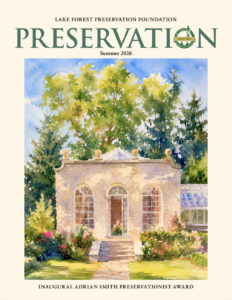
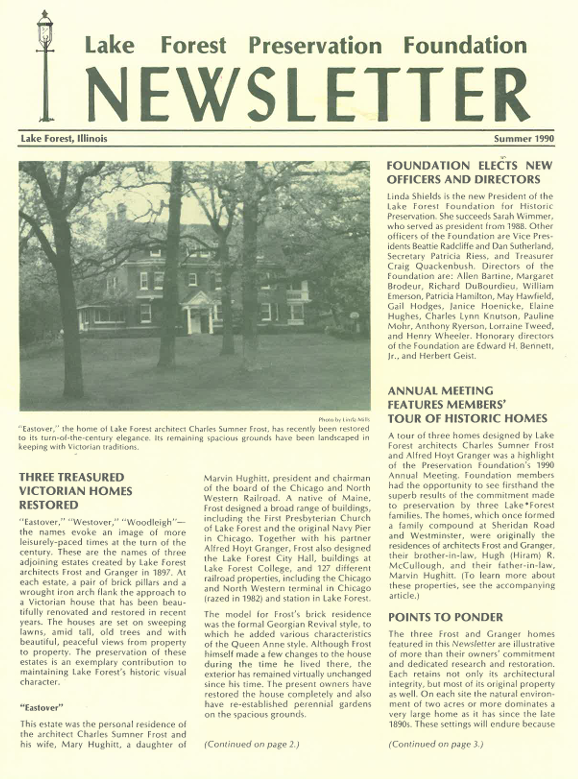
Lake Forest Preservation Foundation NEWSLETTER Lake Forest, Illinois Summer 1990 Photo by Linda Mills ”Eastover,” the home of Lake Forest architect Charles Sumner Frost, has recently been restored to its turn-of-the-century elegance, its remaining spacious grounds have been landscaped in keeping with Victorian traditions, FOUNDATION ELECTS NEW OFFICERS AND DIRECTORS Linda Shields is the new President of the Lake Forest Foundation for Historic Preservation, she succeeds Sarah Wimmer, who served as president from 1988, other officers of the Foundation are Vice Presidents Beattie Radcliffe and Dan Sutherland, Secretary Patricia Riess, and Treasurer Craig Quackenbush, Directors of the Foundation are: Allen Bartine, Margaret Brodeur, Richard DuBourdieu, William Emerson, Patricia Hamilton, May Hawfield, Gail Hodges, Janice Hoenicke, Elaine Hughes, Charles Lynn Knutson, Pauline Mohr, Anthony Ryerson, Lorraine Tweed, and Henry Wheeler, Honorary directors of the Foundation are Edward H. Berinett, Jr., and Herbert Geist, ANNUAL MEETING FEATURES MEMBERS’ TOUR OF HISTORIC HOMES A tour of three homes designed by Lake Forest architects Charles Sumner Frost and Alfred Hoyt Granger was a highlight of the Preservation Foundation’s 1990 Annual Meeting, foundation members had the opportunity to see firsthand the superb results of the commitment made to preservation by three Lake• Forest families, the homes, which once formed a family compound at Sheridan Road and Westminster, were originally the residences of architects Frost and Granger, their brother-in-law, Hugh (Hiram) R. McCullough, and their father-in-law, Marvin Hughitt, (To learn more about these properties, see the accompanying article.), THREE TREASURED VICTORIAN HOMES RESTORED “Eastover,” “Westover,” “Woodleigh”-the names evoke an image of more leisurely-paced times at the turn of the century, these are the names of three adjoining estates created by Lake Forest architects Frost and Granger in 1897, at each estate, a pair of brick pillars and a wrought iron arch flank the approach to a Victorian house that has been beautifully renovated and restored in recent years, the houses are set on sweeping lawns, amid tall, old trees and with beautiful, peaceful views from property to property, the preservation of these estates is an exemplary contribution to maintaining Lake Forest’s historic visual character, “Eastover” This estate was the personal residence of the architect Charles Sumner Frost and his wife, Mary Hughitt, a daughter of Marvin Hughitt, president and chairman of the board of the Chicago and North Western Railroad, a native of Maine, Frost designed a broad range of buildings, including the First Presbyterian Church of Lake Forest and the original Navy Pier in Chicago, together with his partner Alfred Hoyt Granger, Frost also designed the Lake Forest City Hall, buildings at Lake Forest College, and 127 different railroad properties, including the Chicago and North Western terminal in Chicago (razed in 1982) and station in Lake Forest, the model for Frost’s brick residence was the formal Georgian Revival style, to which he added various characteristics of the Queen Anne style, although Frost himself made a few changes to the house during the time he lived there, the exterior has remained virtually unchanged since his time, the present owners have restored the house completely and also have re-established perennial gardens on the spacious grounds, (Continued on page 2.), POINTS TO PONDER The three Frost and Granger homes featured in this Newsletter are illustrative of more than their owners’ commitment and dedicated research and restoration, each retains not only its architectural integrity, but most of its original property as well, on each site the natural environment of two acres or more dominates a very large home as it has since the late 1890s, these settings will endure because (Continued on page 3.), Homes Restored (Continued) “Westover” Charles Sumner Frost designed this estate immediately to the west of his own home for his brother-and sister-in-law, Mr. and Mrs. Hugh (Hiram) McCullough, Mrs. McCullough was Martha Hughitt, another daughter of Marvin Hughitt, and her husband was a vice president of the North Western at the time the house was built, like Eastover, the style of this brick home is Georgian Revival, but it is far more classical in detail, a later owner commissioned David Adler to add many refinements in terms of paneling, moldings, and other classical details to the first floor of the interior, the interior thus has less of a Victorian feeling than does Eastover, the spacious grounds of the restored estate, which includes all of its original property, are enhanced by magnificent trees and a. beautiful sweep of lawn to the south, “Woodleigh” The architect Alfred Hoyt Granger designed and built this home either as his own residence or as a residence for his father-in-law, Marvin Hughitt (Granger’s wife was the former Belle Hughitt), an 1897 issue of House Beautiful identifies the estate as the” Alfred Granger House,” and the 1928 Lake Forester account of Hughitt’s death identifies Woodleigh as Hughitt’s residence, Granger moved to Philadelphia around 1910, returned to Chicago in 1924, and retired to Connecticut in 1936, Granger, a native of Ohio, collaborated with Charles Sumner Frost in partnership from 1898 until about 1911, his independent work included the Church of the Holy Spirit in Lake Forest in 1910, as well as buildings for the University of Illinois, Kenyon College, the University of Indiana.. and the Chicago Club after 1924, Woodleigh, in the half-timbered English style, is markedly different from Eastover and Westover, the House Beautiful article called it “an interesting and quaint looking dwelling.”, constructed of reddish-brown paving bricks, the house includes cream-colored plaster in the upper stories and well-detailed timber work in the eaves and gables, the original formal garden on the north side of the property has recently been uncovered by the present owners, who are restoring the grounds as well as the house, OBSERVATIONS ON PRESERVATION-1988-1990 The following remarks were made by outgoing Foundation President Sarah Wimmer at the Foundation’s 1990 Annual Meeting, Whither 2020? Looking ahead to the future, I often wonder what Lake Forest will be like in 2020-just thirty years from now, we will no longer be here, but the decisions we make or fail to make in the coming years will have a profound effect on this community, will it be the desirable place in which to settle and live that it has been for the past century? will it be peopled by leaders as it has been? will Lake Forest itself be a leader among suburban Chicago communities, as it has been since the railroad opened up the North Shore more than a century ago? I wonder, it will be so only if we living here now and in the coming years care enough to preserve and protect what we have here-not just in the beauty of the land and streetscape, but in the rare quality of life Lake Forest provides, with the wonders of Lake Michigan at our doorstep, easy access to the great city of Chicago, its commerce and culture, and by O’Hare connected to other great cities of the world, we should recognize the challenge and the opportunity presented to us, if we do not, we will most certainly not care enough to preserve it, * * * (Continued on page 6.), PRESIDENT’S MESSAGE As the new president of the Preservation Foundation, I’ve been thinking not only of the challenges that face preservationists in the ’90s, but also of the great strides both local and national groups have made in saving our past treasures for future generations, I commend the Lake Forest Open Lands Association for their continued efforts to preserve our open space, their purchase of the Mcilvaine estate, along with a private donation of 10 acres, adds up to 26 acres of nature preserve along the West Skokie River, the first Open Lands’ preserve in western Lake Forest, on the national level, the Richard King Mellon Foundation of Pittsburgh has purchased and donated to the Federal government 100,000 acres of wildlife refuge and historic areas, this land is spread throughout seven eastern and southwestern states and includes the site of an historic Civil War battlefield, when the Lake Forest Preservation Foundation was founded fourteen years ago, its primary purpose was to conserve and perpetuate the historic character of Lake Forest, through the years the Foundation has kept to that goal by working with the City staff and boards and with residents to help preserve and keep Lake Forest a very special place, as pressure for development continues in the 90s, we will continue with our mission of progress through preservation, we will continue to inform and educate the community about the treasures that are ours, I encourage those of you who share our views on preservation and enjoy our newsletters to join our foundation, I also invite those who are members to take a more active role, our next Member’s Bulletin will detail our need for volunteers, please consider m’.’Hching your talents and time with these needs, Linda Shields, NEW STEPS TAKEN TO PRESERVE LAKE FOREST’S HISTORIC VISUAL CHARACTER The Lake Forest City Council took decisive preservation action April 14 by passing two ordinances designed to help conserve the city’s architectural and open-space heritage, the Preservation Foundation favored adoption of these measures and provided advice during their development, the new Historic Residential and Open Space Preservation ordinance, a revision of the Residential Historic Preservation ordinance, broadens the original ordinance regulating subdivision of historic properties by incorporating means for conserving the prime open space remaining in Lake Forest, revisions in the Building Scale and Environment ordinance are designed to preserve the visual character of the City’s built environment by providing for a delay to consider alternatives to demolition and requiring approval of replacement plans before issuance of a demolition permit, review by the Building Review Board will provide an opportunity to evaluate proposals where demolition and subsequent replacement of an existing home may impact the visual character of a neighborhood, other aids to environmental conservation include the Building Scale and Environment Ordinance, zoning regulations and control over zoning variations, architectural review, and open-space acquisition, in most of these areas, Lake Forest is an innovator among communities in the Chicago metropolitan area, indeed in the nation, only now, in crisis, are some other communities recognizing erosion and destruction of community character, and they are coming to Lake Forest for advice on how to save what remains of their historic visual ambiance, YOU’RE INVITED Sunday September 30 2:30 p.m. Rain or Shine Dr. Arthur H. Miller, Jr., College Librarian, will speak on the historical development of Lake Forest College and its architecture at the Lily Reid Holt Memorial Chapel, following his talk, he will lead a guided tour of selected buildings on the campus, refreshments will be served prior to the lecture in the lounge of Arthur Somerville Reid Hall, adjacent to the Chapel, the public is welcome, and walking shoes are recommended, parking in Middle Campus in designated, LAKE FOREST FOUNDATION FOR HISTORIC PRESERVATION Box 813, Lake Forest, Illinois 60045 I/We want to help preserve the historic character of Lake Forest, please enroll me/us in the selected membership category, (Contributions are tax deductible. Please make checks payable to the Preservation Foundation.) Mr. Mrs. Miss Telephone, Street, City State Zip, DI/We would like to actively work with the Foundation, please call me/us to discuss areas of interest, Member – Annual Dues $25.00, Contributing Member – Annual Dues $50.00, Sponsor – Annual Dues $100.00, Sustaining Member – Annual Dues $250.00, Patron – Annual Dues $500.00, Life Member – Contribution to the Revolving Fund in the amount of $1,000.00 or more, no annual dues required, The Preservation Foundation is open 10 .all who share its goal of progress through preservation, Points to Ponder (Continued) zoning east of Sheridan Road was upgraded to a one- and one-half acre minimum in the 1980s to ensure the preservation of such properties, nature will dominate these buildings as long as Lake Forest maintains this zoning, the zoning upgrade is just one of the means Lake Forest has employed to try to ensure that the natural ambiance created by the City’s development history will be preserved, in spite of the City’s diligence and recognized innovation, however, inconsistent change is noticeable, some accept such change as inevitable and ask: Why should newer homes be affected by standards applied to historic homes? Why can’t a property owner build as big a home as desired or alter at will, whether in a new subdivision, in an older neighborhood, or in a neighborhood with outdated homes from the 1930s, 40s, and 50s? Why not follow the trend of the times? basic principles of zoning apply, of course, as also does the City’s chartered obligation to preserve property values, an individual property owner’s rights must be evaluated in terms of a proposal’s affect on a neighbor or a neighborhood, beyond these basics, the development history of Lake Forest has set precedents which shaped a community of distinctive character where properties are sought after and increasingly valuable, the early settlers before the incorporation of Lake Forest built on open prairie, savanna., and wetlands in the area of the present location of Waukegan Road, this property tended to remain_ open even as development spread in the 20th century, upon annexation to The City of Lake Forest, this land was zoned to be consistent with its more open character, the 1857 plat of The City of Lake Forest considered the natural terrain, essentially mandating a city in a park, it showed a planned community having relatively small lots in the area east of the North Western tracks, however, as land in the area immediately east of the tracks was developed in the mid- to late 1800s, purchasers often bought several lots and placed their homes on relatively large plots, which were landscaped extensively to supplement the natural environment, this trend continued in later development along the lake front, the development along the ridge of Green Bay Road, beginning in the late 1800s, took place on farmland, it respected the open space and vistas of the prairie to the west with the development of larger, more open country estates, extensive formal and informal landscaping was installed in keeping with the properties already established to the east, the Green Bay Road estates, today so lush with mature trees, were largely treeless before landscaping, development west of Waukegan Road in the 1900s followed the country-estate trend of Green Bay Road, but here the properties were even larger and took on the character of “gentle-men’s farms.”, extensive landscaping was also an important addition here, thus the development trends of the 19th and early 20th centuries established the standard of landscape dominating the built environment, as plantings matured, the city in a park that we know today as Lake Forest also matured, coupled with attention to the natural environment was a unique dominance of client-architect development and single-family, property-owner development, both the grand estates and the modest houses were built one by one to suit the needs and desires of individual property owners, not until the mid-20th century did Lake Forest see a modest amount of developer-driven building, and no extensive speculative building was evident until the 1980s, today Lake Forest is faced with the challenge of “completing” a delicate environmental fabric that has evolved over nearly 150 years, new construction nestles comfortably into this environment when it is architecturally compatible and placed and landscaped to harmonize with more mature areas, it jars when out of scale, built in an incompatible style or of incompatible materials, or landscaped without regard for harmony with the mature environment, change in itself is not a problem; incompatible change is a serious problem when it destroys the unique mix that gives a community a special sense of place, Lake Forest has many different types of houses and neighborhoods, the City’s landmark-quality buildings are important; but so also are the numerous other buildings of lesser stature or more vernacular quality that together create a sum greater than any of the parts, whether a neighborhood is over 100 years old, 20 years old, or 2 years old, respect for its visual character is key to maintaining and enhancing its value, every property owner benefits from attention to aesthetics and architectural integrity, as Winston Churchill once said: “We shape our buildings, and then our buildings shape us.”, Lake Forest’s visual character has been shaped by its developmental history, the City has in place most of the tools necessary to foster the architectural and natural environment essential to maintaining this character, only the continued commitment to preserve this environment by everyone with a stake in the City’s future is needed to accomplish this goal, THE ARCHITECTURAL DIVERSITY OF LAIi FOREST Both the grand manor houses and the more vernacular modest homes of historic Lake Forest were built one by one to suit the needs of individual property owners, the result is a unique and delicate environmental fabric created over nearly 150 years, Observations (Continued) The past two years has been a time of change and progress, we in the Preservation Foundation have endeavored to promote preservation locally by our newsletter, programs, and other activities, we take some measure of pride in our efforts and accomplishments, we worked with the Historical Society on a joint program each year, open to the public and well attended, we made several grants, funded by members’ dues, to benefit preservation: To the First Baptist Church, to preserve and maintain its historic building by waterproofing the foundation, to the Advocates for the Public Interest in Fort Sheridan, to support their efforts to determine the best possible re-use of the Fort in the event of its closure, to the City of Lake Forest for replacing approximately $6,000 in ground cover at the North Western station, following the sizzling summer of 1988 (part of our yearly commitment to the Station Restoration since 1978), we submitted for the 1989 City-wide survey questions designed to provoke thoughtful answers, we continued in education with the publication of the Preservation Foundation Newsletter, which has become a valued historical resource, we mounted two preservation exhibits at the Lake Forest Library, we committed our efforts and funds in support of the restoration/reconstruction of the Walden-Bluffs Edge bridge, in this we were unsuccessful due to opposition from a few citizens and financial constraints on the City budget, as a result, we have returned to the donors the contributions earmarked for this project, we continued to monitor City meetings, where we are observers at the City Council, Plan Commission, and Building Review Board on a regular basis, finally, of particular interest to me has been the number of requests for information, advice, and help from our members, the general public, and The City of Lake Forest, we have met with City officials and individuals, and we have made progress and taken a stand where we felt it was important to do so, we supported two landmark ordinances passed this April-the Historic Residential and Open Space Preservation ordinance and the revised Building Scale and Environment ordinance, this legislation, properly enforced, will help preserve the character of Lake Forest, we look forward to the future of Lake Forest with confidence in the leadership of our new president, Linda Shields, and dedication to the principles for which this organization was founded, Sarah Wimmer Immediate Past President, PROPERTY TAX ABATEMENT AVAILABLE FOR REHABlLITATION The state legislation PA-1023 provides an eight-year property tax freeze in valuation for single-family, owner-occupied, historic homes in Lake Forest that are substantially rehabilitated, if they qualify under the terms and standards of the Act, forms for certification of a building as a·landmark as well as for certifying its rehabilitation are available from the Illinois Historic Preservation Office, Old State Capital, Springfield, IL 62701, (217) 785-4512, owners should check their plans with the state historic preservation office before beginning work, the cost of rehabilitation, including architect’s fees, must equal 25% of the fair market value of the house, as determined by the assessor at the time rehabilitation begins.