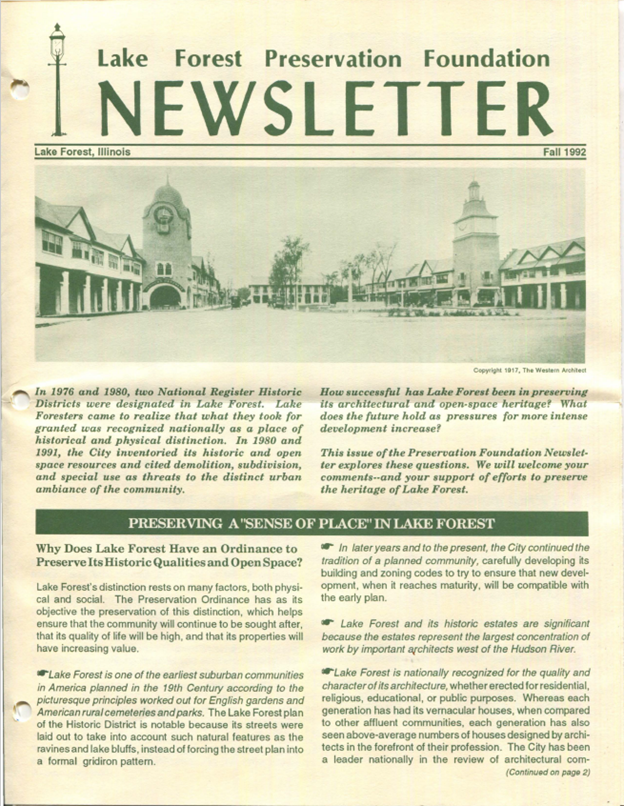
Lake Forest Preservation Foundation NEWSLETTER Lake Forest, Illinois In 1976 and 1980, two National Register Historic -Districts were designated in Lak-e Forest, Lake Foresters came to realize that what they took for granted was recognized nationally as a place of historical and physical distinction, in 1980 and 1991, the City inventoried its historic and open space resources and cited demolition, subdivision, and special use as threats to the distinct urban ambiance of the community, Fall 1992 Copyright 1917, The Western Architect How successful has Lake Forest been in preserving it architectural and open-space heritage? What does the future hold as pressures for more intense development increase? This issue of the Preservation Foundation Newsletter explores these questions, we will welcome your comments–and your support of efforts to preserve the heritage of Lake Forest, PRESERVING A “SENSE OF PLACE” IN LAKE FOREST Why Does Lake Forest Have an Ordinance to Preserve Its Historic Qualities and Open Space? Lake Forest’s distinction rests on many factors, both physical and social, the Preservation Ordinance has as its objective the preservation of this distinction, which helps ensure that the community will continue to be sought after, that its quality of life will be high, and that its properties will have increasing value, Lake Forest is one of the earliest suburban communities in America planned in the 19th Century according to the picturesque principles worked out for English gardens and American rural cemeteries and parks, the Lake Forest plan of the Historic District is notable because its streets were laid out to take into account such natural features as the ravines and lake bluffs, instead of forcing the street plan into a formal gridiron pattern, or In later years and to the present, the City continued the tradition of a planned community, carefully developing its building and zoning codes to try to ensure that new development, when it reaches maturity, will be compatible with the early plan, or Lake Forest and its historic estates are significant because the estates represent the largest concentration of work by important architects west of the Hudson River, Lake Forest is nationally recognized for the quality and character of its architecture, whether erected for residential, religious, educational, or public purposes, whereas each generation has had its vernacular houses, when compared to other affluent communities, each generation has also seen above-average numbers of houses designed by architects in the forefront of their profession, the City has been a leader nationally in the review of architectural com- (Continued on page 2) PRESERVATION FOUNDATION OFFICERS AND DIRECTORS Officers Sarah Wimmer–President Elaine B. Hughes–Vice President Susie Tiller–Vice President Richard J . DuBourdieu–Secretary William H. Emerson–Treasurer Directors Priscilla Billington Margaret F. Brodeur Carol A. Champ Leonard C. Everson Gail T. Hodges C. Lynn Knutson Geoffrey W. Luce Linda G. Mills Pauline M. Mohr David R. Moulton Beatrice Radcliffe Patricia C. Riess Anthony M. Ryerson Linda L. Shields Dan Sutherland Lorraine A. Tweed Honorary Directors Edward H. Bennett, Jr. Herbert Geist Henry P. Wheeler, Sense of Place (Continued from page 1) How Does the Ordinance Work? The Ordinance includes detailed maps–of the entire patibility, building scale, and lighting and sign design, and in demolition protection, lllrThe quality of construction of estates in Lake Forest was very high, this standard influenced subsequent development, the City’s codes are designed to help ensure a compatible continuation of this tradition, Landscaping, both planned and natural, has always been held in high regard in the community, from the first parklike development carved out of the forest near Lake Michigan, to the estates developed on nearly barren farmland on Green Bay Road, to the farm estates created west of the Skokie Valley, there has been a desire to enhance and preserve, Lake Forest has matured with more open space remaining than any other North Shore community, lllrFor more than 25 years, conservation and restoration of the natural open space environment of Lake Forest has been a priority, City–which inventory properties determined to be critical to maintaining the City’s character and property values, Subdivision and demolition are determined to present the greatest threat to the City’s historic and open space resources, therefore, requests for these actions are carefully reviewed, petitions for subdivision must be reviewed by the Plan Commission as applications for Special Use, to afford the opportunity to negotiate the optimum conservation of resources, applications for demolition must be reviewed by the Building Review Board, there is a two-year moratorium on demolition unless one of three criteria for exception is met, replacement structures must be approved before demolition or building permits can be issued, What Has the Ordinance Accomplished? The Ordinance has helped preserve properties in a// areas ~ of Lake Forest, though not “perfect,” without the Ordinance, growth might have been more intense and the new construction in the Historic District less compatible with the (Continued on page 5) PRESIDENT’S LETTER Recently the City completed the new “Milwaukee Road” Metra station just north of Everett Road, designed by Lake Forest architect Richard Geudtner, the station is in a modified English Norman style, be sure to stop by and take a look at it, the opening of this new public building, well designed and well built to serve generations to come, tells a lot about Lake Forest’s attitude toward its civic buildings, the attitude is one that values tradition and stewardship, all cities are not so lucky, in the mid-1960s New York City lost a building of architectural eminence and civic stature, Pennsylvania Station, designed by McKim, Mead & White between 1902 and 1911 and covering a site of nearly eight acres, was demolished, this should not have been allowed to happen, now, a generation later, people are still asking, “Why?” this grand and elegant structure was of a style befitting a large public gathering place, the general waiting room had been modelled on the tepidarium of the Baths of Caracalla (Rome A.O. 212), the exterior was Roman travertine, in his History of Western Architecture, David Watkins states: “Pennsylvania Station has probably never been equalled as a triumph of engineering and organization in which the classical language was used to enoble a mundane activity.” It’s gone–forever–but I remember it as it was during the time I lived in New York City, what a loss! another major loss occurred in Chicago in 1984, when the Chicago and North Western Station was demolished, this fine building had been designed by Frost and Granger (both residents of Lake Forest), who also designed the other stations along the North Shore, including our own station here in Lake Forest, you may recall that Charles Sumner Frost and Alfred H. Granger were sons-in- law of Marvin Hughitt, the President of the North Western Railroad, so it was no accident that they were the architects of several fine stations, while Chicago lost a major station, our North Western station was being restored completed in 1986 largely through our own efforts . we were not alone in restoration oi a major public building, in recent years stations in Washington, D.C., Cincinnati, St. Louis, and other cities have reopened to new splendor and usefulness, buildings come and go, some are lost by fire; many are lost through neglect and decay or lack of funds, it’s up to the citizens of a community to look after their historic buildings, it’s important for Lake Foresters to continue their past stewardship into the future, Sarah Wimmer, Sense of Place (Continued from page 2) City’s historic ambiance, maturity takes time, when we view the historic Green Bay Road estates today, it is hard to imagine that ninety years ago they were largely open farm land, it is hard to imagine Lake Forest Academy as the J. Ogden Armour estate with its extensive landscaped grounds and formal gardens, being built on vast acres of swamp, What Does the Future Hold? The Ordinance, as implemented over the past 12 years, has been reconfirmed by the City Council and the Plan Commission to be valuable legislation for conserving the resources that determine Lake Forest’s quality, the positive effect of the Ordinance is a benefit for every property owner, whether living in an historic home, in a new home, or on the edge of a conservation area, enforcement must be increasingly diligent, however, or the intent of the community to define itself in terms of its heritage will be diminished, the effect will be evident throughout Lake Forest, on September 8, the City Council upheld a Plan Commission recommendation to deny the proposed Gimbel subdivision of part of the historic Noble Judah estate on West Westminster, this action reconfirmed the City’s commitment, through its Residential Historic Preservation and Open Space Ordinance (enacted in 1980 and revised in 1990), to maintain Lake Forest’s historic and open space ambiance, the case was not a simple one, the petitioner submitted a proposal in March 1990 that was turned down by the Plan Commission, after a new plan was presented in June 1991, there was a full exploration of nuances of the Ordinance and thought-provoking testimony by preservation experts and residents alike, ilr’The property warranted consideration of only two lots, thus leaving no room for negotiating a reduction in number of lots, a common practice in applications of the Ordinance, ilr’The donation of a conservation easement, which can provide a substantial economic alternative to subdivision, apparently was not an option for the property owner, ilr’The City’s historical consultant, architectural historian Dr. Paul E. Sprague, had issued an opinion that another subdivision of the estate “would not further threaten the character of the estate” as it had been originally constructed and platted, at the time, he did not know that the Judah manor house to the east and the bath houses and pool on the Gimbel property recently had received the distinction of being listed on the National Register of Historic Places, ilr’The Acting General Counsel of the National Trust for Historic Preservation confirmed that the Ordinance required findings to determine whether the proposal would adversely affect the residential value of surrounding properties, the majority of the Plan Commission, in reaching their decision, recommended denial of the request for subdivision because they could not determine that there would not be an adverse effect on neighboring properties, the City then hired Clarion Associates, a nationally recognized appraiser of historic properties used on earlier City projects, to prepare a report prior to the Council hearing on the proposal, Clarion’s findings were that there would be an adverse effect on the historic Judah manor house, the petitioner’s attorney provided no evidence to the contrary, _.A representative of the Landmarks Preservation Council of Illinois and the architectural historian who prepared the National Register listing testified as to the unique qualities of the National Register structures, they noted the fact that erosion of historic character has a negative impact on property values in historic districts, –rhe neighbors were unanimous in opposition to the proposal’s dissimilarity to neighborhood setbacks and to other lots subdivided earlier from the Judah estate and the historic Brewster estate on the north side of the street, What Does this Decision Mean to the City? The provisions of the ordinance are believed by national preservation counsel to have been met because the proposal was deemed inappropriate after findings were presented that it would adversely affect the value of other property, the “Penn Central Decision” of 1978, which upheld New York City’s landmark ordinance, confirmed the broad authority of government to regulate the use of land both to prevent harm and to promote public benefit, recently, judgments in three cases before the U. S. Supreme Court have added to an extensive body of case law that carefully balances private property rights and the public’s interest in protecting community, environmental, and cultural values, these decisions reinforce the basic principles that support public interest regulations such as Lake Forest’s ordinance, the majority of the Council and the Plan Commission have demonstrated commitment to preservation , the Foundation applauds their action, Champagne buffet Reception to honor the national register listing of the deer path inn Friday March 5, 1993. Proceeds to benefit preservation projects, LAKE FOREST’S PRESERVATION COMMITMENT RECONFIRMED, ADAPTIVE USE: OLD BUILDINGS RENEWED TO PRESERVE AND ENHANCE OUR “SENSE OF PLACE” Every town has its own “culture,” distinctive qualities that give it a sense of place, in older towns like Lake Forest, old buildings, some fine and some ordinary, give the present reassuring roots to the past in a way that no ’50s suburb or ’90s neo-architectural “new town” can, times change, life styles change, the original purpose of old buildings may no longer be relevant, buildings may need repair or updating, how do we make them ”fit” new times, even new places? Adaptive use is often the answer, it has been a Lake Forest tradition since the 1860s, What Is “Adaptive Use? It’s not simply restoration of an old building, it may not be restoration in the pure sense at all, but it’s a commitment to look creatively at a structure from the past to save it for some future use, but not necessarily for the purpose for which it was built originally, adaptive use has many effects, it may preserve a relic from a former era to remind us of our past, a period of development, a certain time in history, it tells us of good–or bad-architecture, it speaks of different styles and tastes, of quality that could be afforded, of the evolution of a place, Lake Forest is fortunate to have many fine examples of adaptive use, the Preservation Foundation honored several of these buildings in 1991 and 1992: The Old Fire Station on Forest Avenue, now Southgate Cafe, served as a fire station and jail, then as a Rec Department building, before it became a restaurant, The Murrie Blacksmith Shop on Deer Path, now The Country House, began its life as a blacksmith shop and a drayage barn for the revered Sam Dent’s livery service, The 1858 John Andrews King House on Green Bay Road is a combination of a country post office (circa 1858) and a school house (circa 1892), there are many other good examples in our midst, some adapted from historic buildings and some from buildings less than 50 years old, here are a few you should know about in the heart of town: The Young Men’s Club on Forest Avenue at Market Square, designed in 1916 by Howard Van Doren Shaw, later housed the Rec Department and was converted to North Gate Center in the 1980s, The Lake Forest Consolidated Bank, designed by Shaw in 1916, also housed the gas company before it was converted for use by Marshall Field’s on Market Square, The North Western Depot, designed in 1899 by Frost and Granger and restored in the 1980s, has been adapted to house convenience businesses and a bank for commuters, City Hall, designed in 1898 by Frost and Granger, at one time was a multi-use building, also housing the first library (now the Council Chamber) and the fire department (hoses were hung to dry in the tower now used as a staircase), Renovation in the early 1980s updated and improved the facility to better serve the City, The Deer Path Theater, designed by Stanley Anderson in 1928, became the offices and Arcade on Deerpath when redesigned by John Vinci in 1990, First Baptist Church, on Oakwood Avenue, was constructed from part of the Noble Avenue School and a meeting house on Westminster, both parts dating from the 1800s and moved to the present site, Gorton Community Center, built in 1901 and remodeled last in 1953, was an abandoned elementary school scheduled for demolition in 1972, when citizen efforts brought it back to life as a privately funded community center, Doctors’ Offices at Western and Vine Avenues, circa 1960s, were remodeled to blend with the adjacent residential neighborhood and transformed into new quarters for Wenban Funeral Home, Lake Forest College has several prime examples of adaptive use, especially significant are the Old North Gym (1890 by Henry Ives Cobb), which was rebuilt after a 1969 fire and became home to the Departments of Psychology, Sociology, and Anthropology in 1988, and Patterson Lodge ( 1879), the first president’s house, which later was a women’s dorm and served as admissions offices, it now is undergoing a complete restoration on the exterior and a complete update on the interior for use as the Admissions Office, elsewhere in town, adaptive use abounds: “Ragdale” and the Ragdale Barn at 1230 and 1260 North Green Bay Road, once the home of architect Howard Van Doren Shaw, now house The Ragdale Foundation and can be used by community groups, the barn house, a portion of which dates from1838, is one of the oldest houses in Lake Forest, the house dates from 1896 ., The Dr. Charles H. Quinlan House, at 334 East Westminster, dates from 1862 and was the first school in Lake Forest, originally located at the northwest corner of Washington and Walnut Roads, it was converted to a residence in 1867 and moved to its present site circa 1906, The Henry Clay Durand Barn on Mayflower Road remained after the Du rands’ 1860s house was destroyed by fire in the early 1900s, it was converted to a home in 1962, Woodbine Lane contains a collection of homes, all converted from outbuildings of nearby estates dating from the early 1900s, The Ferry Hall Chapel and South Hall, on Mayflower Road, dating from 1869 and 1928, have been adapted as a private residence and as condominiums, The Barns, Poultry House and Staff Cottages of the Leonard Estate on Hathaway Circle, lnverlieth Road, and Greenvale Road, designed in 1923 by Ralph Varney, have all been converted to residences, “Mellody Farm,” the J. Ogden Armour Estate, designed in 1908 by Arthur Heun, became the home of Lake Forest Academy in 1947, pre-1929, it had been destined to become the Aviation Golf Club, “Mill Road Farm,” the Albert Lasker Estate, between Everett and Old Mill Roads, designed by David Adler, contained a multitude of buildings, including a theatre, a gatehouse, dairy barns, and a golf club house, all have been converted to residences, the pool even became the foundation for a new house, McAdams Florist Complex, at Waukegan and Conway Roads, circa 1960s, was remolded to become new shops and offices for Conway Court, the buildings mentioned are part of the fabric that comprises our local heritage, all may not rank equally in importance or beauty, but all add to the character of the community as a whole, the Preservation Foundation recognizes their collective significance’ , and commends those whose foresight and creativity preserved these buildings of different styles and different periods that help maintain the City’s roots with its past, if there are buildings you know of not included on our list or buildings with possibilities that you’d like to see included, please Jet us know of them, we’d like to feature them in a future Newsletter, when you here Lake Forest called “a Special Place,” are you aware that: ..-Lake Forest was one of the earliest planned communities of the 1850s? ..-Lake Forest was one of the first North Shore communities to be honored by the Nation¢, Register? ..-Lake Forest has a history of adaptive use dating to the 1860s? ..-Lake Forest has the largest extant assemblage west of the Hudson River of estates designed by important architects?