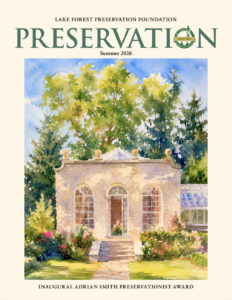
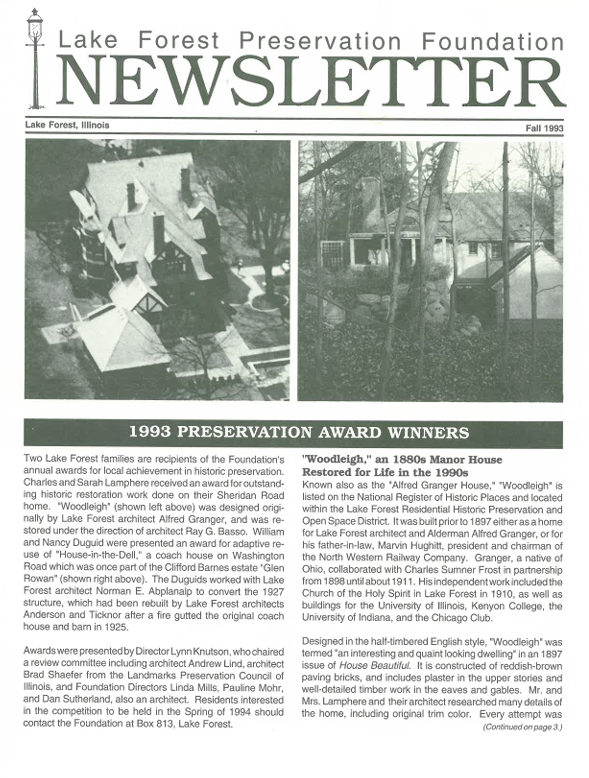
Lake Forest Preservation Lake Forest, Illinois Fall 1993 1993 PRESERVATION AWARD WINNERS Two Lake Forest families are recipients of the Foundation’s annual awards for local achievement in historic preservation, Charles and Sarah Lamphere received an award for outstanding historic restoration work done on their Sheridan Road home, “Woodleigh” (shown left above) was designed originally by Lake Forest architect Alfred Granger, and was restored under the direction of architect Ray G. Basso, William and Nancy Duguid were presented an award for adaptive reuse of “House-in-the-Dell,” a coach house on Washington Road which was once part of the Clifford Barnes estate “Glen Rowan” (shown right above), the Duguids worked with Lake Forest architect Norman E. Abplanalp to convert the 1927 structure, which had been rebuilt by Lake Forest architects Anderson and Ticknor after a fire gutted the original coach house and barn in 1925, awards were presented by Director Lynn Knutson, who chaired a review committee including architect Andrew Lind, architect Brad Shaefer from the Landmarks Preservation Council of Illinois, and Foundation Directors Linda Mills, Pauline Mohr, and Dan Sutherland, also an architect, residents interested in the competition to be held in the Spring of 1994 should contact the Foundation at Box 813, Lake Forest, ”Woodleigh.” an 1880s Manor House Restored for Life in the 1990s Known also as the “Alfred Granger House,” “Woodleigh” is listed on the National Register of Historic Places and located within the Lake Forest Residential Historic Preservation and Open Space District, it was built prior to 1897 either asa home for Lake Forest architect and Alderman Alfred Granger, or for his father-in-law, Marvin Hughitt, president and chairman of the North Western Railway Company, Granger, a native of Ohio, collaborated with Charles Sumner Frost in partnership from 1898 until about 1911, his independent work included the Church of the Holy Spirit in Lake Forest in 1910, as well as buildings for the University of Illinois, Kenyon College, the University of Indiana, and the Chicago Club, designed in the half-timbered English style, “Woodleigh” was termed “an interesting and quaint looking dwelling” in an 1897 issue of House Beautiful, it is constructed of reddish-brown paving bricks, and includes plaster in the upper stories and well-detailed timber work in the eaves and gables, Mr. and Mrs. Lamphere and their architect researched many details of the home, including original trim color, every attempt was (Continued on page 3.), PRESERVATION FOUNDATION OFFICERS AND DIRECTORS Officers Pauline M. Mohr-President Elaine B. Hughes-Vice President Susie Tiller-Vice President Margaret Brodeur—Secretary Richard J. DuBourdieu Treasurer Directors Priscilla Billington Carol A. Champ Thomas Eckland William H. Emerson Leonard C. Everson Kathyrn Gilbertson C. Lynn Knutson Geoffrey W. Lance Linda G. Mills David R. Moulton Beatrice Radcliffe Patricia C. Riess Anthony M. Ryerson Linda L. Shields Dan Sutherland Lorraine A. Tweed Sarah Wimmer Honorary Directors Edward H. Bennett, Jr. Herbert Geist Gail T. Hodges Henry P. Wheeler, PRESIDENT’S MESSAGE 1he systematic destruction over the past fifty years of America’s old residences–great houses, modest dwellings, and apartment buildings –has been one of the mqjorfactors in the architectural impoverishment of our cities, This vandalism has also created an almost insuperable barrier to a full understanding of our nation’s past, these are strong words from David Lowe writing in Lost Chicago, a photographic history of many of the great buildings in the city of Chicago that have fallen to the wrecking ball during the past half century, the destruction of buildings, which is, in a sense, the destruction of an a”spect of public history as well, did not take place in Chicago and other large cities alone, it was–and still is–happening all across our country, from the largest cities to the smallest communities, Lake Forest is not immune and has lost some significant manor houses along with a number of more humble, but historically expressive, small buildings, nevertheless, Lake Forest continues to retain enough of its original character to distinguish it asa unique community of historical and architectural interest, it is the mission of the Preservation Foundation to foster and promote the preservation of this historical and architectural legacy even as we, the directors and members, monitor, encourage, and acceptthe changes that will bring our city into the 21st century, Pauline M. Mohr, Winners of the Foundation’s essay contest, “My Favorite Historic Place in Lake Forest,” (top to bottom): Bill Rutledge, First Prize; Christian Fuqua and Kymberlie Stansell, Runners-Up, , THE FOUNDATION IN THE NEWS Atthe Annual Meeting, the Foundation’s new president, Pauline Mohr, thanks outgoing President Sarah Wimmer for her many years of preservation effort in Lake Forest, during the Lake Forest Day parade, former Foundation presidents Linda Shields and Sarah Wimmer join President Pauline Mohr in an antique car driven by Board member Thomas Eckland, THE LAKE FOREST FOUNDATION FOR msTORIC PRESERVATION WHATITIS-WHATITDOES The Lake Forest Foundation for Historic Preservation (“The Preservation Foundation”) was chartered August 4, 1976, for the purpose of fostering the preservation of the sites, structures, and amenities that comprise Lake Forest’s historic visual character, the Foundation has grown from five charter members to an organization of several hundred families, working to help Lake Foresters preserve their visual heritage, it has: Returned its revenue to the community in the form of public service projects such as : the funding and under-writing of research, engineering studies, and photography of significant buildings, sites, and neighborhoods, Published The Preservation Foundation Newsletter, distributed three times a year without cost to all Lake Forest homes, businesses, and postal box holders, Initiated the renovation of the North Western Station, spearheaded fund-raising for the project, and undertaken planning and completion of the project in cooperation with the City and with the contributions of residents, community groups, station tenants, businesses, and the RTA, Encouraged the renovation of historic buildings, such as the Old Rec Center, the Old Fire Station, City Hall, Northcraft, and Handy Green, Assisted owners of historic properties with restoration and renovation resources and information on tax incentives, • Sponsored and cosponsored public forums, workshops, and other programs to disseminate information about Lake Forest’s historic resources and ways to preserve them, Observed City meetings and presented testimony on issues rel9ted to preserving the City’s character, Provided consultants and recommendations to City bodies and staff, THE LAKE FOREST FOUNDATION FOR msTORIC PRESERVATION WHATITIS-WHATITDOES The Lake Forest Foundation for Historic Preservation (“The Preservation Foundation”) was chartered August 4, 1976, for the purpose of fostering the preservation of the sites, structures, and amenities that comprise Lake Forest’s historic visual character, the Foundation has grown from five charter members to an organization of several hundred families, working to help Lake Foresters preserve their visual heritage, it has: Returned its revenue to the community in the form of public service projects such as : the funding and under-writing of research, engineering studies, and photography of significant buildings, sites, structures, and amenities that comprise Lake Forest’s historic visual character, Published The Preservation Foundation Newsletter, distributed three times a year without cost to all Lake Forest homes, businesses, and postal box holders, Initiated the renovation of the North Western Station, spearheaded fund-raising for the project, and undertaken planning and completion of the project in cooperation with the City and with the contributions of residents, community groups, station tenants, businesses, and the RTA, Encouraged the renovation of historic buildings, such as the Old Rec Center, the Old Fire Station, City Hall, Northcraft, and Handy Green, Assisted owners of historic properties with restoration and renovation resources and information on tax incentives, • Sponsored and cosponsored public forums, workshops, and other programs to disseminate information about Lake Forest’s historic resources and ways to preserve them, Observed City meetings and presented testimony on issues rel9ted to preserving the City’s character, Provided consultants and recommendations to City bodies and staff, JOIN US! THE LAKE FOREST FOUNDATION FOR HISTORIC PRESERVATION Box 813, Lake Forest, Illinois 60045 I/We want to help preserve the historic character of Lake Forest, please enroll me/us in the selected membership category, (Contributions are tax deductible, Please make checks payable to The Preservation Foundation.) Mr.IMS. Mrs. Miss _ Stree. Telephone—–City State Zip D I/V’Je would like to work actively with the Foundation, please call me/us to discuss areas of interest, The Preservation Foundation is open to all who share its goal of progress through preservation, D Member–Annual Dues $35 D Contributing Member–Annual Dues $50 D Sponsor–Annual Dues $100 D Sustaining Member–Annual Dues $250 D Patron–Annual Dues $500 O Life Member–Contribution to the Revolving Fund in the amount of $1,000 or more, No annual dues required, The Preservation Foundation Newsletteris published by The Lake Forest Foundation for Historic Preservation and distributed without charge to the residents and businesses in theCity of residents and businesses in theCity of Lake Forest, Preservation Awards (Continued) made to match the original appearance of the house, an asphalt shingle roof was removed and sawn cedar shingles were installed as per the original, the 1970s flat-roofed garage was redesigned and built in the style of the original residence, then connected with a breezeway, “House-in-the-Dell,” a 1920s Coach House Adapted for Contemporary Living, “House-in-the-Dell” is one of Lake Forest’s secret treasures, located within the Lake Forest National Register District and the Residential Historic Preservation and Open Space District, it is hidden behind trees and sited at a level lower than the street on one of the city’s major ravines, adaptive reuse of the structure actually began in 1927, when Stanley Anderson rebuilt the gutted building after the fire by using allof the original foundation and incorporating much of the original concrete, the Anderson structure housed a three-car garage, boiler room/coal cellar, two horse stalls, and a tack room including one cow stanchion, the upper floor was apartment space with two baths, the Duguids had lived in Lake Forest for more than 20 years before they found this charming, but in 1981, dilapidated, building, their work was completed in 1983, though they did not want a period interior, they made every effort to maintain the exterior in its original form, the entrance was sited in the location of the three sets of garage doors, and the brick pillars which had separated the garage doors were reused and quoining was added, all original windows were removed, stripped, refinished, and reinstalled, only three new windows were needed, the roof was redone, copper gutters cleaned and reattached, and stucco was removed and new stucco applied, on the interior, all five-panel interior doors were reused, and their number dictated the number of rooms requiring door entries, all cabinetry was reused from the harness room, the wood being of a diagonal pattern, four pillars from the horse stalls were reused in the living space, defining the entry hall/ dining area, What Preservation of These Properties Means to the Community, the commitment of these property owners to preserving some of Lake Forest’s history for future generations is commendable, with other owners or in other communities, where no municipal legislative commitment has been made to preservation, these buildings might have been demolished, after all, “Woodleigh” was a large and outdated house by some contemporary standards, “House-in-the-Dell” was a small, relatively insignificant outbuilding in very poor physical condition, in Lake Forest, the City in 1980 made a commitment to preserving the architectural and landscape “roots” that give our community a sense of place, the Residential Historic Preservation and Open Space Ordinance is designed to conserve cultural and natural resources, firm continuing support for the Ordinance is essential to maintain Lake Forest’s distinctive visual character, further, the City must evaluate the challenges of new construction and the character and quantity of development of our remaining open space, GREEN BAY ROAD NATIONAL REGISTER DISTRICT, Foundation Directors Linda Mills and Lynn Knutson, with the assistance of research assistant Traci Schnell and the cooperation of numerous property owners, are making excellent progress on the nomination of the Green Bay Road District to the National Register of Historic Places, properties have been identified, detailed maps have been drawn, and research is being accumulated, members of the Foundation and others who are interested in doing research and photography for the nomination are invited to help with this project, call Linda Mills or 295-9354 or Lynn Knutson at 295-5094 to volunteer, What Is the National Register? The National Register of Historic Places is the nation’s official schedule of cultural property worthy of preservation, election to the Register is the highest national honor that can be awarded to an historic place, properties within a National Register District or listed individually on the National Register are eligible for federal and state tax benefits and may be afforded protection from adverse effects of any federally funded or licensed project, no restriction is placed upon the property owner, listing on the Register does not protect a property from demolition, The City Needs Your Help, the Preservation Foundation recently donated a grant of $2,500 to the City of Lake Forest to help fund the work of graduate student Traci Schnell in creating a comprehensive listing of all “significant” houses within the City’s Residential Historic Preservation District, in conjunction with this survey, the City is seeking information on any house 50 years old or older, if you have information, old plat plans, architectural plans, or photographs, please call Chuck Crook, Director of Community Development, The City of Lake Forest, 234-2600, to arrange for the City to borrow your materials for copying, any items lent will be copied carefully and returned promptly to the owner, The City Needs Your Help, The Preservation Foundation recently donated a grant of $2,500 to the City of Lake Forest to help fund the work of graduate student Traci Schnell in creating a comprehensive listing of all “significant” houses within the City’s Residential Historic Preservation District, in conjunction with this survey, the City – is seeking information on any house 50 years old or older, if you have information, old plat plans, architectural plans, or photographs, please call Chuck Crook, Director of Community Development, The City of Lake Forest, 234-2600, to arrange for the City to borrow your materials for copying, any items lent will be copied carefully and returned promptly to the owner, Lake Forest has two National Register Districts, one includes most of the original City of Lake Forest, the other is comprised of most of Vine Avenue andproperties on Green Bay Road and Oakwood Avenue north of Vine Avenue and south of St. Mary’s Church, eighty properties within these Districts are specially cited, but all District properties over 50 years old are considered to be “on the Register,” four other local properties are individually listed on the Register: “Ragdale,” the Arts and Crafts home of architect Howard Van Doren Shaw; “Mellody Farm,” the J. Ogden Armour estate now Lake Forest Academy; the Noble Brandon Judah manor house; and Deer Path Inn, other nearby properties include the Lester Armour manor house in Lake Bluff and Fort Sheridan, which is also a National Historic Landmark, PROPERTY OWNER BENEFITS NEW TAX LAW MAKES EASEMENT DONATIONS MORE BENEFICIAL TO THE PROPERTY OWNER, The Revenue Reconciliation Act of 1993 repeals the Alternative Minimum Tax (AMT) preference for donations of appreciated property, thus offering greater benefit to the donor of a preservation or conservation easement, “Taxpayers may now deduct-for both regular -tax and AMT purposes-the fair market value (tax basis plus any long-term capital gain) of contributions of appreciated, long-term capital gain tangible personal property made after June 30, 1992, and for all types oflong-termcapitalgainpropertycontributedin1993.” (Source: “The 1993 Tax Act: The Challenges Ahead,” Arthur Andersen & Co., SC.), preservation/conservation easements can benefit the individual property owner and help maintain the historic visual character of Lake Forest, the Preservation Foundation and The City of Lake Forest encourage such easements to help preserve the facades of historic buildings, the character of historic properties, and the open space and landscaping that contribute so much to the distinctive character of our community, the Lake Forest Open Lands Association also encourages conservation easements, given the rising cost of land, the income tax value of conservation easements, particularly, can be substantial and offer an attractive alternative to subdivision and sale, further, the income tax benefit afforded by a facade or conservation easement can free up resources for renovation of an historic home, for an article giving details on this topic, write to: The Preservation Foundation, Box 813, Lake Forest, IL 60045, for further information, contact Charles E Crook, Director of Community Development, The City of Lake Forest, 11O East Laurel Avenue, Lake Forest, IL 60045, 234-2600, or Stephen Christy, Executive Director, Lake Forest Open Lands Association, 560 North Oakwood Avenue, Lake Forest, IL 60045, 234-3880, PROPERTY ASSESSMENT FREEZE AVAILABLE FOR REHABILITATION, the state legislation PA-1023 provides an eight-year property valuation assessment freeze for single-family, owner-occupied, historic homes in Lake Forest that are substantially rehabilitated, if they qualify under the terms and standards of the Act, forms for certification of a building asa landmark and of its rehabilitation are available from the Illinois Historic Preservation Office, Old State Capital, Springfield, IL 62701, (217) 785-4512, owners should check their plans with the state historic preservation office before beginning work, the cost of rehabilitation, including architect’s fees, must equal 25% of the fair market value of the house, as determined by the assessor before rehabilitation, properties individually listed on the National Register of Historic Places or included as an historic property in a National Register Historic District are certifiable, LF GARDENS AND LANDSCAPING FEATURED AT ASIA ANNUAL ME�ING, five Lake Forest properties were featured recently in a special Lake Forest garden tour held in conjunction with the American Society of Landscape Architects Centennial Annual Meeting in Chicago, three historic estates were visited: “Centaurs”–(shown above) designed by Henry Dangler and David Adler and landscape architect Ferruccio Vitale for Mr. and Mrs. Alfred E. Hammil (renovated by Howard Decker and James Martin Associates), “Fairlawn”–designed by Delano and Aldrich and landscape architect Frederick Law Olmsted for Robert G. and Grace Farwell McGann (renovated by James March Goldberg Associates and Scott Byron & Co., Inc.), and “Bagatelle”–designed by Edward H. Bennett, Sr., for Mr. and Mrs. Edward H. Bennett, Sr. (renovated by Robert Geudtner and Associates and Mariani Landscape, Inc.), other properties visited during the tour were Market Square, designed by Howard Van Doren Shaw and believed to be the country’s first planned shopping center (renovated by John Vinci), and Open Lands Park, designed by English garden designer John Brookes with the assistance of Evanston landscape architect Douglas Hoerr, of interest to local residents may the ASLA’s observations about the historic and recent development of Lake Forest: Lake Forest was one of the first suburban developments in the United States planned according to the romantic tradition of rural cemetery design soon after the founding of the Onwentsia Club in 1895, the businessmen began to summer in Lake Forest in order to be within convenient distance of their downtown offices, a wave of country house construction soon began, producing near-competitive attempts to secure the best-known architects and landscape designers of the day, this era produced dozens of country estates on a lavish scale, and construction continued well into the Great Depression…. as America’s and Chicago’s industry grew more diversified, many family fortunes became reduced over ensuing generations, since the middle decades of this century, nearly all of Lake Forest’s great country places have been subdivided, during the real estate boon of the 1970s and 1980s, most of the pastoral landscape in the southwest quadrant of Lake Forest was subdivided and developed, most of the remaining open space is found in the northwest quadrant and on a few estates in the Green Bay and Ridge Road areas, the rampant sprawl of the 1980s increased community awareness of the destruction of local natural resources, the result has been rapid growth of the Lake Forest Open Lands Association in the 1990s to over 1,000 (members), construction continues into the 1990s, however, the original estate houses which remain in Lake Forest are highly sought after for their quality, size, and landscape design, Join the Preservation Foundation for “In the Wake of the Columbian Exposition” A Slide Lecture by Franz Schulze Thursday, October 28, 7:30 p.m. Gorton Community Center Free to Members, $5 for Nonmembers, the Foundation invites you to hear Professor Emeritus Franz Schulze of Lake Forest College discuss the impact of the 1893 World’s Columbian Exposition on the development of Chicago in the years immediately following this phenomenal World’s Fair, over half the population of the United States came to Chicago to view turn-of-the-century innovations and a classically designed “White City” that created a “grand illusion” in a setting that had been wetlands, for many, the Fair was the highlight of a lifetime, these visitors carried back home with them a host of influences that had an impact on the country for years to come, a number ,.,r;if,..�1/r,–i ,.,r;if,..�1/r,–iof architects who came to Chicago to work on the Fair stayed and established Midwest offices, some designed estate houses in Lake Forest, at Cyrus McCormick’s estate “Walden,” timbers used in building the Walden-Bluff’s Edge Bridge were recycled from the Fair, Jarvis Hunt, architect of “Walden,” came to oversee construction of the Vermont State Building at the Fair, and Warren Manning, landscape architect of “Walden,” had come as a member of the staff of the Fair’s landscape architect, Frederick Law Olmsted, architects of the Art Institute building, Shepley, Rutan, and Coolidge, were also among those who established Chicago offices in the years after the Fair and designed homes in Lake Forest and elsewhere in the Chicago area, for further information, call Directors Elaine Hughes, 234-3850, or Sarah Wimmer 234- 3293 (evenings), NON-PROFIT ORG. U.S. POSTAGE PAID PERMITNO.184 LAKE FOREST, IL 60045 NON-PROFIT ORG. U.S. POSTAGE PAID PERMITNO.184 LAKE FOREST, IL 60045 The Preservation Foundation Box 813, Lake Forest, Illinois 60045 CAR-RT Inside: Preservation Awards Property Owner Benefits Membership Information