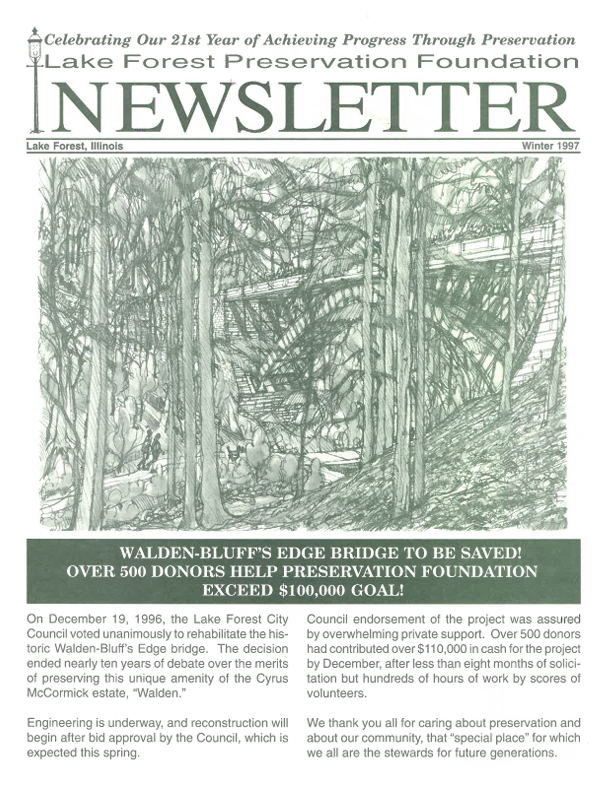
Celebrating Our 21st Year of Achieving Progress Through Preservation, Lake Forest Preservation Foundation, Lake Forest, Illinois Winter 1997, on December 19, 1996, the Lake Forest City Council voted unanimously to rehabilitate the historic Walden-Bluff’s Edge bridge, the decision ended nearly ten years of debate over the merits of preserving this unique amenity of the Cyrus McCormick estate, “Walden,” engineering is underway and reconstruction will begin after bid approval by the Council, which is expected this spring, Council endorsement of the project was assured by overwhelming private support, over 500 donors had contributed over $110,000 in cash for the project by December, after less than eight months of solicitation but hundreds of hours of work by scores of volunteers, we thank you all for caring about preservation and about our community, that “special place” for which we all are the stewards for future generations; PRESERVATION FOUNDATION OFFICERS AND DIRECTORS Officers: Richard J. DuBourdieu -President, Carol A. Champ–Vice President, Susan D. Bryant-Vice President, Louise Weithas -Secretary, Patricia C. Riess -Treasurer; Directors: Marcia Bennett, Priscilla A. Billington, William H. Emerson, Ute Haberli, Elaine B. Hughes, Lynn C. Knutson, Pauline M. Mohr, Alice Moulton-Ely, Kimberly Nicastro, Shirley Paddock, Anthony M. Ryerson, David Schlott, Christine Shaw, Linda L. Shields, Dan Sutherland, Susie Tiller, Sarah Wimmer; Honorary Directors: Herbert Geist, Gail T. Hodges, Lorraine A. Tweed, Henry P. Wheeler; In Memoriam: Edward H. Bennett, Jr., David R. Moulton; PRESIDENTS OF THE LAKE FOREST FOUNDATION FOR HISTORIC PRESERVATION: Edward H. Bennett, Jr., 1976-1978, Gayle K. Dompke, 1978-1980, Gail T. Hodges, 1980-1982, Herbert Geist, 1982-1984, Lorraine A. Tweed, 1984-1986, Henry P. Wheeler, 1986-1988, Sarah Wimmer, 1988-1990, Linda L. Shields, 1990-1992, Sarah Wimmer, 1992-1993, Pauline M. Mohr, 1993-1995, Richard J. DuBourdieu, 1995-1997; PRESIDENT’S MESSAGE: A Successful Continuing Drive—For much of 1996 the Foundation led a vigorous campaign to save the historic, threatened Walden-Bluff’s Edge Bridge, the goal was to raise at least $100,000 by year’s end and we wondered if Lake Foresters would respond to our appeal, the answer was a resounding “YES,” at the December 19 City Council meeting we were able to report that we had cash in hand of $110,906 and would present a check to Mayor Waud at our Annual Meeting on April 27, donations are still being received, pledges are due in 1997, and interest will add to the total, we urge readers to respond with continued gifts during 1997 to help upgrade construction amenities for the finished bridge, the Foundation Bridge Account will accept gifts until the end of 1997; A Wonderful Response—scores of volunteers helped us achieve our goal, in limited space we can’t list everyone who helped but here are just a few special volunteers: Tony Ryerson and Shirley Paddock—bridge chairman and deputy; Bill Sample—drawings for publicity; Kimberly Nicastro—publicity; Dick Williams, Villa Turicum representative, with Doug Berto, Donna Brandt, Mike Burns, Janet Cummings, Pam Dhamer, Bob Elliott, Ray Oddi, Kay Pedian, Mary Van Scoy, and Dick Wisner; Havenwood representatives Allen Bartine and Allison Hughes; Christine and Bob Shaw—special projects; David and Faye Peck; Jack and Corliss Mueller; Chuck Gudbrandson and Mike Koob and the Lake Forest/Lake Bluff Runners Club; hosts for the Bridge Walk—Mrs. A. Watson Armour, Ill, Mr. and Mrs. William Billington, Drs. Nadar and Mandan Bozorgi, Mr. and Mrs. John Mueller, and Mr. Jack Nortman; Bridge Walk Committee—Priscila Billington, Carol Champ, Susan Bryant, Ute Haberli, Elaine Hughes, Pauline Mohr, Patricia Riess, Louise Weithas, Sarah Wimmer, and numerous docents; Bridge Walk van drivers—David DuBourdieu, Mel Jahp, Tom Laster, Ned Murphy, and Dick Williams; Girl Scout aides, organized by Kathy Stansell; and Mark McMahon, who created the splendid drawing of the bridge and the bridge prints; Hundreds of Donors—gifts of every size from more than 500 donors made the goal reality, the largest single gift appropriately came from the Foundation itself which donated $15,000 from its treasury, but most of the total came from hundreds of gifts ranging from $50 to $150 demonstrating the breadth of support the bridge has gained, there were donors from every corner of town, from Lake Bluff, Libertyville, Mettawa, Highland Park, Deerfield, Wheeling, Glenview, Kenilworth, Evanston, and Chicago, as well as gifts from out-of-state friends as far away as New York and California; Businesses and institutions that supported the campaign in a variety of much-appreciated ways included Abbott Laboratories, Baird & Warner, Barat College, B. Dalton Booksellers, Broadacre Management Co., Byerly’s, Deer Path Garden Club, Deer Path Questors, Don’s Finest Foods, Egg Harbor Restaurant, Evanston Bicycle Club, First Chicago Bank, Gorton Community Center, Hansen’s Children’s Shop, Helander’s, Jewel Food Store, Knauz Motors, Lake Forest Bank & Trust Co., Lake Forest Book Store, Lake Forest Bootery, Lake Forest/Lake Bluff Historical Society, Lake Forest/Lake Bluff Running Club, The Kendler Company, The Lantern, Lawrence Framing & Autographs, Little Garden Club of Wilmette, Robert Livermore Flowers, Masonry by Fernando, Newcomer’s Club, Northern Trust Co., The South Gate Group, and Woodlands Garden Club, we are grateful to all the friends who have helped and to all those who will continue to increase the fund, we could never have come this far without each and every one of you, Richard J. DuBourdieu; YOUR LAST CHANCE FOR McMAHON BRIDGE PRINTS, first come first served while they last, a few limited edition prints signed and hand-colored by the artist Mark McMahon are still available, make your check for $150 ($100 is a tax-deductible donation to the Bridge Fund) to Preservation Foundation Bridge Fund and mail to Box 813, Lake Forest, IL 60045, O Check for $ enclosed for prints, Name, Phone, Address, and again YOUR LAST CHANCE FOR McMAHON BRIDGE PRINTS first come first served while they last, a few limited edition prints signed and hand-colored by the artist Mark McMahon are still available, make your check for $150 ($100 is a tax-deductible donation to the Bridge Fund) to Preservation Foundation Bridge Fund and mail to Box 813, Lake Forest, IL 60045, O Check for $ enclosed for prints, Name, Phone, Address; The Preservation Foundation Newsletter is published by The Lake Forest Foundation for Historic Preservation and distributed without charge to the residents and businesses in the City of Lake Forest; CALL FOR NOMINATIONS FOR 1997 PRESERVATION AWARDS: Lake Forest is nationally recognized as a distinctive community, three districts including nearly 1,000 structures have received the nation’s highest property award listing on the National Register of Historic Places, five historic properties are listed individually on the National Register, our community has a unique sense of place worthy of preservation, that is why each year the Foundation recognizes property owners who show that they care about maintaining Lake Forest’s historic visual character by maintaining, restoring, or even enlarging their buildings with special care; Who Can Make Nominations, and When: nominations may be made by any interested person (the Preservation Foundation will secure approval of the owner if necessary), all nominations must be accompanied by the form below and received by April 1, 1997 (you may make a photocopy of the form if you wish to submit several entries, additional forms are available from Kimberly Nicastro, 234-8086), NOTE: NEITHER NOMINATION NOR AWARD RESTRICTS OR OBLIGATES THE PROPERTY OWNER, THE AWARDS ARE HONORS FOR EXEMPLARY STEWARDSHIP AND JOBS WELL DONE; What Structures Are Eligible for Awards: any building in Lake Forest built before 1947 may be eligible for consideration, well-maintained buildings of any size are eligible for awards from Sears houses to mansions, from re-used barns to office buildings (continued on page 4); NOMINATION FORM THE LAKE FOREST PRESERVATION FOUNDATION AWARDS, deadline for entry is April 1, 1997, Address of Property, Owner, Telephone, Nominated by, Name, Address, Telephone, Property Information (if known), Year Built, Original Architect/Builder, Original Owner, Renovation (if any) Year, Architect/Builder, Project Description, Application MUST INCLUDE a photograph, return all entries to The Lake Forest Preservation Foundation Box 813, Lake Forest, IL 60045; 1997 Awards Competition (continued from page 3): Who Will Select the Winners, How, and When: a panel of judges will review the structures from public streets, this year’s panel includes Preservation Foundation Director Kimberly Nicastro, Chairman; Foundation Directors Ute Haberli, Lynn Knutson, Pauline Mohr, Alice Moulton-Ely, and Linda Shields; and judges from outside the Foundation, entries will be judged on the basis of preservation, restoration, renovation, and adaptive re-use, Preservation means maintaining an historic structure in a manner that preserves the integrity of its original character, Restoration means returning a structure or a significant part of it to the original design and condition by restoring or replacing the original architectural detailing, Renovation means rehabilitation of a structure through alterations or additions that are compatible in materials, scale, color, texture, and character with the original design, Adaptive Re-use means changing the use of a structure to meet contemporary life-style needs while retaining the original character of the design; What Will the Winners Receive, and When: winners will be invited to accept their awards and be honored at the Preservation Foundation’s Annual Meeting, Sunday, April 27, the awards are handsome bronze plaques suitable for display on a winning structure, following the Annual Meeting the winners and other guests will be invited to tour a distinctive historic Lake Forest property that exemplifies efforts to maintain Lake Forest as “A Special Place”; THE PRESERVATION FOUNDATION: WHAT IT IS AND WHAT IT DOES: What Is the Foundation: the Preservation Foundation was founded in July 1976 with the goal of conducting activities specifically directed to preserving the historic visual character of Lake Forest, run entirely by volunteers and funded entirely by private donations the Foundation is an Illinois 501(c)(3) public charity qualified to receive tax-deductible donations in support of its purpose and work in the community; What Does the Foundation Do: bringing the significance of Walden-Bluff’s Edge Bridge to the community’s attention and spearheading the drive to raise the funds necessary to save the Bridge is just one example of the Foundation’s work, in the early 1980s the Foundation spearheaded a similar project to renovate and restore the historic downtown railroad station, the Bennett Memorial Bell at the Station was restored and installed by the Foundation last summer, City Hall, the Old Rec Center (now the Northgate building behind Marshall Field’s), the Old Fire Station (now South Gate Cafe), the “Handy Green” property across from St. Mary’s Church, and “Northcraft” (moved from its original site in what is now Northcraft Park) are all examples of once endangered buildings first cited as worthy of preservation by the Foundation which encouraged their restoration and renovation, undertaking the research and funding the documentation for the Green Bay Road National Register nomination is an example of the Foundation’s support of legislative tools for maintaining Lake Forest’s historic distinctiveness, earlier the Foundation assisted in establishing the Lake Forest and Vine Avenue National Register Districts, funded the study for establishing the City’s Residential Preservation District, and helped develop the City’s Preservation, Building Scale, and Demolition ordinances, the Foundation maintains a corps of observers who attend City meetings regularly and report to its board on issues related to preservation; Why Is Your Support Important: the Foundation must have financial support from the community to be able to take timely action in support of issues affecting Lake Forest’s built environment, membership dues provide this support, please join us today so that we may continue to maintain the special qualities of Lake Forest; “If the world is to contain a public space, it cannot be erected for one generation and planned for the living only; it must transcend the life span of mortal men.” Hannah Arendt, and again “If the world is to contain a public space, it cannot be erected for one generation and planned for the living only; it must transcend the life span of mortal men.” Hannah Arendt; JOIN us! THE LAKE FOREST FOUNDATION FOR HISTORIC PRESERVATION Box 813, Lake Forest, Illinois 60045, I/We want to help preserve the historic character of Lake Forest, please enroll me/us in the selected membership category (contributions are tax deductible, please make checks payable to The Preservation Foundation), Mr./Ms., Mrs., Miss, Street, Telephone, City, State, Zip, I/We would like to work actively with the Foundation, please call me/us to discuss areas of interest, the Preservation Foundation, an Illinois 501(c)(3) public foundation, is open to all who share its goal of progress through preservation, Member-Annual Dues $35, Contributing Member-Annual Dues $50, Sponsor-Annual Dues $100, Sustaining Member-Annual Dues $250, Life Member-Contribution to the Revolving Fund in the amount of $1,000 or more, no annual dues required; THE PRESERVATION FOUNDATION INVITES YOU TO A SLIDE LECTURE “FAMILY TIES: THE GREEN BAY ROAD HISTORIC DISTRICT” Presented by Architectural Historian DR. BARBARA BUCHBINDER-GREEN, Author of the Register Nomination, TUESDAY, FEBRUARY 18 AT 7:30 P.M., Community Room, GORTON COMMUNITY CENTER, All Are Welcome, Presented for the Community Without Charge, and again THE PRESERVATION FOUNDATION INVITES YOU TO A SLIDE LECTURE “FAMILY TIES: THE GREEN BAY ROAD HISTORIC DISTRICT” Presented by Architectural Historian DR. BARBARA BUCHBINDER-GREEN, Author of the Register Nomination, TUESDAY, FEBRUARY 18 AT 7:30 P.M., Community Room, GORTON COMMUNITY CENTER, All Are Welcome, Presented for the Community Without Charge; a third National Register Historic District was designated in Lake Forest on November 7, 1995, when the Green Bay Road National Register District was approved by the U.S. Department of the Interior, the District focuses on the “Golden Age” of Lake Forest estate building and features the architecturally-distinctive country homes of “the Builders of Chicago,” certification of the District culminated more than three years of research by Foundation volunteers who contacted property owners and surveyed the entire area cataloguing, researching, and documenting the 294 resources within the District, the Foundation commissioned Dr. Barbara Buchbinder-Green to author the Register Nomination, the following summary is extracted from the Nomination, Deer Path as it slopes west from Green Bay Road late 1920s; DESCRIPTION OF THE DISTRICT, The Environment: about one and a quarter miles west of Lake Michigan, Green Bay Road lies on the crest of a natural ridge that slopes gently down on the west side to the East Skokie River, based upon an 1889 Illinois statute a 1925 Lake Forest ordinance declared Green Bay Road a “pleasure driveway” that prohibited commercial vehicles, the area of Green Bay Road originally was covered with tall prairie grasses and scattered groves of trees, some of the early settlers cleared the land and established working farms that were later sold and developed as large estates, several ponds dotted the area, Holt Pond between Green Bay Road and Summit Avenue was filled in with soil excavated from Market Square and it is now a part of West Park, six extant ponds lie within the boundaries of the Green Bay Road Historic District, the District is distinct from the Lake Forest National Register District because of the differences in the terrain, the land on the west side of Green Bay Road slopes gently down to the East Skokie River and was divided into generous parcels that were unconstrained by the steep ravines winding roads and smaller lots of eastern Lake Forest, although contiguous to the Vine Avenue Historic District the Green Bay Road District also has a visual fabric distinct from this district of more modestly-scaled houses on small lots with twenty-five-foot setbacks; Boundaries of the District: when Lake Forest was incorporated as a city in 1861 its western boundary was extended to Green Bay Road, however the property west of Green Bay Road from the northern edge of the city to Westleigh Road on the south remained outside the city limits until 1912, the Green Bay Road Historic District is almost completely residential in character and includes country houses and estates that developed west of the railroad between 1890 and 1945, it extends the length of Green Bay Road south to Onwentsia Road with extensions east to Western Avenue and west to Ahwahnee Road, the boundaries of the District were determined by the distinct visual character of the park-like setting of the estates and their subsequent development, the irregular pattern of the District boundary follows the historic development of the area and the subdivision of property to accommodate later generations of the same family, as these parcels of land (continued on page 6); Green Bay Road District (continued from page 5): the 1890 home of architect Henry Ives Cobb, as the Onwentsia Country Club, circa 1925, were subdivided to give to family members small enclaves developed, excluded from the District are houses that were built after World War II by real estate developers and speculators who subdivided the land for profit; History and Character of Development: noted architect Henry Ives Cobb was the first to build on Green Bay Road in 1890, not long after Howard Van Doren Shaw built his summer home farther north on Green Bay Road and began designing homes for other wealthy families who left the city to live in Lake Forest full time or just during the summers, in addition to country homes the District includes the Onwentsia Club which was founded in 1895, the Onwentsia Club’s presence was like a magnet and the area developed apace, the major estates were built along Green Bay Road, the other streets in the District were private drives that connected the properties of subsequent generations of the same family and gave egress to Green Bay Road, private roads around the Onwentsia Club, or streets that were later dedicated when the estates were subdivided and broken up, Ahwahnee Road began to see development as early as 1904 and a five-acre parcel on Onwentsia Road saw its first house in 1912 although the road itself was not opened until 1916, Laurel Avenue was opened in 1913 and Ridge Lane in 1925, Westminster west of Green Bay Road was not opened until 1963 as both the Brewster and Judah estates were originally entered from Green Bay Road, Pembroke Drive is the newest street within the District, it was opened in 1974 after the original twenty-acre tract of “Lost Rock” was subdivided, as the population of Lake Forest grew elaborate fences and walls were erected to establish a sense of privacy and seclusion, in keeping with the estate character houses were sited to the best advantage on each property and bear little relationship one to another, setbacks are very generous and not uniform, many estates included outbuildings such as gate houses, stables, carriage houses, gardener’s cottages, guest houses, pool houses, studios, orangeries, and greenhouses, most of these outbuildings remain with some converted to separate single-family residences, the houses are separated from one another by extensive yards, gardens, meadows, and woods, a large proportion of the original owners employed landscape architects to achieve a look of permanence and substantiality and as a result many of the estates present a park-like appearance, in addition the District includes a significant amount of open space in the vast Onwentsia Club golf course, in the open lands that extend to the East Skokie River Valley and Route 41 west of the District, and in the Open Lands Park, today’s streetscape has matured and the overhanging tree cover is substantial, gas streetlights brought to Lake Forest by the North Shore Gas Company in 1902 provide an ambiance of old-world charm, these features contrast to more modest neighborhoods in Lake Forest where houses have their main facades parallel to the street and are set back a uniform distance; Architectural Qualities: the District developed in a homogeneous fashion and is distinguished by outstanding residential architecture designed by architects in the period from 1890 to the 1940s, there are a few late nineteenth-century designs but the preponderance of the structures in the District are in twentieth century revival styles typical of the 50-year period predating 1945, the material workmanship and design of these homes are of the finest quality and integrity is high (continued on page 7); The new Onwentsia Country Club, 1927, Harrie T. Lindeberg, architect; Green Bay Road District (continued from page 6): The Noble B. Judah House, Philip Lippincott Goodwin, architect, the most prevalent styles include Colonial Revival, Tudor Revival, English Manor, French Eclectic, Arts and Crafts, French Renaissance Revival, and Classical Revival, there is even one house in the Art Deco style; SIGNIFICANCE OF THE DISTRICT, Historic Context: Green Bay Road is on the site of a former Indian trail that followed the crest of the ridge and of a post road that linked Fort Dearborn in Chicago and Fort Howard in Green Bay, Wisconsin, in 1835 the Surveyor-General began surveying townships in preparation for subdividing and selling lands exchanged in Illinois and Wisconsin by the native Pottawatamie Indians who accepted five million acres west of the Mississippi under the 1833 Second Treaty of Chicago, Otis and Sarah Hinkley the first settlers in the area that would become Lake Forest built their cabin on the southwest corner of the intersection of Deer Path and Green Bay Road in 1835, the creation of Lake County in 1839 and the coming of the railroad in 1855 encouraged further settlement, the Lake Forest Association was founded in 1856, it purchased 1,200 acres stretching two-and-a-half miles along the lake shore and a mile west of the railroad tracks and commissioned a formal plan for the town, New Jersey founded in 1852, Lake Forest platted in 1857 and incorporated as a town in 1859 was therefore one of the earliest picturesque communities in the United States; Growth of the City: Lake Forest remained primarily a university town with a modest growth rate until the 1880s then a wave of people left Chicago for a quieter life in the country away from the industrial pollution of Chicago, the first people to move into Lake Forest had the means to maintain a summer house in the suburbs and a winter house in the city, however a large number of summer visitors must have decided to make Lake Forest their permanent home, by 1880 Lake Forest had 897 people, by 1890 there were 1,750 people, by 1900 the population had burgeoned to 2,215, by 1910 the population was 3,349, and during the decade of the 1920s the population grew from 3,657 to 6,500; The Country Estate Era: the area of Green Bay Road encompassed by the District became the realm of the country estate, a phenomenon associated with the late nineteenth and early twentieth centuries and an expression of economic achievement, in Illinois country estates were concentrated in the exurbs of Chicago, magnates of the meat-packing railroad mining real estate and banking interests in the Midwest established their hegemony and gentility by building country estates, some of these estates were actual farms while the majority were retreats from the day-to-day business life of the people who made Chicago a center of commerce by the turn of the century, the owners of the estates hired prominent architects who were well-schooled in period architecture to showcase their wealth, some of the most outstanding estates in exurban Chicago would be built in proximity to the Onwentsia Club which became the social center of Lake Forest; The Architects and Builders: of the thirty-six architects and builders who worked in the District the central figure was the architect Howard Van Doren Shaw, his Arts and Crafts country home “Ragdale” was built in 1897-1898 and was listed on the National Register in 1976, Shaw also designed four other estates in the immediate vicinity of his home and another group of six to the south (continued on page 8); The City was designed based on picturesque and romantic influences as promulgated by Andrew Jackson Downing, these ideas were based on English garden planning and were first used in the United States in cemetery design, the first town developed from these ideas was Llewellyn Park, The Walter Brewster House and pond, Howard Van Doren Shaw, architect; NONPROFIT ORG. U.S. Postage PAID Permit 184 Lake Forest, Illinois 60045 and again NONPROFIT ORG. U.S. Postage PAID Permit 184 Lake Forest, Illinois 60045; The Preservation Foundation Box 813, Lake Forest, Illinois 60045, CAR-RT, Inside: Walden-Bluff’s Edge Bridge Saved, “Family Ties: The Green Bay Road Historic District” Slide Lecture Tuesday, February 18, 1997 Preservation Awards Competition; Green Bay Road District (continued from page 7): designed eleven extant main houses and twelve coach houses, gate houses, barns, and stables designed by Shaw, twenty other Lake Forest houses were designed by Shaw whose innovative 1916 design for the Market Square central business district remains a model of sound urban planning with lasting aesthetics, Shaw became “probably the most highly regarded architect in the sphere of domestic, ecclesiastical, and non-commercial architecture in the Middle West,” his architectural legacy extended to five architects who worked for him and also designed houses in the District: David Adler, Henry Corwith Dangler, Robert G. Work, Ralph J. Milman, and Stanley Davis Anderson, and to his son-in-law John Lord King, aside from Shaw almost all the architects who designed houses in the District were products of the Ecole des Beaux-Arts and its atelier system in Paris, as a group their patrons participated in an interlocking network of clubs that provided social venues where the architects met potential clients, at least forty of the men who had homes built in the District belonged to the Chicago Club, others were members of the Cliff Dwellers whose home above Orchestra Hall was designed by Shaw and of the Casino Club; TO LEARN MORE ABOUT THE GREEN BAY ROAD COUNTRY ESTATES AND THE FAMILIES WHO BUILT THEM COME FOR A SLIDE LECTURE Tuesday, February 18, 7:30 p.m., Gorton Community Center (see details on page 5), and again TO LEARN MORE ABOUT THE GREEN BAY ROAD COUNTRY ESTATES AND THE FAMILIES WHO BUILT THEM COME FOR A SLIDE LECTURE Tuesday, February 18, 7:30 p.m., Gorton Community Center (see details on page 5); PRESERVATION FOUNDATION GUIDEBOOK, Second Edition and again PRESERVATION FOUNDATION GUIDEBOOK, Second Edition: your purchase of The Foundation’s award-winning Guidebook to National Register Properties, Lake Forest, Illinois, Second Edition supports activities to preserve the historic visual character of Lake Forest, the Guidebook received the 1996 Landmark Preservation Council of Illinois Richard Driehaus Award for publications, fully illustrated it includes information on the Lake Forest and Vine-Oakwood-Green Bay National Register Historic Districts as well as individually listed properties, organized for use on walking bi-cycle or auto tours the book includes an address index maps and suggested tour routes, copies at $15 each are available at B. Dalton Bookstore, Dans un Jardin, Gorton Community Center, Helanders, Lake Forest Book Store, Lake Forest College Bookstore, and McMasters.