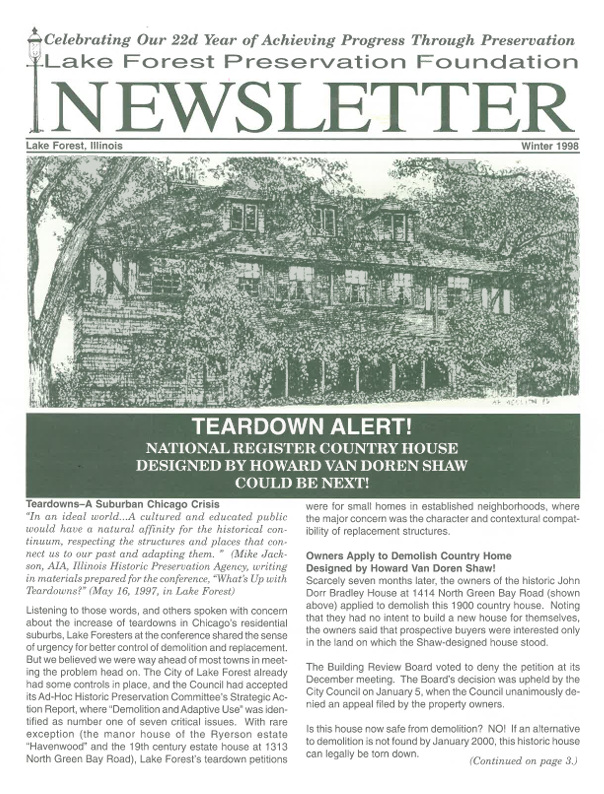
Celebrating Our 22d Year of Achieving Progress Through Preservation, Lake Forest Preservation Foundation -NEWSLETTER, Teardowns—A Suburban Chicago Crisis: “In an ideal world…A cultured and educated public would have a natural affinity for the historical continuum, respecting the structures and places that connect us to our past and adapting them.” (Mike Jackson, AIA, Illinois Historic Preservation Agency, writing in materials prepared for the conference, “What’s Up with Teardowns?” (May 16, 1997, in Lake Forest)), listening to those words and others spoken with concern about the increase of teardowns in Chicago’s residential suburbs, Lake Foresters at the conference shared the sense of urgency for better control of demolition and replacement, but we believed we were way ahead of most towns in meeting the problem head on, the City of Lake Forest already had some controls in place and the Council had accepted its Ad-Hoc Historic Preservation Committee’s Strategic Action Report where “Demolition and Adaptive Use” was identified as number one of seven critical issues, with rare exception (the manor house of the Ryerson estate “Havenwood” and the 19th century estate house at 1313 North Green Bay Road) Lake Forest’s teardown petitions were for small homes in established neighborhoods where the major concern was the character and contextural compatibility of replacement structures; Owners Apply to Demolish Country Home Designed by Howard Van Doren Shaw: scarcely seven months later the owners of the historic John Dorr Bradley House at 1414 North Green Bay Road (shown above) applied to demolish this 1900 country house, noting that they had no intent to build a new house for themselves the owners said that prospective buyers were interested only in the land on which the Shaw-designed house stood, the Building Review Board voted to deny the petition at its December meeting and the Board’s decision was upheld by the City Council on January 5 when the Council unanimously denied an appeal filed by the property owners, is this house now safe from demolition, NO, if an alternative to demolition is not found by January 2000 this historic house can legally be torn down (continued on page 3); PRESERVATION FOUNDATION OFFICERS AND DIRECTORS Officers: Pauline M. Mohr-President, Kimberly Nicastro-Vice President, Marcia Bennett-Vice President, Louise Weithas-Secretary, Shirley Paddock-Treasurer; Directors: Priscilla A. Billington, Susan D. Bryant, Carol A. Champ, Richard J. DuBourdieu, William H. Emerson, Ute Haberli, Warren F. Harshbarger, J. Fred Herlocker, Joseph F. Huber, Elaine B. Hughes, Lynn C. Knutson, Arthur H. Miller, Jr., Alice Moulton-Ely, Patricia C. Riess, Anthony M. Ryerson, David Schlott, Christine L. Shaw, Linda L. Shields, Dan Sutherland, Susie Tiller; Honorary Directors: Herbert Geist, Gail T. Hodges, Lorraine A. Tweed, Henry P. Wheeler, Sarah Wimmer; In Memoriam: Edward H. Bennett, Jr., David R. Moulton; PRESIDENTS OF THE PRESERVATION FOUNDATION: Edward H. Bennett, Jr., 1976-1978, Gayle K. Dompke, 1978-1980, Gail T. Hodges, 1980-1982, Herbert Geist, 1982-1984, Lorraine A. Tweed, 1984-1986, Henry P. Wheeler, 1986-1988, Sarah Wimmer, 1988-1990, Linda L. Shields, 1990-1992, Sarah Wimmer, 1992-1993, Pauline M. Mohr, 1993-1995, Richard J. DuBourdieu, 1995-1997; NEW! you now can visit the Preservation Foundation on its New Web Site where you can learn more about the Foundation and local endangered places, obtain membership information, update your address if you are already a member…and more!, http://members.aol.com/desbarats/preserve; The Preservation Foundation Newsletter is published by The Lake Forest Foundation for Historic Preservation and distributed without charge to the residents and businesses in the City of Lake Forest; MESSAGE FROM THE FOUNDATION’S PRESIDENT, MESSAGE FROM THE FOUNDATION’S PRESIDENT: “We’re The Preservation Foundation.” the Lake Forest/Lake Bluff Historical Society and the Lake Forest Preservation Foundation are two organizations that often are confused one with the other, I think of them as sister organizations since they share common interests and some common goals related to the history of Lake Forest and the preservation of the our city’s heritage and no doubt this is the source of the confusion, the two groups however were founded for distinctly different reasons and with distinctly different missions, the Historical Society collects, catalogs, and preserves documents, records, photographs, and objects of material culture in order to communicate to the public Lake Forest’s and Lake Bluff’s historical heritage and to preserve for future generations a record of this heritage, this is done through educational programs in the schools, programs for the general public, and numerous publications, the Society has been gifted with the use of the former Masonic Temple and will develop the site and structure into a museum of local history with those features one expects to find in a museum—permanent and temporary exhibits, research files, program space, educational outreach, and more, the purposes of the Preservation Foundation are quite different although some of the words describing these purposes are the same as those describing the Society’s activities, the Foundation was founded specifically to preserve the historic visual character of Lake Forest which as is well known is noted both locally and nationally for its many unique features, the Foundation seeks to preserve the whole of the visual aspect of the community bricks and mortar and the landscape as well, this includes everything about the architectural history of our city—historical sites, landscapes, and structures, plus amenities of architectural or historic interest, the Foundation shares with the Historical Society a desire to communicate to the community an appreciation for and understanding of our rich architectural heritage, this we try to accomplish through publications and public programming—perhaps another reason for the confusion in the minds of the public about how the two groups differ, one way to distinguish the difference between the Society and the Foundation is to remember that we are a foundation—we raise and give away money in order to fund public projects in the interest of preservation, in fact when the Society begins the conversion of the Masonic Temple into a museum the Foundation will contribute to the funds required for the exterior restoration of the building—the former carriage house of the estate “The Evergreens”—in order to help preserve the building and the historic Westminster streetscape, during the nearly 22 years of its existence the Foundation has undertaken many preservation-related projects, our most recent accomplishment was raising the funds to save the Walden-Bluff’s Edge Bridge, other public projects include spearheading the restoration of the Market Square Railroad Station, we fully funded the restoration of the Manning drawing for a proposed landscape plan for the Lake Forest College campus (it now hangs in the College library), the restoration of the old Everett School bell (now displayed in the lobby of the current school), and other projects of this type, we also fully funded the preparation of the nomination of the Green Bay Road Historic District to the National Register of Historic Places as well as doing the preparatory work and the photography ourselves, we began 1998 by presenting the Lake Forest City Council with a check for $1,700 on January 5 to pay for the map case recently installed in the lobby of the restored City Hall, in addition we stay alert to preservation issues in the City of Lake Forest by having representatives attend the meetings of the City Council, the Plan Commission, the Building Review Board, and the Zoning Board of Appeals, we also contributed to the deliberations of the Council’s Ad-Hoc Historic Preservation Committee and lent support to its report, I hope this message has helped clarify the differences—the separate missions—of the Society and the Foundation for you, I also urge those of you who are not members of these organizations to support both organizations by becoming a member today, a membership application for the Foundation appears on the back page of this Newsletter, Pauline Mohr, President; CALL FOR NOMINATIONS FOR 1998 PRESERVATION AWARDS: Lake Forest is nationally recognized as a distinctive community, three areas including over 1,000 structures have received the nation’s highest property award by being designated National Register Historic Districts, five historic properties are listed individually on the National Register, our community has a unique sense of place, the Preservation Foundation was founded in 1976 for the distinct purpose of preserving this distinctive character and helping ensure that new development is compatible with it, that is why each year the Foundation makes Preservation Awards to recognize owners who show that they care about maintaining Lake Forest’s historic visual character, the Foundation recognizes property owners who have helped preserve Lake Forest’s sense of place by maintaining, restoring, or even enlarging their buildings with special care; Who Can Make Nominations, and When: nominations may be made by any interested person including the owner or an admiring passerby (the Preservation Foundation will secure approval of the owner if necessary), all nominations must be accompanied by the form below and received by April 1, 1998 (you may make a photocopy of the form if you wish to submit several entries, additional forms are available from Carol Champ, 295-6523), NOTE: NEITHER NOMINATION NOR AWARD RESTRICTS OR OBLIGATES THE PROPERTY OWNER, THE AWARDS ARE HONORS FOR EXEMPLARY STEWARD-SHIP AND JOBS WELL DONE (continued on page 4, inside); NOMINATION FORM THE LAKE FOREST PRESERVATION FOUNDATION AWARDS, deadline for entry is April 1, 1998, Address of Property, Owner, Telephone, Nominated by, Name, Address, Telephone, Property Information (if known), Year Built, Original Architect/Builder, Original Owner, Renovation (if any) Year, Architect/Builder, Project Description, Essential: please include a photograph with application, return all entries to The Lake Forest Preservation Foundation Box 813, Lake Forest, IL 60045; Endangered Historic Shaw House (continued): that is why the Foundation is bringing this property and alternatives to its demolition to the attention of the community and others in hope of finding an interested buyer to restore and renovate this important Lake Forest landmark; Historic Background of the John Dorr Bradley House: this turn-of-the-century house is one of several turn-of-the-century buildings designed by Howard Van Doren Shaw in the area near his own home “Ragdale,” others include “Broadlea” and the “Carry Playhouse,” together they form a unique collection of homes reflecting simpler times and an affinity for the natural landscape as exemplified by the first wave of summer and country homes built in Lake Forest in the late 1890s and early 1900s, the following is the background of the house as described in the Green Bay Road National Register nomination form: “About 1897 John Dorr Bradley bought fifty-one acres to the north of Howard Van Doren Shaw’s property. The Arts and Crafts house that Shaw designed was completed several years after Shaw’s own (‘Ragdale,’ at 1230 North Green Bay Road). Published in Architectural Record in 1906, the house is approached by a long, winding drive off Green Bay Road. A band of half-timbering on the second floor meets a string course under the windows, below which on the first story are six wide bands of five courses of shingles each. The entrance on the north facade is within an enclosed porch tucked beneath the second story, the overhang of which is supported by braced timbers. The symmetrical garden facade has a centered screened porch, and there are three hipped dormers on the hipped roof. There was originally a lattice laid over the shingles on both sides of the porch.” the house currently sits on a nicely-scaled 3+ acres of heavily-wooded property the result of several subdivisions over the years, newer houses have been built on other ample properties carved from the original estate, the owners of five lots including one that has been deeded to the Lake Forest Open Lands Association to be preserved as open space are bound by a covenant that precludes any of these five lots from further subdivision, only The City of Lake Forest can change the covenant of the subdivision ordinance; Possibilities for the House: Paul A. Myers, President of the Howard Van Doren Shaw Society, recently has toured the Bradley House and examined it in detail, his opinion is that despite later incompatible alterations the house retains 90 percent of its original Arts and Crafts character as designed by Shaw, Mr. Myers’ observations may be categorized as supporting a statement made by Ted Hild, Chief of Staff, Illinois Preservation Services Division, at the May teardown conference: “…deterioration is not the same as lack of integrity. A place may need paint and a new roof, and it may have really ugly siding stuck on it, but that doesn’t mean it lacks integrity. Integrity is measured essentially by the amount of original material still in place.” in other words the John Dorr Bradley House retains the integrity to make a commitment to sensitive restoration and renovation worthwhile, further while offering the opportunity for stewardship of an historic property it also offers the opportunity to create a renovation sensitive to 1990’s lifestyles that will ensure the longevity of the property; Property Tax Assessment Freeze: since the Bradley house is a contributing structure in the Green Bay Road National Register District it is a certified structure qualifying for financial incentives provided by Illinois tax laws for substantial rehabilitation, a major incentive is the eight-year property tax assessment freeze which sets the fair market value of the property including the land at the value determined by the assessor before restoration and renovation begin, the cost of rehabilitation including architect’s fees must equal 25% of fair market value as so determined, for the original applicant-owner the freeze applies 100 percent for eight years and then phases in gradually to restored value over the next four years providing a twelve-year benefit, costs including architect’s fees and modernization of kitchens and bathrooms all qualify in determining the 25% improvement dollar total; Facade Easement: a facade easement involves putting restrictions on changes to an important facade of an historic building, the value of the easement as determined by a qualified appraiser may become a charitable income-tax deduction to the donor who gifts the easement to a qualifying nonprofit organization; Renovation and Restoration Alternatives: the Bradley house offers possibilities to remove incompatible later additions, restore the original Arts and Crafts house, and design and build one or more compatible additions that would qualify for restoration tax incentives, such actions would substantially improve the house for family living patterns in the 1990s and beyond, the photo below of “Upton Grey,” the turn-of-the century Arts and Crafts manor house of Charles Holme in Hampshire, England, illustrates a house of similar character and restoration and renovation possibilities (Photo: House and Garden, April 1991); Preservation Awards (continued from page 5): What Structures Are Eligible for Awards: any building in Lake Forest built before 1948 may be eligible for consideration, well-maintained buildings of any size are eligible for awards from Sears houses to mansions, from re-used barns to office buildings, this year for the first time new construction that exhibits outstanding contextural compatibility also may be considered; Who Will Select the Winners, How, and When: a panel of qualified judges with backgrounds in architecture and historic preservation will review the structures from public streets, entries judged on the basis of preservation, restoration, renovation, and adaptive re-use, Preservation means maintaining a historic structure in a manner that preserves the integrity of its original character, Restoration means returning a structure or a significant part of it to the original design and condition by restoring or replacing the original architectural detailing, Renovation means rehabilitation of a structure through alterations or additions that are compatible in materials, scale, color, texture, and character with the original design, Adaptive Re-use means changing the use of a structure to meet contemporary life-style needs while retaining the original character of the design; What Will the Winners Receive, and When: winners invited to accept awards and be honored at the Preservation Foundation’s Annual Meeting Sunday, May 17, 1998 at the conclusion of National Historic Preservation Week, awards are handsome bronze plaques, following the Annual Meeting winners and other guests invited to tour a distinctive historic Lake Forest property that exemplifies efforts to maintain Lake Forest as “A Special Place”; THANK YOU! Walden-Bluff’s Edge Bridge Is Open, construction details to be completed this spring: the Walden-Bluff’s Edge Bridge (shown at right) restored and reconstructed through a major cooperative effort of the Preservation Foundation, area residents, users, other friends, and The City of Lake Forest is now open, with original arches restored, new structural steel work in place and painted a handsome dark green, a new deck installed, limestone walls and masonry repaired, and ravine erosion measures in place the historic bridge and site are almost complete, walkers and runners are already enjoying winter ravine views from the bridge where temporary fencing offers protection until the new railings are in place, this spring the permanent railing system will be installed and additional repairs and amenities in the area will be completed, a dedication ceremony will be held late this spring, watch for future announcements; Do You Have a Copy of PRESERVATION FOUNDATION GUIDEBOOK, Second Edition: the Foundation’s Guidebook to National Register Properties, Lake Forest, Illinois, Second Edition includes information on the Lake Forest and Green Bay Road–Vine Avenue–Oakwood National Register Districts as well as on five properties listed individually on the National Register, a sellout in its First Edition the Second Edition includes information on two newly-listed National Register properties as well as an index by street address, the book is organized for use on a walking, bicycle, or auto tour and includes photographs of each contributing structure as well as maps and suggested routes for tours, copies priced at $15 each are available for purchase at Dans un Jardin, B. Dalton Bookstore, Gorton Community Center, Helanders, Lake Forest Book Store, Lake Forest College Bookstore, and McMasters; THE LAKE FOREST FOUNDATION FOR HISTORIC PRESERVATION Box 813, Lake Forest, Illinois 60045, I/We want to help preserve the historic character of Lake Forest please enroll me/us in the selected membership category (contributions are tax deductible, please make checks payable to The Preservation Foundation), Mr./Ms., Mrs., Miss, Street, Telephone, City, State, Zip, I/We would like to work actively with the Foundation, please call me/us to discuss areas of interest, the Preservation Foundation, an Illinois 501(c)(3) public foundation, is open to all who share its goal of progress through preservation, Member-Annual Dues $35, Contributing Member-Annual Dues $50, Sponsor-Annual Dues $100, Sustaining Member-Annual Dues $250, Life Member-Contribution to the Revolving Fund in the amount of $2,500 or more, no annual dues required.