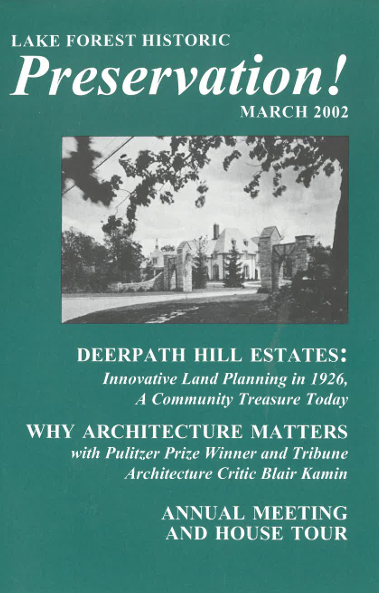
PRESERVATION FOUNDATION OFFICERS AND DIRECTORS Officers Linda L. Shields PRESIDENT Janet M. Gibson VICE PRESIDENT, MEMBERSHIP Arthur H. Miller, Jr. VICE PRESIDENT, PROGRAMS Marcia Bennett SECRETARY Alice Moulton-Ely TREASURER Directors David Bahlman Edward H. Bennett, Ill Paul Bergmann Priscilla A. Billington James M. Brown Susan Dillon Bryant Carol A. Champ Susan Halle Judith Harris Elaine B. Hughes Pauline M. Mohr Kimberly Nicastro Shirley Paddock Patricia C. Riess David Schlott Christine L. Shaw Dan Sutherland Louise Weithas Honorary Directors Herbert Geist Gail T. Hodges Lorraine A. Tweed Henry P. Wheeler Sarah D. Wimmer PRESIDENTS OF THE PRESERVATION FOUNDATION Edward H. Bennett, Jr., 1976-1978 Gayle K. Dompke, 1978-1980 Gail T. Hodges, 1980-1982 Herbert Geist, 1982-1984 Lorraine A. Tweed, 1984-1986 Henry P. Wheeler, 1986-1988 Sarah D. Wimmer,1988-1990,1992-1993 Linda L. Shields, 1990-1992 Pauline M. Mohr, 1993-1995, 1997-1999 Richard J. DuBourdieu, 1995-1997 Edward H. Bennett, 111, 1999-2001 Photos: Pages 4, 6-14, courtesy of Paul Bergmann; page 5 top, courtesy of LF-LB Historical Society; page 15, courtesy of Jan Gibson, Preservation! is published by The Lake Forest Foundation for Historic Preservation, Box 813, Lake Forest IL 60045, (847) 234-1230, Forest IL 60045, (847) 234-1230, www.LFPF.org President’s Recognizing Preservation’s Value Message According to a recent Chicago Tribune article by Blair Kamin, the Tribune’s architecture critic, Soldier Field was once considered a “civic embarrassment,” a “big white elephant,” and a gross violation of Daniel Burnham’s Chicago Plan, today, a consortium of preservationists, including the Landmarks Preservation Council of Illinois and Friends of the Park, have taken on the City of Chicago and the Chicago Bears to try to save the integrity of this monument, though it appears to be a lost battle, I applaud their tenacity and concern, they care enough to try to save a piece of Chicago’s history, Mayor Daley, recognized last fall by the National Trust as one of several mayors they called enlightened and visionary in recognizing the value of preservation, unfortunately lost that vision when it came to Soldier Field, Soldier Field, like Navy Pier before it, will most likely lose its National Register listing, we in Lake Forest are fortunate to have City officials and staff who do have that vision, in an atmosphere where the pressure to change is constant, they see preservation as a tool that improves and enhances our community and quality of life, we are fortunate also to have homeowners who care about our historic visual character, they willingly invest in our community by saving homes slated for demolition or preserving their historic properties, as a Foundation, we encourage the efforts of these preservation-minded citizens, each spring, we recognize their efforts by presenting awards to owners of properties that stand out as exceptional examples of restoration, preservation, and adaptive re-use projects, please join us in celebrating the preservation effort by nominating a building or landscape built or created before 1952 that you admire and believe is deserving of an award, Linda Shields 12th ANNUAL PRESERVATION AWARDS The Foundation is now accepting nominations for its annual preservation awards, please use the form at the center of this booklet to send in your nomination today, deadline is April 1, 2002, The Lake Forest Preservation Foundation recognizes Chuck Crook and his contributions to Lake Forest as the City’s first City Planner and Director of Community Development for the past 25 years, during his tenure, he has overseen the enactment of several landmark ordinances directed to preservation, including those dealing with building scale, teardowns, and preservation and conservation districts, we commend him for his tenacity and creativity in developing tools to help protect Lake Forest’s character, 12th ANNUAL PRESERVATION AWARDS The Foundation is now accepting nominations for its annual preservation awards, please use the form at the center of this booklet to send in your nomination today, deadline is April 1, 2002, The Lake Forest Preservation Foundation recognizes Chuck Crook and his contributions to Lake Forest as the City’s first City Planner and Director of Community Development for the past 25 years, during his tenure, he has overseen the enactment of several landmark ordinances directed to preservation, including those dealing with building scale, teardowns, and preservation and conservation districts, we commend him for his tenacity and creativity in developing tools to help protect Lake Forest’s character, Upcoming Programs and Events March-June Open to the Community! Teardowns, Monster Homes, and Infill Free to Foundation Members; $5 for Nonmembers, Lake Forest works hard to accommodate change without overwhelming the community’s character, other towns have not been so successful, many view the City of Lake Forest as a leader in development innovation and look to us for advice when they see the character of their towns eroding, come hear and exchange ideas with Charles E. Crook, who has directed Lake Forest’s Building Department for the past 25 years working to manage compatible growth and development; Jean A. Follett of Hinsdale, an independent historic-preservation consultant known for her work on the issue of teardowns; and Ellen Shubart of Glencoe, Manager of the Campaign for Sensible Growth for the Metropolitan Planning Council, Why Architecture Matters Free to Foundation Members; $5 for Nonmembers, Blair Kamin, Pulitzer Prize-winning architecture critic for the Chicago Tribune, will speak on the changes in Chicago-area architecture, following the presentation, he will sign copies of his new book, Why Architecture Matters, to quote his biographical sketch from the Pulitzer Prize for Distinguished Criticism: “Since becoming the Tribune’s architecture critic in 1992, he has written about the full range of the built environment-from skyscrapers to museums to parks to public housing, Kamin has lectured widely, among his awards are the George Polk Award for criticism, the American Institute of Architects’ Institute Honor for Collaborative Achievement, and the Peter Lisagor Award for Exemplary Journalism, which he has won eight times,” Annual Meeting Foundation Members Only, join us for the Annual Meeting, the 12th Annual Preservation Awards ceremony, and a tour of an award-winning Lake Forest home designed by Howard Van Doren Shaw, award nominations are now being accepted, please use the form following page 8, any resident, member or nonmember, may submit a nomination, House and Garden Tour Deerpath Hill Estates Tour for Members and Guests Only, the architecture of Stanley D. Anderson and Associates will be featured on this tour, this planned development was begun in 1926 and was considered innovative in its time, the architect was a native of Lake Forest, and his firm was responsible for the design of many Lake Forest homes, as well as for commercial buildings in the Market Square area, join the Preservation Foundation today, and plan to come, THURSDAY MARCH 21 7P.M. Gorton Community Center SUNDAY APRIL 14 2P.M. Gorton Community Center SUNDAY APRIL28 2P.M. Gorton Community Center SATURDAY JUNE 22 Watch your mail in May for your invitation, The handsome French-Norman gates on the south side of Deer Path at King-Muir Road mark the entrance to the original portion of Deerpath Hill Estates, Deerpath Hill Estates: Innovative Land Planning in 1926, a Community Treasure Today By Paul Bergmann with Gail T. Hodges Time and again, month after month and year after year, the Lake Forest City Council, Plan Commission, Zoning Board, Building Review Board, and Historic Preservation Commission weigh the merits of subdivision, development, and building proposals, the process is not new in Lake Forest, and it has been measured and thorough right from our town’s initial planning in the 1860s, long before most other communities were overseeing development, Lake Forest was an innovator in city planning, everything began with the founders, who developed the new community of Lake Forest based on a plan conceived and drawn by a landscape architect, this plan was in the best tradition of 19th century “garden” cities, in fact, Lake Forest is one of the earliest such planned communities, the objective ever since has been to control development for compatibility with the original plan, to this end, in 1923 Lake Forest became one of the first communities in the nation to establish a Zoning Board of Appeals charged with overseeing a zoning code, Deerpath Hill Estates, an innovative planned development, was built within the parameters of the then-new regulations, the north-south road through the development is King-Muir Road, we know the area today by its beautiful French Norman gates at the south entrance to King-Muir Road at Deer Path, the Real Estate Market in the 1920s, the Developer Henry K. Turnbull was a successful advertising and newspaper executive in the 1910s and early 1920s, he had done well in Kansas City and moved his business to Chicago in 1920, to a successful businessman, the strong economy of 1925 would have made it seem like a perfect time to try something new, why not go into the real estate business, the real estate boom of the 1920s was in full force, not unlike the growth atmosphere seen recently in the dot-com phenomenon of the 1990s, optimism reigned, however, the crash that was to come was so huge that it colored history’s perspective on the 1920s forever, in retrospect, the optimism of the 1925-1929 era seems innocent and naive, the Times in the early 1920s, the real estate market was beginning to boom across the country, in Lake Forest, the boom was fueled by Samuel Insull, the utilities tycoon, in the mid-1920s Insull decided to build an extension of his North Shore Inter-Urban Electric Railroad through what was called the Skokie Valley, the North Shore line, as it was called, ran parallel to Highway 41 in Lake Forest, the new rail line promised fast and efficient access to Chicago’s Loop from a new station to be built at what is now the Highway 41-Deer Path underpass, as a result of Insull’s decision, land values in the area skyrocketed, prior to Insull’s announcement, the area west of Green Bay Road was open country with 30-40-acre and larger estates, Waukegan Road was known as Telegraph Road at the time, this was the fox-hunting territory of the Onwentsia Hunt, the Master of the Fox Hounds, Austin Niblack, had a large estate to the south, the A. B. Dicks had their estate, “Westmoreland” on the north side of Deer Path, the Niblacks, the Dicks, and many others in the area rode in the fox hunts throughout the area, just west of Waukegan/Telegraph Road was the 1,100-acre J. Ogden Armour estate, Armour lost his fortune in 1923 in his ill-fated attempt to corner the grain market, and by 1925-1926, there were plans to convert his estate into a country club, if the country club were built, the property between Highway 41 and Waukegan Road would be within walking distance of both high-speed rail to Chicago’s Loop and a major country club, as a speculative real estate venture, any development in this area had to look like a sure bet, the Innovative Plan for Deerpath Hill Estates in 1926 Henry Turnbull laid out a new real estate development called Deerpath Hill Estates, Turnbull had grand plans for a development of elegant manor homes on approximately one-acre lots, these houses would be in contrast to the landed country estates that were prevalent in the area at the time, Lake Forest in the 1920s consisted mostly of either large estates on many acres or individual small houses built on small lots east of Green Bay Road and laid out on the original town plat, all were developed or built individually over time and to suit the property owner, without regard for an overall development plan, Turnbull instead planned a new type of development where the entire environment would be designed and controlled by the developer, this is a commonplace concept today, in 1926, it was considered very advanced land-use planning, the Structure of the Plan, acquiring the land Turnbull first purchased 20 acres of land at the southeast corner of Waukegan Road and Deer Path, he named the central road through the development “King-Muir Road,” which was a combination of his mother’s maiden name “King” and his mother-in-law’s maiden name “Muir,” in the following three years, Turnbull added two more large parcels of land to the development, he bought a second 20-acre parcel of land, the old McKinlock estate, on the north side of Deer Path in 1928, rather than build a gate as at the south entrance, Turnbull built a double-drive entrance that had a reflecting pool in the center, Turnbull then created a third section of Deerpath Hill Estates by acquiring the 21-acre Hibbard estate, east on Deer Path, in March 1929, this area includes Chiltern Drive and Deerpath Square, unfortunately, Turnbull developed this parcel in 1930, as we shall see, the Depression was not going to be kind to him over the next few years, assembling the development team Turnbull turned to the new architectural firm, Anderson and Ticknor, to help him with his design plans, Stanley D. Anderson enlisted his cousin, James Anderson, as surveyor and civil engineer, Turnbull, Stanley Anderson, and James Anderson designed the gently curvilinear streets, several reflecting ponds, and a small lake to create a charming and unified neighborhood, Stanley designed the gates at Deer Path and King-Muir and a circle gate on Verda Lane, as well as the gate posts at the Waukegan Road entrances, the street lamps were new bronze bracket lamps that the City adopted for use in the area, they were electric, which was considered an improvement over the old gas lamps used in the Lake Forest business district and along Green Bay Road, setting criteria for development in the 1920s a developer typically did not build all the houses in a subdivision as is often done today, lots were offered for sale, and the developer provided an architect or the buyers could use their own, what is unique about Deerpath Hill Estates is that Turnbull required each house to be either built by or approved by Stanley D. Anderson, although there was no legally-binding contract, Turnbull would not sell the property without a very firm understanding that the house would pass Stanley Anderson’s review, the houses there are fourteen original houses in the development, Anderson and Ticknor designed six, a contract architect, William Braun, designed four, the remaining four houses are of unknown design, some of them may actually be designed by Anderson and Ticknor, whoever the designer, it is apparent that they benefited from the contextual compatibility provided by Stanley Anderson’s design oversight, design oversight Anderson’s oversight of design helped ensure that the development would result in aesthetically pleasing neighborhoods that would be compatible with the overall character of Lake Forest, his role might be viewed as a precursor of the function filled today by Lake Forest’s Building Department, Building Review Board, and Historic Preservation Commission, while the houses are all different in style, they all maintain a surprising uniformity of scale, massing, and presence within the development, no single house overpowers any other house, all the houses are subtly pleasant to look at without shouting “look at me,” as do so many houses of today, architectural styles Stanley Anderson’s overarching design concept was to showcase many styles of great architecture, no two houses are alike, within the development is an extraordinary display of architectural styles, advertising literature of the era describes the following styles: Maryland Colonial, Philadelphia Colonial, Louisiana Colonial, French Norman, and the ever-popular 1920s English Tudor, among the fourteen houses, there are at least five styles of architecture, few developers in today’s world can muster this level of design talent, the impact of the Great Depression on the developer, the development, and the area, Turnbull went broke in 1932, he had mortgaged and re-mortgaged the properties to the point where any drop in land sales meant that the whole project failed, Turnbull continued to clean up his affairs through the 1930s and 1940s, the economic damage from the Great Depression was prolonged, the Anderson and Ticknor records show construction costs around $40,000 to build a house in Deerpath Hill Estates, a purchaser could buy one of the houses in 1938 for the cost of construction, the underlying land was essentially free to the buyer, Please Join Us, by Janet M. Gibson, Vice President, Membership, when you look around our beautiful community, what do you see, overall, there is a pride in place, exemplified by both families and business owners in the care they take in maintaining and improving their homes and commercial buildings, many owners are stewards of historic buildings in every part of our community, their efforts help maintain the special character of Lake Forest, what the Preservation Foundation does, have you noticed the train station at Market Square, the Walden/Bluffs Edge Bridge, or the steadfast elegance of certain Lake Forest neighborhoods, these are some of the projects that the Foundation spearheaded, including gaining National Register status for Green Bay Road, the Foundation applies its revenue from memberships and donations directly to public service projects, funding of research, engineering studies, publications, and information about tax benefits, everyone can help preserve the special character of Lake Forest, how, by joining the Lake Forest Preservation Foundation, for over 25 years, the Foundation and its members have worked to educate, preserve historically significant structures, and research the cultural resources of Lake Forest, to continue to do this, we need your membership and your volunteer help, why every household should be a member, the Preservation Foundation works on your behalf, whatever you can afford, whether it’s $35, $100, or even $2,500, now is the time to contribute to something where you can really make a difference, what do you receive from membership, your membership commitment in support of the Foundation’s projects and activities brings with it educational publications like this one, information about lectures and programs to attend, and invitations to members-only house tours and special events, looking for a special gift, why not give Preservation Foundation memberships, for only $35, your gift brings all of the benefits listed and helps to preserve Lake Forest’s character as well, Preservation Programs Watch LFTV-Channel 19, beginning in March, Preservation Foundation programs will air Fridays at 3:30 p.m., Saturdays at noon, and Sundays at 7 p.m., look for our programs on Ranch Houses and Teardowns, if you believe in preserving Lake Forest’s character for future generations, you SHOULD become a member, THE LAKE FOREST FOUNDATION FOR HISTORIC PRESERVATION, Box 813, Lake Forest, Illinois 60045, I/We want to help preserve the historic character of Lake Forest, please enroll me/us in the selected membership category, THE PRESERVATION FOUNDATION GUIDEBOOK A Perfect Gift, the Foundation’s Guidebook to National Register Properties, Lake Forest, Illinois, 2d Ed., includes information on the first two Lake Forest Districts elected to the National Register of Historic Places and on five properties listed individually on the National Register, the Guidebook is available in local bookstores and shops, and at Gorton Community Center, for $15, Street, Telephone, City, State, Zip, Member-Annual Dues $35, Sustaining Member-Annual Dues $250, Contributing Member-Annual Dues $50, Patron-$500, Life Member-$2,500 or more, Sponsor-Annual Dues $100, I/We would like to work actively with the Preservation Foundation, contact me/us about volunteering, The Preservation Foundation, an Illinois 501(c)(3) public foundation, is open to all who share its goal of progress through preservation, 3/02.