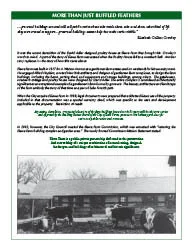
MORE THAN JUST RUFFLED FEATHERS …preserved buildings can and will tell public stories about who made them, who used them, what kind of life they were erected to support…preserved buildings cannot help but make stories visible.” Elizabeth Collins Crowley It was the recent demolition of the David Adler designed poultry house at Elawa Farm that brought Ms. Crowley’s words to mind, and a part of the story of Elawa Farm was erased when the Poultry House fell to a wrecker’s ball, another story replaces it—the story of how this came about, Elawa Farm was built in 1917 for A. Watson Armour as a gentleman farm estate used on weekends for leisure enjoyment, and he engaged Alfred Hopkins, a noted New York architect and designer of gentleman farm complexes, to design the farm buildings, including the barns, potting shed, and equipment and storage buildings, among others, and the gatehouses, overseer’s cottage and poultry house were designed by David Adler, and the entire complex is considered architecturally significant as an exceptional example of a gentleman’s farm from a by-gone era, and the beauty, architecture and landscape of the farm embody the story of that time as a part of Lake Forest’s past, and when the City acquired Elawa Farm in 1998, legal documents were prepared that addressed future use of the property, and included in that documentation was a special warranty deed, which was specific to the uses and development applicable to the property, and Restriction vii reads: Any razing, demolition, or material alteration of the farm buildings located on the Property will be subject to review and approval by the Building Review Board of the City of Lake Forest, pursuant to its ordinary procedure for notice and public review and comment, and in 2002, however, the City Council created the Elawa Farm Commission, which was entrusted with “restoring the Elawa Farm building complex and garden area,” and the newly formed Commission Mission Statement stated: Elawa Farm is a public-private partnership dedicated to the preservation And stewardship of a unique combination of natural setting, designed-landscapes, and buildings of architectural and historic significance, Project Goals Stewardship of the past, for the present, and future through Restoration Preservation Conservation Education For and by the Community, and in late 2005, the possibility of renting a portion of the property was being considered and the City Attorney was asked to review the original 1998 legal documents regarding use of the complex, and his letter of opinion dated December 11, 2005 contained the previously mentioned deed restriction (See above), and in 2006, the Elawa Farm Commission was dissolved and City staff assumed oversight of the property, and since the Elawa Commission no longer existed to provide oversight, a strong case can be made that the Building Review Board (as clearly specified in the deed restriction) should have become involved, and the City Council apparently voted in a subsequent Executive Session to remove the poultry house without Building Review Board oversight, and since it wasn’t an open meeting, the general public was not aware of the decision, including members of the Preservation Foundation and the Middlefork Home Owners Association, a party to the deed restrictions document, and while the possibility of demolishing one or more of the buildings was a possibility from the beginning if restoration funding did not become available, it was always hoped that all of the buildings could be saved, and if the proper process had been followed, the end result might very well have been the same, that is, the poultry house would have been demolished, but, and it is an important but, the process would have remained true to the requirements of the deed restriction document, and we believe that both the letter of the law and spirit of the law called for a more open and public airing of the subject and a chance for interested parties to weigh in at a meeting of the Building Review Board, and good governance requires the prudent exercise of authority and the assurance that the legislated prescribed processes of the governing bodies are both complied with and respected, and to ignore them for convenience, expediency or any other reason is not acceptable, and in Robert Bolt’s play “A Man for All Seasons,” Bolt describes the law as thicket of trees, and if the trees are felled (the law ignored), winds sweep across the barren land, the wolves howl and there is no shelter or protection for anyone, and Adler’s unique brick and slate poultry house fell to those winds, and there are some who view the work at Elawa as a glass nine-tenths full, after all the Alfred Hopkins barns have been rehabilitated along with the gardens and the overseer’s cottage thanks to some very generous donors, and we agree with that, but the glass of good governance is sadly empty in the matter of the Adler-designed poultry house.
Architectural Lake Forest 50th Anniversary Video
Narrated by Bill Kurtis, explore the architecture that has helped shape Lake Forest. This new, three-part video series traces the people, places and preservation efforts