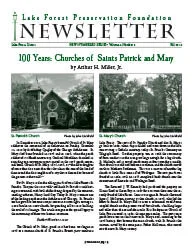
Lake Forest Preservation Foundation’s New Numbered Series, Volume 3, Number 3 (Fall 2010) is anchored by a feature article, “100 Years: Churches of Saints Patrick and Mary” by Arthur H. Miller, Jr., timed to the 2010 centennials of Lake Forest’s two linked Catholic parishes and their historic church buildings—St. Mary’s Church (dedicated December 11, 1910 by Archbishop Quigley) and the “old” red-brick St. Patrick’s (also completed in 1910). The piece emphasizes that both were designed by the same architect, Henry Lord Gay, and argues that the two buildings together are significant, defining elements of Lake Forest’s architectural heritage and neighborhood identity.
The article traces the parish histories to 1910, explaining that St. Mary’s (founded 1875) began as a mission of St. Patrick’s, Everett (southwest Lake Forest), with roots reaching back to 1840 (shipwrecks prompting a Catholic cemetery—today’s St. Patrick’s Cemetery on Telegraph Road) and a first log church (St. Michael’s, 1844). It outlines the parish’s geographic moves and rebuilding cycles: a brick church completed in 1855 near Route 60/Waukegan Road; land purchased in 1867 near Illinois Road/Green Bay for a Lake Forest mission; and the pivotal role of Fr. James J. McGovern (arriving 1875) in founding St. Mary’s and erecting a substantial wood-frame church and rectory. It notes St. Patrick’s repeated misfortune—foundation issues (rebuilt 1883), lightning strike (1895), and eventual destruction by fire (1908)—which pushed parishioners to worship at St. Mary’s while St. Patrick’s was replaced. By 1906, under Rev. Francis T. Barry, the article reports 40 families at the St. Patrick’s mission and 150 at St. Mary’s, with early hardship and low income improving by 1908–1910, partly due to Barry and partly due to an influx of wealthy Catholic Chicagoans connected to new west Lake Forest estates.
A major section profiles Henry Lord Gay (1844–1921), presenting him as a Chicago-based church specialist whose training lineage links back through Sidney Mason Stone and Ithiel Town. The article highlights Gay’s early Chicago career (including a church later lost in the 1871 Fire), his AIA credentials (joined 1874, Fellow 1887), his European competition experience (second place in a Rome competition for the Victor Emanuel monument), and later work that included prominent commissions such as Lake Geneva summer places and San Diego landmarks—while underscoring that his church work continued in 1909–10 with Lake Forest’s St. Mary’s and St. Patrick’s.
On architectural character, the article frames St. Mary’s as a deliberate, contextual blend: Romanesque massing and rounded windows paired with Gothic, buttressed towers, drawing visual kinship with prominent Protestant-era models in town (First Presbyterian Church, Church of the Holy Spirit, and Lake Forest College’s Lily Reid Holt Chapel) while also clearly expressing Roman Catholic identity through a centered entry and distinct limestone detailing. It also notes medieval-referential exterior detailing (machicolation) and portrays the building as both “assimilationist” in its civic fit and unmistakable in its Catholic heritage. The article then explains the 1970 remodeling of St. Mary’s as an outgrowth of Vatican II, led under Fr. James D. Brett with assistance from Fr. Richard J. Douaire (an art-history professor and church-architecture leader), and designed by Lake Forest architect Norman Abplanalp. It summarizes the renovation approach as simplifying and reorienting liturgical elements (new altar/lectern/chair, removal of superfluous altars), improving lighting (including a glass wall at the sanctuary), restoring original oak woodwork, and setting a clean oak-on-white interior tone.
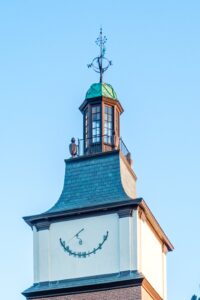
For St. Patrick’s, the article describes the 1910 building as a smaller, village-scaled companion to St. Mary’s—one tower rather than two, similar Romanesque rounded windows and subtle machicolation, and a steeple contributing to a rural “Everett” character. It recounts parish growth in the 1970s (Parish Center; overflow Masses as the 1910 sanctuary became too small), followed by a 1986 remodeling emphasizing simplicity, accessibility improvements, and restoration measures, plus new Stations of the Cross by parishioner-artist Franklin McMahon. The narrative then connects later explosive growth in west Lake Forest to the 1990s: ground broken for a new church in 1995, first service December 1997, and formal dedication March 22, 1998 by Cardinal George, with the parish reported as serving roughly 1,780 families. Importantly, it stresses that the “old” 1910 St. Patrick’s continues to function as a chapel and as an anchor for the west-side community now called Settlers Square, symbolizing continuity back to early Irish Catholic settlement patterns of the 1830s–1840s.
Alongside the feature, the issue includes a President’s Message from Tom Daly that ties preservation to community identity through the story of Lake Forest’s historic gas lights: installed in 1902, adopted as the Foundation logo in 1976 when founder/first president Edward H. Bennett Jr. sketched a gas lamp from his “Pembroke Barn” view, threatened with shutdown in 2003, and then relit through a $15,000 grant (2004) that helped restore 438 gas lights. Daly also notes expected (economy-limited) improvements to the Market Square train station (roof, painting, repairs), celebrates the summer’s Family Fair in Market Square and narrated trolley tours (with thanks to CROYA), mentions a third-place Lake Forest Day Parade finish, and points to strong attendance at a Meadowood Farm Historic District program. He previews upcoming programming (a historic windows program plus reception, and the members-only Holiday Party) and encourages membership support.
A short Forest Park Update reports follow-through after City Council approval of the Conceptual Master Plan: an engineering study on bluff stability (no immediate erosion threat across most of the bluff, but drainage still needs attention), a traffic study (still being evaluated), and the formation of a community committee moving toward establishing a 501(c)(3), chaired by Ralph Gesualdo, described as a group of community leaders prepared to volunteer, raise funds, and protect Forest Park as a treasured cultural landscape.
The newsletter also provides organizational and member information: a membership appeal with tiers (Historic Friend through 1861 Society/Life Member) and benefits (discounts on events, volunteer opportunities, annual report recognition, Holiday Party admission at certain levels), a repeating roster of officers and directors (including President Tom Daly and Executive Director Marcy Kerr), and a substantial member thank-you list by giving levels. Finally, it includes a program committee schedule (2010–2011) listing upcoming events such as a November 14, 2010 “Historic Windows” program at Gorton with reception afterward, the December 5, 2010 Holiday Party, and a slate of 2011 offerings including Annual Meeting & Awards (May 15), the 3rd Annual Family Fair (June, TBD), and other tours/programs.
A separate preservation-planning notice, “Update on Revision of Lake Forest’s East Side Historic District,” states that the City received a Certified Local Government grant from the Illinois Historic Preservation Agency to update the 1976 National Register nomination for the east-side district (noting it emphasized pre-1926 resources and omitted many significant buildings). It outlines an active revision effort led by Benjamin Historic Certifications (Susan Benjamin, Gwen Sommers Yant, Courtney Gray Resnick) with City staff and Foundation volunteers, including surveys of buildings that turned 50 since 1998 and those altered/constructed since 1998, entry of data into the Survey Database (targeted for completion in early October), planned photography after leaf drop, and a timeline aiming for a revised nomination completed by June 2011.
Lastly, the issue includes a note of appreciation for Peter Coutant, Senior Planner for the City of Lake Forest, who was departing after thirteen years; it credits his competence, patience, and respect for historic preservation, and thanks him for helping protect Lake Forest’s visual character.