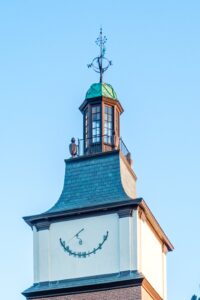
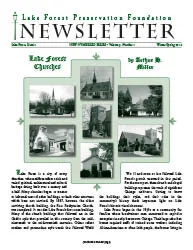
Lake Forest Preservation Foundation Newsletter (Lake Forest, Illinois), “New Numbered Series,” Volume 3, Number 1 (Winter/Spring 2010), led by a feature titled “Lake Forest Churches” by Arthur H. Miller, which opens by describing Lake Forest as “a city of many churches” whose buildings reflect a rich spiritual, architectural, and cultural heritage spanning more than a century and a half, noting that many congregations began as tenants or informal users of other buildings and that some early structures no longer survive, but that by 1887 the oldest surviving church building, the First Presbyterian Church, was completed and was also identified here as Lake Forest’s first stone building, observing that many later church buildings followed the Gothic style prevalent from the mid-19th through mid-20th centuries while others reflect modern and postmodern trends after WWII and broadly track Lake Forest’s westward growth, and emphasizing that most church and chapel buildings represent work by significant Chicago architects and that understanding their styles and community roles illuminates Lake Forest’s historic visual character; the article then begins a brief social history framing Lake Forest’s origins in the 1850s as a commuter suburb for Chicago businessmen whose large homes relied on estate workers (including African-American and often Irish workers), explaining that many estate families and Lake Forest College/school communities attended First Presbyterian, and that by 1870 and 1875 African-American and Irish communities respectively had their own churches supported by estate owners, before noting that as Lake Forest expanded southwestward in the 20th century it annexed the older farming community of Everett near Waukegan and Everett Roads (dating to Irish settler farmers arriving in 1836), where a Catholic church was organized by 1840 as an antecedent to today’s Saint Patrick’s churches, and adding that by 1870 there was an African Methodist Episcopal church built near Washington and Maplewood Roads, while St. Mary’s Catholic Church was organized in east Lake Forest in 1875, then listing an expanding roster of churches, schools, and chapels after 1887 (including Ferry Hall women’s preparatory school chapel, Holy Spirit Episcopal beginnings in 1898 with a new building in 1902, Lake Forest College’s Lily Reid Holt Chapel in 1900, First Baptist as African-American congregation founded in 1900 with building used in 1903, Methodist church later known as Church of the Covenants in 1923, Barat College Chapel 1925 decommissioned/stripped 2008, Lake Forest Academy circa 1950, Faith Lutheran 1957, Woodlands Academy Chapel 1961, St. James ELCA 1965, Friends Meeting 1967, and Christ Church 1989), and stating that this churches survey is being published in two parts, with Part II to appear in the Fall newsletter and to highlight centennial-era topics including St. Mary’s (Henry Lord Gay), St. Patrick’s edifice also by Gay, Woodlands Academy Chapel, the “new” St. Patrick’s building, and a retrospective look at the decommissioned Barat College Chapel; the piece then begins detailed profiles, starting with the First Presbyterian Church of Lake Forest (700 North Sheridan Road), recounting that by January 1859 Presbyterians held Sunday school meetings in the chapel/assembly hall of the then-new Lake Forest Academy at Sheridan and Deerpath (the white clapboard Academy later rebuilt and now the Durand Art Institute), that in 1862 a small Gothic church was erected across the corner and served (with additions) until 1886, when work began on a new stone-based edifice in Norman and Shingle styles designed by Cobb & Frost, describing the architects Henry Ives Cobb (trained at Harvard/MIT; came to Chicago 1881) and Charles Sumner Frost (MIT; partnered from Peabody & Stearns lineage) as quickly becoming leading Chicago architects (with projects including an innovative Chicago Opera House by 1885), noting Frost’s continued Lake Forest work until World War I, and summarizing how the Presbyterian church campus evolved through multiple additions and alterations across decades (school rooms in the early 1900s/1910s; a manse by Stanley Anderson & James Ticknor completed in 1930; Anderson’s sanctuary renovation in 1940; mid-20th-century additions), highlighting that the lower part of the building features “spotted lime stones” salvaged from Chicago’s 1851 Second Presbyterian Church that burned in the 1871 fire and that this earlier church had housed organizing efforts for Lake Forest in 1855–57, describing focal elements like the Shingle-Style bell tower with classic Georgian windows and the church’s siting on Deerpath at the center of the 1857 town plan, and noting a 1902 Tiffany Studios sanctuary interior that helped prompt a gradual conversion to significant Tiffany and Charles Connick Studio stained glass, then concluding that despite alterations the First Presbyterian campus remains dominant in its neighborhood and was recognized by the Preservation Foundation with a Heritage Award (2003) and a Rehabilitation Award (2007) for the new entry; next, the article discusses Ferry Hall Chapel (541 North Mayflower Road), explaining that after Cobb & Frost’s Presbyterian work they renovated/expanded the 1869 Otis Leonard Wheelock building for Ferry Hall (women’s preparatory seminary) and designed a new chapel to the southeast in common brick, noting that today only the chapel stands and that it became a template for the scale and style of buildings Cobb designed for the University of Chicago (1891–1900), characterizing the chapel’s design lineage through H. H. Richardson inspiration and parallels to Chicago’s Lakeview Presbyterian Church (tall thin steeple, simple central aisle, Gothic-arched side windows), and noting that since about 1980 the chapel has been adaptively reused as a residence as part of a condominium preservation of the Ferry Hall campus after Ferry Hall merged with Lake Forest Academy; the article then profiles Lake Forest College’s Lily Reid Holt Memorial Chapel (555 North Sheridan Road), noting the earlier campus chapel space in University Hall (later College, now Young Hall) since 1877, the building campaign under President Rev. Dr. James G. K. McClure (1897–1901), and emphasizing the 1899–1900 chapel and library complex designed by Frost & Granger and linked by a cloister, describing the complex as donated by Mrs. Simon S. (Martha McWilliams) Reid in memory of her two alumni children, recounting the poignant cornerstone moment in November 1899, and mentioning Mrs. Reid’s 1902 donation of the east Tiffany “dove of peace” window, then noting that unlike the Presbyterian church and Ferry Hall Chapel, the Holt Chapel remains little changed, with exterior restoration honored by the Foundation and later an enabling accessible west entry by David Woodhouse also awarded, adding details such as five Tiffany chandeliers relocated from the Presbyterian sanctuary in 1940 by alumnus architect Stanley Anderson, seating and flooring changes in 1978 and again in 2000 to improve flexibility and acoustics for concerts, and describing the chapel’s role historically for convocations, weddings, and memorials, and its architectural character (Indiana Bedford gray limestone, slate roof, Collegiate Gothic aspirations signaling the College’s new center and educational model); the article then turns to Church of the Holy Spirit (Episcopal), 400 East Westminster Road, citing a 2002 centennial book that records early Episcopal prayer-book services in homes beginning in 1865, a service in 1872 in an old schoolhouse off Western Avenue, and that services moved in 1898 to the second-floor assembly room of the 1895 Blackler Building at Western and Deerpath, with context that the early Episcopal presence served Sunday visitors from Chicago and Onwentsia Club weekenders, then describing acquisition of a Westminster Road lot by 1900 and the 1901 groundbreaking and 1902 opening of the original cut-lannon stone Gothic church designed (gratis) by architect Alfred Hoyt Granger (with his background from Kenyon and MIT and work on the Chicago Public Library and Art Institute projects), noting Granger’s associated Tudor-style manse and development of houses on Church Street, and describing how the church blended with the Frost & Granger 1900 train station and 1898 City Hall as part of an Anglophile village-scaled fabric, later expanded by architects Anderson & Ticknor with Stanley D. Anderson’s biography briefly noted; the article also addresses the Methodist Church / Church of the Covenants on Deerpath (built 1923) by Howard Van Doren Shaw, describing its close relationship to Market Square’s architectural language within a Saxon early-English church form and how subsequent additions respected the sanctuary height limits, including a gray Bedford limestone west addition replacing the original manse, a 1969 sanctuary reconfiguration by architect Irving Walker (Ike) Colburn, a 1980 columbarium, and a 1994 westward expansion plan by the Chicago firm Mead Johnson, with a note that while Shaw’s precedent wasn’t ignored, it was honored by the nearby 1931 Lake Forest Library designed by Edwin Hill Clark; next, the article summarizes the First Baptist Church of Lake Forest (673 Oakwood Avenue) as founded in 1900 by former members of the 1870 African Methodist Episcopal church, purchasing and occupying a former lodge hall at that address in May 1903, and describing it (per a 1983 letter by Rev. C. M. Starks) as the “oldest Black Baptist church on the Lake County North Shore,” then characterizing the building’s simple long narrow form with a pediment-like low gable roof, basement under the nave, small spire at the Oakwood entry, and white stucco walls with six windows per side, and emphasizing its streetscape value as a lone structure breaking up parking lots between the commercial district and estate neighborhood and as a keeper of the history of Lake Forest’s African-American population and contributions in the town’s first century; the piece then notes Lake Forest’s Christian Science church, the First Church of Christ Scientist (509 East Deerpath), located at Deerpath and Washington Road on part of the circa-1900 Viles estate, stating that Chicago architect Charles Draper Faulkner designed the exterior around 1948 while Stanley D. Anderson designed the interior in 1951, describing the one-story light-red brick and white-trim New England single-spire form facing Triangle Park and linking it to Mary Baker Eddy’s movement and to Faulkner’s broader denominational work, and framing its siting between Shaw’s Methodist Church and the First Presbyterian Church as making this section of Deerpath “a street of churches”; the newsletter also includes a President’s Message from Tom Daly urging membership growth, previewing 2010 programming (including an “Exploring Lake Forest’s Neighborhoods” tour series with a May 23 tour following a successful Overlook Drive tour of Robert Roloson-designed homes), announcing Preservation Awards at the Annual Meeting on Sunday, April 25 with nominations due March 25, and describing commissioning a $50,000 study to stabilize and restore the east side train station (“fourth side” of Market Square) with costs potentially up to $3 million while working with the City to maintain and improve it until grants can be obtained; finally, the issue includes an explicit Call for 2010 Preservation Nominations for the 20th Annual Historic Preservation Awards, stating eligibility for structures/landscapes over fifty years old, nomination process (any interested person; owner approval obtained if nominated by others), presentation at the Annual Meeting (Sunday, April 25, 2 p.m., Gorton Community Center) followed by a reception at an historic Lake Forest property, award categories (Preservation, Rehabilitation including adaptive reuse, Restoration, Reconstruction, and New Construction/Infill for buildings within past ten years), nominations accepted through March 25 with forms at www.lfpf.org or via the office (847-234-1230), and it reproduces the beginning of The Secretary of the Interior’s Standards for Rehabilitation as ten guiding standards (including use with minimal change, retaining historic character, avoiding conjectural/false history, preserving significant changes over time, preserving distinctive features, repairing rather than replacing with matched materials when replacement is necessary, avoiding damaging treatments like sandblasting, protecting archaeological resources, and ensuring new additions are compatible and do not destroy historic materials), along with the Foundation’s officer/director roster and staff listing repeated in the newsletter layout.