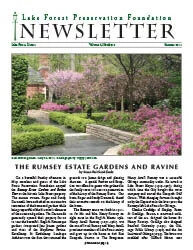
Lake Forest, Illinois, Volume 4, Number 2, Summer 2011, opening with “The Rumsey Estate Gardens and Ravine” by Susan Reinfrank Dedo describing how on a beautiful Sunday afternoon in May, members and guests of the Lake Forest Preservation Foundation toured the Rumsey Estate Gardens and Ravine at a historic Lake Forest property, noting that the current owners, Roger and Sandy Deromedi, have undertaken an extensive restoration of the home and gardens while respecting the estate’s historic references, and that guests toured English Picturesque gardens, interpreted Jens Jensen gardens, and vistas of the Mayflower Ravine, with Kettelkamp & Kettlekamp Landscape Architects credited as the firm that returned the grounds to a Jensen design and planting character, and explaining that a special preview and reception included a presentation on the estate’s history and that the Deromedis shared their research, then providing background that the Rumsey estate was built in 1911–12 for Mr. and Mrs. Henry Rumsey on eight acres in an English Manor style, identifying Henry Axtell Rumsey (1871–1941) as the son of Israel Rumsey and Mary Axtell who grew up at 404 East Deerpath (“The Evergreens”), and noting Rumsey was a successful Chicago commodity trader and served as Lake Forest Mayor (1919–1925) during which the City bought the water company and started the Deerpath Golf Course, and that changing fortunes in the late 1920s Depression era led the Rumseys to leave Lake Forest for Chicago, then naming architect Charles Coolidge of Shepley, Rutan & Coolidge (Boston) as designer of the house and citing examples of his work (Stanford University, Chicago Public Library, Art Institute of Chicago), adding that Rumsey had seen an image of Clifford Manor and sent Coolidge to England to study it, and that after the Rumseys left, the manor was rented, later sat empty, was used as naval officers’ quarters during WWII, and that in the 1950s outbuildings and gardens across the ravine (coach house, stable, gardener’s cottage, kitchen, orchard and cutting gardens) were sold for development, with subsequent owners modernizing the home, then shifting to Jens Jensen’s role—identifying him as landscape architect, conservationist, and Prairie Style founder—stating he designed the Rumsey estate gardens in 1913 after Rumsey decided against hiring Frederick Olmsted, and describing Jensen’s natural/woodland approach influenced by his Denmark childhood and regional materials/forms, mentioning that in 1888 Jensen transformed a small formal garden in Chicago’s Union Park by planting native prairie wildflowers to create the American Garden and that this defined his woodland style, and noting that many North Shore residents commissioned him, then describing how the Rumsey estate is revealed through woodlands into a clearing and displays Jensen characteristics such as meadows with natural plantings, winding paths through light and shade, and indigenous limestone stacked for signature council rings, and explaining that the gardens and ravine have been restored and reinterpreted to respect the original Jensen design while acknowledging changes over intervening years, with the area near the house and pool in English Picturesque style (mid-18th century England) and a woodland periphery evoking Jensen naturalistic themes, and noting that original architectural drawings for the Rumsey estate are held at the Bentley Historical Library at the University of Michigan, then concluding that LFPF recognizes the preservation excellence and stewardship represented by the Rumsey estate and states the Rumsey Estate Gardens are a 2010 Lake Forest Preservation Foundation Preservation Award winner, encouraging readers during the sesquicentennial to honor the Deromedis for preserving Lake Forest’s designed heritage, alongside a President’s message from Suzanne G. Boren stating the Foundation looks forward to continuing successful 150th celebrations with the City, thanking homeowners and members/guests for two major events covered (the Founders House Tour on April 17 and the Rumsey Estate Garden and Ravine Tour on May 22), noting the third Family Fair in Market Square on June 25 co-presented with the Chamber of Commerce to engage the next generation of preservationists, and expressing anticipation of working with Lake Forest organizations and the City on preservation projects, plus a “Welcome New Board Directors” section welcoming newly elected directors Judy Boggess, Rosemary Troxel, Guia Trutter, Elizabeth Sperry, and Bruce Southworth, congratulating Shirley Paddock on becoming an honorary director, and thanking departing directors Patty Kreischer and Liz Moore, stating recognition occurred at the annual meeting and Founders Tour on April 22, then featuring “Celebrating 150 Years of Lake Forest Architecture: The Homes of the 2011 ‘Founders House Tour’” by Rommy Lopat explaining that for Lake Forest’s 150th birthday the Foundation departed from its usual approach of awarding newly rehabilitated houses/landscapes and instead honored four early houses (three built in 1860 and a “youngster” built in 1876) clustered near Deerpath and Sheridan Road, and that owners opened their homes for touring on Sunday, April 17 after the annual meeting at Lily Reid Holt Memorial Chapel at Lake Forest College, featuring presentations by Susan Benjamin and Arthur Miller on the residences’ “genres and genealogies,” noting over 200 guests attended and enjoyed sun after prior cold rainy weather, followed by a reception at “Glen Rowan” (1909, 500 North Sheridan Road) designed by Howard Van Doren Shaw for Alice Reid and Clifford Barnes, then providing individual house profiles including: THE HOMESTEAD (1860), 570 North Sheridan Road, built for Ellen Hubbard and Devillo R. Holt with current owners Herbert and Judith Krueger, describing Holt’s background (fur trading; founding Holt Lumber Company; first canal load in 1848; marriage to Ellen Hubbard; charter membership on Lake Forest University Board of Trustees) and identifying the house as classic Italianate with features such as low-pitched roof, projecting bracketed eaves, arched windows, belvedere/widow’s walk, loggia with balustrade, and attic awning windows, and noting construction details including brick covered by clapboards and a thin concrete layer between floorboards, and briefly referencing nearby 1869 John V. Farwell “baronial castle” built of poured-in-place concrete and noting reinforced concrete’s introduction in Paris in 1867; 660 North Sheridan Road (1860–1861) built for Hannah and Harvey Thompson with current owner Keith W. Jaffee, describing its Italian villa character and more picturesque irregularity including an assertive three-story octagonal tower with pointed spire, some blind windows, and describing ravine landscaping with wooden stairs/bridges/fences and a greenhouse, plus noting Thompson as Lake Forest’s first mayor (1861–65; 1867–68) and citing connections to the Brevoort Hotel and “Bathhouse” John Coughlin; FOREST LAWN (1860), 644 East Deerpath, built for Mary A. and David J. Lake with current owners Wesley and Deborah Clark, describing an originally irregular wood-framed Italianate villa attributed to pioneer architect Rufus Rose in the Downing mode with verandah and light-filled tall windows, identifying David J. Lake as secretary of the Lake Forest Association and third mayor (1866–67), and noting exterior modernization in 1927 (tower removed; stucco; changes to projections and surrounds) and coach house conversion in 1976; and 725 North Sheridan Road, moved/remodeled in the mid-1890s for the Aldrich family with current owners Robert and Eileen Keller, described as possibly an 1874 Whitney farmhouse moved to Deerpath and enlarged by Frost and Granger into a restrained Queen Anne with carved woodwork, matching roof pediments, wraparound porch, Dutch door, quarter-sawn oak floors, 10’ ceilings, and noting that in 1996 a detached garage (originally a two-story barn) was moved/connected to create a new kitchen and back bedroom with preservation guidelines followed, then including a short anecdotal column by Rommy Lopat (“Always Happy to Learn More About Our Architectural Heritage…”) recounting meeting Gloria and Milan Maliarik who brought documentation of their 1955 Edward Robert Humrich–designed house (built on two acres; hand-dug foundation to avoid oak roots), noting it is on file at the Chicago Historical Society and was part of a Chicago Architectural Foundation tour in 1992, and adding a note that Humrich (1902–1991) designed ten houses and several additions in Lake Forest between 1950 and 1966 and that a thesis on Humrich is in Lake Forest College Special Collections, then “Ragdale” by Alice Moulton-Ely describing the March 20 groundbreaking that launched the first-ever restoration of Ragdale House built in 1898 by Howard Van Doren Shaw as his family’s summer retreat, summarizing its Arts and Crafts character and interior features (window seats, inglenook, clear leaded glass, shallow barrel vault ceiling in entrance hall), noting Ragdale’s listing on the National Register of Historic Places and that granddaughter Alice Ryerson Hayes founded the Ragdale Foundation in 1976 and in 1986 donated the house/outbuildings/five acres to the City, describing Ragdale’s artist residency scale and community reach, outlining needed improvements and planned restoration to circa 1926 appearances with systems upgrades including a geothermal-assisted HVAC approach, referencing a 2008 Historic Structure Report guiding repair over replacement and reproduction of wallpapers, noting “Ragdale Blue” trim and careful exterior stucco finishing, and stating the $3 million “Operation Renovation” is privately funded via public fundraising under a long-term lease from the City, with contact info for Susan Tillett and a website reference, plus “Upcoming Events” listing the 3rd Annual Family Fair in Market Square on Saturday, June 25 (co-sponsored with the LF/LB Chamber of Commerce), “Historic Interiors with Frank Ponterio” on Sunday, October 23 with a reception at an historic home, and an annual holiday party for members on Sunday, December 4, and closing with “Recommended Book” in which Sarah Wimmer recommends Paul Goldberger’s 2009 book Why Architecture Matters emphasizing fundamentals like proportion, scale, space, texture, shapes, and light and highlighting the urban design principle that the whole is more than the sum of its parts, plus membership prompts to join online at www.LFPF.org.
Architectural Lake Forest 50th Anniversary Video
Narrated by Bill Kurtis, explore the architecture that has helped shape Lake Forest. This new, three-part video series traces the people, places and preservation efforts