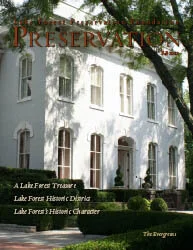
Fall 2012, A Lake Forest Treasure, Fall House & Garden Tour, noting the Preservation Foundation celebrated its Annual Home & Garden Tour of Georgian Estates on the beautiful afternoon of October 5th, FROM THE PRESIDENT explaining the Foundation’s October 5 Home and Garden Tour provided a private look at some of the most architecturally significant Georgian homes in Lake Forest and their gardens and offering thanks to attendees and to homeowners Mr. and Mrs. Jeffrey R. Brincat, Mr. and Mrs. Kent Haeger, Mr. and Mrs. Robert G. Hershenhorn, and Mr. and Mrs. Miles Marsh for sharing the afternoon with guests and to Mr. and Mrs. Robert W. Crawford II for graciously hosting the reception, and thanks to underwriters Paul Bergmann, Mr. and Mrs. Timothy Derr, Jan Gibson, Mr. and Mrs. David Grinnell, Mr. and Mrs. Jerry Shields, Lake Forest Bank & Trust Company, Baytree National Bank & Trust Co., and Melichar Architects, stating the success of the sole annual fundraising event was ensured by the Tour Committee chaired by Jan Gibson, Executive Director Marcy Kerr, and thirty-seven docents and volunteers, along with the weatherman who held off a ferocious thunderstorm, and announcing the launch of the Foundation’s new website encouraging readers to learn more and participate and support preservation at www.lfpf.org and noting the site allows subscribing to email updates and includes Newsletter archives and other useful information, and with sadness reporting the passing of James F. Herber the Foundation’s sixteenth president in May and describing Jim as active member of Lake Forest community for more than 50 years who led the Foundation from 2005–2007 with projects during his tenure supporting Elawa Farm, Lake Forest College, and preservation of a 172-year-old Mills Court log cabin believed to be Lake Forest’s oldest surviving home, and closing with an invitation to join as a Foundation member to support preservation and share yearly benefits including educational programs advocacy opportunities special events and the Annual Holiday Celebration held each year at an historic home and inviting readers to celebrate on December 8, signed Gail Hodges, Find Us Online! • www.LFPF.org promotional blurb describing the new website as colorful up-to-the-minute and trendy with ability to sign up for informative presentations and tours of local homes, see photos and videos of events, and join in supporting the Lake Forest Preservation Foundation and encouraging visiting the site and joining today “to preserve for tomorrow,” followed by masthead line PRESERVATION FALL 2013 • VOLUME 6, NUMBER 1 with contributor list Suzanne Boren, Peter Coutant, Allison Derr, Jan Gibson, Maureen Grinnell, Gail Hodges, Cappy Johnston, Arthur Miller, Laura Turansick and address Lake Forest Preservation Foundation • 400 East Illinois Road Lake Forest, Illinois 60045 • www.lfpf.org, feature article Preserving the DNA of Lake Forest in a Changing Economy explaining that in mid 1990s through mid 2000s economics of real estate historic preservation and the stock market intersected to encourage updating and preserving Lake Forest’s historic housing stock with countless historic homes purchased rehabbed and sometimes resold to buyers seeking completely updated historic homes, and noting many projects were successful and a significant portion of older housing stock was modernized rather than demolished with speculative builders fueling many projects because preservation economics presented a risk worth taking, and observing housing market changed considerably over past six years in values and buyer wants and speculative building and it remains uncertain if return to those days will occur, while noting there remain historic homes needing updating and long-term investment, and stating the City of Lake Forest has been a leader in historic preservation embracing tools and incentives allowing homes to be improved for modern function and viability and that success now requires continued commitment to proven approaches and willingness to consider new ones, and noting preservation projects will continue to require exceptions to City Code sometimes significant with building-scale ordinance cited as difficult to apply to many large historic homes due to original designs subdivisions or code modifications and that application requires balancing numeric aspects with aesthetic and visual features to determine impacts on streetscapes and surroundings and that Historic Preservation Commission and Building Review Board have expertise to evaluate and grant appropriate exceptions and that continued willingness of City to grant exceptions even if large or questioned is crucial for encouraging long-term investment, and raising a critical challenge of handful of 15,000+ square-foot estate homes with limited market appeal due to size and upkeep despite importance to community’s historical and architectural “DNA” and asking whether enough buyers exist for sustainability as single-family homes, suggesting creative approaches to make preservation economics work such as conversion to boutique hotel or bed & breakfast, use as business offices or corporate headquarters (citing example of Tangley Oaks manor home in Lake Bluff converted to Terlato Wines International headquarters in mid 1990s), or conversion into multiple family dwellings, noting these would require exceptions and public scrutiny and proposing an in-depth study and community dialogue before City faces demolition requests, section The Robert G. Hershenhorn House, 808 East Deer Path, Architectural Description stating the house is product of Chicago office of Boston firm Shepley, Rutan and Coolidge heirs to Henry Hobson Richardson and built in 1902 during period when firm undertook more than a dozen Gothic buildings at University of Chicago and illustrating ability in Georgian idiom later noted in Harkness Houses at Harvard and noting firm also designed Art Institute of Chicago (1893), describing exterior as perfect Georgian symmetry with elegant portico and Palladian window over front door and sculpted dormers and details such as carved Ionic capitals of columns and pilasters, carved pediment over front door, cornice at roof line, and curvilinear tracery of third-floor dormer windows, and describing interior continuing symmetry with living room and library to east and dining room and kitchen/service to west as flanking wings with matching porches and Georgian cornices mantels overmantels and raised paneling, highlighting Williamsburg dining room with features seen in Metropolitan Museum of Art and the library designed by Robert Work former associate of Howard Van Doren Shaw and Hency C. Dangler and David Adler’s partner from 1918–1928, and describing central stairway with three types of balusters and mahogany handrail terminating in carved scroll and a detailed arch in entry softening straight stairway, Other Points of Interest noting belief house built on site of Samuel F. Miller house (1860) with Miller surveying and supervising first railroad from Chicago to Milwaukee that became Chicago and North Western Railway and serving as first teacher at Lake Forest Academy, first headmaster (1858–1862), and Lake Forest’s first postmaster and superintendent of schools, and noting original property included a coach-house/stable now another private residence to the north, Architects section recounting that after Richardson died at 47 in 1886 work taken up by assistants George Foster Shepley, Charles H. Rutan, and Charles Allerton Coolidge who finished posthumous works including 1885 Marshall Field Building and Glessner House in Chicago, Alleghany County Courthouse in Pittsburgh, and Cincinnati Chamber of Commerce, and that new commissions were more delicate and generous in fenestration and firm won competition for Chicago Public Library (1893) and followed with Art Institute design and that local architects perverted firm name to “Simply Rotten and Foolish” leading firm to establish permanent Chicago office and later commissions including Corn Exchange Bank and Harris Trust and University of Chicago buildings and other major works listed including Howard Memorial Library New Orleans, Wells Fargo Building San Francisco, Ames Building (1889), Harvard Medical School (1903), Merchant’s National Bank Boston, Stanford University campus Palo Alto (1888), and that firm continues in Boston as Shepley Bulfinch, with biographical notes on George Foster Shepley (born St. Louis Nov 7 1860, MIT grad 1882, married Richardson’s daughter Julia June 1886, died 1903) and that his son Henry Richardson Shepley drove firm 1936–1962 and grandson Hugh Shepley last family partner retiring 1990, and on Charles H. Rutan (born Newark March 28 1851, joined Richardson 1878, firm engineer at Richardson’s death, Fellow of AIA, died 1914) and on Charles Allerton Coolidge (born Boston Nov 30 1858, Harvard 1881, studied at MIT, joined Richardson 1882 as designer, married Shepley’s sister 1889, later formed Coolidge and Hodgdon in Chicago and in 1924 partnership with Shepley’s son Bulfinch and Abbott, died 1936), and noting “Shepley, Rutan and Coolidge, 1902 • Renovation by Robert Work, 1940s,” The Owners section stating house designed for Russell Day Hill Chicago native born Dec 19 1869 educated at Chicago’s Harvard School, member of Yale Class of 1891 but left in 1888 after father’s death to assume real estate business R.D. Hill & Co engaged only in central business district Chicago transactions controlling tract books and at time built Lake Forest home Hill was vice-president of Chicago real estate board and leader of minority advocating surface plan for boulevard connecting link between north and south sides of Chicago, that he married Lucia Elliott Green in 1896 and had one daughter Helen Dorothy Hill and that Hills were residents of Highland Park before moving to Lake Forest and it is surmised Hill’s Chicago business drew him to appreciate Shepley, Rutan and Coolidge and that design may be unique locally with only one other Lake Forest home by firm the Henry Rumsey residence, and that house later home to Mr. Owen A. West who commissioned Robert Work to renovate library/music room and that Wests enjoyed house many years, and that current owner Mr. Robert G. Hershenhorn lived in house approximately 40 years and when purchased assured former owner he would always be steward and preservation efforts evident including formal garden to west and terraces to east personally designed and created by Hershenhorn using his drawings to blend with architecture, concluding that his family’s steadfast love has been a gift for Lake Foresters to admire.