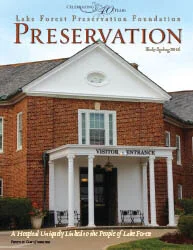
Early Spring 2016 A Hospital Uniquely Linked to the People of Lake Forest Photo by Cappy Johnston A Hospital Uniquely Linked to the People of Lake Forest From the time of the very first hospital established in Lake Forest in 1899 to the current and expanding Northwestern Lake Forest Hospital, the community of Lake Forest has been responsible for bringing superior health care to the area, and the original 1942 Lake Forest Hospital building embodies this symbiotic relationship between a visionary and supportive community and one of its vital institutions, in the late 1890s after establishing their schools, homes, church, necessary retail businesses and later clubs and summer homes, the founding families of Lake Forest realized the need for a local hospital to serve all of its 2,000+ residents and many seasonal visitors since the nearest hospital was in Waukegan, a slow train or horse and buggy ride away, Dr. Alfred C. Haven, the first physician to reside in Lake Forest, led the campaign to build a hospital on the grounds of Lake Forest University (Lake Forest College, North Campus), and Mrs. Henry Durand, wife of the president of Lake Forest University’s Board of Trustees, submitted a proposal to the board along with $5,000 to be used to build the “Alice Home” hospital in memory of her sister Alice Burdsall Burhans, Alice Home, Lake Forest Hospital’s original structure on the campus of Lake Forest College, was designed by architects Frost & Granger in a traditional English half-timbered style and modeled after a rural cottage hospital with all the soothing comforts of home, with the outbreak of several epidemics and no vaccines in the early 1900s the need for a separate Contagious Hospital arose and Dr. Theodore Proxmire raised funds in 1908 by establishing Lake Forest Day with parade, games and carnival, later expansions such as the 1925 north wing by architect Charles Frost and equipment needs were supported by countless families donating money or organizing events such as The Lake Forest Horse Show and the Trading Post Gift and Rummage Shops, and Reverend James G.K. McClure of the Presbyterian Church even took up a special Easter collection each year for the hospital’s continuing needs, in 1926 architect Stanley D. Anderson’s firm designed a Tudor style English Arts & Crafts nurse’s residence, Bradley Lodge, later repurposed in 1942 as faculty and student housing and today known as Cleveland-Young Hall, and in the late thirties Anderson began drawing plans for a major expansion of Alice Home but the ten-acre site could not accommodate growth, so Mary Dick, widow of Albert Blake Dick, donated 23 acres of her farm estate west of Route 41 and north of Deerpath, and Anderson designed the new 1942 hospital in the classic style, materials and color of the 1903 A. B. Dick family manor Westmoreland designed by James Gamble Rogers, using red brick with white trim and columns and a perpendicular wing layout respectful of the estate’s architectural heritage, the new Lake Forest Hospital opened in 1942 prompting many to ask “Whose mansion was this?” and while later expansions were mixed in harmony, the 1942 building’s similarity to Westmoreland represents historic generosity that fostered the first 1899 cottage hospital and allows Northwestern Lake Forest Hospital to grow, with hopes that the 1942 Anderson building can be retained and adaptively reused, reflecting Lake Forest’s rich heritage of adaptive re-use including Alice Home later serving as a women’s residence hall 1943-65, Cleveland-Young International Center, Gorton Community Center saved from demolition in 1972, Hixon Hall converted to theater space, Lake Forest Academy at Melody Farm, Lake Forest Open Lands headquarters in the Armour gatehouse, Ragdale evolving into an artists’ community, Market House on the Square formerly the fire station, Grove Cultural Campus repurposed from Ridge Farm Preventorium, and Elawa Farm restored for educational uses, From the President Arthur H. Miller wrote Dear Neighbors and Friends as the Lake Forest Preservation Foundation celebrates its 40th anniversary, noting that Lake Forest’s so-called boring ranking belies its restored landscapes like Forest Park and Lake Forest Open Lands and its collaborative stewardship where harmony trumps self-interest and evolutionary development pays forward a rooted quality of life, encouraging membership renewal with 10 compelling reasons including education, advocacy, awards, funding restorations, dialogue, communications, six membership levels, member events, discounted admission, and the reminder that Forty is the new 50, and let’s get this party started, the Annual Holiday Celebration at the stunningly modern Summer House at Crab Tree Farm honored I.W. Colburn with tours and Jay Pridmore’s book Emotion in Architecture and honored Pauline and Roger Mohr with the Lawrence R. Temple Distinguished Public Service Award, Crab Tree Farm itself a 200+ acre gentleman’s farm since 1860 and eminent Anglo-American Arts & Crafts Museum under John and Neville Bryan with Solon Beman’s 1911 barn complex and collections rivaling Winterthur and the Victoria and Albert, featuring Gustav Stickley and Harvey Ellis works and books such as History of Crab Tree Farm by Kim Coventry and Arts & Crafts Rugs for Craftsman Interiors and 100 British Chairs edited by Adam Bowett, with docent-led tours June 11, 2016 at 10:00 A.M. and 1:00 P.M. for $30 members and $50 non-members, Historic Train Station Restoration Update reports Illinois Transportation Enhancement Program grants totaling over $2.07 million supporting roof, dormer, masonry and interior work with Foundation funds for lighting and features and contact Marcy Kerr at 847-234-1230 for contributions, Thank You To our 2015 Members, Donors, Volunteers and Sponsors including extensive membership and annual fund donors denoted by asterisks and organizations such as Lake Forest Garden Club, Lake Forest Library, Lake Forest Open Lands, LF-LB Historical Society, Melichar Architects, Ragsdale, Inc., sponsors and in-kind donors including Authentico Mexican Restaurant, First Presbyterian Church of Lake Forest, Forest & Bluff Magazine, Mariani Landscape, Market House on the Square, Adrian and Nancy Smith, Sunset Foods, The UPS Store – Lake Forest, and many more with apologies for omissions, LAKE FOREST PRESERVATION FOUNDATION 2015-2016 Board of Directors Executive Committee Arthur Miller President Stephen Bent VP Development Allison Derr VP Programs Maureen Grinnell Secretary Fred Moyer Treasurer Directors Guy Berg Lynn Bertram Judy Boggess Ingrid Bryzinski Kristen Chun Peter Coutant Cathy Dohnalek Tom Gleason Gail Hodges Linda Liang Laura Luce Roger Mohr Elizabeth Moore Jim Opsitnik Peggy Pandaleon Lynn Van Cleave Kent Woloson Honorary Directors Herbert Geist Pauline Mohr Shirley Paddock Linda Shields Lorraine Tweed Sarah Wimmer Executive Director Marcy Kerr Preservation Early Spring 2016 Volume 9 Number 1 Contributors Peter Coutant Allison Derr Maureen Grinnell Gail Hodges Marcy Kerr Arthur Miller Peggy Pandaleon Photography Cappy Johnston and Allison Derr Lake Forest Preservation Foundation 400 East Illinois Road Lake Forest Illinois 60045 www.lfpf.org NON-PROFIT ORG U.S. POSTAGE PAID PERMIT NO. 184 LAKE FOREST IL 60045 ECRWSS Residential Customer Lake Forest IL 60045 Nominations for 2016 Historic Preservation Awards Due by March 25th with categories Preservation, Rehabilitation, Restoration, Reconstruction, and New Construction or Infill and nomination forms at www.lfpf.org/preservation-awards or 847-234-1230, and Upcoming Events including Sunday March 13 Market Square’s First 100 Years 1916 to 2016 Preservation and Adaptive Re-use of a Lake Forest Treasure, Sunday May 1 Annual Meeting and 2016 Historic Preservation Awards, Saturday June 11 Crab Tree Farm Tour, Friday August 26 Summer Garden Stroll, Sunday October 2 Annual Benefit Architectural House & Garden Tour Exploring The South Woods, Sunday December 4 Annual Member Holiday Celebration, with programs and updates at www.lfpf.org.