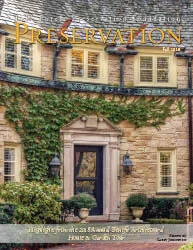
Fall 2018 Highlights from the 2018 Annual Benefit Architectural House & Garden Tour From the President September’s House and Garden Walk, commemorating Stanley Anderson’s contribution to Lake Forest’s architectural and visual beauty, was a major success, nearly 200 people attended the event, culminating at an outdoor reception at Stanley’s former home, coincidentally, this is the home that my wife Elaine and I purchased thirty-four years ago, we have upgraded and restored many aspects of the home and have enjoyed it immensely, over the years I have learned of Stanley’s many contributions to the visual character of the city, from the cast concrete post and lantern street lights adopted throughout the city, to the design of the nationally recognized Lake Forest High School, Northern Trust Bank, and approximately 200 homes and home modifications on the North Shore, Stanley’s influence is still with us today, the stewardship of Lake Forest’s historic and architectural heritage is guided by the dedicated individuals who serve the City on the Building Review Board and Historic Preservation Commission, petitions for demolitions, replacement structures, major renovations, and variances pass through their review, the Preservation Foundation, although not part of the City system, also reviews these documents and filings and provides the City staff with our opinions and perspectives, through this collaborative public and private dialogue, we work together to help insure the quality and beauty that is Lake Forest, if you would like to learn more about or participate in this process, I encourage you to become a member of the Lake Forest Preservation Foundation, we are now in the process of our Annual Fund drive and would appreciate your financial support, these funds have been used throughout the years to restore the interior of the downtown train station, the King Muir and Castlegate entry gates and many restorative projects in the City, your help in keeping Lake Forest a beautiful and unique “special place” is needed, sincerely, gh, Fall Architectural House & Garden Tour the Preservation Foundation celebrated its annual benefit on the afternoon of September 23rd, many thanks to the homeowners featured in the newsletter, April’s Linens Craig Bergmann Landscape Design, Inc. Davey Tree Company DiVinci Painters, Inc. Fitness Together Forest & Bluff Knauz Autopark Lake Forest Bank & Trust Co. Lake Forest Hearing Lake Forest Place Lynch Construction Market House Mariani Landscape Melichar Architects Northwest Vascular and Vein Specialists Robb Orthodontics Shea Lubecke Designs SilverPepper Sunset Foods The Organic Gardner The UPS Store Timbers Edge Northbrook Webb Financial Group Our Generous Sponsors: Tour Committee, House Chairs, and Docents Without their support and time, this lovely event would not have been possible, Tour Chairs: Elizabeth Abbattista and Natalie Reinkemeyer, 2018 Year-End Annual Fund Launch Help Us Make A Difference Last month the Board of Directors of the LFPF held its annual retreat, board members participated in an exercise of listing the things they love most about Lake Forest and that make the community a special place, after filling a whiteboard with characteristics, the Board then asked two fundamental questions of its mission to protect the historic visual character of Lake Forest: If not us . . . who? If not now . . . when? when it comes to preservation issues, the time to engage, support, and act is now, once an historic building is demolished, it’s gone for good, the Lake Forest Preservation Foundation relies on the support of community members like you who share our commitment to preserving the historic visual character of Lake Forest, we live in a unique and amazing community that is unlike any other in the Midwest because of its history and natural beauty, with your help we can continue our mission as the primary organization in the community dedicated to safeguarding the historic visual character of Lake Forest, we encourage you to make a gift to this year’s Annual Fund so that we may continue our work of preserving the treasured vistas, streetscapes, neighborhoods, and beauty that drew us all to Lake Forest in the first place, your contribution, of any size, WILL make a difference, donations to the Annual Fund can be made with the envelope enclosed in this publication, or through the LFPF website, www. LFPF.org, here are a few of the characteristics from our whiteboard list of things that make Lake Forest a special place: Variety of housing Streetscapes Lakefront/Beach Historic Central Business District Open spaces Strong sense of community Historic architecture • Trees/mature tree canopy • Parks and Recreation • Train station • Bike paths • Beautiful public buildings • Lake Forest College • Small businesses – shop local • Ravines, few Lake Foresters would argue that these are some of the very reasons they love living in this community but we want to hear from you, what would you add to this list, what are the things you love most about Lake Forest, let us know through our Facebook page where you can comment or post a picture of your favorite thing about Lake Forest, Stanley D. Anderson’s Lake Forest 1920-1980s this year the Lake Forest Preservation Foundation celebrates the work of Architect Stanley D. Anderson and his impact on Lake Forest, Anderson, perhaps more so than any other architect, had a profound influence in shaping Lake Forest’s built environment, from the numerous public, commercial, and residential buildings throughout the community, to the lantern style streetlights, and even the entry sign at Lake Forest High School, Lake Foresters encounter the work of this prolific architect on a daily basis, according to the Stanley D. Anderson firm records and information from Paul Bergmann, Lake Bluff, Anderson’s impact on local building began while he was a draftsman for Howard Van Doren Shaw by 1920 and continued after his death in 1960 with the Stanley D. Anderson Associates firm of William Bergmann to 1992, Stanley Anderson was a 1916 graduate of Lake Forest College, who then studied architecture at the University of Illinois before entering the Army during World War I and serving in France under General Pershing as his aide de camp or German-speaking driver, in case they ended up behind German lines, after the war he continued his studies at the Ecole des Beaux-Arts, Paris, before returning home and joining Shaw’s office, he also studied engineering at the University of Pennsylvania, Shaw had been increasingly ill at the beginning of the 1920s, and died in 1926, young Anderson took the lead on local Shaw projects like the church next to the Lake Forest Library and the large Cotswold style Hinckley house on Wisconsin, by 1925, the new firm of Anderson & Ticknor emerged, collaborating with the James Anderson Company and the James Anderson Trust of his Lake Forest pioneer grandfather, Anderson’s most remembered work includes his 1935 Lake Forest High School, dubbed in 2017 Illinois’ most beautiful high school by Architectural Digest, in the twilight of the estate era, Anderson created a public high school that resembled an Anglo-American mansion, perhaps a private school in a mansion, between 1925 and 1930 he developed for the Anderson Trust the commercial stretch of Deerpath between Western and Forest Avenue within the Howard Van Doren Shaw style palette of Market Square, in the Depression’s early years, the firm kept working and stayed intact, thanks to the James Anderson Company link—with the draftsmen leaving their desks to go out in the field to survey properties going into bankruptcy, he had helped provide for the uniformity in estate neighborhood street lights with the introduction of the lantern style design common throughout much of the community today, when work revived by the mid 1930s, his firm alone survived to build new places like the Arthur Dixon III house at 5 E. Laurel Avenue, work on Gorton School, now Gorton Community Center, and what is now the Hughes Auditorium, led to commission for the federally-funded Lake Forest High School, in 1930 he built the Presbyterian Church’s parish house on Deerpath and in 1940 renovated the Church interior, he also later added to the Church of the Holy Spirit, with parish wings to the west, from his early work as a draftsman for Howard Shaw, through the 1980s under his successor firm Stanley D. Anderson Associates, the Anderson firm’s work created compatible structures and maintained much of estate-era Lake Forest that we see today, from large commercial projects to small amenities of civic design, AnnuAl Benefit ArchitecturAl house And GArden tour Stanley D. Anderson at the End of the Estate Era this year’s Annual Benefit Architectural House and Garden Tour highlighted the works of Stanley D. Anderson with a peek into the successful and enduring design work of one of Lake Forest’s very own, King Muir Road Waukegan Road Stanley D. Anderson Associates is best known for its “Country Georgian” style of architecture, Anderson was raised in Lake Forest, educated at Lake Forest College, and would eventually return to spend six years in the architectural office of Howard Van Doren Shaw (from 1919 unit Shaw’s death in 1926), thus, Anderson had a strong local following, many of his 200 fine residences and 30 public and commercial buildings in town are distinguished by their classic pediments and finely sculpted moldings of the English Georgian style, others were designed in the Tudor, English Cottage, American Colonial, and French Normandy styles, several of which were included in this year’s walking tour, Lake Forest estate architecture, post the 1913 re-introduction of the federal income tax, required some scaling back in size when compared to that of our historic country places, e.g., Villa Turicum, Mellody Farm, Havenwood, and the Noble Judah estate, so smaller estates like those of the Deerpath Hill Estates subdivision, fit the model of the picturesque house: classic, quaint, and full of character, The Rise of Deerpath Hill Estates Subdivision In 1925, Henry K. Turnbull of Kansas City, Missouri moved to Chicago to get into the booming real estate business, utilities tycoon Samuel Insull had planned an extension of his North Shore Inter-Urban Electric Railroad, through Lake Forest, parallel and next to Route 41, Turnbull, thinking it an auspicious time to speculate, purchased 30 acres at the southeast corner of Waukegan and Deerpath for a new type of development where he would design and control the environment, Turnbull subsequently added two more parcels to his development, to the north of Deerpath on King Muir and to the east as far as Deerpath Square, bringing his total land acquisition to 81 acres, with easy access to the city via the new North Shore line with a stop at the overpass of Deerpath and Route 41, employing a combination of City Beautiful and American Garden theories, Deerpath Hill Estates was born, Turnbull enlisted the new architectural firm of Anderson and Ticknor, and cousin James Anderson, civil engineer, to design gentle curving streets, reflecting ponds, and beautiful stone gates to enhance the common areas, as lots were sold, Turnbull required that each house be designed or approved by Stanley Anderson, resulting in a pleasing uniformity of scale, massing, and presence among the properties, there were 14 houses built in the late 1920s through 1930, it all came to a “crashing” halt after October 1929 and the subsequent depression, by 1932, Turnbull was deeply in debt, he had mortgaged and re-mortgaged to the point where any drop in land sales meant the whole project failed, houses that were selling were listed for half of their pre-crashed prices, due to the extreme post-depression deflation, still low in 1935, and the economic upturn of the late 1930s, some Lake Foresters had been able to preserve cash reserves and many in the Chicago business community had been accustomed to stock-market volatility, estate building continued albeit on a slightly less grand scale than that of the high-flying 1920s, it was at this time that Arthur Dixon III commissioned Stanley Anderson to build his home at 5 East Laurel Avenue, at the corner of Laurel and Green Bay Road, styled in the Georgian tradition, but less flamboyant than those of the earlier era, it recalled in its classic details many of Anderson’s successful projects of the late ’20s and early ’30s (Northern Trust Bank, Lake Forest High School, the William MacIlvaine Jr. house on West Westleigh Road, shown below) as well as being referential to some of David Adler’s then recent work, King Muir Road Current Owners: Julie and Ron Thauer Original Owner: Robert Kenyon Architects: Anderson & Ticknor, 1927 gh this French Norman house was nicknamed “Big Frenchy” by the Anderson firm, the house was originally painted cream with henna (dark red) trim, often referred to as French Eclectic style and popular in America from 1915-1945, it shows a great variety of form and detailing but is united by the characteristic tall, steeply pitched roof without a dominate front facing gable, 971 Verda Lane Current Owners: Elaine and Jim Opsitnik Original Owner: Stanley D. Anderson Architects: Anderson & Ticknor, 1928 gh this Normandy Provincial house was lived in by Stanley Anderson himself from 1930 until his death in 1960, the L-shaped house with garage at one end has a round turret typical of Norman architecture and contains a circular stair with wrought iron railing, 5 East Laurel Avenue Current Owners: Ana Bedran-Russo and Stephen Russo Original Owner: Arthur Dixon III Architects: Anderson & Ticknor, 1935 gh this stately home in the classic style was built in 1935 just as the country was emerging from the worst years of the Depression, described as Neo-Palladian, the front facade is organized around a classic pediment, a mid-Atlantic farmhouse-style porch serves to “domesticate” the appearance of the central block in the, 349 King Muir Road Current Owners: Molly and Brian Sarver Original Owners: Fanny and Henry Turnbull Architects: Anderson & Ticknor, 1927 gh adapted from a famous Sir Edwin Lutyens-designed house at Muirfield Links in Scotland, this Wisconsin Lannon stone house, built for the developer of Deerpath Hill Estates, is the most elegant house Anderson designed in the area, one of several revival designs employed in the subdivision, typical English Tudor elements include a cross gable layout, large chimneystacks, and tall inset windows with mullioned designs, 251 King Muir Road Current Owners: Linda and Larry Remensnyder Architect: Howard Irwin, in collaboration with Stanley Anderson, built in 1929 and designed by Howard Irwin in collaboration with Anderson this house in the French country farmhouse style is as carefully detailed as any of the original 14 houses in Deerpath Hill Estates, the brick exterior, steeply pitched clay tile roof, intricate wrought iron French scroll detailing, blue stone balcony, and tall divided light windows are typical Norman features, Greek Temple form from which the style derives, the house is one of the earliest of Anderson’s Country Georgian style houses, it reflects classical design and quiet good taste, with country informality and a sense of tradition, the tributes to the late John Bryan, who passed away on October 1st at the age of 81, have been boundless, they enumerate his role and profile as a cultural leader in Chicago, the nation, and across the Atlantic in art, architecture, historic preservation, and the public garden vision—Millennium Park, he and his family have lived a quiet and low-key life in our communities of Lake Forest and Lake Bluff for 34 years, their openness and lack of pretension, however, tended to downplay Mr. Bryan’s quiet, but significantly supportive contributions to local preservation, community, and history, the ca. 1837 Lake Forest Log House Rescued from Teardown and Rehabilitated for the Preservation Foundation, John Bryan’s most visible local contribution was his stepping up in late 2005 to rescue from teardown the ca. 1837 Log House on Mills Court, he engaged a mover to run it up Sheridan Road to Crab Tree Farm (CTF), the farm that he and his wife of 60 years, Neville, bought in 1984, he and his family became the fourth owners of CTF since its establishment in 1860 (previous owners were Judge Henry Blodgett, dairy-farming Mrs. Scott Durand, and investment banker William McCormick Blair), Mr. Bryan kept intact the original walls and floor of the Log House and had them studied by an archeologist, who learned there were ten layers of interior wall treatments, his team at CTF added a new roof, door, etc., in 2006, when all was complete, Mr. Bryan hosted the LFPF for the inaugural event, opening the newly restored Log House for visitors, John Bryan’s long and very impressive history in supporting the arts and preservation started in his youth, he was often asked by visitors to CTF, during personal tours he conducted, “When did you start collecting?” his reply, with his signature warm smile, was “It must have been as a young boy collecting stamps, and took off from there,” in 1968, as a wedding present to his wife, he purchased nine acres of land in West Point, Mississippi, on the land was a ruin of a 19th century brick house, he restored the house over the period of a year and, when complete, moved in with his family, the Bryans moved to Kenilworth in 1974, then to Lake Bluff ten years later, at CTF, John Bryan preserved the Farm itself, including Mrs. Durand’s 1911 Solon Beman-designed barn complex and meadows for grazing, he also preserved the 15-acre portion that comprised the lakefront William McCormick Blair estate, Port O’Call, and its associated buildings designed by David Adler in 1926, the adaptively-reused barn structures provide a display venue for his collections of American and British Arts & Crafts furnishings and decorative arts, annually Mr. Bryan hosted the LFPF membership for a summer tour of these collections, Gardens and Landscape Mr. Bryan was the driving vision behind Chicago’s Millennium Park, to hear him speak of the park, you sensed the strong civic pride one has in creating a monumental park in Chicago, for all of Chicago, as much detail went into his thoughts and consideration toward the landscape of a project, as were given to the structure of a project, with any project he was involved with, his keen eye to a complete environment meant he often left no stone unturned in considering the angles at which a person views and experiences the completed space, The Example of Crab Tree Farm for Generosity toward Neighbors these, plus many other acts of his generosity in recent years, define him as a giant in our time, locally, he supported the Lake Forest Garden Club, Ragdale, Lake Forest/Lake Bluff History Center, Lake Bluff History Museum, Conserve Lake County and many other organizations, for the Lake Forest Preservation Foundation, he was always so generous and giving of his time and support of our campaigns, hosting tours at Crab Tree Farm, and attending programs and lectures, he will be missed by so many in our community, Rehabilitation of the 1900 Train Station Interior Captures Its Moment of Lighting Transition Research on the 1900 built Chicago & North Western Railway station, now the Metra North Line or east Lake Forest station, began in 2008-09 with work on the Historic Structure Report commissioned by the Preservation Foundation and carried out by Harboe Architects, this brick and limestone eastside station, the first side of Market Square in effect, is the fourth on that property and the first one built with masonry, the main station was augmented by a west-side warming house, now Pasquesi’s, and a tunnel—the last abandoned in 1970, this building went up just as piped natural gas and electricity were beginning to be available in town, leading to hybrid lighting fixtures and heavy reliance on redistributed natural light, a mid 19th century innovation, this information about the station’s history and technology comes from research by David Mattoon, a former Preservation board member who is active in many railroad safety and preservation efforts, he is a Lake Forest High School and Lake Forest College graduate, also with an engineering degree from Purdue, the first phase of rehabilitation was the slate roof for the two buildings and their sheds, the latter restored to their original hipped shape, the main station roof had been missing its dormers since ca. the 1960s, according to Mattoon, these dormers were reconstructed, two on the east and two on the west, they functioned in 1900 to channel natural daylight through refactors into the center of the building, since electric service from Highland Park did not begin in 1900 until 4 pm, as Mattoon discovered, the light from the dormers came out over the ticket window, from a lay-light or skylight, this is represented by a simulation completed last spring, its framing built by project manager for Preservation, also its president, Jim Opsitnik, he and David Mattoon had researched electrically-lit bulb options that could re-create the feel of the original, since attic infrastructure prevented restoration of the original channeled daylight, another such skylight was between the tracks over the tunnel, to illuminate and distribute sunlight in that long space, at the same time, in the summer of 1900 natural gas was piped to Western Avenue businesses, with a line east to the station, which would open in November of that year, as a result, the lighting fixtures shown on the photograph of the interior are combination gas and electric ones, Mattoon also located the latest programmable LED bulb technology to simulate the gas flame lighting the waiting room and the ticket area, gas light could be used on days too dark for sunlight to suffice, a more detailed and more carefully accurate account of the station’s hybrid technology in 1900 written by David Mattoon will appear in a future issue of First and Fastest, the journal of the Shoreline Interurban Historical Society, thank you again to those whose generous contributions made the rehabilitation of the interior of the train station possible, a complete list of all donors can be found on the Foundation’s website, www.LFPF.org, Replica two-light gas-electric Recreated lay-light fills the entry vestibule with light Recreated lay-light above the ticket window combination fixture One Enchanted Evening Late Summer Garden Stroll On August 24, Foundation Members were treated to a rare opportunity to view the “hidden” gardens of the Schuler Prairie, the gardens, which cannot be seen from any public viewpoint, are composed of thirty acres of restored prairie lands, sculpture gardens, a pine grove, and a private home perched high on a bluff overlooking Lake Michigan, the night of the Garden Stroll, members approached the property from a drive through Crab Tree Farm followed by a walk through what once had been a corn field, now restored to an original prairie–abundant prairie grasses and wild flowers thriving, from the edge of the prairie, the view is of a magnificent pine grove with the Larry Booth designed residence creating a backdrop and, then– The Lake– a perfect epilogue to the view, other aspects of the gardens include three monumental sculptures, Prairie Sentinel, Closed Arch and Emergence, all by noted sculptor Raymond “Jake” Jacobson, each one has significant meaning to the land and the architecture, all in all, the evening was a singular experience of nature and art and how one can enhance the other, that this beauty of the land will remain for future generations to enjoy is insured as the natural prairie has been placed in a conservation easement, and it shall forever remain as open space.