LAKE FOREST PRESERVATION FOUNDATION
Fall 2024
Fall 2024PRESERVATION
“Family Walk Around West Park” Event October 20, see Page 6
from the president
President Brian Norton welcoming trick-or-treaters on his West Park porch during Covid
On coffee tables, you will often find large hardbound books with pages of black and white photos or drawings showing architectural treasures that cities have lost. Whether the books are titled Lost Chicago, Lost New York, or yet another city, the story is familiar; through neglect, disasters, or “progress,” all that remains of these historic structures are grainy photos and descriptions of what they were and once meant to the community.
While Lake Forest has lost some architectural gems, what distinguishes it from other cities is how much has been saved. Through early and tireless preservation efforts, classic public buildings, significant houses and estates, inviting business districts and welcoming neighborhoods largely remain as they were, both in form and context. So much so, that the better title for a book about our city could well be Lake Forest Found.
And the wonder of Lake Forest is that
every generation finds it anew. This is a testament to Lake Forest’s enduring and thoughtful architecture and urban design. Survey after survey bears this out. Among the most important reasons that people choose to live in Lake Forest, right along with safety, services, and schools, is the historic character of the City. Put another way, while Lake Forest may be 167 years old, it is not growing old.
As the Lake Forest Preservation Foundation nears its 50th anniversary, it begins celebrating all that has been preserved. In this issue, we feature both a grand estate, the Lasker Estate, and an entire neighborhood recognized on the National Register of Historic Places, the West Park Neighborhood. The Lasker
Estate was a gentleman’s farm, designed by David Adler, covering 480 acres with 27 buildings and its own nationally recognized 18-hole golf course. Remarkably, the
estate home itself and 16 farm buildings remain, having been repurposed into private residences. In downtown Lake Forest, Howard Van Doren Shaw planned the West Park Neighborhood for Lake Forest’s merchants, tradesmen, and workers, which includes nearly 150 contributing structures in a variety of styles.
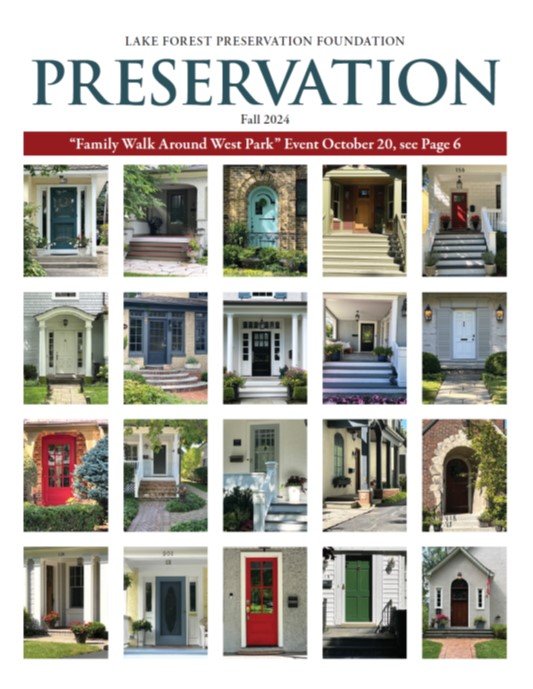
With Halloween fast approaching, it is altogether fitting that the cover of this issue should highlight the doors of this historic neighborhood, which will soon be opening for ghosts, witches, Minions, and monsters. I am convinced that the first childhood lesson in economics is not taught in school, but on the sidewalks
of Halloween. A trick-or-treater must survey a street and calculate whether the investment in steps is worth the return in candy. With houses closer together,
wide sidewalks and a comforting park, the West Park neighborhood passes the test. We regularly get more than 300 happy hauntings.
And every year, amid the bubbling excitement, one or two trick-or-treaters, after receiving their treat, will bound off to the next house, only to stop just for
a moment, turn around and say: “I love this house.” The next generation is finding Lake Forest again.
Brian Norton, President
R
RArcady/Dieu Foret Gates and Structures Rehabbed
ehabbed recently on the southwest corner of Waukegan Road and
Melody Road are the early 1900s gate structures and 1980s gates for this former Arthur Meeker estate, Arcady, redeveloped in 1985 as Dieu Foret. Over a year ago, a tree had fallen and taken out a portion
of the stonework, perhaps dating back to landscape designer Jens Jensen’s work on the Meeker property. Board member Jim
raised bronze lettering, with three clear finish coats.
The spear tops on the gates were painted gold.
Tree limbs and ground shrubs were removed to enhance safety and access to Waukegan Road.
For more details regarding this project, please visit our InfoHub at lfpf.org
Opsitnik, for LFPF, local historic gate structures whisperer, worked with the City and the neighbors to fund and repair this notable Waukegan Road historic feature.
The stonework repairs were done by Brugioni Masonry.
The four decades old metal gates were
Arcady/Dieu Foret Gates restoration project completed by LFPF in partnership with the City
sanded, primed, and painted with two black finish coats.
The cast bronze plaque was removed, painted, and finish sanded to reveal the
/infohub-blog
Cover: Doors of houses in the historic West Park neighborhood. See the article on October 20th “Family Fall Walk Around West Park” on page 6.
Your Support to Our Annual Fund is Important to the Lake Forest Community
Rehabilitation progress–Kasik & Scarpone painting contractors at work at the Arcady/Dieu Foret gates project
Bank Lane looking north from Illinois with view of vacant gas station lot and trial angled parking spaces
Y
Your generous contributions to our 2023 Annual Fund allowed our
dedicated Board members to accomplish a myriad of mission-driven goals. Over the past year, the LFPF’s primary focus has been on preserving the historic and
architectural character of the Central Business District. The opportunity to do so presented itself largely through the City’s Bank Lane Streetscape Enhancement Plan. The LFPF submitted an 18-page statement to the City on this plan that included (1) design suggestions for the Bank Lane streetscape from Wisconsin to Vine, and (2) detailed design parameters for any private or public development along Bank Lane, both aimed at preserving the historic visual character of the Central Business District.
While the scope of the City’s Bank Lane Plan was limited to streetscape enhancements, the LFPF included the design parameters for private development because the two are inextricably linked. If the City succeeds in enhancing the Bank Lane streetscape only to have private development occur that is unsympathetic to the historic character of Lake Forest, the plan will have failed. Because significant portions of Bank Lane and the Central Business District are not part of any historic district, the LFPF believes that it is imperative that the City adopt legal protections for it, whether in the form of a new or expanded historic district, form-based zoning requirements, or binding design parameters. The LFPF will continue to advocate for such protections
and assist the City in this process.
In addition, we restored the Arcady Gate in the Dieu Foret neighborhood located at Waukegan Road and Mellody Road. We also hosted noted speakers in the spring, including Steven Semes to discuss “The Value of Sensitive Development in Lake Forest” and Larry Booth showcasing his outstanding architectural projects written up in Jay Pridmore’s beautiful book. Our Board members also organized many wonderful outings in Lake Forest and Lake Bluff to recognize our area’s historically significant gardens and unique properties. In addition, many Board members observed City meetings in order to assist with preservation issues. We recognized and applauded projects in the community that contribute to the visual character of Lake Forest through our annual presentation of Historic Preservation Awards.
This year of 2024–2025, our goals are equally ambitious. We will continue to communicate and guide in the development of the Bank Lane Streetscape Enhancement Plan. We have more nationally-known speakers coming to share their expertise on preservation topics and architectural accomplishments. Our upcoming plans need you as members to contribute to our Annual Fund so we can continue to educate the community about the importance of preserving the historic character of Lake Forest.
There are some exciting and new things about your contributions to the Lake Forest Preservation Annual Fund.
Custom watercolor of Lasker Estate Horse Barn by Carmel, CA artist Glenn Vilpuu
First, we have commissioned the noted Carmel, CA artist Glenn Vilppu to sketch your home, as shown in the watercolor example of an Adler home in the Lasker Estate neighborhood. For a $1,500 annual fund contribution, you receive a custom
9 × 12 watercolor sketch of your home along with a PDF of the artwork for future use for notecards, stationery, or other personal uses.
We also are launching our new Corporate Sponsorship initiative. This opportunity extends three different sponsorship levels for local businesses ranging from
$1,000 to $5,000 and offers many benefits to a business including increased visibility in the Lake Forest community and positive brand association with a respected local non-profit.
We hope you will contribute to our 2024 Annual Fund. Please feel free to use our enclosed envelope or donate online at www.lfpf.org/donate. Your contributions are greatly appreciated.
Old Mill Farm, the Albert Lasker Estate, 1925–1939:
Its Rise, Transfer, 1940s Breakup, and Preservation into the 21st Century
The Main House, 1998 Renovation Award–Dr. James Milgram and Carol Milgram
Arthur Miller
A
Albert Lasker’s 1925 Lake Forest estate,
Old Mill Farm, had its heyday in the late 1920s, when he was a powerful advertising innovator, until the death of his spouse, Florence, in 1936. This date also corresponded to the introduction of
President Franklin D. Roosevelt’s sky-high upper bracket income taxes. Lasker soon remarried, moved to New York, and donated the Old Mill Farm estate to the University of Chicago.
The estate, designed by David Adler (1882–1949) in the 1920s, included
the main house on Estate Lane, nearby cocktail lounge, barns, stables, theatre, and cottages. The landscape, including Estate Lane, was the creation of Winnetka-based landscape designer Louise Stone Hubbard (1887–1932). Many of her picturesque, wooded copses and rows of trees survive. Historic photographs of the house and estate have appeared in Stephen M. Salny’s 2002 monograph on Adler and in Kim Coventry et al. in their 2003 Classic Country Estates of Lake Forest. In 2002, Adler was recognized as the leading traditional residential architect in the U.S. from the 1910s to 1930s by the Art Institute of Chicago during its exhibit, “David Adler, Architect: Elements of Style.”
The University began selling off this property ca.1940, while using the grounds for botanical demonstration gardens.
Early on, the institution sold off half of the property. Thus, most of this 400-acre estate area’s history has been one of adaptive reuse, preservation of several buildings, and the construction of new
housing. Eight decades of preservation and recollection of the Lasker estate’s grandeur makes this locally and nationally significant former estate area a great story.
In the early 1940s–1950s many buildings were adapted as residences. Former Old Mill Farm, though, soon saw the modernist one-story house built at 1711 Devonshire Lane, south of Old Mill Road. It was designed in 1948 for the Fagens by Keck & Keck—stars of the 1933–1934 Century of Progress House of Tomorrow. By the 21st century it was in ruins after the post-2008 financial meltdown, rescued
by preservationist Christopher Enck, and placed on the National Register in 2021.
While taxes were high, local architect Jerome Cerny, who had worked for Adler, acquired the Lasker main house and subdivided it into four apartments, the south one for himself and his family. One unit was rented by future local leaders, Dick and Charlotte Simmons. Cerny died in 1970, and the house passed to Bonnie and Donald West and then to the current owners, the Milgrams.
Sixteen of the original 26 outbuildings along Estate Lane from Everett Road south to Old Mill Road have been maintained and meticulously restored. Between
1997 and 2023, seven of the properties received Preservation Awards from LFPF and are featured here.
The famous long golf course was redeveloped with mid-century modern and early postmodern suburban housing, some of it now over 50 years old. A decade or
so ago, a Lake Forest College class taught by Professor Holly Swyers, researched the locations of the original tees and holes
on the 18-hole course. The results led to an exhibit at the LFLB History Center. Homeowners were intrigued to learn that Bobby Jones was one of the celebrity
golfers to stride across this suburban development. As taxes declined by the 1970s, more new homes were built along Estate Lane, Oak Knoll, and other new streets within the estate, joining earlier ranch houses from the 1960s.
The Albert and Florence Lasker estate survives—its main house, garage, movie theater, stables, barns, and cottages. It preserves much of a remarkable country place era, as well as the history of its adaptive reuse, development, and preservation by owners, architects, and
designers. Though some features are lost—swimming pool, topiary garden, and that golf course—much more has been valued, saved, adapted for use, and preserved.
That responsible paying forward for three generations of this glamorous grandeur is the legend of the “Lasker Estate.”
Theatre House, 2016 Preservation Award–
Debbie and Mark Saran (Photo by Diana Melichar)
Horse Barn 1, 2023 Preservation Award–Jennifer M. McGregor
Gate House, 2008 Preservation Award–Becky and Frank Ponterio
Dovecote, 2014 Preservation Award–Joan and Brian Maxwell
Milk House, 2009 Rehabilitation Award–Julie and Bruce Burnham
Garage House, 1997 Adaptive Reuse Award–Julia and André Pernet
West Park: Visit This Historic Neighborhood Sunday Afternoon, October 20
T
The Preservation Foundation invites you to explore the character of the
historic West Park neighborhood on Sunday, October 20, from 1:00 to 4:00
p.m. Please join us at the park for fall refreshments, a scavenger hunt, and other activities. Rain or shine!
Did you know?
Summit Place, from Oakwood to Woodland, follows the old road to and from downtown to the 1830s farmhouse area west of Green Bay Road.
By 1906, the portion of the 1830s Atteridge farm that was east of Green Bay Road was set aside for a park and a neighborhood. A group of estate owners engaged architect Howard Van Doren Shaw to lay out a park and surrounding
streets with lots. Property was auctioned to members of the local Young Men’s Club, a reform-era group of men who worked in nearby offices, stores, and schools. The estate owners financed interest-free loans for five years.
Some houses, including pre-cut kits and four squares, were assembled by local builder, James Griffis. Among the first families to settle in West Park were the Bakers, Fitzgeralds, Julians, Kiddles, and Smiths. Some residents built and maintained nearby estates, one resident emigrated from St. Andrews, Scotland to make golf clubs for members of the Onwentsia Club. Later, third generation, Rollie Griffis, built his own brick colonial on Summit Ave. from a plan purchased from a catalog in 1958.
By 1977, members of the Preservation Foundation found the integrity of the neighborhood remarkable for its varied, yet harmonious character and began documenting the houses.
In 2006, Shirley Paddock gathered stories about the houses from old timers like Rollie Griffis and Mike Rafferty. Paddock led a Sunday walking tour to highlight the research.
Foundation members, guided by Paul Bergmann, completed an Historic District nomination to the National Register.
The application included the area from Westminster to Atteridge and Oakwood to Green Bay. Since receiving National Register recognition over a decade ago, many houses have been restored and preserved.
Join us for
Lake Forest Preservation Foundation’s
FAMILY WALK AROUND WEST PARK
Sunday, October 20
1:00–4:00 PM
Join us for
Lake Forest Preservation Foundation’s
FAMILY WALK AROUND WEST PARK
Sunday, October 20
1:00–4:00 PM
Programs
Ahuge thank you to all who attended and supported a fabulous summer of
LFPF programs and events. From the June Garden Stroll on the site of the first Crab Tree Farm to the two sold-out tours of the current Crab Tree Farm and the August Garden Stroll at Frank Lloyd Wright’s only house in Lake Forest, we are deeply appreciative of your support and love seeing you at our events!
The June Garden Stroll took place on the site of a 1920s Stanley Anderson house and garden, said to be the former Crab Tree Farm. The current 1982 I.W. Colburn residence includes a remnant tower-like form and a 2011 Melichar expansion. The present owners enhanced the original gardens to extend their vistas and added lavender and fruit gardens. Many thanks to Loan and Norbert Riedel for hosting a spectacular evening.
Again this summer, both of the tours at Crab Tree Farm were sold out! The
magnificent lakefront property, the Farm’s buildings and the Arts & Crafts collections within the buildings comprised
this popular annual event. LFPF Board members volunteered as docents, led by Board Member Tom Gleason, our Crab Tree Farm resident expert.
The August Garden Stroll was held at the Frank Lloyd Wright-designed home of Mary Keefe and Bob Scales. Sitting atop a ravine on Mayflower Road, this stunning house and property was a wonderful way to spend a Friday evening—especially while enjoying a Frank Lloyd Wright signature cocktail and wandering through walkways of beautiful flowers and grasses.
FALL EVENTS
New Building in Old Cities: Advice from an Early 20th Century Italian Master,
a program led by Steven W. Semes, took place on Wednesday, September 11. Professor Semes presented his new book about the writings of Gustavo Giovannoni, a central figure whose theory and practice have had a great influence up until the present day. As an architect and conservationist, his expertise stressed community between historic architecture and contemporary design and respect for the character and meaning of historic buildings, cities, and landscapes. Mr. Semes is a Professor
of Architecture and Director of the Duda Center for Preservation, Resilience, and Sustainability at the University of Notre Dame.
Join us for the LFPF Family Walk Around West Park on Sunday, October 20, 1:00–4:00 p.m. In addition to learning more about this wonderful historic neighborhood, designed by Howard Van Doren Shaw, there will be plenty of family-friendly activities, fall refreshments, and a scavenger hunt. Meet at the welcome table just east of the tennis courts. The West Park neighborhood is currently on the National Registry of Historic Places.
On Wednesday, November 6, 6:30–7:30 p.m., Stuart Cohen will present a free program at the History Center of Lake Forest/ Lake Bluff about his new book, First Additions: Strategies for Adding On. Stuart is
a partner at Stuart Cohen & Julie Hacker
Architects and professor emeritus in the department of architecture at the University of Illinois, Chicago. A Fellow of the American Institute of Architects, he is the author of several books, including Inventing the New American House: Howard Van Doren Shaw, Architect. His new book will be available for purchase and signing.
Also coming up is the Members Holiday Party on Sunday, December 8 from 2:00–4:00 p.m. Celebrate the season with
members and friends at a beautiful historic Lake Forest property. This event always fills up quickly!
For more information and updates, visit lfpf.org/events
NON-PROFIT ORG
U.S. POSTAGE
PAID PERMIT NO. 184 LAKE FOREST, IL
60045
NON-PROFIT ORG
U.S. POSTAGE
PAID PERMIT NO. 184 LAKE FOREST, IL
60045Lake Forest Preservation Foundation 400 East Illinois Road, Lake Forest, Illinois 60045 www.lfpf.org
ECRWSS
Residential Customer Lake Forest, IL 60045
Thanks to Marcy Kerr and Welcome to Executive Director, Jennifer McGregor
2024–2025
BOARD OF DIRECTORS
EXECUTIVE COMMITTEE
Brian Norton
President
Ray Buschmann Laura V. Luce VP Advocacy
Arthur H. Miller Karla Schwartz VP Communications
Jan Gibson
VP Development
Tom Gleason Nadine Shepard VP Programs
Tim Knight Secretary Patti Poth
Treasurer
DIRECTORS
Stephen Bedrin Nicole Curcio John Diefenbach Craig Fox
Perry Georgopoulos Trey Gonzales
John Julian Jennifer Karras Dawn Kimbrel Henry Kleeman Kelsey Kleinert Max Lynch Peter O’Malley Jim Opsitnik James Shearron Jason Smith
Susannah Sullivan Gina Zisook
HONORARY DIRECTORS
Pauline Mohr Shirley Paddock Linda Shields
EXECUTIVE DIRECTOR
Jennifer M. McGregor
The Lake Forest Preservation Foundation is a tax-exempt nonprofit 501(c)3 organization. You may donate directly to us at LFPF.org.
PRESERVATION
FALL 2024
VOLUME 19, NUMBER 3
contributors: Susan Banks, Jan Gibson, Dawn Kimbrel, Jennifer McGregor, Arthur Miller,
Brian Norton
editors: Arthur Miller and Karla Schwartz
design: Robson Design, Inc.
2024–2025
BOARD OF DIRECTORS
EXECUTIVE COMMITTEE
Brian Norton
President
Ray Buschmann Laura V. Luce VP Advocacy
Arthur H. Miller Karla Schwartz VP Communications
Jan Gibson
VP Development
Tom Gleason Nadine Shepard VP Programs
Tim Knight Secretary Patti Poth
Treasurer
DIRECTORS
Stephen Bedrin Nicole Curcio John Diefenbach Craig Fox
Perry Georgopoulos Trey Gonzales
John Julian Jennifer Karras Dawn Kimbrel Henry Kleeman Kelsey Kleinert Max Lynch Peter O’Malley Jim Opsitnik James Shearron Jason Smith
Susannah Sullivan Gina Zisook
HONORARY DIRECTORS
Pauline Mohr Shirley Paddock Linda Shields
EXECUTIVE DIRECTOR
Jennifer M. McGregor
The Lake Forest Preservation Foundation is a tax-exempt nonprofit 501(c)3 organization. You may donate directly to us at LFPF.org.
PRESERVATION
FALL 2024
VOLUME 19, NUMBER 3
contributors: Susan Banks, Jan Gibson, Dawn Kimbrel, Jennifer McGregor, Arthur Miller,
Brian Norton
editors: Arthur Miller and Karla Schwartz
design: Robson Design, Inc.Changing of the Guard
M
Marcy Kerr, who served as LFPF Executive Director since 2007, retired in late June. A group of Board
8
8members organized a farewell event in her honor at a Lake Forest estate garden. In attendance were past and current Board
members who worked with Marcy during her 17-year tenure. Music was provided by the J. Ellison Band. Here Marcy (at left) stands with Jennifer McGregor (at right), who assumed the Executive Director role on July 1.