Summer 2022
LAKE FOREST FORWARD
page 6
LAKE FOREST FORWARD
page 6
1
1PHOTO BY CAPPY JOHNSTON
l lake forest e
library update
The Lake Forest Library Board of Trustees voted unanimously in their May meeting to authorize the submission of an application to the Historic Preservation Commission for a Certificate of Appropriateness for dome restoration. The Building Committee had previously retained the services of global but local firm Wiss, Janney, Elstner Associates (WJE) to investigate, assess, and make recommendations for restoration and repair of the beloved and iconic library dome. WJE, based in Northbrook, is a corporation of architects, engineers, and material scientists specializing in historic structures. LFPF supports the direction taken for the Library Capital Improvement Project while in the able hands of LF Library’s Building Committee Chairs Bryan Bertola and Heather Strong, who are both architects.
For more information or to watch WJE’s presentation, check out the Lake Forest Library website: https://www.lakeforestlibrary.org/board-meetings
l lake forest e
ibrary updat
The Lake Forest Library Board of Trustees voted unanimously in their May meeting to authorize the submission of an application to the Historic Preservation Commission for a Certificate of Appropriateness for dome restoration. The Building Committee had previously retained the services of global but local firm Wiss, Janney, Elstner Associates (WJE) to investigate, assess, and make recommendations for restoration and repair of the beloved and iconic library dome. WJE, based in Northbrook, is a corporation of architects, engineers, and material scientists specializing in historic structures. LFPF supports the direction taken for the Library Capital Improvement Project while in the able hands of LF Library’s Building Committee Chairs Bryan Bertola and Heather Strong, who are both architects.
For more information or to watch WJE’s presentation, check out the Lake Forest Library website: https://www.lakeforestlibrary.org/board-meetingsFROM THE PRESIDENT
Dear friends of LFPF,
Finally – welcome summer! Lake Forest always looks its best this time of year.
The Preservation movement has evolved over the years since its inception as a grassroots movement in the 1960s. It is no longer about saving one old building at a time. Preservation today means preserving the unique character of a harmonious place and ensuring the future of a valued area by retaining its uniqueness through careful community stewardship, planning,
and development.
and development.
In Lake Forest, we are blessed with many architectural and historic treasures. But our City didn’t happen by accident. Through a lot of planning and foresight, our town was created through the dedication of many visionary architects, civic leaders, and developers. The resulting Market Square plan has stood the test of time because of their commitment to excellence, quality materials, classical architecture, and the creation of “a place of distinct and harmonious character”. Our vintage and historic buildings create the sense of place in our community and that’s why they’re valuable. Any new development should not disrupt that sense of place, but rather should perpetuate and confirm the unique character that is Lake Forest and was established by our visionary town planners and architects over a century ago.
And thanked our retiring members for their service and dedication: Bob Alfe, Adrienne Fawcett, Angela Fontana and Lauren Kelly (not pictured).
members
At our Annual Meeting we welcomed new members to our Board of Directors: Laura Luce and Peter O’Malley.
Welcome!
new board
And thanked our retiring members for their service and dedication: Bob Alfe, Adrienne Fawcett, Angela Fontana and Lauren Kelly (not pictured).
members
At our Annual Meeting we welcomed new members to our Board of Directors: Laura Luce and Peter O’Malley.
Welcome!
new boardPreservation efforts in our community today need to be proactive and forward-looking to what we all want our community to be in the future. This requires the participation and communication of all stake holders, including developers, architects, government officials, and community members. It requires the stakeholders to reach consensus on their vision for the future of their community and honor the existing quality architecture with new compatible, quality buildings that honor and
maintain our community character and sense of place. In a
maintain our community character and sense of place. In a
unique city like Lake Forest, we need to require more quality, compatible architecture that honors our historic buildings but creates future growth and prosperity that supports our distinctive “sense of place”.
This issue of our newsletter recognizes our Preservation Award winners announced at our Annual Meeting on May 1st. Congratulations to all the winners and thank you to the members of the community who nominated such outstanding projects! We commend all the owners, architects, and builders for the care, effort, and stewardship you undertake to produce such beautiful homes and buildings that help preserve the historic visual character of Lake Forest and our community’s legacy of a significant and historic environment. Preserving our sense of place begins with your commitment!
Thank you for your continued support!
Susan Rafferty Athenson
President
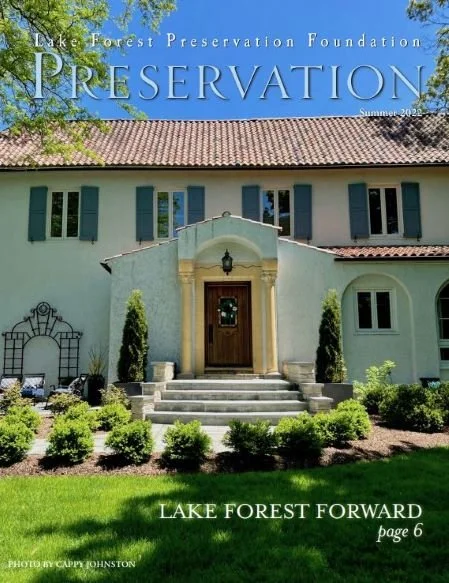
on the cover:
479 NORTH WASHINGTON ROAD
Joseph Francke Rumsey/J.F. Rumsey, Jr. Residence, ca. 1900, perhaps 1896
Architect, attributed: William Ernest Walker; renovated likely, 1920s owner, Hugh M.G. Garden Mediterranean Style Villa, Stucco with a Tile Roof
The cover photo shows the home of Christine and Jim Farrell at 479 Washington Road, which they have had the pleasure to own and restore since 2018. This 6,000+ Mediterranean style stucco villa stunner in East Lake Forest has been the backdrop for their family, with the luxury of being centrally located and proximate to downtown, beach and Lake Forest College. The home is perfectly refined with intricate details and elegance throughout and has been completely renovated for today’s modern living, with a gated entry to provide privacy for the family.
Home for their busy family of
6 – with intriguing décor applied for perfect entertaining
including a gracious kitchen, elegant dining room, two largescale gathering spaces and wrap-around porch. The basement has been improved for their children to enjoy.
While the history of this fine, over 6,000 sq ft estate-scaled residence, remains somewhat shrouded in the past, a few facts have become clear. Jean Rumsey in her 1977 Walking Tour of Lake Forest for the new Historical Society showed this as the residence of J. F. Rumsey. As researched by the History Center’s curator, Laurie Stein, in 1909 and 1913 local phone books, this residence was originally the home of Joseph Francke Rumsey, 1848-1909, and after that likely Joseph Francke Rumsey, Jr., 1888-1945, until perhaps his marriage in 1915 in Oklahoma City and relocation there. The Rumsey brothers, Israel and J. Francke, were members of the eminent pioneer Chicago clan of Board of Trade leader, Israel P. Rumsey, by 1887 living at 404
- Deerpath. J. Francke Rumsey was a founding member of Onwentsia, 1895, perhaps building his house as early as the next year, with Wm. E. Walker, possible original architect, who was then working for architect Henry Ives Cobb.
According to Laurie Stein, “the next listed resident, by 1919, was Robert E. Belknap, who worked for Bethlehem Steel and served on Lake Forest’s Board of Local Improvements.” Very interesting, though, on Laurie Stein’s History Center record of subsequent owners, by the mid 1920s, was notable Chicago architect Hugh M.G. Garden, 1873-1961. Garden designed several historically styled houses in Lake Forest between 1899 and ca. 1930, though he is better known outside this community as a Chicago Prairie School architect. The current
Mediterranean villa appearance of this residence may be his design, a renovation of an earlier perhaps Romanesque styled country house. This type of renovation is suggested by entry stone and interior wooden columns, as at 901 E. Rosemary, 1890, renovated in 1914 as Tudor by Arthur Heun.
In the 1920s, California Hispanic/Mediterranean Santa Barbara style was a popular variation on the Italian villa style of the 1900s-1910s (Mellody Farm/ Lake Forest Academy, 1908-10; Villa Turicum, 1912; Adler’s
Pike estate, 955 N. Lake, 1916-17; and the Cuneo Museum and Gardens, Vernon Hills, 1918). This house appears to represent this later version of Mediterranean style, well
within the capabilities of architect Garden, who worked for Shepley, Rutan & Coolidge and Cobb before entering his partnership with Richard Schmidt, 1895. See more on Garden and his career in Stuart Cohen’s 2021 book, Frank Lloyd Wright and the Architects of Steinway Hall…, p. 188 and passim.
Laurie Stein goes on to chronicle later owners. Benjamin F. Affleck acquired the property in 1927. Affleck was a “self-made” man who worked his way up in industry to become president of Universal Portland Cement Company. He was elected president of the Union League in 1928. In 1933, the Afflecks sold the house to the Edward
- MacDonald family, who would own the home through the mid-1950s. Edward K. MacDonald was a broker who served as a Lake Forest alderman in the 1940s. Later residents were J. Bernard Mullen Jr. and W. H. Rentschler.
Rentschler, an engaging entrepreneur, ran as a Republican for governor in the 1960s. In this century a former Mrs. William Wrigley preserved the handsome villa and improved its landscape.
Christine and Jim continue to “tinker” on the home—spreading the love and infusing more modern and upgraded elements throughout the house and grounds each year. They have done a fantastic job preserving the integrity of this 1928 beauty. For our members, it was wonderful to see this property so well loved. They were very appreciative of the Farrells for opening their beautiful home after our Annual Meeting for tasty bites, libations and great conversation led by Arthur Miller. Thank you Christine and Jim!
2022 Preservation Awards
This year marks the 31st year that the Lake Forest Preservation Foundation has presented its annual Preservation Awards. The range and variety of properties honored since 1991 cover large and small homes and businesses, landscapes and public spaces all across Lake Forest. The goal of the awards is to showcase best works and the owners and architects who made it happen.
The ten awards presented this year represent three categories, Preservation, Rehabilitation and In-Fill or New Construction.
The standards for judging structures and landscapes for awards are those of the Department of Interior for the Treatment of Historic Properties and well executed, newly constructed buildings and structures that fit into their surrounding areas.
115 N. Green Bay Road – Preservation Award
Original Owner: Elizabeth Hinde and Charles S. DeLong
Current Owner: Jennifer and Jack Durburg
Architect: Alfred H. Granger, 1924; Gardens by Anne Baker
Built as one of two homes for two Hinde sisters opposite Onwentsia for the Charles DeLongs, this almost century-old picturesque English Tudor cottage and its Arts & Crafts garden and pool have been carefully maintained to high preservation standards.
1240 N. Sheridan Road – Preservation Award
Original Owner: John and Mary Kerrigan
Current Owner: Chrissy and Matt Davis
Architect: Unknown -1840s, later additions Walter Frazier, 1930s
This historic residence, based on the Italianate clapboard farm homestead with many additions, has been maintained and updated on its conservancy-protected spacious lawn, under the careful stewardship of the current owners.
Knollwood Club – Preservation Award
Original Men’s Locker Room: Howard Van Doren Shaw 1925
Project architect: Witmer and Associates
Howard Van Doren Shaw designed this men’s locker room for the 1925-organized Knollwood Club, its first new building, in a blended Tudor and classic style, its end gables recalling the architect’s early 1920s Lamont house, 810 S. Ridge, with its long central portion dominated on the main level by classic Roman arches. The attic level has also symmetrically organized dormers, with a portico at one end designating the entry. Careful rehabilitation after a century is a major contribution to preservation of local historic character.
245 Vine Avenue – Rehabilitation Award
Original Owner: Unknown Original Architect: Unknown, 1910 rehab 1920s-1930s Anderson & Ticknor
Current Owner: Susan and Darren Weninger
Project Architect: Melichar Architects This 1910 built originally as a four-square suburban type residence was updated for its Green Bay road neighborhood status from 1927 to 1937 by Anderson & Ticknor. This involved removal of the large front porch, new classic trim, and two large west side additions. The current owners, guided by Diana Melichar through extensive rehabilitation after almost a century, have stabilized and made serviceable once again a major contributor on this Vine Avenue enclave streetscape.
375 Washington Road – Rehabilitation Award
Original Owner: E. J. Manahan
Current Owner: Leigh Ann and Dan Bruhn Original Architect: Stanley D. Anderson, 1925 Project Architect: Streightiff Architects & Builders
Stanley Anderson designed the house for E.J. Manahan in 1925, a very early period for the firm’s history, as Anderson & Tichnor opened their office in May of 1925 and the home was completed in late 1926 early 1927. The recently restored exterior showcased some interesting and delightful masonry details in the chimney and front arch.
685 Burton Drive – Rehabilitation Award
Original Owner: Unknown 1928 Current Owner: Julie and Pat Barry Project Architect: Breseman Architects
This house was built in the style and character of architect Russell Walcott & Robert Work’s 1930-completed residence at 850 E. Deerpath, a version of English/French early 19th century classic style. The compatible though differentiated addition, set
back from the main symmetrical block, enabled this elegant home to be enlarged, now more suitable for modern living.
120 Woodland Road – Rehabilitation Award
Original Owner: Unknown 1900s Current Owner: Suzanne Boren Project Architect: Melichar Architects
This key former Atteridge farm/West Park neighborhood residence was located at the confluence of two major streets, now with stop signs, in Howard Van Doren Shaw’s 1906 subdivision. This place of honor was granted to Ellen Atteridge Griffis and her spouse, Willis Griffis, Sr., a builder. Little changed in over a century, this restored ca. 1910 stucco “L” shape plan home’s front porch has been enclosed to restore the space to usefulness, adding true divided light fenestration.
509 E. Deerpath – Rehabilitation Award
Original Owner: First Church of Christ Scientist, 1951 Current Owner: History Center of Lake Forest/Lake Bluff Project Architect: Witmer and Associates
Awarded for adaptive reuse of this 1948 former church structure, First Church of Christ Scientist, as meeting, exhibition, and office space. The original Federal style exterior and its spire were by Charles Draper Faulkner with the 1951 interior by the Anderson firm.
301 N. Sheridan Road – In-Fill or New Construction
Current Owner: Yvonne and Devon Bruce
Project Architect: Breseman Architects
Architect Breseman designed this new pool house as a compatible fit for the adjacent residence built by Russell Walcott in 1925. This character is conveyed by the central gable with its Tudor half-timbering at the roof level of this brick structure. In its simplicity it also recalls 1960s early postmodern local pool houses of Frazier & Raftery and I.W. Colburn.
347 Bluff’s Edge Road – In-Fill or New Construction
Current Owner: Thomas Fuller
Project Architect: Melichar Architects and McCormack & Etten, Lake Geneva
This major new residence and lake bluff pavilion represents a collaboration of two leading regional design teams, creating a recollection of Shingle Style/Richardsonian picturesque style fully equal to its dramatic setting. The bluff side boathouse-like pavilion continues this nostalgic character, adding a copper-roofed turret typical of 1880s styles. The design unity and detailing, with the materials quality, set a high benchmark for new construction along Lake Forest’s southeast lakefront.
LAKE FOREST FORWARD:
A Sensible and Sensitive Approach to Development in our Historic Downtown
It was standing room only on May 7 at the Lake Forest-Lake Bluff History Center when the Lake Forest Preservation Foundation (LFPF) hosted Stefanos Polyzoides, Dean of the School of Architecture at the University of Notre Dame. LFPF friend and famed North Shore architect Thomas Norman Rajkovich engaged Dean Polyzoides in a conversation and dialogue on the unique history and character of Lake Forest, especially Market Square and the central business district.
Mr. Rajkovich started the event by sharing some perspectives of “preservation” and how the image of the mythical Janus – depicted as a dual-faced sculpture, the older looking backward and the younger looking forward – is an apt analogy for how residents of Lake Forest might think about development in cities: looking back for inspiration
while understanding how best to adapt to meet the needs of the future.
Both speakers noted that the Lake Forest central business district was developed primarily in the first half of the last century by committed owners who partnered with inspirational architects and urban designers to formulate a civic and commercial center for the City which was highly innovative when developed and remains the envy of many communities across the country. It combined thoughtful design with the highest quality materials to ensure this visual emblem of Lake Forest would be both aesthetically and physically durable, and could last for centuries to come.
After spending several hours on a beautiful Saturday walking in our community, Dean Polyzoides noted that there are likely less than a dozen parcels available for development in the central business district. The opportunity for those in leadership roles in the community is this: identify clear design parameters and criteria that architects and property owners must follow to ensure new developments are consistent with the unique character of Lake Forest.
In addition to design sensibilities, Dean Polyzoides also emphasized the concept of sustainability and respect for the limited natural resources of the planet. In this context, he noted a common practice of today is developers using inferior building materials to make the financial return on a project more attractive. A consequence of this is the shortened useful life of such structures which then need to be replaced, further depleting natural resources, or significantly rehabilitated at great cost. He contrasted this to the use of high-quality materials and skilled craftsmanship across many Lake Forest structures, resulting in their long—and continuing—useful lives. While these structures cost more up front, they will last for centuries, with appreciably lower maintenance costs and ultimately use fewer natural resources.
The speakers suggested a few ways for the residents of Lake Forest to be like Janus: have deep respect for the past while we move forward together. Some of these ideas include:
Convene a “Charrette” – a process where members of the community meet to resolve differences and map out a path forward, guided by a team of urban designers, architects and other consultant specialists.
Adopt form-based zoning codes which would provide more reliably-sensitive development for the central business district, rather than traditional zoning codes that simply prescribe land uses, maximum heights and setbacks.
Consistent full enforcement of the Historic Preservation ordinance and form-based codes, so developers know what they need to do in order to move forward with a project. Property values of the entire community will increase as the beauty and vibrancy of the civic and commercial center of the City increases.
LFPF hopes to explore these ideas and others over the coming months as we pursue Lake Forest Forward. To view the full recording of the May 7 program go to Lake Forest Preservation Foundation’s YouTube channel or https://youtu. be/Bpwwntmeouo
BOOK REVIEW:
ANTA, Archives of New Traditional
Architecture, No’s 1-2 (spring, Fall, 2021)
This ambitious new periodical – based in our own Midwest at the University of Notre Dame’s School of Architecture, South Bend, Indiana – in its inaugural issue a year ago displayed two strong links to the upper North
Shore area, indeed Lake Forest. In general, it is a call to re-examine and support the successful development patterns from before modernism that nourished our walkable, livable, and human-scaled communities.
The first of these articles provides a sweeping history of the Ecole des Beaux-Arts architecture in Paris and as adopted in the U.S. by historian Carroll W. Westfall describes the usable past for today’s traditional architects and their informed clients. A result of Westfall’s own 1981 study at Lake Forest Library was a tour of notable sites in downtown and east central Lake Forest, published in Ira J. Bach’s 1982 Guide to
Chicago’s Historic Suburbs. A step on the way to the new 3rd edition Foundation Guide out late this year.
In addition to Westfall’s historical and theoretical overview and implied reading list, the inaugural issue includes an article on the stunning new classic Mundelein Hall Visitors Center addition to the Refectory, University of Saint Mary of the Lake, Mundelein. The architect of this handsome new example of the Beaux Arts approach is Thomas Norman Rajkovich, Evanston, a frequent speaker in Lake Forest.
This great start for ANTA, very relevant to Lake Forest, bodes well for its interest to locals interested in the compatible development of this community. Annual subscriptions for two large-format issues of over 200 full color pages per year is $35. https://architecture.nd.edu/about/anta-archives-of-new-traditional-architecture/
coming this fall:
A NEW EDITION OF
PRESERVATION’S GUIDE BOOK!
As projected in its recent annual fund campaigns, Lake Forest Preservation Foundation is updating its Guide to National Register Historic Districts and Properties in Lake Forest, Illinois. LFPF last published the Guide Book 1994 when the city had two districts on the Register, east Lake Forest and Oakwood-Vine, and half a dozen local
properties listed individually. In 2022 Lake Forest has three more nationally recognized districts and many more contributing sites, now over 50 years old. Since 1994, Green Bay Road, Deerpath Hill Estates, and West Park districts have been included on the National Register. LFPF’s 2022 edition highlights 250 properties that span many decades and architectural styles, providing an exceptional representative sample of each historic district. All of the properties are visible from the street, making this book an excellent companion for walking, biking or driving tours for newcomers, long-time residents, and visitors alike.
LFPF AWARDS LAKE FOREST HIGH SCHOOL SCHOLARSHIPS
The Preservation Foundation honored two Lake Forest High School students at this year’s Senior Class Awards Night on May 26th.
First-place winner, Mimi Gordon, wrote about her emotional connection to her family’s 1928 Walter Frazier home on Crabtree Lane. With photos and an essay, she described entertaining in the same spaces, decades apart, and reusing old fixtures found in storage.
Runner-up, Chloe Darling, articulated her feelings on protecting the visual character of Lake Forest, as a public asset, through adhering to current city policies. She presented both sides of a recent controversy on Westminster Road, acknowledging the impact of changing precedents.
LAKE FOREST PRESERVATION FOUNDATION
2021-2022
BOARD OF DIRECTORS
EXECUTIVE COMMITTEE
Susan Rafferty Athenson
President
Michelle Curry Tim Knight
VP Communications
Trey Gonzales
VP Development
Laura Luce Jim Opsitnik VP Programs
Patti Poth
Secretary
Debbie Marcusson
Treasurer
DIRECTORS
Elizabeth Abbattista Jennifer Durburg Jim Farrell Sr.
Craig Fox
Perry Georgopoulos John Julian
Brian Norton Peter O’Malley
Natalie Reinkemeyer Jason Smith
Sarah Somers Scott Streightiff
Courtney Trombley
HONORARY DIRECTORS
Arthur Miller Pauline Mohr Shirley Paddock Linda Shields
EXECUTIVE DIRECTOR
Marcy Kerr
PRESERVATION
SUMMER 2022
VOLUME 17, NUMBER 2
Contributors:
Elizabeth Abbattista, Susan Athenson, Adrienne Fawcett, Marcy Kerr, Tim Knight, Arthur Miller, Pauline Mohr, Jason Smith, Courtney Trombley
Editors: Michelle Curry, Tim Knight
Photography: Cappy Johnston
Lake Forest
Preservation Foundation
400 East Illinois Road Lake Forest, Illinois 60045 www.lfpf.org
NON-PROFIT ORG
U.S. POSTAGE
PAID PERMIT NO. 184 LAKE FOREST, IL
60045
NON-PROFIT ORG
U.S. POSTAGE
PAID PERMIT NO. 184 LAKE FOREST, IL
60045
ECRWSS
Residential Customer Lake Forest, IL 60045
upcoming summer programs
early summer garden stroll
Friday, June 24
5:30 to 7:30 PM
summer visit to crabtree farms
Saturday, July 16
10:00 AM or 1:00 PM
late summer garden stroll
Friday, August 26
5:30 to 7:30 PM
visit lfpf.org.org/events for details and to buy tickets
The Lake Forest Preservation Foundation is a tax-exempt nonprofit 501(c)3 organization.
You may donate directly to us at LFPF.org.