Spring 2021
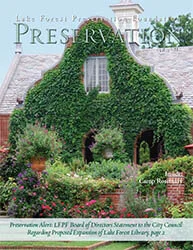
Inside: Camp Rosemary
1
1Preservation Alert: LFPF Board of Directors Statement to the City Council Regarding Proposed Expansion of Lake Forest Library, page 2
Preservation Foundation Board of Directors Statement to the City Council Regarding the Proposed Expansion of Lake Forest Library
On March 15th, the Lake Forest Library went before the City Council to discuss a proposed Library capital improvement campaign that proposes a greatly expanded and reimagined Library building. The LFPF Board of Directors has been following this proposal closely. We recognize that changing needs and technologies necessitate modernizing and perhaps expanding the building, however, as we stated in our Fall 2020 issue of Preservation, we are greatly concerned about the proposed addition’s overall size and architectural compatibility with the original historic 1931 building’s classical design, as represented in preliminary plans floated by the Library Board. The following is a statement submitted by the Preservation Foundation Board of Directors to the City Council in advance of the March 15th meeting.
Dear Mayor Pandaleon and Members of the City Council:
Lake Forest Library
Lake Forest Library As you are all aware, a notable thing happened this past year with many historic residential properties in Lake Forest. After years of languishing on the market, large historic homes began to sell, fueled by many factors including changing buyer needs, and a desire for more space, high-quality schools, civic institutions, city services, and natural beauty. Buyers of these properties have chosen to make a substantial investment in the historic fabric of Lake Forest and many will choose to invest further by expanding and modernizing their new homes for the 21st century. Each will be held to the high standards for architectural compatibility, harmony, and respect for historic integrity that is embodied in the requirements of The City of Lake Forest Historic Preservation Ordinance.
Lake Forest is justifiably proud of its magnificent residential architectural heritage. But it is precisely the city’s historic civic structures that authentically distinguish Lake Forest and contribute greatly to what makes it a desirable place to live. City Hall, Gorton Community Center, the Senior Center at Dickinson Hall, Elawa Farm, Market Square, Lake Forest Train Station, and historic houses of worship such as The First Presbyterian Church, St. Mary’s Church, and The Church of the Holy Spirit, all contribute to a unified composition of historic civic structures. And all in the past 20 years have successfully found ways to modernize and expand their facilities while sensitively rehabbing and respecting the original historic integrity of their buildings.
The successful modernization and sensitive rehabilitation of each of these civic structures, plus countless historic homes, didn’t happen by accident. It is the result of careful planning and review processes that date back to the 1960s with the creation of the Building Review Board and then strengthened 20 years ago with the adoption of an Historic Preservation Ordinance. These set standards for compatibility and harmony to which all historic property owners and stewards of historic civic buildings have been held.
Imagine if many of the recently purchased historic homes were permitted to be expanded in a manner that bears no architectural relation to the original historic structure — simply following the latest design fad merely to make it eye-catching. What would it mean for the legitimacy of our Historic Preservation Ordinance and the value of other properties throughout our historic districts?
Edwin Hill Clark’s 1931 designed library is surely the centerpiece of our town’s ensemble of historic civic structures. It is one of the most architecturally significant small-city libraries in the U.S. The Preservation Foundation Board of Directors recognizes that changing needs and technologies necessitate modernizing and perhaps expanding the building. However, services and spaces that are desired in the new addition, as well as parking and ADA accessibility, should be integrated into the new addition while sensitively addressing the building’s original architecture rather than juxtaposing a building addition of boxes clad in the latest design fad.
As the City Council considers the important “big picture” issues, including the cost to taxpayers, the potential duplication of services within the community, and the overall scope of any expansion, we ask that you give careful consideration to the following concerns:
Fixing the dome, which has been wrapped in a white tarp for three years, is paramount to this discussion. The process for considering the size and scope of any expansion plan will continue to take time. But issues relating to historic building maintenance are immediate. Addressing the basic ongoing upkeep of the building envelope is the most important and cost-effective preservation treatment for extending the life of the building and protecting its collections.
Any expansion of the library needs to be “right-sized”, both for the community, for the site, and for the building. Issues related to life safety, ADA compliance, and structural integrity should be the highest priority. Adding to the building footprint and square footage should be considered if it’s necessary for functions that don’t duplicate those that already exist within the community.
Any expansion to the library should participate fully in the classical tradition that Edwin Hill Clark established as the “language” of the building’s architecture. The parts (new and old) should act as an ensemble, not in contrast and not as “then and now”. An expanded library should function as “one library” not “the old wing and the new wing”. And it should express that unity of function with an equal aesthetic unity. These are the very standards to which other historic property owners and stewards of historic buildings in Lake Forest’s historic districts have been held.
As we have stated to representatives of the Library Board as well as publicly on several occasions, the Preservation Foundation stands ready to work collaboratively with the Library to help achieve a solution that respects the historic integrity of the building and works within the classical language of its architecture.
The future of the Library as an institution is important, but the future of the physical building is no less important.
We thank you for your consideration.
Lake Forest’s Preservation Foundation: Protecting the Historic Visual Character of Lake Forest
Lake Forest Train Station
Market Square
Gorton Community Center
Elawa Farm
Since 1975 and across a few generations, Lake Forest’s own independent, not-for-profit historic preservation advocacy organization has worked to pay forward the City’s remarkable built and landscaped distinction. A largely volunteer organization, with its dynamic executive director Marcy Kerr since 2007, the Lake Forest Preservation Foundation (LFPF) advises the City’s boards and commissions on proposals for development. The group, through its board of directors, advocates for compatibility with existing built, designed, and natural elements that distinguish this community among Chicago’s 200 suburbs. We favor development that keeps the community vital, evolving consistently with its past careful planning. This planning DNA goes back to the City’s 1857 railroad garden-city-suburban-naturalistic town layout east of the UP/Metra North tracks by Almerin Hotchkiss, commissioned by Chicagoans’ Lake Forest Association, 1856.
As the town grew it evolved out of this model, rooted in landscape, with zoning and a Plan Commission established in the 1920s. As developers and new residents by the 1960s and early 1970s began to disrupt the historic continuity of local growth, the Preservation group broke off from the History Center’s predecessor Historical Society to advocate for managed change.
How is the Preservation organization different from the City’s Preservation Commission or the History Center? The Historic Preservation Commission is an instrument of City government, its charge embedded in ordinances to oversee continuity within our historic districts and of our historic landmarks. The vital History Center collects and promotes knowledge of local history, though in a descriptive way rather than the prescriptive manner of the Preservation group.
What exactly is compatibility? Compatibility generally is defined as “capable of existing in harmony, or consistent.” Architectural compatibility results from designing a building, or an addition to a building, that is in harmony with itself and its surroundings.
How is a building or landscape feature compatible or not? Lake Forest’s 1916 town center by AIA Gold Medalist architect Howard Van Doren Shaw illustrates this. Shaw fit his relatively large development into space between the tall one-story 1900 train station to the east, the 1903 three-story Anderson Block to the south, the Gorton and Griffith (Einstein’s) Blocks to the north on Western, and the 1899 City Hall with its tower to the southwest. With the Federal Savings building, then for Carl Krafft, Shaw stepped down to two and a half stories and then in his south building for Market Square to two stories. The two towers pick up on the spire at City Hall, taller even, indicating that this was the town center, hierarchy dictating that the most important thing should be the strongest, tallest, or brightest visually. The long park reflected the community’s focus on natural open space, even among its businesses. The varying facades of the south and north long buildings spilling from Western Avenue into the Square break up the scale to convey a sense of a diverse streetscape, as elsewhere in the nearby area.
Shaw and his committee made sure his development, a big change in town, fit into its context. The Preservation Foundation recognizes that change is a sign that our community is successful. We welcome change because that is how our community will continue to evolve and grow. However, that change needs to be carefully guided so that this community does not lose its cherished historic character and architectural assets. LFPF assists the City Boards and Commissions in this stewardship.
At the present time, at least three significant center of town proposals are before these City boards and commissions that have the potential to challenge their neighbors through added structural density; crowding of traffic, access, and parking; and features and colors that may be self-referential rather than respectful of surroundings. These current proposals include the 20,000 square foot expansion of Lake Forest Library, Phase 3 of the McKinley Road condominium development, and redevelopment of the First Midwest Bank site at the corner of Deerpath and Bank Lane.
As it has done for going on five decades, Lake Forest’s active Preservation organization will play a leading role in advocating for respectful, though not necessarily bland or boring, changes. The LFPF board welcomes comments from residents and also to the relevant City bodies who are charged with stewardship of the peoples’ and the community’s existing, sometimes historic investments. What is newly added should fit in smoothly with these existing best places.
For additional information and contact resources go to LFPF.org, Preservation-in-Action.
Circus-themed Party, December 1928
Market Square ca. 1917, photo by E. L. Fowler
The Spanish Flu Pandemic of 1918-1920 Then The Roaring Twenties!!!
approximately 100 years later covid pandemic of 2020 will history repeat itself again in lake forest?
The origin of the phrase, “History has a way of repeating itself” has roots from novelist Mark Twain, philosopher George Santayana, and former Prime Minister of England Winston Churchill. The genesis of the statement is that sometimes there are certain patterns and repetitions that occur again and again, patterns perhaps more relatable to the science of “cause and effect”.
As we look back at history and search for a time that echoes our shared experience of the Covid19 pandemic, it is natural to gravitate towards the Spanish Flu pandemic of 1918-1920. The pandemic much like today altered the course of day-to-day life in America and by necessity isolated and closed off its citizens from normal life, instilling fear, isolation, and loneliness as a norm and shaking the fabric of society.
Fast forward past the Spanish Flu Pandemic and we get the birth of the Roaring Twenties, a period in Western culture celebrated by economic prosperity, innovation, art, fashion, and a lot of craziness. One must believe that the isolating times resulting from dealing with the Spanish Flu were in part the reason for the adventures and economic prosperity of the Roaring Twenties, a release of energy after a period of hibernation.
Will history repeat itself and will Lake Forest see equal prosperity post pandemic this time? Ask realtors in town, and they will say the answer to this is “yes”. Lake Forest is already seeing a strong migration from Chicago, which will dynamically change our town and demographics.
Lake Forest endured vibrant times in the 1920s. New country clubs were built, such as Knollwood Club in 1924, with a neighborhood laid out by Edward H. Bennett. The rickety 1893 Onwentsia three-story frame clubhouse, uninsurable by mid-decade, was replaced by New York’s Harrie T. Lindeberg’s 1928 brick clubhouse on Green Bay Road. Deerpath Inn was built for Lake Forest visitors in 1928. New buildings in the ’20s included the 400-acre Albert Lasker—inventor of radio advertising—estate in today’s southwest Lake Forest, with a French manor house, 40 auxiliary buildings, and an 18-hole private golf course, beginning in 1925.
It was a time of great progress and master architects like David Adler were able to develop picturesque smaller estates, such as in his mid-1920s Dutch-style Bentley place, 1421 N. Lake Road and his classic and modern 2nd W.E. Clow, Jr., property, 111 Ridge Lane. His 1928 Italian tower on S. Mayflower for Alfred Hamill was the height of picturesque expression. Delano & Aldrich’s 1923 modern Federal style “Fairlawn” rebuilt estate for Mrs. McGann brought New York classic style to a new level locally. Howard V. D. Shaw also stepped down in scale from his Green Bay Road country places for his 1924 English cottage Hinckley place on Wisconsin Avenue. Lindeberg also designed his French-styled Chapin/Beidler and Dexter Cummings estates, gems on a more modest scale from his 1916 Clyde Carr estate at Mayflower and Illinois. And Frazier & Raftery’s sophisticated 1928 Williams Modern English cottage was built across Mayflower from Carr’s “Wyldewood.”
Will the result of this pandemic breaking up social normality for a period of time become awakened to a world thirsty for new experiences and vitality, and a new Roaring Twenties?
One thing for certain is that the pandemic has created movement, and that movement created opportunity. As houses and businesses in town are being gobbled up by those seeking value in what Lake Forest has to offer—schools and churches, active and passive open land including the beach, and social life—this change also creates new demand generators on our existing system. This in turn may generate new opportunities for future growth, innovation, and prosperity within a framework of managed, evolutionary change that preserves the historic physical character that these newcomers came to enjoy.
Finding Appreciation For the home during covid
As one can imagine, COVID has created an appreciation for the home with renovation and redecorating at an all-time high.
Five years ago the “open concept” trend was booming, consolidating the kitchen with the dining and the living room, allowing a family to be fully integrated in one massive space. We saw the “open concept” popularized by Joanna Gaines in the home reno juggernaut “Fixer Upper” and by the Scott twins of the popular show “Property Brothers.”
When COVID first struck last February, families bonded together in these “open” dwellings for a few weeks, but after a very short time, the story changed. Today’s needs couldn’t be more opposite. Women, men, and older-aged children started to request rooms to “escape”. Folks were feeling too confined during COVID and the urge for creating man caves, cigar cellars, and finding solace in formerly unused house square footage like above-garage dwelling space exploded in popularity.
Local general contractor Lynch Construction recently talked with us about assisting homeowners with these trends, “People are really looking to build out their personal space to enhance the quality of time at home. We are providing direction on how they can conveniently upgrade features within their already beautiful home. The most wanted elements requested are luxury bathrooms, basement areas, and, of course, the home office.”
This Spring, the home improvement boom is expected to triple. Research has indicated that 2020 front and back yard spending was only the beginning—many homeowners have expressed regret in not making “enough of an impact” to improve the look of their home and will tackle projects immediately as the temperatures rise.
In searching for articles of home renovation stories, we came across a fascinating story of how one local Lake Bluff resident began the restoration and beautification of a dilapidated 1,900 sf horse barn adjacent to their lakefront property. Formerly outfitted with troughs and stalls, the renovation of the barn will now feature a loft, kitchenette, screened-in porch and will be the perfect spot to entertain guests. The project will be completed later this spring, so please be on the lookout for the before and after photography in the next LFPF newsletter.
Also trending is the migration of urban dwelling to rural dwelling, and, as many of our past newsletter stories indicate, Lake Forest and Lake Bluff are on the receiving end of those activities. To quote a newcomer on why they chose Lake Forest, “Lake Forest’s winding streets provide space to breathe and a wonderful blend of access to the outdoors and proximity to Chicago. It’s also a great place to raise a family!” This homeowner found an historic home on Mayflower Road and also offered this to say about inheriting this historic home gem, “Historic homes have stories to tell! They have unique architectural appeal and authenticity that provide context and a sense of place.”
We couldn’t agree more! Please share your stories of home renovation and home appreciation during COVID. We would love to feature your interesting endeavors in the next newsletter to: [email protected].
A Fresh Look for LFPF.org
Made possible through the generous support of our members and donors.
The Lake Forest Preservation Foundation is pleased to announce a fresh and updated website.
Visit us at LFPF.org for news, information and updates.
Tribute to LFPF Supporter Posy Krehbiel:
One in a Million
by Adrienne Fawcett
Photo by Jim Prisching, shared with permission by JWC Media
Posy Krehbiel’s gardens are sophisticated, vividly colorful, and sublime: like Posy herself. She is among the most influential local gardeners, preservationists, and philanthropists of modern times.
“She is the original influencer of the second golden age of gardens in Lake Forest,” says Lake Forest historian Art Miller.
Posy’s commitment to gardening, preservation, and leadership runs deep. She has received national recognition for her gardens, described in books and by those who visit as harmonious, serene, whimsical and magical.
“For as long as I have known her, she has been a beacon of positivity and a warm and welcoming person,” says Frank Mariani, who has worked with Posy for years. “For Posy, her garden has always been a most vibrant natural place in which to relax, in which to enjoy the beauty that only nature can give us as people, and where one can share a beautiful spot on earth with friends and visitors alike.”
In the arena of gardening Posy has served on many boards, including the Chicago Horticultural Society, helping for years to design and develop the Chicago Botanic Gardens. She has served on boards for the Garden Conservancy, Lake Forest Garden Club, Lake Forest Open Lands Association, Morton Arboretum, and the Chicago Lakefront Millennium Park Blue Ribbon Committee. She considers The Lurie Garden in Millennium Park to be among the most meaningful and groundbreaking public gardens in the country and is honored to have played a dynamic role in the process.
Posy cares about people and worked to increase access to high quality medical care for women and children. She has served on the board of the Infant Welfare Society, Children’s Memorial Hospital Women’s Board, Mayo Clinic Leadership Council, and Lake Forest Hospital Women’s Board and its Women’s Health Advisory Council. At Northwestern Lake Forest Hospital she is literally an institution, as the namesake for the Posy Krehbiel Breast Center.
In 1988, Posy and her family moved into the English-country manor home on Rosemary Road in Lake Forest designed by architect Benjamin H. Marshall for John Taylor Pirie, heir to the Carson Pirie Scott department store, and his wife, Sophie Skirving Hunter. The Krehbiels began restoring the house and soon Posy set her sights on the gardens.
The second golden age of gardens began with Posy.
In 1991, the book The Golden Age of American Gardens was published, documenting the country’s first golden era from 1890 to 1940. The book featured many Lake Forest estates and featured a list of hand-colored lantern slides of notable early 20th century gardens, which had been found in Lake Forest Garden Club archives by members in the early 1980s, and then sent off to the Garden Club of America headquarters in New York, and ultimately to the Smithsonian Institution. Among the slides were images of the original Pirie gardens designed by prominent early 20th century landscape designer Rose Standish Nichols.
“Posy got copies of those slides,” recalls Art Miller, and she set out to revive and amplify the many acres of hedge-defined “rooms” planted in parterres on the Rosemary estate. The restoration was remarkable and noteworthy, and not just for its beauty. Posy kickstarted a trend in reviving legacy gardens that continues to the present.
Art Miller recalls quite a few: “By 2000 the Redfields were redesigning with Craig Bergmann the Ibero-Moorish Shaw/Nichols garden for the McBirneys at the House of the Four Winds; artist Lorna Marsh ca. 2000 designed new and restored old gardens at the C. B. Farwell/Grace McGann 1870/1923 Fairlawn with its 1870 arbors, perhaps the oldest above-ground garden features in the Chicago region. Pamela Miles restored the 1925 Warren Manning garden for Misses Colvin, Lake Road; Pamela Hull created new gardens on a smaller Spruce Avenue parcel with Britain’s John Brookes, who designed the English garden at the Botanic Garden. The late Jane O’Neill restored and added new gardens at Lake Bluff’s Mrs. Morse Ely estate on Moffett Road. There are many more examples in Planting with Purpose, the Lake Forest Garden Club history, in which Posy is pictured.”
Among the Pirie glass slides were images of a garden with a reflecting pool in the middle. “Posy found remnants of that garden under a compost heap and behind a row of full-grown pine trees,” recalls Art. “Working with landscape architect Craig Bergmann, she recreated it.”
Now known as “The White Garden”, it is a peaceful alcove surrounded by hydrangeas, dogwood, perennials, and two original Chinese statues.
English garden writer Noel Kingsbury says her planting style evokes two contemporary looks from mainland Europe: the millefleur seasonal bedding and the much wilder-looking long-term mixed planting.
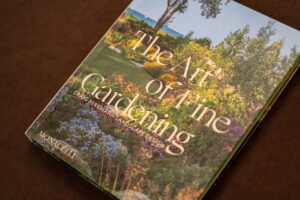
“The Camp Rosemary style is special, sophisticated and unique,” he says in Posy’s Garden, a beautiful coffee-table book produced in 2014 to commemorate Posy and her team’s three decades of passion, hard work, and dedication.
Posy developed a team of superb gardeners to help manage 9 acres of plantings, including longtime head gardener Marya Padour and container designer Betty Kirincich. Posy loved to collaborate and is a working gardener who for years has spent all day, every day in her gardens. Longtime personal assistant Lois Sheridan said guests often have arrived at “Camp Rosemary” to find Posy in a T-shirt, REI gardening pants and a visor, coffee in hand, deadheading plants.
Posy named her home and garden “Camp Rosemary” early on in the renovation of Rosemary, when work crews would camp on the lawn for lunch. These days, the estate’s circa 1995 conservatory and guesthouse, known affectionately as “HQ”, operates as the garden headquarters.
Over the past three decades, Posy has opened her garden to the world. She loved to share it and hosted many organizations interested in gardening, putting on more than 15 garden events a summer, plus philanthropic dinners for everything from the Mayo Clinic to area garden clubs. When famous speakers came to the Chicago Botanic Garden to give a presentation, they often visited Posy’s garden and stayed in Posy’s guest house.
“Posy has had countless garden walks and no matter the organization, the family, or the individual visitor who comes through her garden gate, she makes all who visit her garden feel most special with her personal invitation,” says Frank Mariani.
He adds: “Gardens have been built throughout history, and the finest ones always represent special places of peace, where one can find respite from the pressures of life no matter what. Posy’s garden ranks among the most special that we have ever been associated with, which perfectly matches the way we feel about her. Posy Krehbiel is one in a million.”
The Lake Forest Preservation Foundation is participating in the local Lake Forest High School annual scholarship program for the Class of 2021. A $1000 scholarship will be awarded to a graduating LFHS senior who best conveys how historic preservation is an important part of Lake Forest and why preserving the historic visual character is important.
The scholarship is intended to help create greater awareness of and interest in preserving the tradition and beauty of Lake Forest, asking students to share how Lake Forest resonates with them.
The LF Preservation Foundation is one of over a dozen local organizations participating in offering students thousands of dollars of unrestricted scholarships. All graduating seniors are eligible to apply for these local scholarships. Winners will be recognized in May at the LFHS Honors Night ceremony.
For more information search for LOCAL SCHOLARSHIPS 2020-2021 on the LAKE FOREST HIGH SCHOOL website.
Join or Renew
Our annual membership year runs April 1 – March 31st. We are grateful for your ongoing support in both annual fund donations and memberships.
Your membership supports our programs, advocacy, and education. Despite the pandemic, we have been resourceful and continued to provide educational programs, new self-guided walking tours, a Crab Tree Farm tour, and garden strolls. We have continued to support our mission to help protect the visual character of Lake Forest, including historic properties, neighborhoods, streetscapes and landmarks.
Partner with us to help conserve and protect Lake Forest’s historic assets. Join online – LFPF.org/membership
We thank all our 2020 members and donors. A complete listing is on our website or available by scanning this QR code.
LAKE FOREST PRESERVATION FOUNDATION
2020-2021
BOARD OF DIRECTORS
EXECUTIVE COMMITTEE
Peter Coutant
President
Tom Gleason
VP Communications
Elizabeth Abbattista
VP Development
Liz Brandel
Trey Gonzales
VP Programs
John Julian
Secretary
Craig Fox
Treasurer
DIRECTORS
Robert Alfe
Susan Rafferty Athenson
Michelle Curry
Jim Farrell Sr.
Adrienne Fawcett
Angela Fontana
Lauren Kelly
Laura V. Luce
Debbie Marcusson
William McFadden
Roger Mohr
Natalie Reinkemeyer
Monica Artmann Ruggles
Jason Smith
Courtney Trombley
HONORARY DIRECTORS
Gail Hodges
Arthur Miller
Pauline Mohr
Shirley Paddock
Linda Shields
Lorraine Tweed
EXECUTIVE DIRECTOR
Marcy Kerr
Preservation
SPRING 2021
VOLUME 15, NUMBER 1
Contributors:
Elizabeth Abbattista, Peter Coutant, Michelle Curry, Adrienne Fawcett, Trey Gonzales, Marcy Kerr, Arthur Miller, Pauline Mohr, Jason Smith and Courtney Trombley
Editor: Tom Gleason
Lake Forest Preservation Foundation
400 East Illinois Road
Lake Forest, Illinois 60045
www.lfpf.org
NON-PROFIT ORG
U.S. POSTAGE
PAID
PERMIT NO. 184
LAKE FOREST, IL
60045
ECRWSS
Residential Customer
Lake Forest, IL 60045
The Lake Forest Preservation Foundation is a tax-exempt nonprofit 501(c)3 organization.
You may donate directly to us at LFPF.org.