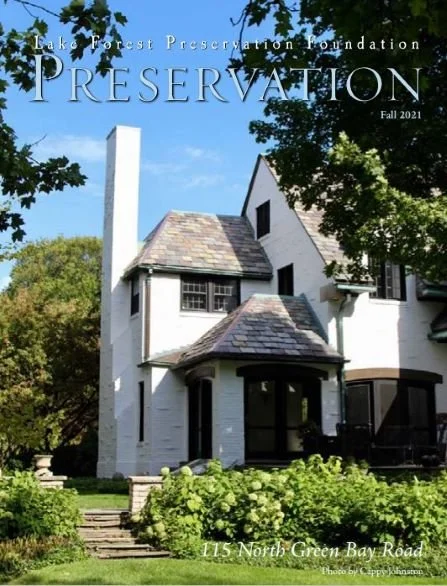
Fall 2021
1
1115 North Green Bay Road
Photo by Cappy Johnston
FROM THE PRESIDENT
Dear Friends,
Lake Forest Preservation Foundation’s mission is to protect the historic visual character of Lake Forest.
Our recent advocacy efforts reflect our commitment to the City of Lake Forest’s nationally recognized Historic Preservation ordinance. This groundbreaking ordinance was developed in the late 1990s by many concerned community members and City officials including former alderman and our former president and board member the late Gail Hodges. Its intent was to preserve our community’s cherished historic environment and ensure development is compatible with the historic neighborhoods and surrounding environment. The Historic Preservation Commission, the Building Review Board, and the Plan Commission have spent decades reviewing petitioners’ building plans, considering the concerns of the surrounding neighbors, and asking families and developers to modify their plans to meet our historic preservation standards and preserve our historic visual character.
The challenge is to “safeguard Lake Forest’s unique historic and cultural heritage as embodied and reflected in such areas, properties, structures, sites, and objects” by “encouraging orderly and efficient development that recognizes the special value to the city of the protection areas, properties, structures, sites, and objects”. This is a quote from the Historic Preservation ordinance. LFPF does not believe Lake Forest is a museum but rather a unique, nationally recognized, architecturally significant city that must be cared for through conscientious development. We are all stewards of this beautiful architectural environment that so many citizens before us worked hard to preserve; let us work together to continue this legacy of careful and thoughtful growth, maintenance, and protection of our historic assets and significant neighborhoods.
LFPF’s Annual Fund supports special projects that help recognize and preserve our community’s unique architectural and historic heritage. This year’s Annual Fund will fund the continuation of two multi-year projects – the Historic Building Markers and the update of our guidebook, published in 1994. Look for the first of the plaques to be installed on architecturally significant buildings throughout the Central Business District later this year. The updated Guidebook is expected to be released in the next two years. Please consider supporting these special projects by giving to our Annual Fund this Fall.
LFPF also has many exciting events and programs on the horizon that focus on the architecture of our community. Check out our full schedule of events and programs on the back page of this newsletter and on our web site LFPF.org.
Thanks for your continued support!
Susan Rafferty Athenson
FRANK L. WRIGHT AND THE ARCHITECTS OF STEINWAY
HALL A Study in Collaboration by Stuart Cohen
The American Institute of Architects, Chicago Chapter, has announced that architect, author, teacher, and mentor Stuart Cohen, FAIA, has been named the recipient of its 2021 Lifetime Achievement Award.
Cohen’s latest book on collaboration among designers of Frank Lloyd Wright’s 1890-1910 generation shows his fascination with architectural ideas, their origins, and their evolution. The book profiles many architects who contributed to Lake Forest architecture: Hugh Garden, Alfred Granger, Arthur Heun, Dwight Perkins, Howard Van Doren Shaw, Robert Spencer, Frank Lloyd Wright, and others. Some had offices in Chicago’s Steinway Hall building (built on the site of Lake Forest founder Robert W. Patterson’s house) and others were part of the group of “Eighteen” who lunched together at the Bismarck Hotel. Along with photos of Ragdale and Market Square by Shaw (pages 199-200), there is the heretofore unpublished original 1899 Mrs. Charles (Isabelle Corwith) McGennis house by Arthur Heun, 261 Mayflower (page 192), now known as it was remodeled after the 1950s by Mrs. McGennis’s daughter, Isabelle McGinnis Ryerson.
FRANK L. WRIGHT AND THE ARCHITECTS OF STEINWAY
HALL A Study in Collaboration by Stuart Cohen
The American Institute of Architects, Chicago Chapter, has announced that architect, author, teacher, and mentor Stuart Cohen, FAIA, has been named the recipient of its 2021 Lifetime Achievement Award.
Cohen’s latest book on collaboration among designers of Frank Lloyd Wright’s 1890-1910 generation shows his fascination with architectural ideas, their origins, and their evolution. The book profiles many architects who contributed to Lake Forest architecture: Hugh Garden, Alfred Granger, Arthur Heun, Dwight Perkins, Howard Van Doren Shaw, Robert Spencer, Frank Lloyd Wright, and others. Some had offices in Chicago’s Steinway Hall building (built on the site of Lake Forest founder Robert W. Patterson’s house) and others were part of the group of “Eighteen” who lunched together at the Bismarck Hotel. Along with photos of Ragdale and Market Square by Shaw (pages 199-200), there is the heretofore unpublished original 1899 Mrs. Charles (Isabelle Corwith) McGennis house by Arthur Heun, 261 Mayflower (page 192), now known as it was remodeled after the 1950s by Mrs. McGennis’s daughter, Isabelle McGinnis Ryerson.President
library update
The Lake Forest Library Board of Trustees voted to prioritize preservation of the leaded dome as well as conservation of the interior rotunda and murals at their monthly meeting on August 10, 2021. The unanimous vote followed a special meeting of and recommendation by the Library board’s newly formed Building Committee headed by Library trustees Bryan Bertola and Heather Strong. This is great news for the Lake Forest community and advocates for the historic preservation of our most important community asset.
As the first step in the library’s Capital Improvement Project, the Building Committee will review the existing dome analysis completed in 2018 and determine if additional study is required, with the goal of retaining a qualified firm to develop an implementation strategy and guide the repair process.
The LFPF supports and commends the Lake Forest Library Board’s efforts and we stand ready to commit resources and offer assistance and expertise to achieve a compatible, classic addition to the historic Edwin Hill Clark treasure.
library update
The Lake Forest Library Board of Trustees voted to prioritize preservation of the leaded dome as well as conservation of the interior rotunda and murals at their monthly meeting on August 10, 2021. The unanimous vote followed a special meeting of and recommendation by the Library board’s newly formed Building Committee headed by Library trustees Bryan Bertola and Heather Strong. This is great news for the Lake Forest community and advocates for the historic preservation of our most important community asset.
As the first step in the library’s Capital Improvement Project, the Building Committee will review the existing dome analysis completed in 2018 and determine if additional study is required, with the goal of retaining a qualified firm to develop an implementation strategy and guide the repair process.
The LFPF supports and commends the Lake Forest Library Board’s efforts and we stand ready to commit resources and offer assistance and expertise to achieve a compatible, classic addition to the historic Edwin Hill Clark treasure.
Durburg Residence: Nearly A Century of Style Respected by New Owners
DeLong by 1908 led the sales unit. Young Charles attended Hotchkiss before Yale, Class of 1911, and afterwards also worked for Railway Equipment in Chicago. He served in France as Captain of an artillery company, September to December 1918.
Elizabeth’s sister, Mrs. John Andrews King, lived immediately north at 165 N. Green Bay Rd. and after the DeLongs’ house was built had a 1926 south wing by Anderson & Ticknor added to her 19th century farmhouse. Even though this was the Prohibition Era, distiller Hinde who had sold his product, “Four Roses” bourbon, in Chicago successfully since 1887, managed to continue to prosper—at least sufficiently to build substantial country places for his daughters.
Both the Hinde sisters’ places had stunning English formal gardens designed by a family friend from their father’s hometown and distilling base of Frankfort, KY. She was “cousin” Anne Baker, a notable landscape architect, New York City. Her main duties were as
The Durburg residence at 115 N. Green Bay Rd., opposite the executive director of the NYC office of landscape architect Beatrix
Onwentsia Club, stands as an anchor of stability, just as it appeared Jones Farrand, a niece and mentee of gardener/author Edith when Onwentsia’s 1928 clubhouse was designed by Harrie T. Wharton. Miss Baker also directed in 1930-34 a women’s graduate
Lindeberg and built. The new owners at 115 N. Green Bay, only program in landscape architecture.
the third in its history, inherited a façade easement, like many local purchasers in recent years, and set about updating an interior that still echoed century-ago lifestyles…and electrical wiring. They have transformed the interior of their home to reflect their style and their family’s technological savviness, staying within the restrictions of their covenant not to alter the exterior, preserving too their great sunset views west.
This charming house was a 1924 gift for Elizabeth Hinde (Mrs. Charles S.) DeLong, 1893-1990, by her father, Thomas W. Hinde, who after 1909 lived in a Frost & Granger house at 1524 N. Astor St.
(demolished, replaced). Architect LATE SUMMER GARDEN STROLL AT THE DURBURGS
Alfred H. Granger, Lake Forest, On Friday, August 27, new LFPF board member Jennifer Durburg
designed the nearly 7,000 sq ft was kind enough to offer her home as the setting and garden
English Cotswold traditional styled showcase of our Summer Stroll.
DeLong house. The interesting “T”
shaped house plan thrusts its long Roughly one hundred guests joined this beautiful night in late
central wing west overlooking the August—everyone finding the perfect “strolling” pace to enjoy the
lawn and the sunset across Green myriad paths through the property set by the acoustic music from
Bay Rd. Jennifer’s brother Andy Peterson and fellow musician Matt Lincoln.
Charles Shaver DeLong was raised The sunny yet breezy weather cooperated perfectly.
in Detroit where his father, Frederick Tucked far behind the grounds of the nearly 7,000 sf house (and
Thomas DeLong, was the manager turning heads at the event) was the serene reflecting pool Jennifer
of a railway equipment firm, and Jack have restored. It was perfectly concealed from all directions
combined in 1905 with Chicago’s with tall arborvitae and complimented with bluestone walking trust-like Railway Equipment DeLong’s Anne Baker designed, paths, and knee-height hedges leading guests betwixt several garden Company, of which the older restored classic reflecting pool. and seating areas.
Thank you to Jennifer and Jack for their devotion in restoring this
On the Cover: 115 North Green Bay Road
Original Architect: Alfred H. Granger, 1924
Landscape Architects: Thomas Seyster (1920s driveway) and Anne Baker, NYC (1930s gardens)
historic home, and their hospitality to host the LFPF community! As the Durburgs are only the 3rd owner in the history of this amazing home, this was a rare opportunity we all thoroughly enjoyed!
Town Center Planning History:
The Central Business District and Its Limits Defined
Arial photo of Lake Forest Central Business District and beyond
Lake Forest residents have had a clear idea of appropriateness for new building since the earliest building, 1859-60. In 1860, town founder Devillo R. Holt wrote a letter to the Lake Forest Association stating that if any commercial buildings remained on the east side of the train tracks at what now is McKinley Avenue, he would not build his new house, the Homestead, at 570 N. Sheridan Road. It was built, of course, and the one store on the northeast corner of present-day McKinley and Deerpath was moved and included in the Barnum house at 797 N. Sheridan Road.
By 1867, after the Civil War, James Anderson opened his business on the west side, on Western Avenue at Deerpath. By 1923-24 the City of Lake Forest was formalizing this separation of residential and commercial with a new zoning ordinance, written by the distinguished Chicago planning firm of local resident Edward H. Bennett (1909 Plan of Chicago, Grant Park), who lived on the southwest corner of Deerpath and Green Bay Road. This Bennett plan kept businesses off Green Bay Road, leading to the 1920s development of Ridge Lane, and the second Clow house by Adler on the corner opposite Bennett’s house—not a gas station!
The 1920s, following the 1913 return of the Civil War-era income tax, saw new building in picturesque country places on smaller parcels, often subdivisions of earlier estates, as with the quaint English DeLong house and property described here separately. To manage this process the City, working again with Bennett’s firm in the late 1920s, instituted a Plan Commission to consider changes.
In the mid 20th century there was some building mostly south and north of Market Square, small shopping centers and grocery supermarkets, with Knauz auto sales further north at Western and Laurel Avenues. Beyond that was a new cluster of condominiums and mixed-use buildings. By the 1970s, though, as income taxes began to drop from mid 1930s levels finally, the need to protect historic estate properties in east Lake Forest led to a National Register district, 1977, including estate neighborhoods east of the C & NW Railroad tracks, but also Market Square, recognized as the early model for later shopping centers. To the south, along Oakwood south of Illinois, Vine Avenue, and a few houses north of Vine Avenue on Green Bay Road, a second National Register
district was approved following the beginning of condo development on Oakwood Avenue. Then in 1997 a third district, a major swath of land west of the tracks and Green Bay Road, went into a new National Register Historic District, including also Onwentsia Road, Ahwahnee Road, Westminster Road and Laurel Avenue.
Finally, a 1998 City ordinance gave to these grandfathered in districts stronger preservation guidelines and gave a new mayor-appointed Historic Preservation Commission authority to deny demolition, though with the elected City Council authority to override denials. The result for the 21st century’s central business district was a circumscribed long, narrow corridor for development along the railroad tracks north of Vine Avenue. The 2010s saw the Kelmscott redevelopment of the former Municipal Services large parcel, at Western Avenue, between Laurel and Franklin Avenues. This was between the earlier N. Western Avenue condominiums and the smaller such buildings along Laurel Avenue.
Since the mid 2010s, the City has sought to include the East Historic District site of the former 1870 Quinlan carriage house, demolished ca. 2016, in the McKinley Road Library Park development, though this City-owned parcel is on the 1977, 1998 approved east historic district territory. The Plan Commission, 2016, approved a plan for a single-family house and a small development to the south; then in 2021 after Historic Preservation Commission and Plan Commission denials of more dense proposals, an appeal by the developer failed to pass the City Council in September.
Kelmscott neighborhood
Looking forward, the City and local business interests wish to encourage more CBD area density with condominiums while residents in protected areas insist on transitional spaces between three-story developments and their single family houses. The Kelmscott neighborhood, for example, built single-family houses west of its three story multi-family structures, stepping down to the one- and two-story houses to the west. The Preservation Foundation will be watching this ongoing conversation, following its mission to protect the historic visual character of Lake Forest.
Classicism Part 2:
planning and site selection
As the Coonley-Field estate exemplifies, Howard Van Doren Shaw was a master planner as well as an architect. In 1906, likely with backing from future clients, Shaw made plans for the 1830s Cole-Swanton-Atteridge farm that spanned Green Bay Road on the west side from Westminster north to Laurel Avenue and on the east side from the north side of Sunset north to the other side of Atteridge Road today. West of Green Bay Road the farm ran west across the Skokie River. Shaw subdivided this into six long estates, five including the vista west, only leaving the 3 1/2 acre parcel of the old Atteridge farmhouse. East he created a development for middle-class builder homes, though with a buffer for the estates west, a park roughly opposite the old farmhouse and north of the park undeveloped land up through Atteridge Road, this stretch only developed after World War II.
HOWARD VAN DOREN SHAW DESIGNED COONLEY-FIELD ESTATE ca. 1909
HOWARD VAN DOREN SHAW DESIGNED COONLEY-FIELD ESTATE ca. 1909
The Prentiss Coonley estate, 1909, with its Shaw house and Jens Jensen landscape, was the northernmost, reaching then and now from Green Bay Rd. west to the Skokie River, west of the house’s 11 acres now Lake Forest Open Lands protected prairie. The earliest full-length estate had today’s Westminster Road on its south for the Walter Brewsters, with gate houses at Green Bay Rd. and a house west of the post-glacial-lake kettle pond, one of two in town. The other
full-length estate was for E. Norman Scott, though Scott sold the front parcel for the current house by Hugh Garden, 1912, when he moved to New York. The other estates were shorter, west of the old farmhouse, by 1930 the Cudahy/Smith house by Adler, or on Laurel, the McBirney House of the Four Winds, with the Johnston house east on Green Bay Rd.. All six estate houses were designed by Shaw, 1908-16.
Since originally they were built on an open field, they varied by materials—brick, Brewster; stucco, Clow; brick, Donnelley; stucco, Scott; brick, Coonley; stucco, McBirney. These were similar in mass and roof plans but varied in style and materials.
While the original undeveloped buffer opposite 980 N. Green Bay Rd. is no longer present, Shaw’s plan put his estate houses west of Green Bay Rd. and his smaller lots’ development east across an open area, West Park.
prentiss coonley/marshall field v house
Recently sold was the notable Coonley/Field estate. The two-story red brick estate house at 980
COONLEY-FIELD ESTATE 2020
COONLEY-FIELD ESTATE 2020N. Green Bay Rd. on 11 acres, with an LFOLA-protected vista west, was designed by Howard Van Doren Shaw, 1908-09, for Prentiss Loomis Coonley, 1880-1970, and his spouse, Alice Lord Coonley of Chicago. As historic photographs show, the house is little changed and only in superficial ways. Following a familiar Shaw
country place form—a long two-story red brick, hipped-roof house with a forward-thrusting central entry portion and recessed entry—it managed to exhibit a simple Viennese modernist version of the type, with striking period wall fountains flanking the entry, preserved. Only a Georgian balustrade over the central section contributes a later-added classic historicist character. The landscape of the former Atteridge farm field segment was by naturalist landscape designer Jens Jensen. The house and mature grounds offer uncommon privacy;
from Green Bay Rd. only the gate house/staff lodge is visible.
Prentiss Loomis Coonley was the youngest son of John Clark Coonley (1839-1882), head of Chicago Maleable Iron Co.. Prentiss went to the Latin School and Harvard, 1903, before entering the business and spreading out into related enterprises. After moving to New York City, by the 1930s he was in the Roosevelt administration’s NRA economic recovery operation.
His brother Avery built the Avery Coonley house at the same period in Riverside, Illinois, with Frank Lloyd Wright as the architect. Marshall Field V, scion of the great commercial empire founded by Marshall Field, Chicago, lived on the estate for four decades. He led the development of the Conway Farms north commercial section in west Lake Forest, now the home of the City’s Municipal Building, the Bears, a new hotel, and several corporate office buildings.
Stories from Handy Green
On Illinois Road, across the street from the Church of St. Mary, stand two white stuccoed-brick gateposts and their iron gates. The right gatepost has an inset plaque with the name Handy Green scrolled across its black surface. Beyond the gateposts stands a simple white farmhouse-style cottage, Handy Green, the last vestige of what was once the Aldis compound. What stories could this ensemble tell of life in Lake Forest at the turn of the 19th century?
By the early 1900s, it was not uncommon for distinguished Chicagoans to board the Chicago and Northwestern train to head for Lake Forest to spend the weekend or the summer enjoying the lake, the
forest, and the activities of the Onwentsia Club. Among these were Mary and Arthur Aldis, a couple deeply interested in the arts, particularly repertory theatre. Their culture ran deep, and their ideas were progressive with a bent for experimental drama. One weekend, on the ride from the train station to Onwentsia, Mary’s driver pointed out some property that was for sale on the southeast corner of Green Bay and Deerpath.
The Aldis Compound captured by famous cartoonist, John T. McCutcheon, 1916
The Aldis Compound captured by famous cartoonist, John T. McCutcheon, 1916Mary was immediately interested, as the property consisted of a lovely manor house, a four-stall barn, perfect for Mary’s horses, at the time stabled at Onwentsia (she and Arthur both rode to the hounds), and several cottages, including Handy Green. All the elements were in place to convert an Aldis summer retreat into a lively cultural arts center with drama as a centerpiece.
Mary began by converting one of the cottages into a small theatre by removing interior walls, creating space to seat 100, and expanding the opposite end of the cottage to create a stage. Once this was accomplished, Mary and Arthur embarked on the production and presentation of plays enacted by the little amateur group, The Lake Forest Players. A listing of the players read like a small social register! Works by Strindberg, Synge, Yeats, Chesterton, O. Henry, and more
were chosen. And, members of the players group wrote a good number of their own plays for presentation, notably, Mary Aldis. Soon the group gained the attention of notables such as Vachel Lindsay, Eugene Field and Carl Sandberg. When Lady Gregory of the Abbey Theatre in Dublin was in Chicago, she visited the playhouse, so impressed was she of the work being done there. The group prospered a good number of years, and then, as happens, the troupe aged, energies waned and The Lake Forest Players gave its last performance in 1920.
Graham Aldis, Mary and Arthur’s son, eventually took over the
property and lived in the manor house with his wife, Dorothy, a prolific writer of novels and children’s books. Graham and Dorothy died in 1966, Graham in April and Dorothy in July.
In 1969, the compound was razed with the exception of Handy Green and the home east of it, Bird Center. From this time on, the fate of Handy Green rose and fell as the ownership of the properties changed several times.
In the hey days of cultural activity on the Aldis compound, Handy Green was occupied during the summer months by Charles Atkinson and his wife Martha Wells Atkinson, sister of Frances Wells Shaw, Howard Van Doren Shaw’s wife. The close relationship of these families makes one suspect that Shaw had a hand in designing some of the elements of the cottage and the gateposts, although no definitive documentation has been found to substantiate this.
By 1947 John T. McCutcheon, the famous Chicago Tribune cartoonist, and his wife, Evelyn Shaw McCutcheon, and a Shaw daughter, owned Handy Green and the property one door east of it, a charming home called Bird Center from the Aldis’ days. Both properties were sold to the City of Lake Forest in 1969.
The properties sat vacant for 10 years and deteriorated badly. Bird Center reached a point where it was beyond repair and was razed. The city had purchased the properties with a public use of some kind in mind, perhaps the location for a new city hall or space for a badly needed parking lot for the central business district. Preservationists, backed by Lake Forest citizens, voiced strong objections to such plans and mounted a successful campaign to save Handy Green. The properties were put out to bid with certain stipulations in place guarding the future of Handy Green. Edward Bennett Jr. was the winning bidder.
Bennett engaged his stepson architect Frederick Phillips to oversee the restoration of the cottage. The results of that restoration remain today, and Handy Green looks essentially as did in the early 1900s with the exception of the blue shutters added at the time of the restoration project.
Information Sources: The Aldis Compound by Dawn K. Kimbrel, The Lake Forester
remembering the late preservation leader
GAIL HODGES t
When Lake Forest’s Gail Hodges (Mrs. James) passed away this summer the community lost one of its leading preservationists. As an early influential woman member of the City’s Building Review Board and City Council in the 1980s and 1990s, she played a key role in defining the issues of growth in town and the need to manage growth even while promoting compatible improvements. This work culminated in the 1998 preservation ordinance that created the Historic Preservation Commission to oversee preservation in our historic districts. By then these included the 1970s east side and 1990s Green Bay Road estate neighborhood districts,
which were grandfathered in as protected by new procedures, including the power to deny demolition, though subject to City Council review.
Gail also led this Preservation Foundation’s board of directors as president on multiple occasions, in the 1980s and 1990s especially producing its newsletters sent to all Lake Forest households. By 2000 she also was Executive Director of the 1972-rescued Gorton Community Center, managing the first major renovation of the former grade school building with an accessible elevator, new restrooms, and bus-friendly new porte cochere and south entry. She also
encouraged Preservation to take an office on Gorton’s second floor, both giving the organization a permanent home, and helping to support the preservation and vitality of the fine building by James Gamble Rogers, Howard Van Doren Shaw, and Stanley D. Anderson. Uniquely, she worked to save from demolition the 1900 train station on McKinley in the 1970s and 1980s and again in this century contributed to gaining the funding to restore more permanently that same vital historic structure. Gail was an active leader in the Lake Forest Open Lands Association, seeing preserved open space also as a key community resource for balancing buildings with conserved natural areas.
Though Gail’s participation in the Preservation Foundation began in the 1970s before the group’s mission had been articulated succinctly, her steady work embodied the current Preservation mission statement: “to protect the historic visual character of Lake Forest.” She oversaw four decades of balancing saving old buildings, guiding new compatible ones, and maintaining Lake Forest’s historic equilibrium of built and developed spaces with natural resources—the lake, ravines, woodlands, prairies, and wetlands. From the train station and Gorton, from the restored Forest Park and Lake Forest Open Lands headquarters and adjacent preserve, Lake Forest’s remarkable balance of old and new, built and landscaped stand as her legacy.
As articulated by fellow LFPF honorary board member Pauline Mohr: “It is hard to capture all that Gail was and all that she did. Her passing is a tremendous loss for the community and for us personally. Gail gave her knowledge, talents, and time freely and generously to her community, her work, and the organizations whose missions she supported. She is greatly missed.”
2021
d
dannual fund appeal
It’s that time of year! We hope you will support LFPF’s mission to preserve Lake Forest’s unique visual character with a year-end tax-deductible gift to our annual fund.
Our annual fund supports important preservation projects in Lake Forest. We fund and lead both historic studies and physical restoration projects. We have been busy this year! In addition to our ongoing advocacy, we are in the midst of several multi-year projects with notable public outreach. One is our Historic Building Markers Project. Coordinated with the city and business owners, Phase I includes 18 bronze plaques and a walking tour documenting historic details on notable buildings in the downtown central business district of Lake Forest. Installation of the plaques is planned for this fall. Look for an announcement to celebrate the completion of Phase I with us. Future phases will include additional neighborhoods and homes.
The second, is an update of LFPF’s guidebook. It will be expanded in coverage from the last edition with significant updates as more homes in Lake Forest have aged and now qualify as historic. The new guide will be revised with a more contemporary look and feel and include historic maps and aerial photos.
New this past year, we participated in Lake Forest High School’s annual scholarship program. Via creative submissions, high school seniors told us why preservation is important to them. We were thrilled with the feedback from the students and parent community and plan to participate again. It was a successful outreach to a youthful segment of our community.
LAKE FOREST PRESERVATION FOUNDATION
2021-2022
BOARD OF DIRECTORS
EXECUTIVE COMMITTEE
Susan Rafferty Athenson
President
Michelle Curry
VP Communications
Elizabeth Abbattista
VP Development
Trey Gonzales Courtney Trombley VP Programs
John Julian
Secretary
Craig Fox
Treasurer
Peter Coutant
Immediate Past President
DIRECTORS
Robert Alfe Liz Brandel
Jennifer Durburg Jim Farrell Sr.
Adrienne Fawcett Angela Fontana Perry Georgopoulos Lauren Kelly
Tim Knight Debbie Marcusson Brian Norton
Jim Opsitnik Patti Poth
Natalie Reinkemeyer Jason Smith
Sarah Somers
Scott Streightiff
HONORARY DIRECTORS
Arthur Miller Pauline Mohr Shirley Paddock
Linda Shields
NON-PROFIT ORG
U.S. POSTAGE
PAID PERMIT NO. 184 LAKE FOREST, IL
60045
NON-PROFIT ORG
U.S. POSTAGE
PAID PERMIT NO. 184 LAKE FOREST, IL
60045
ECRWSS
Residential Customer Lake Forest, IL 60045
Upcoming Fall & Holiday Events
Lorraine Tweed
EXECUTIVE DIRECTOR
Marcy Kerr
PRESERVATION
FALL 2021
VOLUME 16, NUMBER 3
Contributors:
Elizabeth Abbattista, Susan Athenson, Adrienne Fawcett, Trey Gonzales, Marcy Kerr, Arthur Miller, Pauline Mohr, Jason Smith, Courtney Trombley
Editor: Michelle Curry Photographer: Cappy Johnston
Lake Forest
Preservation Foundation
SUNDAY, NOVEMBER 21
1:00-2:00
Author, educator and practicing architect, Stuart Cohen discusses his new book Frank L. Wright and the Architects of Steinway Hall: A Study of Collaboration. Lecture at Gorton Community Center is free of charge but reservations are requested.
2:15-3:15
Benefit Tour of private Frank Lloyd Wright designed home.
Members $60, Non members $75
Advance tickets for tour are required and limited.
SUNDAY, DECEMBER 5
2:00-4:00
LFPF Members Annual Holiday Celebration.
Celebrate the season with fellow members and preservationists.
Advance tickets are required and limited.
d
For updated and complete event details, visit our website LFPF.ORG/EVENTS
400 East Illinois Road Lake Forest, Illinois 60045 www.lfpf.org
The Lake Forest Preservation Foundation is a tax-exempt nonprofit 501(c)3 organization.
You may donate directly to us at LFPF.org.