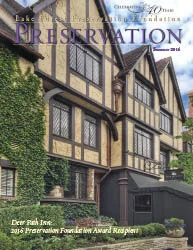
Deer Path Inn: 2016 Preservation Foundation Award Recipient Summer 2016 The meticulous renovation of the Deer Path Inn took twelve months to complete and was unveiled last December, and viewing the exterior passersby might not notice anything different except possibly the updated logo and signage, new patio area, and fireplace on the east side, however the carefully restored details of the Inn’s exterior make the whole building sparkle like a newly polished and reset vintage diamond, each window was removed and sent for restoration or replaced as needed, the façade was rehabilitated carefully with necessary masonry repair while making sure the ivy was not disturbed in the process, “We wanted to leave it alone as best we could to preserve the English manor house style,” said Matt Barba, Innkeeper, and stepping inside one sees the sparkle turn to a warm glow with familiar aesthetics retained in the public space such as window seats, original woodwork, and welcoming fireplaces, overnight guests can now enjoy totally refurbished rooms and suites with beautiful marble bathrooms, individual room climate control, multiple electrical outlets in easy-to-find places, and updated yet classic décor, much of the renovation is hidden in the infrastructure with a complete replacement of all the electrical, plumbing, and heating/cooling systems, and this comprehensive renovation ensures that each guest’s experience will meet 21st-century standards wrapped in 19th-century charm, the original local architects Lynn and William Jones were inspired by the Tudor half-timbered and stone Manor House of Chiddingstone (circa 1453) when they designed the Inn in the 1920s, after a fire in 1938 Stanley Anderson’s firm rebuilt the Inn retaining its Manor House character, local architectural firm Knauer, Inc. designed the renovation and members of the management team traveled to England to tour estates and inns for inspiration and to verify authenticity, the renovation plan ensured local residents would receive benefits as well, unlike a typical English inn with 100 rooms and one dining area the Deer Path has only 57 rooms but three spacious dining rooms, the porch off the English Room has been turned into a dramatic dining area resembling a glass conservatory, a repurposed room off the lobby now the Hearth Room provides guests with a cozy place to enjoy a cocktail or relax during the day, all this work paid off and Barba said the reception and support from the community have been wonderful, “In fact,” he said, “we foolishly thought we could quietly start up again with a soft opening, but residents poured through the doors on that day in December, like they were storming the castle. The finishing touch on the renovation was the warmth of people coming in again to enjoy the same spaces. We picked right up where we left off.” 2 Deer Path Inn: 2016 Preservation Foundation Award Recipient The venerable 1920’s English manor inn in downtown Lake Forest sparkles once again after a spectacular top to bottom rehabilitation. Deer Path Inn 255 E. Illinois Road Rehabilitation Award Project Designers: Knauer Incorporated, Architect Craig Bergman, Landscape Architect 3 2016 Preservation Foundation Awards Established in 1991, the Lake Forest Preservation Foundation’s Historic Preservation Awards Program seeks to recognize and honor examples of the preservation of local historic properties, amenities, streetscapes, and landscapes that exemplify the best of preservation efforts and contribute to the Foundation’s mission of preserving and protecting the historic visual character of Lake Forest, awards are based on criteria established by the Secretary of the Interior’s Standards for the Treatment of Historic Properties, the standards relate to the types of treatment undertaken for each property, Preservation – maintenance of an historic property that respects the original character; Rehabilitation – acknowledgement of the need to alter or add to an historic property while retaining its original character; Restoration – depiction of a property as it appeared at a particular period of history; Reconstruction – recreation of vanished or non-surviving portions of a property, a fifth category Infill considers the compatibility of new construction in an established neighborhood, this year awards were earned in the categories of Preservation, Rehabilitation and Restoration, 777 Washington Road Restoration Award Current Owner: Mr. & Mrs. David Brush Original Architects: Burnham & Root, 1879 Stanley D. Anderson, 1925 Originally the stables of the 1879 Oakhurst Estate, this Burnham & Root-designed building was converted to a single-family residence with an attached doctor’s office in 1925 by Stanley D. Anderson, the current owners Mr. & Mrs. David Brush have restored the exterior including carefully stripping and repainting all the exterior shingles and millwork, 435 E. Illinois Road Rehabilitation Award Current Owner: Mr. & Mrs. Allen Laufenberg Project Designer: Melichar Architects This 1869 Victorian had been altered and expanded numerous times over the past few decades and the current owners Mr. & Mrs. Allen Laufenberg working with Melichar Architects removed some unsympathetic additions, performed needed structural rehabilitation, replaced non-historic windows with more period-appropriate windows, repainted the façade, and restored the front door facing the street, 222 W. Onwentsia Road Rehabilitation Award Current Owner: Sharon Harvey & David Poulton Project Designer: Poulton Group Original Architect: Ralph Huszagh, 1950 This 1950’s Dutch Colonial was rehabbed by current owners and designers Sharon Harvey and David Poulton and through careful editing and updating of exterior materials and details along with modest expansion of the building footprint they created an updated classically detailed home, 4 Church of the Holy Spirit 400 E. Westminster Avenue Rehabilitation Award Project Designer: Thomas Rajkovich, Achitect Craig Bergman, Landscape Architect Original Architect: Frost & Granger, 1902 Designed by architect Thomas Rajkovich and landscape architect Craig Bergman, the church’s main entrance was sensitively rehabbed to improve accessibility for visitors while incorporating a new terrace and adjacent walled garden, Market Square Preservation Award Current Owner: L3 Real Estate Project Designer: OKW Architects Original Architect: Howard Van Doren Shaw, 1916 Market Square owner L3 Real Estate and project designer OKW Architects were given a Preservation Award for their comprehensive and historically sensitive work repairing and restoring the exterior materials and details of Market Square’s buildings, 710 N. Mayflower Road Preservation Award Current Owner: Mrs. Frank Preibe This property originally served as the cow barn on the 1860 estate of Capt. James Hugh Stokes and in 1965 Juli and Frank Preibe purchased the property and engaged architect I.W. Colburn to convert the barn into a unique residence, Juli continues to maintain the home and gardens to a high standard that respects the historical roots that define the former barn and grounds, Forest Park Rehabilitation Award Lake Forest Garden Club, The Forest Park Project Board, and The City of Lake Forest Project Landscape Architects: Stephen Stimson Associates with P. Clifford Miller Original Landscape Gardener: O.C. Simonds, 1896 The nine-acre bluff-top park originally designed in 1896 by landscape gardener O.C. Simonds was rehabilitated by landscape architect Stephen Stimson Associates along with local landscape architect P. Clifford Miller and the project successfully restored the Park’s original character while sensitively updating and improving infrastructure drainage and pedestrian amenities, the project was spearheaded by the Lake Forest Garden Club in coordination with The City of Lake Forest, 5 373 Wisconsin Avenue Preservation Award Current Owner: Mr. & Mrs. Jim Vermillion Original Architect: Stanley D. Anderson, 1927 One of the smallest houses designed by architect Stanley D. Anderson, the residence retains all of its original features including Anderson’s custom-designed wrought-iron flower box brackets and downspout gutter boxes and the building has been sensitively maintained by current owners Mr. and Mrs. Jim Vermillion, 1355 Estate Lane East Lasker Estate Theater Preservation Award Current Owner: Mr. & Mrs. Mark Saran Project Designer: Melichar Architects Original Owner: Albert Lasker Original Architect: David Adler, 1927 Originally the theater to Albert Lasker’s vast west-side estate, the building was converted to a residence following subdivision of the estate in the 1950s and the structure has been well-preserved retaining much of its original exterior integrity with only minor additions and alterations over the years, the current owners Mr. and Mrs. Mark Saran working with Melichar Architects have carefully undertaken repair work to preserve the exterior brick, roof, shutters, trim, and front door, LFPF’s Annual Benefit Architectural House & Garden Tour The Preservation Foundation’s annual fall Architectural House and Garden Tour will take place on Sunday afternoon, October 2, 2016, from 1:30 p.m. to 4:00 p.m. with a reception from 4:00 p.m to 5:00 p.m., the focus of this year’s walk will be the area known as the South Woods on and near the south end of Mayflower Road, this area of the 1857-registered town plan by landscape gardener Almerin Hotchkiss located in what is now Moraine Township was developed later than the sections further north, much of the building in the neighborhood was complete by the mid1930s and only in this century has new construction approached the scale and the classic historic architectural level of that earlier Renaissance, visits to open houses and gardens will include 1910s, 1920s, and 21st century examples—each one a model of classic principles applied masterfully by notable architects, please support the Foundation’s work in the community by purchasing your tax-deductible tickets on our website, www.LFPF.org, Crab Tree Farm Members and Friends of the Preservation Foundation enjoyed a wonderful tour of the 1911 restored dairy farm, Crab Tree Farm, on Saturday, June 11, thank you to our board member Tom Gleason, his docents, and to John and Neville Bryan for their support, Sunday, October 2: Early 20th Century South Woods Estate Legacy 6 Celebrating 40 Years: Preserving the Past for Future Generations From its founding on August 4, 1976, the Preservation Foundation has engaged and educated the community to ensure the preservation of Lake Forest’s historic visual character while supporting the needs of a vibrant community, all told the Foundation and community members have contributed nearly $1 million to this cause in addition to assisting The City of Lake Forest in obtaining $2,072,000 in Federal grants to fund the ongoing restoration and renovation of the historic downtown railroad depot, Key milestones during 40 years include: In the 1970s • Provided support to establish the Lake Forest National Register Historic District. • Co-sponsored the first Lake Forest Preservation Conference with Lake Forest Garden Club, Historical Society, Open Lands, and Nature Conservancy. In the 1980s • Raised $400,000 to save the historic downtown railroad depot from demolition. • Provided financial and research support to establish the Vine-Oakwood-Green Bay Road National Register District. • Funded the architectural survey that initiated the City’s Preservation and Open Space District. In the 1990s • Donated $34,000 and research to establish the Green Bay Road National Register District. • Raised over $125,000 to restore the historic Walden-Bluff’s Edge Bridge. • Published two editions of A Preservation Foundation Guide to National Register Properties. • Granted $10,000 to Market Square 2000, including toward restoration of the fountain. • Granted $10,750 to restore the original west entrance of Gorton Community Center. • Supported the City’s establishment of the Historic Preservation Ordinance and Commission. In the 2000s • Granted $25,000 to the City for exterior restoration of Dickinson Hall. • Granted $37,500 for Elawa Farm renovation and displays. • Granted $50,000 to the Ragdale restoration. • Granted $15,000 to the City to relight 438 historic gas lights. • Funded a $50,000 Historic Structure report for the restoration of the downtown railroad depot. • Granted $10,000 to Lake Forest College to help fund a campus-wide preservation planning document. • Assisted the City in obtaining $2,071,610 in Federal grants through the Illinois Department of Transportation to fund the ongoing restoration and renovation of the historic downtown railroad depot. • Provided financial and research support to establish the West Park Neighborhood National Register District. • Funded one quarter of the cost to restore the only surviving original, officially-signed version of the 1857 plan of Lake Forest. • Assisted a neighborhood campaign to restore the historic Castlegate gates at Deer Path/King Muir Road and Waukegan Road/Castlegate Court. 7 Key Principles of Good Classical Design Often when we look at new houses designed in a traditional style, we can sense right away when the building feels classic, solid, and timeless or when it’s an unconvincing imitation, articulating what it is about the design that feels right or wrong is much more difficult and these guidelines are intended to help, buildings aren’t traditional in design simply because columns have been used or trim has been applied, rather they are traditional because the elements are arranged by a common set of rules, successfully integrating new traditional houses into established neighborhoods or expanding an historic building requires an understanding of these rules and the use of local materials to create authentic long-lasting architecture with a whole that is greater than the sum of its parts, we will explore some of these rules and key principles in this and future newsletters, Make the Whole Greater than the Sum of its Parts when it comes to the design of successful traditional and classically designed architecture thinking about the building as a whole is important, creating a well-designed building is not about assembling the many pieces it’s about linking the pieces together so that each element relates to the other elements in location scale and proportion, the most beautifully designed elements and details will look out of place if they are not integrated with the rest of the building, these two houses both have five bays with a gable roof pedimented porticos and gable dormers but only the second one is designed so that each element is sized scaled and located in relation to the other elements of the building, from across the street this façade will look unbalanced because the elements bear little relation to one another, the windows are poorly spaced the dormers overpower the windows below and the portico overpowers the entire house, by contrast this design shows a house that has a balanced composition, the windows are rationally spaced away from the building’s corners, the dormers are modest and scaled in relation to the windows below, the entry surround contributes to the design without overpowering it, a pair of chimneys terminates the composition, Keep it Simple, Use Restraint Beauty in traditional architecture arises from balance emphasizing some elements while simplifying others, when designing a building it’s tempting for the designer to want to add a lot of architectural elements to the facade and show what they can do, in most traditional architecture there is tremendous restraint and even when ornament is used it’s very carefully located, this creates hierarchy in the design, the goal is to create a building that is interesting but not overwhelming and confused, let the success of the design be derived from proportion scale harmony and good detailing, Don’t use every element you can think of in a single building even if each element is well detailed it can be too much for the composition, the beauty of traditional architecture comes from simplicity and hierarchy, 40th Annual Meeting and Reception at the Deer Path Inn On May 1, LFPF members celebrated new board members, 2016 Historic Preservation Award winners, and the recognition of our 40th Anniversary, the Deer Path Inn graciously hosted the meeting in the Windsor Room and a bountiful reception with guided tours of the exquisite interior renovations and we give our sincere thanks for the generosity of the Deer Path Inn, Sarah Wimmer – Preservation Advocate Friends, family, colleagues and admirers gathered on April 16 at Lake Forest’s First Baptist Church to celebrate the life of Sarah Darling Wimmer long-time Lake Forest resident and preservation advocate par excellence, Sally as she was known to her friends was twice president of the Lake Forest Preservation Foundation during the late 1980s, she served multiple times as board secretary and kept meticulous records of the organization’s work to promote projects and grants benefiting preservation efforts, spearheading a practice continued today she along with other early LFPF leaders initiated the Board’s practice of monitoring City meetings involving preservation issues and Sally could often be found in the audience of Historic Preservation Commission and City Council these meetings until shortly before her death, the First Baptist Church was a preservation cause that Sally embraced and it stands today adjacent to the municipal parking lots north of City Hall between Forest and Oakwood Avenues as a testimony to her and others’ commitment to preserving it at a time when its viability was endangered, “Sarah Wimmer will be long respected for her rock-solid reliability and for her leadership for doing things that mattered, and doing them quietly,” said Arthur Miller current LFPF President, to honor Sarah Wimmer’s legacy the LFPF has awarded a $1,000 Heritage Fund grant to the First Baptist Church for preservation/capital improvement, AVOID USE AVOID USE LAKE FOREST PRESERVATION FOUNDATION 2016-2017 BOARD OF DIRECTORS EXECUTIVE COMMITTEE Arthur Miller President Ingrid Bryzinski VP Development Tom Gleason Laura Luce VP Programs Maureen Grinnell Secretary Peggy Pandaleon Treasurer DIRECTORS Guy Berg Lynn Bertram Judy Boggess Stephen Bent Maggie Coleman Peter Coutant Cathy Dohnalek Sharon A. Harvey Linda Liang Roger Mohr Elizabeth Moore Fred Moyer Jim Opsitnik Kurt Pairitz Sara TenBroek Lynn Van Cleave Kent Woloson HONORARY DIRECTORS Herbert Geist Gail Hodges Pauline Mohr Shirley Paddock Linda Shields Lorraine Tweed EXECUTIVE DIRECTOR Marcy Kerr NON-PROFIT ORG U.S. POSTAGE PAID PERMIT NO. 184 LAKE FOREST, IL 60045 ECRWSS Residential Customer Lake Forest, IL 60045 PRESERVATION SUMMER 2016 – VOLUME 9, NUMBER 2 CONTRIBUTORS: Peter Coutant, Maureen Grinnell, Gail Hodges, Marcy Kerr, Arthur Miller, and Peggy Pandaleon PHOTOGRAPHY: Cappy Johnston Courtesy of Deer Path Inn Peter Coutant LAKE FOREST PRESERVATION FOUNDATION 400 East Illinois Road Lake Forest, Illinois 60045 www.lfpf.org Upcoming programs you won’t want to miss Friday, August 26, 2016 Late Summer Lakeside Garden Stroll 5:30 p.m. ~ 7:30 p.m. Members $20 Non-members $30 Sunday, October 2, 2016 Annual Benefit Architectural House & Garden Tour Tour 1:30 p.m. – 4:00 p.m. Reception 4:00 p.m. – 5:00 p.m. Advance tickets $100 Day of event $125 Annual Member Holiday Celebration Sunday, December 4 | 2:00 p.m. – 4:00 p.m. ongratulations to newly appointed Honorary Director Gail Hodges elcome to ew oard irectors Maggie Coleman Sharon A. Harvey Kurt Pairitz Sara TenBroek hank you to retiring Board Directors Allison Derr Kristen Chun Arthur Miller accepts The City of Lake Forest Proclamation honoring Lake Forest Preservation Foundation and Preservation Month from Mayor Don Schoenheider. Photo courtsey of the City of LF.
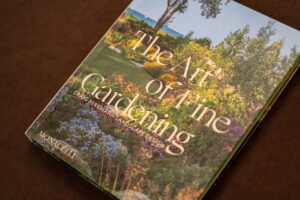
The Art of Fine Gardening: Craig Bergmann Landscape Design
Craig Bergmann and Russell Buvala presented The Art of Fine Gardening, showcasing four decades of landscape design that unites architecture and horticulture. Featuring twenty North Shore gardens—including the historic Gardens at 900—the book blends stunning photography, personal stories, and practical guidance for gardeners and design enthusiasts alike.