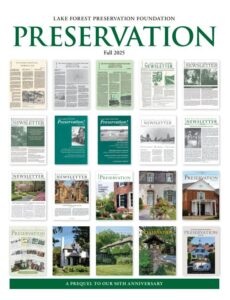
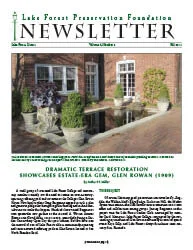
Lake Forest Preservation Foundation Newsletter, Lake Forest, Illinois, Volume 4, Number 3 (Fall 2011), featuring a lead story titled “Dramatic Terrace Restoration Showcases Estate-Era Gem, Glen Rowan (1909)” by Arthur H. Miller, introduced with a caption noting the “just restored 1909 Glen Rowan reflecting pool, fountain, sculpture and containers” and rejuvenated seasonal planting schemes completed by collaborating local experts and funders (photo by the author, October 2011), then explaining that a small group of Lake Forest College and community members recognized the need to restore the over-a-century-operating reflecting pool and terrace at Lake Forest College’s Glen Rowan House (500 North Sheridan Road), and that new Lake Forest resident Craig Bergmann stepped in with a plan and generous pledge that assembled both funding and in-kind contributions, noting that while many had visited Bergmann’s gardens at the restored A. Watson Armour Elawa estate, fewer had seen the renewal of the continuously operating terrace-sited reflecting pool at Glen Rowan, then outlining “The Project” as a collaboration similar to other local preservation successes (Ragdale, Walden-Bluff’s Edge Bridge, Dickinson Hall, Market Square train station) and naming partners including Craig Bergmann, the Lake Forest Garden Club (encouraged by member Carol Blomquist), Lake Forest College (energized by Glen Rowan programming under director of special events Kaye Kelly), and Lake Forest’s stone masonry firm Fernando, with continuation later in the issue describing that Carol Blomquist championed the restoration through the recession, drawing on historical research and her Garden Club/College ties, and noting that Kaye Kelly had earlier received a senior class gift to restore terrace turf with modest replanting but that the larger restoration required the broader partnership, then providing “Some Glen Rowan History,” stating Glen Rowan was purchased from the Barnes family in 1968 and became the entertaining/guest-house focal point for Lake Forest College in 1979, and that it was built in 1909 as the country place of Rev. Clifford W. Barnes and Alice Reid Barnes and designed by architect Howard Van Doren Shaw (credited in the text with works including Market Square, Ragdale, and the College’s Calvin Durand Hall), describing Barnes as a Chicago reformer associated with the Sunday Evening Club and women’s suffrage and as a friend of Jane Addams with Hull House connections in the 1890s, and describing Alice Reid as the older surviving daughter of Mrs. Simon S. Reid and an heiress to the Reid wholesale grocery firm (also known for Monarch Foods), noting family deaths (including Arthur S. Reid in 1899) and that the Barneses carried forward the family mission until the death of their daughter Lilace Barnes in 1988, and stating the house was built south of the Reid family’s 1872 Stick Style “The Lilacs” (demolished 1971) at the southwest corner of Sheridan and College Roads, then describing the architectural significance of Glen Rowan’s terrace as unique among Shaw terraces for integrating an open terrace into a central-hall classic/Beaux-Arts interior plan, allowing Shaw to blend an informal asymmetrical English traditional exterior with a symmetrically arranged elegant Stuart-period interior, and noting the terrace’s long east-side balustrade referencing an Edwin Lutyens “Deanery” terrace design (with a pointer to Lake Forest College: A Guide to the Campus, 2007), and explaining that early-20th-century family photos showed the terrace to be largely intact (described as 99% original) but in deteriorating condition, which inspired the team, then profiling Craig Bergmann as an “extraordinary garden designer” newly established in Lake Forest and described as a key figure in restoring notable local gardens, with an anecdote about the author’s 2003 Sotheby’s lecture where photos of the restored House of the Four Winds Ibero-Moorish garden (Shaw, 1909; Rose Standish Nichols) drew an audible reaction, and asserting that Bergmann’s “garden whispering” revived overgrown spaces and that at Glen Rowan he provided a plan, coordinated partners such as Fernando, and pledged to keep seasonal plantings as long as he remains local, with additional funding from the College and the Lake Forest Garden Club, and listing completed improvements including replacement of the 1909 pump and electric motor (rebuilt in 1970), restoration of sculptures, reconstruction of the pool, resetting the brick floor surface, espaliering an apple tree against the north wall, planting shrubs, and updating containers seasonally, then emphasizing “Collaboration for Preservation Success” as a model partnership among a local entrepreneur/artist (Bergmann), a nonprofit (Lake Forest College), the Garden Club’s charitable entity, and an individual advocate (Carol Blomquist), and providing contact and reference information for Glen Rowan history through Lake Forest College archives and event booking plus references to Bergmann’s website and Fernando’s masonry contact, along with a photo caption noting members Susan Dedo and Bill Redfield with Executive Director Marcy Kerr at a reception tied to the Foundation’s October 23 “Historic Interiors Presentation and Wine Stroll” event featuring interior designer Frank Ponterio, then including a section “What’s the Latest on Forest Park?” by Rommy Lopat reporting that on Wednesday, September 21 the Forest Park Project Board presented more detailed rehabilitation information to a joint meeting of the Lake Forest Historic Preservation Commission and the Parks & Recreation Board, noting a “packed house” heard volunteer committee reports on park history and engineering and horticultural aspects with a fourth amenities committee to report later, directing readers to the Foundation website (www.lfpf.org) for a full report and to the Forest Park Project Board site (www.forestparkproject.com) for committee reports and updates, and reiterating Forest Park’s significance as an historic cultural landscape designed by O. C. Simonds and the Foundation’s intent to continue following the project, then an “In Memoriam” section for Henry P. Wheeler (1919–2001) describing his community service (youth sports, Marine major in WWII and reserve commander, six years as an Alderman on the Lake Forest City Council) and his leadership within the Foundation, noting the Foundation’s charter date of August 4, 1976 and its purpose of preserving Lake Forest’s historic visual character, stating Wheeler served as the sixth president (1986–1988) during the conclusion of the Chicago & North Western Railway Station restoration/renovation and at the beginning of the “Balkanization” concern around property subdivision and oversized new construction affecting neighborhood character, recounting that on July 29, 1986 Wheeler addressed the Plan Commission which spurred City discussions of bulk and mass limits, listing other contemporaneous concerns including Handy Green, adjacent green space, gas lights, infill, and Fort Sheridan’s future, quoting his Spring 1986 message ending with a John Aull line about holding land in trust for the next generation, and remembering his ongoing attendance and presence at Lake Forest Day, concluding with a tribute to his playful, humorous style signed by Sarah Wimmer and Pauline Mohr, then a book note titled “New Biographical Study of Landscape Designer O. C. Simonds (1855–1931)” by Arthur H. Miller reviewing Barbara Geiger’s Low-Key Genius: The Life and Work of Landscape-Gardener O. C. Simonds (Ferme Orne Press; $34.95), describing it as a 343-page softbound scholarly biography with botanical illustrations by Simonds’ granddaughter-in-law Roberta Simonds, many photo and line-drawing illustrations, and extensive back matter including a job list (noted as about 1,000 projects nationwide), bibliography, and index, plus design commentary (“Tracing O.C.”) by designer William M. Walker, and noting the book debuted at the Foundation’s summer garden visit at Bill and Lynn Redfield’s House of the Four Winds on Laurel Avenue, then summarizing Geiger’s background (IIT adjunct; master’s thesis on Simonds) and highlighting her coverage of Simonds’ local work including Lake Forest Cemetery (1901), Lake Forest Academy and Lake Forest University landscape plans (1892), Fort Sheridan (1888), Forest Park (1896), and private estates (Colvin, Armour, Horace Martin, Byron Smith), adding that partner J. Roy West continued work after Simonds’ 1931 death on Lake Forest High School and the Hafner residence, and mentioning a 1912 plan for the Franklin P. Smith estate (Deerpath and Mayflower) in the Lake Forest-Lake Bluff Historical Society collections, concluding that the book broadens participation beyond specialists and is valuable both as reference and readable narrative with strong illustrations and respect for Simonds’ regional impact, then featuring a repeating quote excerpted from Gertrude Jekyll’s “Gardens Past and Present” (A Gardener’s Testament, 1937) about the obligation to make human works “sightly and gracious,” followed by a station update headlined “Station Roof Restoration To Be Completed by Thanksgiving!” by Gail T. Hodges reporting that restoration of the original slate roof, dormers, and related exterior structural elements/trim on the Market Square train station began in late September and was expected to be completed for the Thanksgiving-weekend tree-lighting, explaining that to restore original gable ends on the west platform canopies two trees flanking the west building were removed due to their role in roof deterioration and would be replaced later per a conceptual landscape plan and review, noting additional exterior work planned for next spring (stucco, masonry reconstruction, tuckpointing, windows, doors) subject to available funding, stating the goal is an 80–100-year solution using long-lasting workmanship and materials comparable to the 1900 original station, detailing funding as an $835,090 ITEP grant plus $250,000 from METRA and $160,000 budgeted by the City, naming oversight by preservation architect Gunny Harboe (Harboe Associates) and City of Lake Forest Director of Public Works Dan Martin with updates linked via the Foundation site to the City’s “What’s New,” recounting the project’s origin in structural failure observed in 2008 and the Foundation’s commissioning of a $50,000 Historic Structure Report by Harboe, noting Harboe’s being named “Chicagoan of the Year” in 2010 for work on the Carson Pirie Scott building façade, stating this effort initiated a two-year City/Foundation collaboration securing over $1.245 million to begin, and noting an additional $2+ million would be needed for interior restoration/renovation including a long-term cost-effective HVAC system, and ending with a call for contributions, tax-deductibility, online donation option, and naming opportunities, accompanied by a photo caption identifying Arthur H. Miller, Suzanne Boren, Gail Hodges, Gunny Harboe, and Dan Martin, and finally including extensive membership recognition lists by giving level (e.g., 1861 Society, Preservation Benefactor, Preservation Circle, Landmark Society, Foundation Partner, Historic Friends) and a membership form describing membership tiers and benefits (discounts on events, docent/volunteer opportunities, updates on preservation issues, recognition in the annual report, and complimentary holiday party admission for higher tiers), along with “Tributes and Remembrances” gifting and standard nonprofit mailing indicia and a “Become a Member” call to action with the www.LFPF.org link.