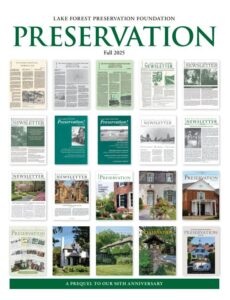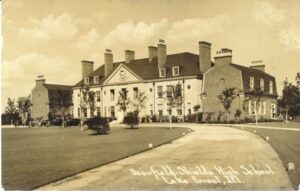
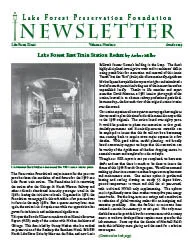
NEWSLETTER L a k e F o r e s t P r e s e r v a t i o n F o u n d a t i o n NEWSLETTER L a k e F o r e s e r v a t i o n F o u n d a t i o n Lake Forest, Illinois Volume 2, Number 2 Awards 2009 Lake Forest East Train Station Redux by Arthur Miller Life Member David Mattoon discovered this 1901 station interior photo The Preservation Foundation’s major interest for the past two years has been the condition of and future for the 1900 east Lake Forest train station, and the Foundation led in renovating the station after the Chicago & North Western Railway and other railroads abandoned inter-city passenger travel in the 1960s, leaving the initiative to locals, and organized in 1976, the Foundation was engaged in this task within a few years and was its focus in the early 1980s, but a quarter century later, once again, the station is in disrepair, even while our appreciation has grown for its historic and architectural significance, and this year the Board of Directors undertook an Historic Structure Report (HSR) study of the station with Harboe Architects of Chicago, a firm led by Gunny Harboe who has worked on preservation of the Rookery, the Burnham Hotel, 860-880 North Lake Shore Drive by Mies van der Rohe, and now Louis Sullivan’s former Carson’s building in the Loop, and the firm’s highly-disciplined investigative work and its architects’ skill in seeing possibilities for restoration and renewal of this iconic “fourth” but also “first” (built) side of internationally-significant Market Square have yielded many new insights and stimulated a level of research pursuit including use of the internet heretofore unparalleled locally, and thanks to life member and expert researcher David Mattoon, a 1901 interior photograph of the station, located in an obscure railway professional periodical, has turned up–the first such view of the original station interior ever discovered, and our station experience from a quarter century ago has taught us that we need to plan this time for durable materials comparable to the 1900 originals, since the station lasted over eighty years, and it would be prudent to phase our renovation so that good, similarly-permanent and historically-accurate materials can be employed to insure that this fix will not be a boomerang one, coming back to require more major expense in a few decades, and with good advice, careful planning, and broadly based community support we hope that this restoration can be worthy of the significance of the first shopping center, its essential context and template for scale and style, and though our HSR report is not yet completed, we have seen drafts and see that there is much to be done to insure the future of this 1900 Frost & Granger gem, and we will recommend making up-front investment to reduce longer-term replacement and maintenance costs, and one serious option is geothermal heating and cooling drawing on steady 55 degree below-ground temperatures to warm and chill the air year-round, with traditional HVAC only supplementing, and the upfront cost is significantly more than another twenty-five year, energy intensive fix, but the long-term cost savings and contribution to reduction of global warming makes this an intriguing and attractive possibility, and also, the facilities or restrooms have retained a certain last-century je ne sais quoi, and not only must disabled access be provided, but for a town center with as many events as we have developed here requires more space for this infrastructure, and some say that the demise of Marshall Field’s made this infelicity more glaring and the need for a solution more urgent, HISTORIC PRESERVATION AWARDS 2009 marks the 19th consecutive year of the Foundation’s Historic Preservation Awards program, and this year there was once again an extraordinary number of outstanding entries, of which fourteen received awards from the Foundation at the May 3 Annual Meeting, and since the inception of the program, 149 awards have been presented recognizing efforts that help preserve the historic visual character of Lake Forest, and the solid bronze award plaque contains an inscription of the type of award and year, and is proudly displayed on award winning structures throughout Lake Forest, and this year, previous awardees were recognized with a lawn sign for several weeks before and after the May 3 meeting, and all awardees are listed on the Foundation’s website, 2009 Historic Preservation Award Winners 745 Barberry Lane – Rehabilitation ROGER & LINDA MEDEMA ARCHITECT: ROGER MEDEMA, MEDEMA ARCHITECTS This 1906 Howard Van Doren Shaw home was originally built for Augustus A. Carpenter Jr. who, like his father, was a lumberman and capitalist, and the current owners executed a complete restoration of the exterior including four porches, all masonry, and blue stone patios, as well as a rehabilitation of the entire interior of the home, and the close attention to detail and preservation of original designs are clearly evident, 325 North Ahwahnee Road – Rehabilitation DANIEL & CATHY DOHNALEK This house was built in 1928 for Mr. Edward K. Welles, an investment banker, and his wife, Elizabeth Cluett Scott, the Carson Pirie Scott department store heiress, and it is a common-brick and half-timbered version of the English traditional style, adjacent to the Onwentsia golf course, and was designed by architect Walter Frazier, and his firm, Frazier and Raftery, also expanded the house in the 1930s, and later work by architect Jerome Cerny occurred in the 1960s, and the Arts and Crafts style landscape was designed in the late 1930s by Annette Hoyt Flanders, and the house has been meticulously preserved by the current owners who have restored the wood windows from photos, removing the 1960’s aluminum casing and returning them to their original splendor, 55 North Mayflower Road – Rehabilitation BARRY & BARBARA CARROLL The Clyde M. Carr residence, Wyldewood, was designed by nationally well-known architect Harrie T. Lindeberg and built in 1916, and the wrought iron entry arch with a large coach lamp, visible from Mayflower Road, was severely corroded at the base, and there was insufficient clearance for taller, modern vehicles which were causing damage, and the current owners have repaired or replaced many decorative details which were missing or deteriorated on the original 1916 iron work, as well as restored the supporting brick gate posts and fence, 111 Ridge Lane – Preservation DAVID & LYNDA SCHOPP This Colonial Revival house was built in 1936 by Anderson and Ticknor for W. Paul McBride, who served as mayor of Lake Forest from 1951 to 1954, and Stanley Anderson was born in Lake Forest, graduated from Lake Forest College in 1916, and subsequently studied architecture at the University of Illinois and the Sorbonne in Paris, and worked for Howard Van Doren Shaw from 1919 until going into his own business with James H. Ticknor in 1926, and Colonial Revival architecture, which stemmed from early English and Dutch houses of the east coast, was the prevailing style for houses built in the United States for the first half of the twentieth century, and masonry is most prevalent in high-style examples, such as this beautifully preserved house, 1050 East Illinois Road – Preservation RON & CORINNA WAUD This Frazier and Raftery house was built for Lawrence and Clarice Walther Williams in 1928, and Walter Frazier received his degree in architecture from MIT in 1919 and attended the Ecole des Beaux-Arts from 1919 to 1920, and John Howard Raftery attended Princeton, MIT, the Ecole des Beaux-Arts, and the American Academy in Rome, and the style of this house is French Country Eclectic, and the original structure is exceptionally well-preserved, 1435 Lake Road – Preservation HAROLD & MARGARET MARSHALL The Richard Bentley House, on the lake bluff immediately east of this house, was designed by David Adler in the informal Dutch and South African style design and built in 1928-1929, and due to the financial markets of 1929, the garage building was not completed until 1931 by architect Ambrose Cramer Jr., and the building was adaptively reused and converted to a single family residence circa 1950, with its visual character carefully preserved, 57 Stonegate Road – Rehabilitation PAUL & SUSAN SVIGOS ARCHITECT: PHILLIP LIEDERBACH, LIEDERBACH & GRAHAM Located on the bluff above Lake Michigan, Rathmore was built in 1896 by Boston architect F.W. Stickney for Ambrose Cramer and his wife, one of three Corwith sisters with nearby houses along the shore, and recent work incorporates sensitively-designed elements to make this house viable for generations to come, and includes garage and family room additions, restoration of porches and reconstruction of the east terrace with original stone, 1150 East Westleigh Road – Rehabilitation RICHARD & ROBIN BUXBAUM ARCHITECT: R. MICHAEL GRAHAM, LIEDERBACH & GRAHAM This property contains two parallel structures, both originally service buildings to the Harriet and Cyrus McCormick, Jr. estate Walden, and the current owners have converted the structures from open storage sheds to a residential building, and overall, the exterior of the site remains very much as originally constructed, securing a true treasure for our town, 1536 South Estate Lane – Rehabilitation BRUCE & JULIA BURNHAM ARCHITECT: THE POULTON GROUP This one-and-a-half story residence, also known as the Lasker Estate Milk House, was constructed in 1926 as a one-story structure, open to the rafters, and the current homeowners replaced aluminum sliding windows and introduced a one-and-a-half story north wing addition, and this recent work complements the historic visual character of the original Milk House through material usage, scale and roof shape, 170 North Mayflower Road – Preservation ANDREW & RUTH WINICK Renowned architect James Gamble Rogers built this house in 1926 for the general counsel of a Chicago railroad, and Rogers is responsible for many of the Gothic Revival structures at Yale University built in the 1910s and 1920s, and the current owners have pristinely maintained and preserved this beautiful house set on a quiet ravine, 100 East Old Mill Road – Infill (Garden) LAKE FOREST/ LAKE BLUFF SENIOR CENTER LANDSCAPE ARCHITECT: ANTHONY TYZNIK This terrace garden at Dickinson Hall was designed and built on a former path that connected the east entrance with stairs on the southwest side that exit the great room, and balusters are from the original 1928 bridge on Sheridan Road that spans the ravine immediately south of Deerpath, and now brought back to life as recycled artifacts of the past, they pay a tribute to the preservation ethic of the City of Lake Forest, 990 East Illinois Road – Preservation FRANK & MEGAN BEIDLER This is the only Frank Lloyd Wright house in Lake Forest and one of his last built on the North Shore, and the Charles F. Glore Residence was commissioned in 1951 and completed by Wright in 1953, and built of pink Chicago common brick, Honduran mahogany, salmon-colored concrete block and vast expanses of glass, and the current owners are dedicated to preserving this treasure, 721 North Mayflower Road – Restoration BRAD & NICOLE LANE ARCHITECT: DIANA MELICHAR, MELICHAR ARCHITECTS Designed in 1954 for Mrs. William Clow by Stanley Anderson Associates, and the current owners have restored as much of the original design intent as possible and reconfigured unsympathetic additions to make the house more suitable for family living, PRESERVATION FOUNDATION OFFICERS AND DIRECTORS Officers Thomas Daly – President Suzanne Boren – V.P. Membership Jan Gibson – V.P. Programs Camille Stohlgren – Secretary Len Dedo – Treasurer Directors Jerry Henry Gail Hodges Dennis Johnston Patty Kreischer Cynthia Leahy John Litchfield Rommy Lopat Pauline Mohr Liz Moore Alice Moulton-Ely Joy Murawski Shirley Paddock Jane Partridge William Redfield Immediate Past President Arthur H. Miller Honorary Directors Herbert G. Geist Gail T. Hodges Linda L. Shields Lorraine Tweed Henry P. Wheeler Sarah Wimmer Past Presidents Edward H. Bennett, Jr. 1976-1978 Gayle K. Dompke 1978-1980 Gail T. Hodges 1980-1982 Herbert Geist 1982-1984 Lorraine A. Tweed 1984-1986 Henry P. Wheeler 1986-1988 Sarah D. Wimmer 1988-1990, 1992-1993 Pauline M. Mohr 1993-1995, 1997-1999 Richard J. DuBourdieu 1995-1997 Edward H. Bennett, III 1999-2001 Linda A. Shields 1990-1992, 2001-2003 Alice Moulton-Ely 2003-2005 James F. Herber 2005-2007 Executive Director Marcy Kerr PRESIDENT’S MESSAGE The Preservation Foundation is 33 years old this year, and celebrated the 19th anniversary of its Historic Preservation Awards Program at the May 3 Annual Meeting, and handsome bronze plaque awards were given to recognize the contribution of 14 properties to preserving the historic visual character of Lake Forest, and prior recipients were invited this year to display our new green on white signs declaring the properties as an “Historic Preservation Award Recipient,” and we have underwritten a $50,000 Historic Structure Report on our deteriorating east train station, and much more will be reported on this initiative to restore the most visible structure in the center of our City as it unfolds, and our educational role is supported by our Programs Committee and our newsletter, which is published on a regular basis now with the Winter/Spring, Awards, and Fall editions, and Tom Daly encourages membership, and ByjoiningtheLakeForestPreservationFoundation,youwillhaveavoiceinandtheabilitytoplayanactiveroleineffortstopreserveandenhancethequalityoflifethatinfluencedyoutochooseLakeForestforyourhomeorbusiness, Together,wecanensurethepreservationofthehistoricvisualcharacterofLakeForest, Tobecomeamembervisitourwebsiteatwww.lfpf.orgorcall847-234-1230foramembershipbrochure, BECOMEAMEMBER, WELCOMENEWBOARDDIRECTORS TheLakeForestPreservationFoundationwouldliketowelcomeournewlyelectedDirectors, JanGibson,JerryHenry,DennisJohnston,JohnLitchfield,RommyLopat,LizMooreandAliceMoulton-Ely, and heartfelt thanks to Art Miller and to Director Christine Puch, and a reception to honor our new and departing Directors and Preservation Award winners was held at the Lake Forest College, Glen Rowan House, designed by Howard Van Doren Shaw and completed in 1909 for the Reverend Clifford Barnes, RECOMMENDED BOOKS “The Economics of Historic Preservation A Community Leader’s Guide”, by Donovan D. Rypkema, Second Edition, 2005, published by the National Trust for Historic Preservation, and Rypkema defines historic preservation as the careful management of a community’s historic resources and the thrifty use of those resources, and Don Rypkema was the keynote speaker at the “Sense and Cents-ability” seminar on tax credits and property tax freezes co-sponsored by the City of Lake Forest and the Preservation Foundation on May 21-22, 2004, Lake Forest Preservation Foundation’s Market Square Family Fair Saturday, June 27, 2009 – 11:00 am to 1:00 pm Did you know that Market Square is the first planned shopping center in the United States and that the Lake Forest Train Station has a tunnel, and the Foundation is rolling back the time to 1916 with children’s scavenger hunt and interactive building games, tours of the Lake Forest Train Station tunnel, 10-cent hot dogs, sno-cones, and popcorn, croquet demonstrations by the Lake Forest Woman’s Club, and guided architectural tours, SAVE THE DATE, Visit us on the web at www.lfpf.org, NON-PROFIT ORG U.S. POSTAGE PAID PERMIT NO. 184 LAKE FOREST, IL 60045, The Lake Forest Preservation Foundation 400 East Illinois Road, Lake Forest, Illinois 60045 www.lfpf.org, UPCOMING EVENTS “Family Fair in Market Square” Saturday, June 27 – 11 am to 1 pm – Market Square, “Exploring Lake Forest Neighborhoods – Scenic Overlook Drive and the Homes of Robert Roloson” Sunday, Sept 20 – 2 pm to 4 pm – Gorton Community Center reception following at an Overlook Drive private home, Past LFPF programs are aired monthly on LFTV channel 17, and How should we proceed, every indication is that this will require a level of fundraising well beyond the scope of the Foundation’s 1980’s effort, and like Market Square 2000 this task appears to require a separate 501c3 charitable organization to make decisions, raise funds, obtain final design work, carry out an appropriate restoration, and provide for future maintenance, and this must be an all-out and community-wide effort, and if the task ahead is daunting, it comes at a time when the country is stepping back and looking at making solid, long-term investments in infrastructure and in green-friendly energy choices, and in an energy-responsible future train travel is getting renewed attention for its efficiency promising more utilization for our local stations, and a renewed station will help reduce the charm of inefficient driving to Chicago one by one, and this investment can be the start of a new commitment to the viability of our central business district, one of the most significant not only in the region but in an international context, and that is our challenge.
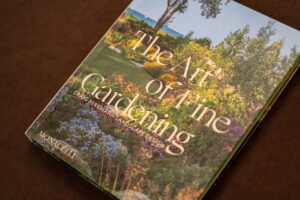
The Art of Fine Gardening: Craig Bergmann Landscape Design
Craig Bergmann and Russell Buvala presented The Art of Fine Gardening, showcasing four decades of landscape design that unites architecture and horticulture. Featuring twenty North Shore gardens—including the historic Gardens at 900—the book blends stunning photography, personal stories, and practical guidance for gardeners and design enthusiasts alike.