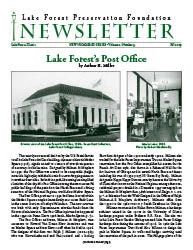
NEWSLETTER L a k e F o r e s t P r e s e r v a t i o n F o u n d a t i o n NEWSLETTER L a k e F o r e s t P r e s e r v a t i o n F o u n d a t i o n Lake Forest, Illinois NeW NUMBeReD SeRIeS • Volume 2, Number 3 Fall 2009 Lake Forest’s Post Office by Arthur H. Miller Exterior view of the Lake Forest Post Office, 1930s, Susan Dart Collection, Lake Forest College Library, and Interior view, 2009, Photo by Robert Moulton-Ely, and the recently announced decision by the U.S. Postal Service to sell its Lake Forest Art Deco building adjacent to historic Market Square (1916) signals an end to a tenure of over three-quarters of a century in this location, and designed by Milman & Morphett in 1932, the Post Office was created to be compatible in height, materials, and high style with the historic first-ever shopping center to its south and east sides, and set back in a park-like setting in a simplified classicism of the day, this Post Office is among the most successful public buildings of the period on the North Shore and a fitting extension of the National Register world-class Market Square, and the Post Office previous to 1932 had been located within the Market Square complex immediately east across Bank Lane in the corner location of today’s Helander’s, and the new structure was built with early Depression-era stimulus funds from the Hoover administration, and the Post Office is pictured as it appeared in the 1930s in Susan Dart’s 1984 book Market Square, and the Post Office’s architects, Milman & Morphett, were successors to Howard Van Doren Shaw Associates and were on Market Square architect Shaw’s staff when he died in 1926, and the designer of this firm was Ralph J. Milman (1888-1963), Harvard-educated and Paris-trained, and a leading Shaw firm designer of the 1910s and early 1920s, and Milman exemplified esteem for the French Art Deco style, also shown in a Rehearsal Hall for the Art Institute of Chicago and in several North Shore residences including his own of 1932 at 1275 North Green Bay Road, and Milman also worked for the Lake Forest Improvement Trust on Market Square renovations, and in 1940 the Trust hired Mrs. Helen Brown Milman, a landscape architect trained under Professor R.R. Root at the University of Illinois, to design the park in Market Square, and the Post Office exterior found in the 1937 Milman & Morphett monograph includes a modern formal landscape with squared hedges and informally growing trees, and the Post Office’s Art Deco style reflects the Bauhaus-influenced French version of modern design promulgated by Le Corbusier in Paris in the late 1910s and 1920s, and Le Corbusier’s Vers Une Architecture published in 1923 advocated streamlined forms inspired by ships, automobiles, and planes, and this modern classicism was echoed locally in Walter Frazier’s 1930 Hodges house on Westminster and the 1931 Lake Forest Library by Edwin Hill Clark, and the Post Office exterior is decorated in low relief modern sculpture influenced by Paul Manship and others, and metalwork over the entrance doors reflects a domestic tradition found in great houses locally by Lindeberg and Frederick Perkins and in Market Square itself, and on the interior the plan is organized into two great spaces, public on the south and private for processing on the north, and the public space is two stories in height with federal metalwork motifs, black marble and terrazzo floors, period lighting, and postal boxes and service windows along the north wall, and later Milman projects in Lake Forest included French-style houses on Ridge Lane and Westminster, a pool complex for Knollwood Club, Georgian Colonial residences for the Fred Kramers and Philip Reddys, and circa 1950 the modern Deerpath School west of Green Bay Road, and Lake Forest’s Post Office remains a significant contributing structure to the adjacent Market Square ensemble within the original National Register Historic District, PRESIDENT’S MESSAGE Dear Fellow Residents and Property Owners of Lake Forest, and in this issue we pay tribute to our many members whose support and generosity over the past 33 years have enabled the Foundation to carry out its mission of preserving the unique historic character of our town, and over 30 projects large and small have been initiated and financially supported by the Foundation from the 1980s rehabilitation of the Market Square train station to the saving of the Walden/Bluff’s Edge bridge, and grants to projects at Gorton, Ragdale, Dickinson Hall, and Elawa Farm, as well as work on preservation ordinances and National Register Districts, are part of this legacy, and none of this would have been possible without your support, and if your name does not appear on our roster join now and become part of a great organization dedicated to helping our City maintain its beautiful and unique visual character, sincerely Thomas Daly, President, PRESERVATION FOUNDATION OFFICERS AND DIRECTORS Officers Thomas Daly – President Suzanne Boren – V.P. Membership Jan Gibson – V.P. Programs Camille Stohlgren – Secretary Len Dedo – Treasurer Directors Jerry Henry Gail Hodges Dennis Johnston Patty Kreischer Cynthia Leahy John Litchfield Rommy Lopat Pauline Mohr Liz Moore Alice Moulton-Ely Joy Murawski Shirley Paddock Jane Partridge William Redfield Immediate Past President Arthur H. Miller Honorary Directors Herbert G. Geist Gail T. Hodges Linda L. Shields Lorraine Tweed Henry P. Wheeler Sarah Wimmer Past Presidents Edward H. Bennett, Jr. 1976-1978 Gayle K. Dompke 1978-1980 Gail T. Hodges 1980-1982 Herbert Geist 1982-1984 Lorraine A. Tweed 1984-1986 Henry P. Wheeler 1986-1988 Sarah D. Wimmer 1988-1990, 1992-1993 Linda L. Shields 1990-1992, 2001-2003 Pauline M. Mohr 1993-1995, 1997-1999 Richard J. DuBourdieu 1995-1997 Edward H. Bennett, III 1999-2001 Alice Moulton-Ely 2003-2005 James F. Herber 2005-2007 Executive Director Marcy Kerr, Postwar Modernism in Lake Forest by Rommy Lopat, Arthur H. Miller, Sarah Wimmer, and post–World War II modernism in Lake Forest residential architecture was a second-generation expression of European and Prairie School reform housing design rejecting classical and traditional styles, and architects such as Mies van der Rohe, Philip Johnson, and Frank Lloyd Wright responded to new materials like plate glass and steel and to local materials like Wisconsin limestone and natural wood, and clients encouraged east and west coast design trends while still influenced by Shaw, Adler, and Lindeberg, and this later modernism is explored in the 2009 book Walter Frazier, Frazier Raftery Orr & Fairbank, Architects: Houses of Chicago’s North Shore 1924-1970, co-authored by Art Miller and Kim Coventry, and examples include Boyd Hill’s circa 1950 Telfer MacArthur house at 485 East Westminster Road blending simplified colonial style with Art Deco elements, and George Fred Keck’s 1950 Fagen/McMahon house at 1711 Devonshire Lane reflecting Bauhaus influence and solar orientation principles, and Edward Robert Humrich’s 1950 McMahon house at 806 South Green Bay Road featuring post-and-beam construction, radiant heat, horizontal cedar siding, and integration with the landscape, and Frank Lloyd Wright’s 1955 Charles F. Glore house at 170 North Mayflower Road, one of his greatest late homes, hugging a ravine edge with simplified elegance, and Edward Dart’s 1957 Peck house at 334 Circle Lane embodying International style modernism in a ravine setting, and Gerald Siegwart’s 1958 home at 700 East Green Briar Lane blending Miesian and Wrightian inspirations, and Balfour Ames Lanza’s 1969 Davies house at 230 North Mayflower Road reflecting Wrightian and Japanese influences, and Robert M. Roloson Jr.’s 1974 Glore residence at 270 Overlook Drive embracing its ravine site with International lines and Wrightian sensitivity, and New Formalism examples include Irving Walker Colburn’s 1958 McLennan house at 1101 North Lake Road projecting over the bluff edge with dignified modern symmetry, Walter Frazier’s 1955 Donnelley house at 1050 West Melody Road combining International vocabulary with Adler-influenced formality, and John Black Lee’s 1960 Lydia Beckwith Lee house at 367 Bluff’s Edge Drive expressing New Formalist balance overlooking Lake Michigan, and Forest Park Master Plan by Rommy Lopat explains that the City, with funds from the Lake Forest Garden Club, engaged Stephen Stimson Associates to prepare a comprehensive master plan for Forest Park, Lake Forest’s first park designated in Almerin Hotchkiss’s 1857 town plan with 3,200 feet of lake frontage, and goals include bluff stabilization, roadway repair, pedestrian safety, improved vistas, and consistent aesthetic standards, and public workshops and presentations have informed evolving concepts, and the firm’s work is influenced by minimalism and a modern aesthetic emphasizing clear spatial ordering and environmental stewardship, and UP-TO-THE-MINUTE INFORMATION invites residents to send email addresses to [email protected] for program reminders, and the 2009-2010 Winter/Spring Program Schedule includes Annual Meeting April 25, Exploring Lake Forest’s Neighborhoods events, the 2nd Annual Family Fair in Market Square June 19, 2010, and the December 6, 2009 Annual Holiday Party at a Howard Van Doren Shaw private home for members only, and the 2010 Membership Raffle offers prizes including Holiday Party passes, merchant gift certificates, signed copies of Lake Forest Then and Now, and Bernard Callebaut chocolates, and JOIN or RENEW NOW to support preservation efforts, and the Lake Forest Preservation Foundation thanks its generous members for their 2009 membership year contributions, and NON-PROFIT ORG U.S. POSTAGE PAID PERMIT NO. 184 LAKE FOREST, IL 60045, The Lake Forest Preservation Foundation 400 East Illinois Road, Lake Forest, Illinois 60045 • www.lfpf.org.
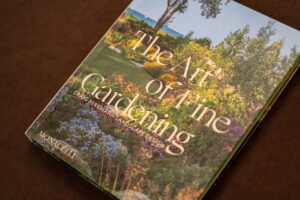
The Art of Fine Gardening: Craig Bergmann Landscape Design
Craig Bergmann and Russell Buvala presented The Art of Fine Gardening, showcasing four decades of landscape design that unites architecture and horticulture. Featuring twenty North Shore gardens—including the historic Gardens at 900—the book blends stunning photography, personal stories, and practical guidance for gardeners and design enthusiasts alike.