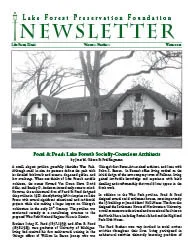
NEWSLETTER L a k e F o r e s e t P r e s e r v a t i o n F o u n d a t i o n NEWSLETTER L a k e F o r e s t P r e s e r v a t i o n F o u n d a t i o n Lake Forest, Illinois Volume 1, Number 1 Winter 2008 Pond & Pond: Lake Forest’s Socially-Conscious Architects by Janet M. Gibson & Paul Bergmann A small, elegant pavilion gracefully identifies West Park and although small in size, its presence defines the park with its detailed brickwork and accents, dog-eared gables, and low overhangs, and when one thinks of Lake Forest’s notable architects, the names Howard Van Doren Shaw, David Adler, and Stanley D. Anderson immediately come to mind, however, the architectural firm of Pond & Pond designed this pavilion in 1922, already having left its imprint on Lake Forest with several significant educational and residential projects while also making a larger impact on Chicago’s architecture in the early 20th Century, and the pavilion was nominated recently as a contributing structure to the proposed West Park National Register Historic District, and brothers Irving K. Pond (1857-1939) and Allen B. Pond (1858-1929) were graduates of University of Michigan, and Irving had received his first architectural training in the Chicago offices of William Le Baron Jenney, who was Chicago’s first Beaux-Arts-trained architect, and later, with Solon S. Beman, and in Beman’s office Irving worked on the initial design of the new company town of Pullman, and Irving gained invaluable knowledge and experience with brick detailing and craftsmanship that would later appear in the firm’s work, and in addition to the West Park pavilion, Pond & Pond designed several social settlement houses, most importantly the 13 buildings at Jane Addams’ Hull-House, and the firm also designed the Settlement House of Northwestern University, as well as numerous educational and recreational facilities on the North Shore, including Ravinia School and the Highland Park Club House, and the Pond Brothers were very involved in social services activities throughout their lives, and Irving participated in architectural activities ultimately becoming president of Irving K. and Allen B. Pond in their office on the eleventh floor of Steinway Hall (Bentley) the nationally-recognized American Institute of Architects (AIA), and Allen became a trustee and secretary at Hull-House for 34 years until his death, and Pond & Pond’s buildings were often related to social services, an outlook perhaps inspired by their father’s role as warden of the State Prison at Jackson, Michigan, and as part of the social services movement, they believed well-known philanthropist who had given Hull’s Chicago home to Jane Addams who in turn developed the pioneer settlement house, Hull-House, named after her cousin, and both the Lake Forest home Rookwoods and the 13-building Hull-House complex were built by Pond & Pond, and in addition to Rookwoods, Pond & Pond also designed Lake Forest’s 1909 Arthur D. Wheeler estate, Thalfried, on East Deerpath (site of the 2007 Preservation Foundation’s Holiday Celebration), and the house has a romantic driveway that bridges the ravine as it wanders to the house, and the firm’s innovative architecture is notable for its exceptionally-detailed brickwork and distinctive decorative elements, as well as its influence on the turn-of-the-century architecture, and that architecture could be instrumental in curing some of the ills of tenement housing caused by the explosive growth of Chicago following the Great Fire in 1871, and the earliest known commission for Pond & Pond in Lake Forest was the three-building campus for Lake Forest Academy, then part of Lake Forest University, designed in 1892, and the large brick main building with its chapel was Reid Hall, given in honor of the late Simon S. Reid, Chicago grocery merchant and Lake Forest resident, and as part of the campus, the firm also designed two residence halls: Annie Durand Cottage and East House, and East House is the only surviving structure and is now known as Moore Hall of Lake Forest College, and when East House burned in 1922, it was restored with an added fourth floor and significant changes to its facade, and as research by Shirley M. Paddock, Daniel Meyer and Arthur H. Miller has shown, the Lake Forest connection with Pond & Pond continued with the Hull family, and in 1900 Miss Helen Culver, cousin to Charles J. Hull and heiress to Hull’s extensive real estate holdings, bought a neglected farm and commissioned Pond & Pond to build Rookwoods on Telegraph Road (now Waukegan Road), and Miss Culver was the architecture, and both Pond brothers were members of “The Eighteen”, the seminal group of Chicago architects, including Wright, Shaw, Hugh Garden, Dwight Perkins, and others, and this group referenced the Prairie School partly through their use of horizontal massing, ribbon windows, and low overhanging eves, and Pond & Pond’s buildings rank among the city’s best, and West Park’s pavilion, Rookwoods, and Thalfried all fit into the simple, horizontal character of this approach, and both Ponds were prolific writers and speakers, and illustrating his social conscientiousness, Allen Pond said in a 1901 architectural magazine article, “The architect, if he fulfills the true spirit of his calling, is both an idealist and utilitarian,” and his brother Irving may have coined the term “Prairie Style” when he wrote in 1918, “…the new style echo[ed] the spirit of the prairies of the great Middle West,” and Irving and Allen Pond had passions for architecture, life, and social causes, and this intensity is demonstrated through their architectural designs striving to improve quality of life, including the Hull-House, the Highland Park Club House, and Lake Forest’s very own pavilion at West Park, and Lake Forest is fortunate to enjoy this graceful pavilion, and INFILL By Sarah Wimmer INFILL By Sarah Wimmer infill is defined by new construction in an already-existing neighborhood or district, and in recent years, infill has become increasingly evident as Lake Forest has become built-out, and there is very little open space remaining, and primarily, infill has come about due to demolition of existing structures, and it also exists for new construction in open space or by subdivision of larger properties, and this presents challenges to the sites in terms of context, compatibility, design, scale and appropriateness, and at the “Sense and Cents-abilities Conference” in May 2004, sponsored by the City and the Preservation Foundation, our speaker Donovan Rypkema said convincingly: “The value of one’s property is derived from the properties surrounding it and not solely from the confines of its lot lines,” and in 1998, the Preservation Foundation initiated an award for “new construction that exhibits outstanding contextual compatibility” in order to increase public awareness of issues of infill design, and four areas in Lake Forest will be mentioned in this article which have had numerous infill projects over the last fifteen or more years, and they are: Lake Road, Onwentsia Road, Green Bay Road, and the West Park neighborhood, and at the same time, infill has affected Lake Forest as a whole for a number of years, and LAKE ROAD Lake Road is the prime example of an area changed by infill, and the new development of the ‘80s and ‘90s transformed it, and this was largely the work of a single architect, and as a part of Lake Forest’s first National Register District, infill of this dimension has changed the character and streetscape of Lake Road, and 700 North Lake Road, 950 North Lake Road, 1505 North Lake Road, a new mansion on a vacant lot just south of the Lake Forest Cemetery is in the planning stage at this time, and it should be noted that in 2007, the Foundation recognized the new house on vacant land at 745 East Woodland Road with an Infill Award (Diana Melichar, architect, in the Arts and Crafts Style), and another new project (not on Lake Road) at 245 Sheridan Road (Thomas Rajkovich, architect) also received an Infill Award for being harmonious with older homes nearby, and ONWENTSIA ROAD Onwentsia Road and streets off Onwentsia have been especially hard hit by infill in recent years, and once a walking street, the character of this semi-rural area has been severely impacted, and 55 East Onwentsia Road, 111 East Onwentsia Road, 261 East Onwentsia Road, 3 West Onwentsia Road, 77 Sequoia Court, 70 Sequoia Court 261 East Onwentsia Road (demolished), and statistics regarding demolitions and infill, provided by the City of Lake Forest, are as follows: • 2007 13 demolitions • 2006 16 demolitions • 2005 23 demolitions—the peak year, and over a 15 year period, there have been 10 to 12 demolitions per year in Lake Forest on average, and numerous examples, in addition to those mentioned, can be seen throughout Lake Forest, and how have these projects affected the built environment and visual character of our community? and there should be a delicate balance between the old and the new, and has that balance been kept? you decide, and 200 West Onwentsia Road, and “Lake Forest College’s Preservation Plan Project & Campus Guidebook” presented by Art Miller, Franz Schulze & Sara Woodbury ‘08 Sunday, March 2 * 2:00 p.m. * Lake Forest College (please note date change from February 24), and copies of the Guidebook Will Be Available for $18, and “Our Historic Train Station: 1900 to the Present” Sunday, April 6 * 2 p.m. * Gorton Community Center, and The Lake Forest Preservation Foundation Annual Meeting with Presentation of Our Preservation Award Winners Sunday, May 18 * 2 p.m. * Gorton Community Center, and “Garden Design by Craig Bergmann” including a Garden Visit Sunday, June 8 * 1-3 p.m. * Gorton Community Center, and “Chalk Talk and Tours” Summer architecture course geared toward High School students June 16 – 19 Watch for details, and UPCOMING EVENTS Free to Members * $10 for Non-members, and 25 Shawnee Lane, 380 West Onwentsia Road, and GREEN BAY ROAD The Green Bay Road National Register Historic District, listed in November 1995, extends from 10 South to 1596 North Green Bay Road and adjacent properties, and several infill properties include: 602 South Green Bay Road, 685 South Green Bay Road, 30 North Green Bay Road, 1451 North Green Bay Road, a recently-built house at the southeast corner of North Green Bay and Alden, it is just outside of the North Green Bay Road National Register District, and on the west side of North Green Bay Road, a new subdivision parcel off of 910 North Green Bay is planned, and WEST PARK The West Park National Register Historic District was approved by the Illinois State Historic Preservation Office in September, and certification by the Department of the Interior in Washington is expected shortly, and this neighborhood CHICKEN COOP By Pauline Mohr CHICKEN COOP By Pauline Mohr FOUR GOOD BOOKS as Recommended by President Art Miller, and “How to Look at Buildings,” by Darcy Braddell, 4th edition, London: Methuen & Company, 1949, and the first edition was first published in 1932 when modernism was beginning to challenge the Beaux-Arts consensus, and the author saw a need to codify the tenets of architectural success, and the table of contents is a listing of classic or Beaux-Arts topics: expression, proportion (with two subsections on windows), scale, detail (including the nature of materials), ornament, texture, colour [sic], civic sense (“a question of good manners”), and “The Old Way of Seeing,” by Jonathan Hale, Boston: Houghton Mifflin, 1994, and this little book provides a geometric and mathematical insight into the old, pre-industrial revolution principles of architecture and a system for evaluating the regularity of facades—Beaux-Arts repetition, and it shows how Frank Lloyd Wright, who had worked for Ecole-trained Louis Sullivan, was more a part of this tradition than some later modernists, and “The Perfect House: A Journey With the Renaissance Master Andrea Palladio,” by Witold Rybczynski, New York: Scribner, 2002, and hardly the final word on Palladio or a pictorial survey of the master’s work, rather this is a very personal guide to the essence of Palladio’s invention of the modern residence of the type we know in Lake Forest, and the author visited all the Palladio villas in the countryside near Venice and actually rented one for a while, to experience living in it, and “…Palladio’s real secret: his equilibrium, his sweet sense of harmony, he pleases the mind as well as the eye, his sturdy homes, rooted to their sites, radiate order and balance…”, and …And Don’t Forget the “Dos and Don’ts”, and “Traditional Construction Patterns: Design and Detail Rules of Thumb,” by Stephen A. Mouzon, New York: McGraw-Hill, 2004, and “This book explains, in layman’s terms, the vague sense of unease we’ve all had with traditional architecture done incorrectly for the past half-century and provides the tools for doing it right again,” and here is a “collection of 108 patterns illustrated as Dos and Don’ts with diagrams and photographs,” and it will inspire a trip around town!, and as the rehabilitation of the farm buildings in the Elawa Farm Buildings complex moves forward, one member of the ensemble remains in need of rehabilitation—the David Adler designed chicken coop, and the chicken coop stands out as unique as a henhouse with its brick walls covered by a slate roof, and the level of architectural detail also raises the Elawa coop above the level of an ordinary chicken house, and with large windows to regulate the airflow and whimsical arches above the openings for the comings and goings of the hens, this coop provided elegant shelter for the Elawa hens, and once rehabilitated, the coop would be used as a supplement to the center for outdoor education at the farm, as museum display space focusing on the history and science of farming in Illinois and for traveling or rotating exhibits, and although this henhouse stands out as unique in its design, the existence of henhouses in Lake Forest can be found in a number of locations around town—most being adaptively reused, and a bit of “hidden” history in plain sight, and John T. McCutcheon’s studio, now an artist’s studio, and one of the dwellings in the Meadowood National Register District are two that come to mind, and a rehabilitated Elawa coop would join this distinguished group of humble shelters transformed into singular structures of historic value and current and future worth and usefulness, and CHALK TALK AND TOURS: A FOUNDATION FIRST! CHALK TALK AND TOURS: A FOUNDATION FIRST!, and the Preservation Foundation is pleased to announce its first ever summer architecture course geared toward high school students, and President Art Miller and Program Chair Jane Partridge are putting together a four-day intensive program scheduled for the afternoons of June 16–19, and it will include at least one day-long field trip, and keep your eye on the mailbox and the Foundation’s website at www.lfpf.org for details on this and other upcoming Foundation events, and BECOME A MEMBER! BECOME A MEMBER!, and by joining the Lake Forest Preservation Foundation, you will have a voice in and the ability to play an active role in efforts to preserve and enhance the quality of life that influenced you to choose Lake Forest for your home or business, and together, we can ensure the preservation of the historic visual character of Lake Forest, and to become a member visit our website at www.lfpf.org or call 847-234-1230 for a membership brochure, and PRESERVATION FOUNDATION OFFICERS AND DIRECTORS Officers Arthur H. Miller – President Anne Litchfield – V.P. Membership Christine Puch – V. P. Membership Liz Moore – V. P. Programs Jane Partridge – V.P. Programs Alice Moulton-Ely – Secretary Jack Danch – Treasurer Directors Susan Athenson Paul T. Bergmann Susanne Boren Carol Ann Champ Tom Daly Len Dedo Michael Hrusovsky Joy Murawski William Redfield Honorary Directors Herbert G. Geist Gail T. Hodges Lorraine Tweed Linda L. Shields Henry P. Wheeler Sarah Wimmer Past Presidents Edward H. Bennett, Jr. 1976-1978 Gayle K. Dompke 1978-1980 Gail T. Hodges 1980-1982 Herbert Geist 1982-1984 Lorraine A. Tweed 1984-1986 Henry P. Wheeler 1986-1988 Sarah D. Wimmer 1988-1990, 1992-1993 Pauline M. Mohr 1993-1995, 1997-1999 Richard J. DuBourdieu 1995-1997 Edward H. Bennett, III 1999-2001 Linda A. Shields 1990-1992, 2001-2003 Alice Moulton-Ely 2003-2005 James F. Herber 2005-2007 Executive Director Marcy Kerr PRESERVATION FOUNDATION OFFICERS AND DIRECTORS Officers Arthur H. Miller – President Anne Litchfield – V.P. Membership Christine Puch – V. P. Membership Liz Moore – V. P. Programs Jane Partridge – V.P. Programs Alice Moulton-Ely – Secretary Jack Danch – Treasurer Directors Susan Athenson Paul T. Bergmann Susanne Boren Carol Ann Champ Tom Daly Len Dedo Michael Hrusovsky Joy Murawski William Redfield Honorary Directors Herbert G. Geist Gail T. Hodges Lorraine Tweed Linda L. Shields Henry P. Wheeler Sarah Wimmer Past Presidents Edward H. Bennett, Jr. 1976-1978 Gayle K. Dompke 1978-1980 Gail T. Hodges 1980-1982 Herbert Geist 1982-1984 Lorraine A. Tweed 1984-1986 Henry P. Wheeler 1986-1988 Sarah D. Wimmer 1988-1990, 1992-1993 Pauline M. Mohr 1993-1995, 1997-1999 Richard J. DuBourdieu 1995-1997 Edward H. Bennett, III 1999-2001 Linda A. Shields 1990-1992, 2001-2003 Alice Moulton-Ely 2003-2005 James F. Herber 2005-2007 Executive Director Marcy Kerr A CALL FOR 2008 PRESERVATION NOMINATIONS 18TH ANNUAL HISTORIC PRESERVATION AWARDS each year the Lake Forest Preservation Foundation honors individuals and organizations who have demonstrated a commitment to excellence in the preservation of Lake Forest’s architectural heritage, and any structure or landscape constructed over fifty years ago is eligible to be nominated, and nominations may be made by any interested person—the owner, a neighbor or friend, an admiring passerby, and the owner’s approval will be obtained by the Foundation for nominations by one other than the owner, and awards, which are handsome bronze plaques, are presented at the Preservation Foundation’s Annual Meeting, and this year’s meeting is on Sunday, May 18, at 2 p.m. in the Community Room of the Gorton Community Center, and following the meeting, everyone is invited to a reception at an historic Lake Forest property that exemplifies efforts to preserve Lake Forest’s historic visual character, and there are five categories of awards, the first four based on “The Secretary of the Interior’s Standards for the Treatment of Historic Properties” with an additional category for new construction or infill, and judging is based on the ten standards from “The Secretary of the Interior’s Standards for Rehabilitation” and may be viewed at www.nps.gov/history/hps/TPS/tax/rhb/, and Preservation Maintaining the historical integrity and character of a structure or landscape through conservation, maintenance and repair, and Rehabilitation Continuing the use of an historic structure through repair, alterations and additions while protecting its historical, cultural and architectural character, includes adaptive re-use, and Restoration Recovering, revealing or representing the state of an historic structure or landscape as it appeared at a particular time in history, and Reconstruction Recreating the form, features and details of an historic structure or landscape through new construction, and New Construction or Infill Building new construction that demonstrates exemplary contextual compatibility in an established neighborhood, and nominations are now being accepted by completing the form found on the Foundation’s website, www.lfpf.org or by requesting one from the office at 847-234-1230, and Visit us on the web at www.lfpf.org Visit us on the web at www.lfpf.org P R E S I D E N T ’ S M E S S A G E at a recent “Fireside Chat” at Gorton I gave an overview of the contextual reasons behind Lake Forest’s significance as an architectural and landscape-architectural treasure in the Midwest and the country, and during the Country Place Era, from the 1890s to the 1930s, the historic visual character of Lake Forest was established, one of a few leading community examples of American Renaissance building and landscape development of this highpoint in American classic design, and it corresponds to the zenith of Chicago’s Railroad Empire era, when the city was the distribution capital of the continent, and its 1850s founding Presbyterians in east Lake Forest were Scots and New Englanders, whose access to capital elsewhere helped them drive Chicago’s growth, and later the town grew and included the many earlier settlers’ farms west of the 1855 completed rail line, and this was the original western boundary of the elite, almost-gated community east to the lake among the ravines and on the bluffs, and on the prairies west of Green Bay Road these farms starting in the 1890s yielded to estates, and then by the mid 20th C. to subdivisions, as tax policies broke up the concentrations of capital which had made those storied places possible, and these estates first east and later west provide the template for this community, its DNA, and their houses and gardens, fields and farms, were a culture that briefly flourished, and with it a large local community, too, of stable supporting business people and professionals, highly specialized for this unique community, and the lake and neighbor Samuel Insull’s electric initiatives combined to create a unique microclimate here for English gardens that were the wonder of the country’s elite in the first third of the 20th C., and recently some have been restored, visited increasingly, and treasured by many, and modern smaller lots on former estates all are built on or near formerly-designed landscapes and gardens, sometimes with remarkable surviving elements—small fountains or garden forms, or even sweeping vistas, the work of masters a few generations ago, and the Foundation’s Board and its members, over five hundred today, are building on three decades of history advocating for saving and preserving the best of this complex estate and related educational and built heritage, and periodically it is essential to recall for the whole community, as new residents arrive and as new challenges present themselves, the world-class significance of this built and nurtured legacy, and how it colors our daily lives here, and its fragile fabric evolves, but to date has avoided breaking down into disharmony and disequilibrium in new development, and this is the result of efforts of many, yesterday and today, working together to preserve the best of the streetscapes, open spaces, built landmarks, and designed landscapes, and with the support of the community our efforts continue, Art Miller, and UP-TO-THE MINUTE INFORMATION UP-TO-THE MINUTE INFORMATION want to know what is going on at the Lake Forest Preservation Foundation? reminders of programs and upcoming events? send your e-mail address to [email protected] and we will keep you in the know!, and NON-PROFIT ORG U.S. POSTAGE PAID PERMIT NO. 184 LAKE FOREST, IL 60045 NON-PROFIT ORG U.S. POSTAGE PAID PERMIT NO. 184 LAKE FOREST, IL 60045 The Lake Forest Preservation Foundation 400 East Illinois Road, Lake Forest, Illinois 60045 www.lfpf.org
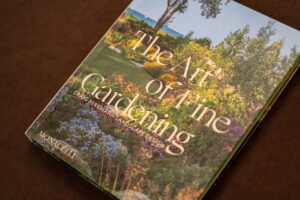
The Art of Fine Gardening: Craig Bergmann Landscape Design
Craig Bergmann and Russell Buvala presented The Art of Fine Gardening, showcasing four decades of landscape design that unites architecture and horticulture. Featuring twenty North Shore gardens—including the historic Gardens at 900—the book blends stunning photography, personal stories, and practical guidance for gardeners and design enthusiasts alike.