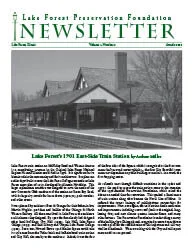
NEWSLETTER L a k e F o r e s t P r e s e r v a t i o n F o u n d a t i o n NEWSLETTER L a k e F o r e s t P r e s e r v a t i o n F o u n d a t i o n Lake Forest, Illinois Volume 1, Number 2 Awards 2008 Lake Forest’s 1901 East-Side Train Station by Arthur Miller Lake Forest’s train station on McKinley Road and Western Avenue is a contributing structure in the Original Lake Forest National Register Historic District established in 1976, it is significant for its historic role in the community and for its architecture, it replaces an earlier depot built to serve the Lake Forest College-centered east Lake Forest street plan of 1857, developed by Almerin Hotchkiss, this larger replacement structure was designed to serve the needs of the new Onwentsia Club southwest of the station on Green Bay Road, with its large city crowds for horse shows (1900-70), polo matches, and other events, it was planned by architects Frost & Granger for their father-in-law, Marvin Hughitt, president and builder of the Chicago & North Western Railway, all three men lived in Lake Forest, the architects each in homes they designed, by 1900 the firm already had designed other local buildings: City Hall (1899), Lois Hall, Lake Forest College (1899), and Reid Library and Chapel, Lake Forest College (1900), soon, too, Howard Shaw’s 1916 Market Square would take its style cues from the Tudor brick and half-timbered train station and City Hall, also nearby to the southwest, indeed, it was the first of the four sides of the Square, which is recognized as the first town center built around motor vehicles – the first City Beautiful town center not dependent on public buildings as anchors…in a word, the first shopping center, as railroads went through difficult transitions in the 1960s and 1970s, the need to restore the train station came to the attention of the 1976-founded Preservation Foundation, which raised the $400,000 needed then for renovation, this sparked a Renaissance of train stations along what became the North Line of Metra, it reflected the town’s heritage of public/private partnerships for improvements, now, once again, the train station needs restoration and improvements, including a new roof (back to the original, long-lasting slate) and new climate systems, interior floors, and many other features, the Preservation Foundation is undertaking a survey of the building by a Chicago-based, recognized preservation architect to craft a plan for the rehabilitation of this important and still very vital local landmark, we are working with the City and will report more on this as we proceed, H I S T O R I C P R E S E R V AT I O N A W A R D S 2008 marks the 18th consecutive year of the Foundation’s Historic Preservation Awards program, this year there was an extraordinary number of exceptional entries, of which eleven received awards at the May 18 Annual Meeting, since the beginning of the program in 1991, 135 awards have been presented to recognize those who help preserve the historic visual character of Lake Forest through the preservation of historic structures, the restoration of historic landscapes and the construction of new homes in established neighborhoods, the award plaque is bronze with an inscription of the award category and year, and can be seen on award winning structures throughout Lake Forest, a list of all previous awardees will be added to the Foundation’s web site this year, H I S T O R I C P R E S E R V AT I O N A W A R D S 2008 marks the 18th consecutive year of the Foundation’s Historic Preservation Awards program, this year there was an extraordinary number of exceptional entries, of which eleven received awards at the May 18 Annual Meeting, since the beginning of the program in 1991, 135 awards have been presented to recognize those who help preserve the historic visual character of Lake Forest through the preservation of historic structures, the restoration of historic landscapes and the construction of new homes in established neighborhoods, the award plaque is bronze with an inscription of the award category and year, and can be seen on award winning structures throughout Lake Forest, a list of all previous awardees will be added to the Foundation’s web site this year, 2008 Historic Preservation Award Winners 621 East College Road – Rehabilitation 621 East College Road – RehabilitationAlport, has restored the original butler’s cottage and converted This Art and Crafts house was built in 1902 for Mr. Cornelius Trowbridge, a silver company merchant, and designed by noted architects Frost and Granger who were both graduates of the Massachusetts Institute of Technology, their work is significant to the history and development of Lake Forest as well as Chicago, with projects that included the LaSalle Street Station, the home has been meticulously preserved by the current owners, Mr. and Mrs. George Hender, a recent project included the restoration of the front entry, 565 East Deerpath – Rehabilitation 565 East Deerpath – Rehabilitation Built in 1909 by the architectural firm of Pond and Pond, the Thalfried estate was designed for Mr. and Mrs. Arthur D. Wheeler, Mr. Wheeler was among the first sixteen graduates of Lake Forest College and had a key role in the Chicago law firm that eventually became known as Sidley and Austin, situated on 2 ½ acres of land across a private wooden bridge, Thalfried (German for “peaceful valley”) was influenced by the English Arts & Crafts style, the diamond muntin patterns in the windows and porch balustradings are found in other buildings by Pond & Pond as well, formal gardens, lush landscape, and a deep ravine surround the rectilinear design, the current owners, Mr. and Mrs. Joseph Tripodi, rehabilitated the home in keeping with the original character and design, the architect was the firm of Melichar Architects and the builder, Demari Homes, 250 North Western Avenue – Rehabilitation 250 North Western Avenue – Rehabilitation This 3500 square foot residence was completed in 1935 by David Adler for the Mrs. J. Ogden Armour estate as one of the gate houses, evidence of Adler’s touch on the design is seen throughout the building details and forms, the current owner, Mr. Howard the adjacent five-car garage into a dining room, family room, and master suite, an octagonal addition links the garage with the cottage, exterior trim profiles and Ludovici terra cotta roofing were matched to the originals, the project was completed by architect Garret Eakin, 670 Rosemary Road – Rehabilitation 670 Rosemary Road – Rehabilitation Six previous alterations to Mr. and Mrs. Richard Johnsen’s home were repaired and untangled on this clapboard and painted brick Cape Cod built in 1948, aluminum siding was replaced with clapboard, aluminum gutters and downspouts with copper, and asphalt shingles were replaced with cedar, Greek Revival detail was added to the front façade, and natural stone and clay brick patios were added to replace a wood deck, the result is a beautifully rehabilitated home that enhances the visual character of the Rosemary Road neighborhood, 350 Circle Lane – Rehabilitation, Adaptive Re-use 350 Circle Lane – Rehabilitation, Adaptive Re-use Mr. and Mrs. Jerry Evoniuk rehabilitated the remains of one of four ravine-spanning bridges on the former grounds of the Cyrus H. McCormick, Jr. estate, Walden, three of the bridges still exist, two are on Walden Lane and the third and largest is the Walden~Bluff’s Edge Bridge, saved from demolition and restored with funds raised by the Preservation Foundation in 1998, although this fourth bridge was deteriorated and razed in the 1950s, the limestone abutments and bridge approach remained hidden beneath decades of overgrowth in the Evoniuks’yard, working with Wiss Janney Elstner Associates, the engineering firm responsible for rehabilitating the other three bridges, and Lester’s Material Services, 30 to 50 tons of limestone were removed andreassembledtoreturnthestructuretoitsoriginalconditionasclosely as possible, the former bridge approach is now an enchanting paver patio ontheedgeofthe. ravine, terminated byarowof concrete balusters identical to those on the sides of the restored Walden Lane bridges, 1358 Edgewood Road – Infill 1358 Edgewood Road – Infill This new house was built in the Edgewood Road neighborhood by Mr. and Mrs. Grant Farrell and designed to fit in beautifully with its neighbors, it has the appearance of a rehabilitated 100 year old home, and few would think otherwise, the architect, Streightiff and Associates, added details appropriate for the appearance of a vintage home, including clapboard siding, painted lattice beneath the porch, and an open balustered porch railing, 614 East Spruce Avenue – Preservation 614 East Spruce Avenue – Preservation The home of Mr. and Mrs. Thomas Bernardin was designed in the style of an English cottage, Argyllshire was built in 1895 for Cyrus McCormick III, grandson of Cyrus Hall McCormick (inventor of the reaper), one of several McCormicks to settle in Lake Forest, the walls are half-timbered, and the wood shingles have been applied to the roof to resemble thatching, the entrance faces west and is marked by a gable and small projecting porch, during WWII, this house was used as a residence for WAVES, it is a beautifully preserved example of one of the classic estates in Lake Forest, 2 North Ahwahnee Road – Preservation 2 North Ahwahnee Road – Preservation In 1912, 9 ½ acres of the former Louis F. Swift 1500 acre estate were sold to Harold J. Bryant, a member of the new Onwentsia Club, he married Elizabeth Parker in 1913 who was the sister of A. Watson Armour’s wife, in 1914, the Bryants retained Schmidt, Garden and Martin to design and build this Prairie School residence, in 1924, they sold it to a prominent Chicago attorney who lived there through the mid-1950s, in 2004, Mr. and Mrs. Wayne Sorensen purchased the property and returned it to the original design by retaining the original gardens and adding complimentary landscape additions, 1450 West Old Mill Road – Preservation 1450 West Old Mill Road – Preservation Currently the residence of Frank Ponterio, this house was originally a staff cottage and one of twenty-six outbuildings on the 480 acre Albert Lasker Estate, David Adler, master architect of the late Country Place Era, designed the entire project in the 1920s, it was originally bounded by Everett Road on the north, Telegraph Road on the east, Old Mill Road on the south, and extended to about 200 feet west of the Tollway, the original structure is very well preserved, 621 East Ryan Place – Preservation 621 East Ryan Place – Preservation This house was built in the 1910s as a wedding gift for Ellen Crane, sister of Ed Boobyer Jr., who grew up and lived next door at 89 N. Washington Road until his passing at age 97 circa 1997, Ed Boobyer Sr. worked as chauffeur and gardener for Edward L. Ryerson at “Havenwood,” a few blocks east, he contracted builder Martin Jensen to build the one storey house in the back yard of his own home on Washington Road, the well-preserved residence is a unique example of a home built for families who maintained the large estates in Lake Forest and were able to construct smaller homes of their own, Kimberly Tunney, the present owner, purchased the home in 1988 and has preserved it in keeping with its pre-WWI cottage-like appearance through landscaping and exterior projects, Lake Forest Log Cabin, Crab Tree Farm – Preservation Lake Forest Log Cabin, Crab Tree Farm – Preservation Dating from the mid-19th Century, this log house may have served as an early school or church, from around 1910 on, it was located at 297 Mills Court, hidden beneath clapboard siding, perhaps two coverings from the 1850s and the 1910s, multiple reports, including that of Foundation member Shirley M. Paddock who knew the long-time owner who had moved it to Mills Court, placed its origins west of the railroad tracks, rescued from demolition, the cabin has been restored by noted preservationist and owner of Crab Tree Farm John Bryan and his team of conservationists, it is located in a section of Crab Tree Farm that is amazingly rural in character and noted for being the last lakefront working farm in Illinois, “Garden Design by Craig Bergmann” A presentation by Craig Bergmann begins at Gorton followed by a visit to a beautiful local garden Sunday, June 8 1-3 p.m. Gorton Community Center “Chalk Talk and Tours” Summer architecture course geared toward High School Students Why is architecture so important? The Preservation Foundation is pleased to announce its first summer study of architecture course geared toward High School students, LFPF President Art Miller and Program Chair Jane Partridge are putting together a four day intensive program, call the Foundation at 847-234-1230 or Jane Partridge at 847-234-1247 for dates and details.. “The City Beautiful” Mark your calendars for September 25, 7:30 pm, Carl Smith, author of “The Plan of Chicago,” will set the stage for our 2008-2009 programs on The City Beautiful and City Planning, celebrating the 100th anniversary of Daniel Burnham’s 1909 Chicago Plan, learn about important connections with Lake Forest then and now, UPCOMING EVENTS Free to Members * $10 for Non-members “Garden Design by Craig Bergmann” A presentation by Craig Bergmann begins at Gorton followed by a visit to a beautiful local garden Sunday, June 8 1-3 p.m. Gorton Community Center “Chalk Talk and Tours” Summer architecture course geared toward High School Students Why is architecture so important? The Preservation Foundation is pleased to announce its first summer study of architecture course geared toward High School students, LFPF President Art Miller and Program Chair Jane Partridge are putting together a four day intensive program, call the Foundation at 847-234-1230 or Jane Partridge at 847-234-1247 for dates and details.. “The City Beautiful” Mark your calendars for September 25, 7:30 pm, Carl Smith, author of “The Plan of Chicago,” will set the stage for our 2008-2009 programs on The City Beautiful and City Planning, celebrating the 100th anniversary of Daniel Burnham’s 1909 Chicago Plan, learn about important connections with Lake Forest then and now, UPCOMING EVENTS Free to Members * $10 for Non-membersRECOMMENDED BOOKS “The Seven Lamps of Architecture,” by John Ruskin (London, 1849), a compilation of lectures on architecture, later printings and editions were widely held in local private libraries, including that of Howard Shaw, available from the Lake Forest Bookstore, quote from chapter “The Lamp of Memory:” “…[I]t is…no question of expediency or feeling whether we shall preserve the buildings of past times or not, we have no right whatever to touch them, they are not ours, they belong to all the generations of mankind who are to follow us, the dead have still their right in them: that which they laboured for, the praise of achievement or the expression of religious feeling, or whatever else it might be which in those buildings they intended to be permanent, we have no right to obliterate, what we ourselves built, we are at liberty to throw down; but what other [persons] gave their strength and wealth and life to accomplish, their right over does not pass away with their death… By joining the Lake Forest Preservation Foundation, you will have a voice in and the ability to play an active role in efforts to preserve and enhance the quality of life that influenced you to choose Lake Forest for your home or business, together, we can ensure the preservation of the historic visual character of Lake Forest, to become a member visit our website at www.lfpf.org or call 847-234-1230 for a membership brochure, BECOME A MEMBER! By joining the Lake Forest Preservation Foundation, you will have a voice in and the ability to play an active role in efforts to preserve and enhance the quality of life that influenced you to choose Lake Forest for your home or business, together, we can ensure the preservation of the historic visual character of Lake Forest, to become a member visit our website at www.lfpf.org or call 847-234-1230 for a membership brochure, BECOME A MEMBER!Neither does any building whatever belong to those mobs who do violence to it, for a mob it is, and must be always: it matters not whether enraged, or in deliberate folly; whether countless, or sitting in committees: the people who destroy anything causelessly are a mob, and Architecture is always destroyed causelessly. “ “A Building History of Northern New England,” by James The Foundation spent a beautiful morning in May giving the 2nd graders from Cherokee a hands-on history lesson about the origin, construction and preservation of the log cabin at Crab Tree Farm as part of their study unit on pioneers, CHEROKEE SCHOOL 2ND GRADERS VISIT THE LOG CABIN AT CRAB TREE FARM The Foundation spent a beautiful morning in May giving the 2nd graders from Cherokee a hands-on history lesson about the origin, construction and preservation of the log cabin at Crab Tree Farm as part of their study unit on pioneers, CHEROKEE SCHOOL 2ND GRADERS VISIT THE LOG CABIN AT CRAB TREE FARML. Garvin, Hanover and London: University Press of New England, 2001, don’t be misled by the title, this book will appeal to homeowners in any region, particularly those beginning the restoration process, included are in-depth discussions of materials and guidelines on how to date them, it offers answers to questions that most perplex architects and preservationists and is generously illustrated, from the book: “Whether you love or merely tolerate your old house, it is well to approach the building with one truth firmly in mind, human life is short, the life of a house is potentially limitless, even in the youthful United States, we have houses that have been sheltering families for three hundred years or more, barring disaster or imprudent neglect, your house is destined to outlive you, you are but one in a long line of custodians of the property—a line that extends backward through the decades or centuries and forward to an indefinite future, that being the case, let the changes you make to your property be additive rather than subtractive in nature, if you need a new kitchen or bathroom or furnace, install it, but wherever possible, install it in such a way as to preserve the original features or fabric…Try to make your work add to the legacy of the past so that you can pass on a dwelling of even greater value and comfort to the future, remember that the number of old houses is finite, and diminishes each year, it is a privilege and responsibility to own a piece of the past.” “I LEARN SOMETHING NEW EVERY DAY” Those are the words of Marcy Kerr–the Foundation’s first-ever Executive Director, she started as Office Manager a year ago and was recently voted by the Board to head up the day-to-day operations, Marcy has always loved architecture and lived in a number of communities besides Lake Forest boasting world-class design, her background is in marketing and her interests revolve around education and the arts, locally, she’s played dedicated roles in events associated with School Districts 67 and 115, the Gorton Community Center, CROYA and Infant Welfare, until recent years all the work of the Foundation has been carried out by Board members and when appropriate, with the assistance of volunteers from our membership, it has been a long-term goal of the Foundation to maintain continuity in its operations under the watchful eye of a professional director, we have found that in Marcy, her organizational skills, sound advice and steady demeanor have provided top-notch leadership, we are fortunate to have her, UP-TO-THE MINUTE INFORMATION Want to know what is going on at the Lake Forest Preservation Foundation? Reminders of programs and upcoming events? Send your e-mail address to [email protected] and we will keep you in the know! WELCOME NEW BOARD DIRECTORS The Lake Forest Preservation Foundation would like to welcome our newly elected Directors, as members of the Class of 2011, they bring a variety of talents to the Board and we look forward to working with them, they are: Gail Hodges, Patty Kreischer, Cynthia Leahy, Pauline Mohr, Shirley Paddock, Camille Stohlgren and filling an unexpired term, Joy Murawski, Class of 2010, we also would like to thank the Directors whose terms expired, we appreciate the time and expertise they put into the Foundation, Paul Bergmann, Carol Ann Champ, Anne Litchfield, and Alice Moulton-Ely will be missed, a reception to honor our new and departing Directors and Preservation Award winners was held after our annual meeting at “Linden Lodge,” this beautiful, historic home of Cindy and Jeff Long was designed by Frost and Granger and built in 1903 for Henry Calvin Durand, WELCOME NEW BOARD DIRECTORS The Lake Forest Preservation Foundation would like to welcome our newly elected Directors, as members of the Class of 2011, they bring a variety of talents to the Board and we look forward to working with them, they are: Gail Hodges, Patty Kreischer, Cynthia Leahy, Pauline Mohr, Shirley Paddock, Camille Stohlgren and filling an unexpired term, Joy Murawski, Class of 2010, we also would like to thank the Directors whose terms expired, we appreciate the time and expertise they put into the Foundation, Paul Bergmann, Carol Ann Champ, Anne Litchfield, and Alice Moulton-Ely will be missed, a reception to honor our new and departing Directors and Preservation Award winners was held after our annual meeting at “Linden Lodge,” this beautiful, historic home of Cindy and Jeff Long was designed by Frost and Granger and built in 1903 for Henry Calvin Durand, PRESERVATION FOUNDATION OFFICERS AND DIRECTORS Officers Arthur H. Miller – President Christine Puch – V.P. Membership Liz Moore – V.P. Programs Jane Partridge – V.P. Programs Tom Daly – Secretary Len Dedo – Treasurer Directors Susan Athenson Susanne Boren Jack Danch Len Dedo Gail Hodges Michael Hrusovsky Patty Kreischer Cynthia Leahy Pauline Mohr Joy Murawski Shirley Paddock William Redfield Camille Stohlgren Honorary Directors Herbert G. Geist Gail T. Hodges Lorriane Tweed Linda L. Shields Henry P. Wheeler Sarah Wimmer Past Presidents Edward H. Bennett, Jr. 1976-1978 Gayle K. Dompke 1978-1980 Gail T. Hodges 1980-1982 Herbert Geist 1982-1984 Lorraine A. Tweed 1984-1986 Henry P. Wheeler 1986-1988 Sarah D. Wimmer 1988-1990, 1992-1993 Linda A. Shields 1990-1992, 2001-2003 Pauline M. Mohr 1993-1995, 1997-1999 Richard J. DuBourdieu 1995-1997 Edward H. Bennett, III 1999-2001 Alice Moulton-Ely 2003-2005 James F. Herber 2005-2007 Executive Director Marcy Kerr PRESERVATION FOUNDATION OFFICERS AND DIRECTORS Officers Arthur H. Miller – President Christine Puch – V.P. Membership Liz Moore – V.P. Programs Jane Partridge – V.P. Programs Tom Daly – Secretary Len Dedo – Treasurer Directors Susan Athenson Susanne Boren Jack Danch Len Dedo Gail Hodges Michael Hrusovsky Patty Kreischer Cynthia Leahy Pauline Mohr Joy Murawski Shirley Paddock William Redfield Camille Stohlgren Honorary Directors Herbert G. Geist Gail T. Hodges Lorriane Tweed Linda L. Shields Henry P. Wheeler Sarah Wimmer Past Presidents Edward H. Bennett, Jr. 1976-1978 Gayle K. Dompke 1978-1980 Gail T. Hodges 1980-1982 Herbert Geist 1982-1984 Lorraine A. Tweed 1984-1986 Henry P. Wheeler 1986-1988 Sarah D. Wimmer 1988-1990, 1992-1993 Linda A. Shields 1990-1992, 2001-2003 Pauline M. Mohr 1993-1995, 1997-1999 Richard J. DuBourdieu 1995-1997 Edward H. Bennett, III 1999-2001 Alice Moulton-Ely 2003-2005 James F. Herber 2005-2007 Executive Director Marcy KerrVisit us on the web at www.lfpf.org P R E S I D E N T ’ S M E S S A G E Perhaps Lake Forest’s best preservation effort to date has been Ragdale, the 1898 estate of architect Howard Van Doren Shaw, located at 1230-60 North Green Bay Road, it was named by the Illinois Chapter of the American Institute of Architects in August 2007 as one of Illinois’ one hundred and fifty Great Places, the AIA saw these as the “best of the best” and as “uniquely contributing to their community’s quality of life,” according to Meredith Eastburn writing in the Ragdale Foundation Newsletter (Number 42, Winter 2008, p. 8).*, founded in the mid-1970s, Ragdale became City property in the 1980s, and by the 1990s began its steady improvement in stewardship and accomplishment, especially with the founding of the Friends of Ragdale, in a community blessed by notable educational institutions, elegant homes, distinguished clubs and, of course, Market Square, how did Ragdale come to stand out? One good clue to this success appeared in a 1994 book by William Shopsin, AIA, entitled Preserving American Mansions and Estates (McGraw-Hill), out of seventy places discussed and three in Illinois, Ragdale was the only Illinois estate not by Frank Lloyd Wright, besides Ragdale, Shopsin discussed the Dana-Thomas house in Springfield, saved with governor-led state largesse, and the Robie House, then languishing in the shaky hands of the University of Chicago, Howard Shaw’s Ragdale, though, was thriving by the early 1990s due to a partnership approach among the City of Lake Forest, Lake Forest Open Lands, the Ragdale Foundation, and the Shaw family, soon after this book was published, the University of Chicago struck up a partnership with the F.L. Wright Home and Studio Foundation, Oak Park, and the National Trust, to preserve the Robie House, now undergoing thorough preservation efforts, Lake Forest’s Ragdale, though, with the City, Open Lands and the family, had pointed the way for the University! And we know, of course, that Ragdale is not the City’s only successful preservation partnership, but one of many, others include the Gorton Community Center, with the Friends of Gorton and many not-for-profit tenants (like the Preservation Foundation), and the Ridge Farm or Grove School complex that houses the Senior Center and the Lake Forest Symphony, as we look forward to the City partnering with the Preservation Foundation and private, for-profit tenants at the 1900 train station, to preserve and restore it, we will be looking to these past models of success locally, how they have worked and thrived, and which have gained widespread recognition for the City and the community, we are eager to learn from our successes, *More such sites can be seen at www.illinoisgreatplaces.com Gratefully, Art Miller NON-PROFIT ORG U.S. POSTAGE PAID PERMIT NO. 184 LAKE FOREST, IL 60045 NON-PROFIT ORG U.S. POSTAGE PAID PERMIT NO. 184 LAKE FOREST, IL 60045The Lake Forest Preservation Foundation 400 East Illinois Road, Lake Forest, Illinois 60045 www.lfpf.org
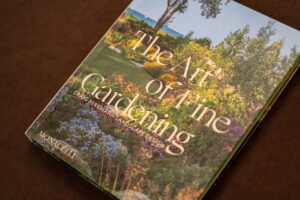
The Art of Fine Gardening: Craig Bergmann Landscape Design
Craig Bergmann and Russell Buvala presented The Art of Fine Gardening, showcasing four decades of landscape design that unites architecture and horticulture. Featuring twenty North Shore gardens—including the historic Gardens at 900—the book blends stunning photography, personal stories, and practical guidance for gardeners and design enthusiasts alike.