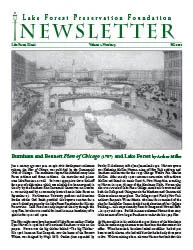
NEWSLETTER L a k e F o r e s t P r e s e r v a t i o n F o u n d a t i o n NEWSLETTER L a k e F o r e s t P r e s e r v a t i o n F o u n d a t i o n Lake Forest, Illinois Volume 1, Number 3 Fall 2008 Burnham and Bennett Plan of Chicago (1909) and Lake Forest by Arthur Miller Just a century ago next year, an epic civic development milestone volume, the Plan of Chicago, was published by the Commercial Club of Chicago, the committee responsible included many Lake Forest residents and future residents; the co-author and printer were Lake Foresters, as well, so it was appropriate that a kick-off for a year of celebrations, which was scheduled to be announced in the city by the Burnham Plan Centennial Committee on October 2, was anticipated by a community lecture here in Lake Forest on September 25, Northwestern University professor and American Studies scholar Carl Smith provided this keynote occasion for a year of related programs by the Lake Forest Foundation for Historic Preservation, Lake Forest not only impacted the city through this 1909 Plan, but also was a model for it and in turn, a beneficiary of its spirit in the 1910s and 1920s, the Plan might never have happened if Lake Forest resident Charles Dyer Norton in 1906 had not convinced Burnham to take on the project, Norton was the big thinker behind “The Big Thinker,” his 1906 home on East Deerpath, now the home of the Emmett Whites, was designed by Hugh M.G. Garden (later expanded by Stanley D. Anderson) with a Jens Jensen landscape, Norton’s spouse was Katherine McKim Norton, niece of New York architect and Burnham collaborator for the 1893 Chicago World’s Fair, Charles McKim, after an early 1900s summer conversation with architect McKim and friends in scenic Cornish, New Hampshire, according to Norton in 1922 (history of the Merchants Club), Norton who also was a trustee of Lake Forest College, came back to town and led both the College and Chicagoans in the Merchants and Commercial Clubs to take on major plans, the College’s 1906 Plan by New York architect Benjamin Wistar Morris, who later first conceived of the plan for Rockefeller Center, decided on the location of four College buildings – still campus icons by Frost & Granger and Howard Shaw – in 1907 and 1908, but life insurance salesman Norton’s best story is his account of how he got Burnham to undertake his 1909 Plan, as Norton tells it in his article in the 1922 history of the Merchants Club, he made an appointment to see Burnham one afternoon at his office, when he arrived, Burnham looked crestfallen: he had just been to see his doctor, who had told him that he had only three years to live, without missing a beat, salesman Norton shot back that this was a great coincidence: he was here representing the Merchants Club to ask Burnham to take on a three-year project: a plan for Chicago! the great architect perked up at the notion, and said he would do it, Paul Starrett, a colleague of Burnham’s and Lake Forest College alumnus, would recall “being moved by Burnham’s frequent admonition: ‘Make no little plans; they have no magic to stir men’s blood.’” (Larson, Devil in the White City, p. 26, from Starrett, Changing Daniel H. Burnham Daniel H. Burnhamthe Skyline…, p. 311) the Plan was published in 1909 and Burnham lived six, not just three, more years, Norton himself left Lake Forest and Chicago in 1909 to be private secretary (chief of staff ) to President William Howard Taft, and later moved to New York, but the great Plan, long after alum and Ryerson Steel executive Clyde Carr, who also built his home in Lake Forest in 1916, and who took on the challenging job of convincing the residents of Pine Street north of the Chicago River to allow their thoroughfare to be linked up with Michigan Avenue up to the lakefront near Oak Street, he convinced them to let Bennett build the two-level bridge across the river making the hook-up, and created what we know as the Magnificent Mile, before the bridge was complete in 1920, already the Wrigley Building and the Fourth Presbyterian Church, in 1914, and the Drake Hotel, 1919, signaled the stellar future of this internationally-known promenade, and a good deal of the Plan’s success comes from its beautiful physical form, the stunning limited-edition, large-scale bound volume, on thick paper, of handsome plans and striking color renderings by Jules Guerin and others, all the product of R.R. Donnelley & Sons, this company was led by future (1911) Lake Forest resident, T.E. Donnelley, father of future Lake Forest mayor Elliott Donnelley (1960s), also Lake Forest College’s board chair subsequently and responsible for much of the planned development of the campus in the 1960s, like several descendants of T.E. both men had left Chicago, lives on as a testament to their vision, sales ability, and management skills during 1906 to 1909, the Chicago iconic lake front and central city river front, focused on Grant Park now home to the Field Museum, the Art Institute, and today Millennium Park along with the Magnificent Mile of North Michigan Avenue, all are legacies of this intense three-year period of leadership, collaboration, and creativity, led in much of the professional work on the Plan by Burnham’s young associate Edward H. Bennett, a Paris trained Englishman, the book was a rallying call for civic development across the country, “Make no little plans; they have no magic to stir men’s blood and probably themselves will not be realized, make big plans; aim high in hope and work, remembering that a noble, logical diagram once recorded will never die, but long after we are gone will be a living thing, asserting itself with ever-growing insistency.” Daniel Hudson Burnham (attributed to him by Charles Moore in his 1921 biography of Burnham, Volume 2, page 147) Donnelley still active in Lake Forest, many other current residents are descendants of Commercial Club (combined with the Merchants Club in 1907) Plan subscribers, they are listed at the beginning of the landmark 1909 volume printed by Donnelley, and also more widely available in a modern reprint edition, these descendants have been active in the Lake Forest Garden Club, the Preservation Foundation, and Lake Forest Open Lands and on City boards, commissions, and the City Council, they in turn have trained and inspired others here, the Plan’s legacy in Lake Forest is not just built but also working to continue this heritage in town and in the Bennett himself, with Burnham’s blessing, launched his own city planning practice which led to work on the mall in Washington, D.C. as well as to the system of bridges on Wacker Drive in the city and Grant Park with its signature Buckingham Fountain, a super-sized version of Versailles’ Fountain of Latona, carried out by French artists, Bennett married a Lake Forest woman, Catherine Jones, and the couple built their own home on Deerpath in Lake Forest, Bennett also crafted Lake Forest’s first 1923 zoning ordinance, laid out the Knollwood Club neighborhood in 1925, and designed the Bedford-stone Sheridan Road bridge south of Deerpath in 1928 (recently replaced in a similar style), Bennett also consulted on Market Square, designed by Howard Shaw and completed in 1916: the first town center planned around motor vehicles, according to architectural historian Richard Longstreth, and the first commercially-driven City Beautiful (as the movement came to be called) town center: in other words, the first shopping center, a new major architectural form in the 20th Century, Norton chaired the Chicago Plan committee, showing the management skills which would have made him valuable to the future U.S. president he served, and drew in others motivated by him to take on thorny tasks, one of these was Lake Forest Academy Chicago region, planning in Lake Forest is an on-going collaborative, community-wide process, not a book or something that happened long ago, the spirit of Bennett, Norton, Carr, Donnelley and others shape our orchestrated responses today, when they are at their best, to the challenges of growth and development, as we think big, we think together, Edward H. Bennett Charles D. Norton Edward H. Bennett Charles D. Norton LAKE FORESTERS AND THE FUNDING OF THE 1909 PLAN OF CHICAGO As Carl Smith explains in his 2006 book, the 1909 Plan and the Plan through publication required about $100,000, there were some early gifts, including one from Samuel Insull (who later built the Cuneo Museum and Gardens, Vernon Hills) but the idea was to raise the money from Commercial Club members and their friends, as subscribers, these started out at $100 each but rose to pledges of up to $300 or $400, a large number of these subscribers were members of Onwentsia, had places in Lake Forest, or before long built places here, many of our classic estate residences today were built by the circle or network that raised the money to fund the 1909 Plan, some of the names are local icons–such as J. Ogden Armour, Lois F. Swift, Cyrus and Harold McCormick, and Thomas E. Donnelley, by 1909 Armour’s Mellody Farm, now Lake Forest Academy’s Reid Hall, was nearing completion in west Lake Forest, Louis Swift’s Westleigh had been completed in 1899 on Green Bay Road south of the Onwentsia club, now west of the Day School, the original house is gone, but the 1916 striking wing by Howard Shaw remains on Foster, the homes of both Cyrus and Harold McCormick in southeast Lake Forest have been demolished, though in each case—for Walden (Cyrus, 1896) and Villa Turicum (Harold, 1909)—significant landscape architectural features have survived and been restored by modern homeowners, Clinola, the 1911 country place by Howard Shaw for T.E. Donnelley and his family still survives on Green Bay Road, lived in by Donnelley descendants to the present year, there are many less prominent names, too, but who were equally significant in the Plan, among these were George Getz, of Globe Coal, whose son James R. Getz built a house, Shagbark, in Mettawa on over fifty acres in 1938-39, banker John H. Wrenn was a subscriber and his granddaughter, Phoebe Norcross (Mrs. Richard) Bentley, built a Dutch styled David Adler-designed house on the lake near Lake Road and Spruce in 1928, Francis Beidler, a subscriber, was succeeded by three generations of Lake Forest residents, Francis II (deceased), III (Stone Gate), and IV (Mayflower), descendants and relations of Stanley Field, a subscriber, have lived in the community since shortly after the Plan was published, John V. Farwell (Jr.), a subscriber, built his house on Stone Gate in the 1890s, designed by Arthur Heun; Farwell’s descendants have led many civic beautification and betterment causes in that period and since, there are dozens more examples, but these are just a few! many of these same names were prominent among the subscribers for development of the West Park neighborhood in 1907, for which John V. Farwell (Jr.) played a major role, and of Market Square, 1912-16, and these subscribers’ descendants and their families, too, provided leadership for Market Square 2000, the seven-figure project a decade ago that rebuilt the Market Square landscape and its infrastructure, RECOMMENDED BOOKS “The Preservationist’s Progress: Architectural Adventures in Conserving Yesterday’s Houses”, by Hugh Howard, Farrar, Straus and Giroux, New York, Hugh Howard takes the reader on a chapter by chapter journey through historic villages, historic homes and house museums, the reader meets the people who made these projects come alive through hands-on physical work, research and dedication to the preservation and restoration of irreplaceable historic structures, although the book’s title alludes to Bunyan’s pilgrim, Howard’s stories are not allegories; rather they are descriptions of the actual processes of preservation and the ramifications and implications for the future that these projects represent, general and specific principles of preservation, including areas of disagreement among professional preservationists, are illustrated though the telling of the stories and the interviews with the principal players in the project described, there is Donald Carpentier’s East Field Village, a series of buildings dating between 1787 and 1840, that Carpentier personally and at his own expense moved to the east field of his father’s diary farm, painstakingly restored himself using the same techniques of the original builders, all work was done by hand using tools from the nineteenth century! East Field Village is now a teaching “academy” of sorts where craftsmen or just interested citizens can come to learn the crafts and trade skills of times past from hand planing a beam, grain painting, plastering, tinsmithing to shoemaking, weaving and more, unlike East Field Village, Old Sturbridge Village is a re-creation of a rural New England village, as it might have existed in 1830, it was conceived as, and is, a tourist destination, as Howard takes us through these villages, as well as the University of Virginia campus, as designed by Thomas Jefferson, the George Read II House in Maryland, Frank Lloyd Wright’s Martin House in Buffalo, New York and several private residential homes, he illustrates, through the stories of these structures, basic preservation principles along with some of the differing opinions on how to approach a preservation project, both the general reader and the professional preservationist will find this book interesting and entertaining, a painless education in the intricacies of dealing with historic properties, V i s i t u s o n t h e w e b a t w w w . l f p f . o r g STEALTH GREEN “The greenest building is one that is already built.” “Green building” is a newly-coined term that denotes design and construction practices that increase the efficiency of how structures use energy and materials, it is common to hear of “LEED (Leadership in Energy and Environmental Design) certification” for new construction that follows guidelines created by the non-profit U.S. Green Building Council, Lake Forest’s new Municipal Services Building off of Route 60 will be LEED certified, interestingly, building green is not a new concept, Mike Jackson, chief architect with the Illinois Historic Preservation Agency: “We in the preservation business have always been about sustainability and stewardship, but it’s a message that’s not getting out,” he goes on to say: “We’re just stealth green, we don’t show it—we have no solar panels, no collectors, no whiz-bang things, we’re taking old buildings and putting them back in use and making them more green,” but aren’t old houses and buildings “energy sieves?” says Florida architect Steve Mouzon: “The original buildings had no choice but to be green, otherwise, you’d die of heat stroke in the summer, or freeze to death in the winter,” from the Jan./ Feb. 2008 issue of Preservation News: “Houses in the South had high ceilings and louvered shutters; in the North, they featured thick walls and smaller windows, sleeping porches provided coolness in summer and woodstove-centered kitchens gave off warmth in winter, today, new houses tend to be largely interchangeable wherever you live, shutters, for instance, have become vestigial, totems from the past screwed into the sides of new houses that do nothing against the wind or sun,” Walter Sedovic, a preservation architect in New York: “Before sustainability had a name, traditional builders incorporated sustainable elements into buildings, working in sync with the environment was the norm, including siting, local materials, natural ventilation, shading, reflective roofing, cisterns, indigenous plantings—the list becomes long, and in many ways mirrors ‘new’ standards espoused today,” what about drafty old windows? nothing gets the attention of those who love old houses and buildings like the specter of vinyl or metal clad replacement windows, aesthetically, they destroy the look of older structures, thicker frames and muntin bars are necessary to accommodate the two panes of glass and the result is “a building that had long worn elegant wire-rimmed frames suddenly switching to clunky, Clark Kent glasses,” (Preservation News) then there is the supposed energy savings, most of the heat loss occurs through openings in and around a window, not through the glass, single pane wood windows with a good fitting wood storm window are as energy efficient as the replacements, so why the barrage of ads? says Sedovic: “It’s because windows are easy to construct, easy to transport and easy to sell, but they’re the wrong idea,” and further: “We call them replacement windows because you keep replacing them,” the Preservation News article sums it up this way: “When modern windows, with their high-tech seals eventually fail—and they will—the result tends to be catastrophic failure, you don’t repair them, you replace them, anyone who doesn’t see something amiss in replacing century-old windows with ‘environmentally responsible’ windows that will be junked and replaced every decade or two is suffering from an iron deficiency,” as someone who once lived in a mid-18th Century farmhouse, I can attest to the beauty, durability and warmth of 250 year old windows, in addition to “operating energy”—costs associated with heating, cooling and lighting— there is the term “embodied energy,” it denotes the energy needed to “extract, process, manufacture, transport and install building materials” and is used to promote the reuse of old buildings instead of building from scratch, says Jackson: “Old buildings are a fossil fuel repository, places where we’ve saved energy,” when embodied energy is taken into account, a new, energy-efficient office building, for example, doesn’t actually start saving energy for about 40 years, Preservation News: “And if it replaces an older building that was knocked down and hauled away, the break-even period stretches to some 65 years, since demolition and disposal consume significant amounts of energy, the figures are less eye-popping for new residential construction, it takes about 13 years to recoup lost energy, assuming that a new, environmentally-efficient home is similarly sized to an older one, but it’s probably not, given the ballooning of the average American house, double the size of a house, and the time needed to recoup lost energy grows to 28 years,” Lake Forest has embraced the principle of embodied energy over the years in its number of old structures that were moved from one location to another for reuse, some of these will be detailed in the upcoming Winter Issue of the Preservation Foundation Newsletter, Alice Moulton-Ely, learn more about “Stealth Green” at the LFPF 2/8/09 program, our key note speaker will be Mike Jackson, chief architect with the Preservation Service Division of the Illinois Historic Preservation Agency, UP-TO-THE MINUTE INFORMATION Want to know what is going on at the Lake Forest Preservation Foundation? Reminders of programs and upcoming events? Send your e-mail address to [email protected] and we will keep you in the know! PRESERVATION FOUNDATION OFFICERS AND DIRECTORS Officers Arthur H. Miller – President Christine Puch – V.P. Membership Liz Moore – V.P. Programs Jane Partridge – V.P. Programs Tom Daly – Secretary Len Dedo – Treasurer Directors Suzanne Boren Jack Danch Len Dedo Gail Hodges Michael Hrusovsky Patty Kreischer Cynthia Leahy Pauline Mohr Joy Murawski Shirley Paddock William Redfield Camille Stohlgren Honorary Directors Herbert G. Geist Gail T. Hodges Linda L. Shields Lorraine Tweed Henry P. Wheeler Sarah Wimmer Past Presidents Edward H. Bennett, Jr. 1976-1978 Gayle K. Dompke 1978-1980 Gail T. Hodges 1980-1982 Herbert Geist 1982-1984 Lorraine A. Tweed 1984-1986 Henry P. Wheeler 1986-1988 Sarah D. Wimmer 1988-1990, 1992-1993 Pauline M. Mohr 1993-1995, 1997-1999 Richard J. DuBourdieu 1995-1997 Edward H. Bennett, III 1999-2001 Linda A. Shields 1990-1992, 2001-2003 Alice Moulton-Ely 2003-2005 James F. Herber 2005-2007 Executive Director Marcy Kerr PRESERVATION FOUNDATION OFFICERS AND DIRECTORS Officers Arthur H. Miller – President Christine Puch – V.P. Membership Liz Moore – V.P. Programs Jane Partridge – V.P. Programs Tom Daly – Secretary Len Dedo – Treasurer Directors Suzanne Boren Jack Danch Len Dedo Gail Hodges Michael Hrusovsky Patty Kreischer Cynthia Leahy Pauline Mohr Joy Murawski Shirley Paddock William Redfield Camille Stohlgren Honorary Directors Herbert G. Geist Gail T. Hodges Linda L. Shields Lorraine Tweed Henry P. Wheeler Sarah Wimmer Past Presidents Edward H. Bennett, Jr. 1976-1978 Gayle K. Dompke 1978-1980 Gail T. Hodges 1980-1982 Herbert Geist 1982-1984 Lorraine A. Tweed 1984-1986 Henry P. Wheeler 1986-1988 Sarah D. Wimmer 1988-1990, 1992-1993 Pauline M. Mohr 1993-1995, 1997-1999 Richard J. DuBourdieu 1995-1997 Edward H. Bennett, III 1999-2001 Linda A. Shields 1990-1992, 2001-2003 Alice Moulton-Ely 2003-2005 James F. Herber 2005-2007 Executive Director Marcy Kerr P R E S I D E N T ’ S M E S S A G E This year’s Preservation Foundation programming is about this community’s remarkable heritage of planning, celebrated on the occasion of the centennial of the 1909 Burnham and Bennett Plan of Chicago, the best and most treasured built and preserved architecture and landscape in Lake Forest is linked to advance strategizing to maximize natural beauty and architectural harmony, in the beginning, before the Civil War, the founders envisioned a beautiful town here, near the picturesque lake views, the 1857 street plan for the “old” east side, by Almerin Hotchkiss, was the Chicago area’s first significant landscape plan that extended beyond a single property, and it is no surprise that Lake Foresters were behind much of what we know today as planned Chicago, a century ago the rapid rise of cities in chaotic fashion, such as Chicago with its Union Stockyards and clogged shipping in the Chicago River, drew derisive comments from visitors from established and planned Europe, they came to see the beautiful 1893 World’s Fair, but had to pass through a hodge-podge of other urban accumulation in the city, also, Chicagoans went abroad and saw that it didn’t have to be like that even here: they could do something about it, and they did with the 1909 Plan and the follow up education to build support and action to implement it over many years, also, the City Beautiful Movement, as this reform effort was called by the early 1900s, saw the virtues of working together for overall municipal effects, it was good manners to have everything laid out in advance so relationships honored all owners’ rights, as author Edith Wharton put it in the same period, “my mother’s rule of behavior was that one should be polite, my father’s that one should be kind,” zoning and city plans a century ago aimed to accomplish both and for all, including neighbors and for those who visited or passed by, to achieve this orchestrated politeness and kindness they embarked on a massive educational effort, starting with teachers and getting the Plan adopted in Chicago classrooms, the children led their parents, rather than arranging everything behind closed doors, they convinced the citizens that what they needed was best done with joint action, Charles Wacker, with descendants nearby, was a leader in this, in 1976, as these lessons were being forgotten—following modernism’s emphasis on the self-referential structure—the Lake Forest Foundation for Historic Preservation and a first National Register Historic District, were established, this district was followed by others, and also by a local ordinance in 1998 aimed at creating a mechanism for shared decision-making about changes and for allowing time for deliberation and for development manners – the orderly process for politeness and kindness to neighbors, today when development is successful locally, it is the result of fair and open discussion and of deference to treasured local landmarks and to neighbors, the strength of this town in good times and bad is owed to this impulse to fit the new into the established and to balance personal or organizational needs and rights with those of others and of a valued, planned and built local heritage, this year’s Preservation Foundation programming honors this community legacy of cooperative decision-making and progress working together, it has worked for over a century and a half, and it is the best prescription for the future of Lake Forest, gratefully, Art Miller, to interest area young people in the history of Chicago area planning and the Burnham Plan centennial, Lake Forest College faculty and students are developing a “Virtual Burnham Initiative” (VBI) employing interactive technology to draw cyber-literate high school and college students into first-hand experience “planning” Chicago a century ago, one of the partners is Lake Forest High School, to learn more, follow some of the hits for VBI in Google, to interest area young people in the history of Chicago area planning and the Burnham Plan centennial, Lake Forest College faculty and students are developing a “Virtual Burnham Initiative” (VBI) employing interactive technology to draw cyber-literate high school and college students into first-hand experience “planning” Chicago a century ago, one of the partners is Lake Forest High School, to learn more, follow some of the hits for VBI in Google, 10/19/08 Exploring the works of Edward Bennett and his influence on Lake Forest 2:00PM Gorton Community Center 12/14/08 Holiday Party – Members only 2:00-4:00PM location to be announced 2/8/09 “Stealth Green” – Joint program with the City of Lake Forest (date change) 2:00 PM Gorton Community Center 3/15/09 LF City Planning 1920 to Present – History of City Ordinances 2:00 PM Gorton Community Center 4/26/09 Annual Meeting and Preservation Awards 2:00PM Gorton Community Center, reception to follow 6/28/09 Market Square Walk – a Family Event Noon-4:00PM Market Square Become a member and enjoy all our programs free of charge Visit our website at www.LFPF.org 2008-09 PROGRAM SCHEDULE 10/19/08 Exploring the works of Edward Bennett and his influence on Lake Forest 2:00PM Gorton Community Center 12/14/08 Holiday Party – Members only 2:00-4:00PM location to be announced 2/8/09 “Stealth Green” – Joint program with the City of Lake Forest (date change) 2:00 PM Gorton Community Center 3/15/09 LF City Planning 1920 to Present – History of City Ordinances 2:00 PM Gorton Community Center 4/26/09 Annual Meeting and Preservation Awards 2:00PM Gorton Community Center, reception to follow 6/28/09 Market Square Walk – a Family Event Noon-4:00PM Market Square Become a member and enjoy all our programs free of charge Visit our website at www.LFPF.org 2008-09 PROGRAM SCHEDULE, have you checked the Foundation’s website lately? new Board member and Webmaster Joy Murawski has put her skill and expertise to work to create a new look and updated site for Foundation news, Joy is a 1979 graduate of Lake Forest High School and has a degree in Business Administration and Marketing from the University of Illinois, her career began at Abbott Laboratories and quickly expanded into sales and marketing leadership positions at the Alcar Group and Hyperion Software Corporation over the next 15 years, during that time she worked with Fortune 500 companies to help them implement strategic financial planning systems, from 2000-2003, she was the Director of Marketing for a hairstyle imaging company called CyberImaging, in 2004, Joy joined the Communications Department at Lake Forest High School and is there today, her three children are LFHS classes of ’07, ’08 and ’10, in addition to serving on the Preservation Foundation Board, Joy is a member of the LFHS Foundation, LFHS Wall of Fame Nominating Committee and was a previous raffle chairperson for the Friends of Gorton Benefit, JOY MURAWSKI, have you checked the Foundation’s website lately? new Board member and Webmaster Joy Murawski has put her skill and expertise to work to create a new look and updated site for Foundation news, Joy is a 1979 graduate of Lake Forest High School and has a degree in Business Administration and Marketing from the University of Illinois, her career began at Abbott Laboratories and quickly expanded into sales and marketing leadership positions at the Alcar Group and Hyperion Software Corporation over the next 15 years, during that time she worked with Fortune 500 companies to help them implement strategic financial planning systems, from 2000-2003, she was the Director of Marketing for a hairstyle imaging company called CyberImaging, in 2004, Joy joined the Communications Department at Lake Forest High School and is there today, her three children are LFHS classes of ’07, ’08 and ’10, in addition to serving on the Preservation Foundation Board, Joy is a member of the LFHS Foundation, LFHS Wall of Fame Nominating Committee and was a previous raffle chairperson for the Friends of Gorton Benefit, JOY MURAWSKI, by joining the Lake Forest Preservation Foundation, you will have a voice in and the ability to play an active role in efforts to preserve and enhance the quality of life that influenced you to choose Lake Forest for your home or business, together, we can ensure the preservation of the historic visual character of Lake Forest, to become a member visit our website at www.lfpf.org or call 847-234-1230 for a membership brochure, BECOME A MEMBER! by joining the Lake Forest Preservation Foundation, you will have a voice in and the ability to play an active role in efforts to preserve and enhance the quality of life that influenced you to choose Lake Forest for your home or business, together, we can ensure the preservation of the historic visual character of Lake Forest, to become a member visit our website at www.lfpf.org or call 847-234-1230 for a membership brochure, BECOME A MEMBER! exploring the Works of Edward Bennett Sunday, October 19, 2:00 pm Gorton Community Center The next in our 2008-2009 series of programs on “The City Beautiful” Celebrating the 100th anniversary of Daniel Burnham and Edward Bennett’s 1909 Chicago Plan Learn about important connections with Lake Forest then and now, this program will include many unpublished photos of Daniel Burnham, the development of the Plan and Edward Bennett’s role, career and life, this will be an exclusive one time only showing of photos from the collection of former Lake Forest Preservation Foundation president Edward H. Bennett III, reserve now 847-234-1230 or e-mail [email protected], UPCOMING EVENTS Free to Members * $10 for Non-members, exploring the Works of Edward Bennett Sunday, October 19, 2:00 pm Gorton Community Center The next in our 2008-2009 series of programs on “The City Beautiful” Celebrating the 100th anniversary of Daniel Burnham and Edward Bennett’s 1909 Chicago Plan Learn about important connections with Lake Forest then and now, this program will include many unpublished photos of Daniel Burnham, the development of the Plan and Edward Bennett’s role, career and life, this will be an exclusive one time only showing of photos from the collection of former Lake Forest Preservation Foundation president Edward H. Bennett III, reserve now 847-234-1230 or e-mail [email protected], UPCOMING EVENTS Free to Members * $10 for Non-members, NON-PROFIT ORG U.S. POSTAGE PAID PERMIT NO. 184 LAKE FOREST, IL 60045 NON-PROFIT ORG U.S. POSTAGE PAID PERMIT NO. 184 LAKE FOREST, IL 60045The Lake Forest Preservation Foundation 400 East Illinois Road, Lake Forest, Illinois 60045 www.lfpf.org
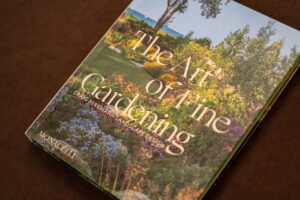
The Art of Fine Gardening: Craig Bergmann Landscape Design
Craig Bergmann and Russell Buvala presented The Art of Fine Gardening, showcasing four decades of landscape design that unites architecture and horticulture. Featuring twenty North Shore gardens—including the historic Gardens at 900—the book blends stunning photography, personal stories, and practical guidance for gardeners and design enthusiasts alike.