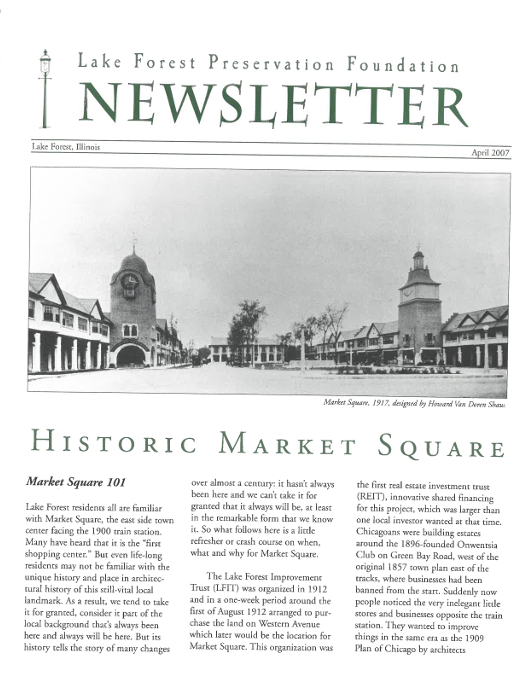
Lake Forest Preservation Foundation NEWSLETTER Lake Forest, Illinois April 2007 Market Square, 1917, designed by Howard Van Doren Shaw. HISTORIC SQUARE Market Square 1OJ Lake Forest residents all are familiar with Market Square, the east side town center facing the 1900 train station, and many have heard that it is the “first shopping center,” but even life-long residents may not be familiar with the unique history and place in architectural history of this still-vital local landmark, and as a result, we tend to take it for granted, consider it part of the local background that’s always been here and always will be here, but its history tells the story of many changes over almost a century: it hasn’t always been here and we can’t take it for granted that it always will be, at least in the remarkable form that we know it, so what follows here is a little refresher or crash course on when, what and why for Market Square, and the Lake Forest Improvement Trust (LFIT) was organized in 1912 and in a one-week period around the first of August 1912 arranged to purchase the land on Western Avenue which later would be the location for Market Square, and this organization was the first real estate investment trust (REIT), innovative shared financing for this project, which was larger than one local investor wanted at that time, and Chicagoans were building estates around the 1896-founded Onwentsia Club on Green Bay Road, west of the original 1857 town plan east of the tracks, where businesses had been banned from the start, and suddenly now people noticed the very inelegant little stores and businesses opposite the train station, and they wanted to improve things in the same era as the 1909 Plan of Chicago by architects Western Avenue, 1913. Burnham and Bennett, which laid out Grant Park and Wacker Drive, among other beautification projects along the lake front, and Bennett lived in Lake Forest, and consulted on the new plan for a Lake Forest town center, and the organizers were architect Howard Van Doren Shaw, local developer John Griffith, Chicago developer Arthur Aldis, and many estate owners and Onwentsia members, and fund raising was brutal, as the LFIT records from the Griffith, Grant and Lackie, Realtors, Inc. archives, now in the Lake Forest College library Special Collections, make dear: a contact sport, with all participating, or else, and architect Shaw ended up drawing three separate plans: December 1912, 1914, and 1915-the last finally meeting one of the very interesting requirements of Market Square,-its ability to be commercially self-sustaining with the investors getting a modest return, and the 1912 Town Market plan introduced the style but not the plan of the final product, with a shallow little park west of the train station, and the 1914 plan added a library building on the west end, on Forest Avenue, but Richard Longstreth’s 1997 book From Central City to Regional Mall… (MIT Press) noted that the final plan, with its deep park thrust west to the formal Macy’s (former Marshall Field’s) building, increased the high-rent, high-visibility Western Avenue front footage by 300%, and made the project a commercial success-the first ever City Beautiful Movement town center to accomplish this, rather than being supported by publicly funded anchors like city halls or libraries, and it was widely published, and became the model for 1920s pioneer malls in Florida and California, and the new, longer park shape led to stronger detailing on the now-distant from the platform west end Macy’s building and to taller towers, the north one also with a new Wren-inspired design, and except for the fountain, grass, and some elm trees along the drive, the park was left pretty plain, with nothing blocking the views from the platform to the renters’ store windows, and the World War I memorial flagpole soon anchored the west end of the park, and the construction work began using local and city contractors in 1915, beginning on the west end, and the Italian Renaissance style architecture, and Field’s, the adjacent store northeast of this, originally the post office, becoming retail space (today Helander’s), with the construction of the 1931 Post Office, and signage evolved over time, but was returned to its original character with open windows over the display windows in the 1980s restoration, and also in the mid 1980s, the old service drive on the south became a mall, with the old brick stores which had been moved back from Western in 1915-16 renovated and the heating plant converted into the present Deerpath Gallery, and the Young Men’s Club building west of Field’s became the Rec Dept. and then in the 1980s office and retail space, and the YWCA on the second floor above Field’s became retail space as well-in 2006 becoming Macy’s, the anchor store, and today, the tower details north and south are deteriorating, and require restoration-more than two decades after John Vinci’s work on Market Square, and built to compete with city shopping by commuters in the 1910s, Market Square today, with many smaller chain stores, competes with larger malls, and its offspring evolved from its role as a model in the 1920s for such developments around cars in Florida and California, and while preservationists in Lake Forest cannot always affect changes impacting community character though private properties, in the case of Market Square there are steps they can take, and friends of this local landmark can make every effort to shop here, supporting the local merchants and through them the managers and owners of Market Square, and they also can consider renting office or retail space here rather than somewhere else nearby, and what friends of preservation locally cannot do, though, is take Market Square for granted, and its long-term well-being is a project for all of us working together, and to read more: Edward Arpee with Susan Dart, Lake Forest: History and Reminiscences. (1964 and 1991); Susan Dart, Market Square (1984); Michael Ebner, Creating Chicago’s North Shore (1988); Arthur H. Miller and Shirley M. Paddock, Lake Forest: Estates, People and Culture (2000); Kim Coventry et al., Classic Country Estates of Lake Forest (2003), and Arthur H. Miller and Shirley M. Paddock March 2007 North Tower, and Market Square under construction, 1916 local contractors employed gained useful knowledge and sophistication on the large job Griffis Brothers, who had built houses in the West Park area, and Niemeyer, among others, and when the west end was completed for temporary occupancy by the Western Avenue store owners, work began on the east side, all occupied by late in 1916, and Griffith, today Griffith Grant and Lackie, Realtors, Inc., has the only space still occupied by the original tenant-where Shirley M. Paddock with Gordon Lackie discovered the LFIT archives in 1998, apparently untouched since Griffith’s death in 1949, and the only tenant to buy his store was druggist Karl Krafft, at the south end of the Western Avenue stores (now La Mirage, with Baytree Bank above), and the LFIT group planned to sell the rest, but World War I (1917-18) depressed business conditions for most of the remainder of the mid 20th C., and the apartments above the stores all impeded any move to selling, but in the early l 980s the personal computer revolution meant that the second floor apartments could be converted to offices for business persons unchained from commuting to the city, and in 1984 Broadacre bought the property, and restored it using distinguished Chicago architect John Vinci, and Griffith and his firm had managed the Square until 1968, and then Gilbert Rayner took over, with a pledge to increase the percentage of return, and since 1984 Broadacre has managed the Square, and the park space remained unchanged to about 1940, when the Lake Forest Garden Club hired landscape architect Helen Brown (Mrs. Ralph) Milman to redesign the space, with walks down the park, hedges at the roadway, and benches, and after many elms died in the 1970s, landscape architect Franz Lipp replanted the Square, again with the sponsorship of the Lake Forest Garden Club, and in the late 1990s the Garden Club organized Market Square 2000 to undertake renovation of the Square, hiring this time Delaware landscape architect Rodney Robinson, whose design restored variations in surface textures to the streets and walkways and created new garden spaces among the new trees, and the underground infrastructure and the fountain too were restored, and change has been a constant in the Square, with the original bank and utility renters of the west end formal building in 1931 yielding to Marshall Escutcheon with Shaw’s initials, above Macy’s entrance, and NON-PROFIT ORG U.S. POSTAGE PAID PERMIT NO. 184 LAKE FOREST, IL 60045 NON-PROFIT ORG U.S. POSTAGE PAID PERMIT NO. 184 LAKE FOREST, IL 60045 The Lake Forest Preservation Foundation 400 East Illinois Road, Lake Forest, Illinois 60045 www.lfpf.org
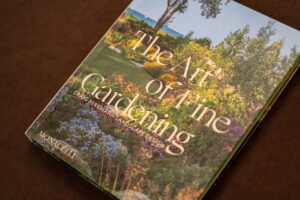
The Art of Fine Gardening: Craig Bergmann Landscape Design
Craig Bergmann and Russell Buvala presented The Art of Fine Gardening, showcasing four decades of landscape design that unites architecture and horticulture. Featuring twenty North Shore gardens—including the historic Gardens at 900—the book blends stunning photography, personal stories, and practical guidance for gardeners and design enthusiasts alike.