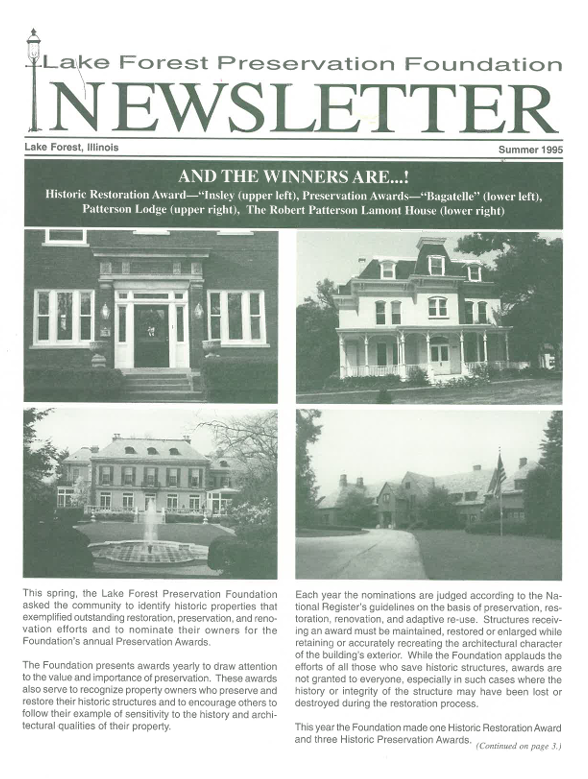
Lake Forest, Illinois, Summer 1995: This spring, the Lake Forest Preservation Foundation asked the community to identify historic properties that exemplified outstanding restoration, preservation, and renovation efforts and to nominate their owners for the Foundation’s annual Preservation Awards, and the Foundation presents awards yearly to draw attention to the value and importance of preservation, to recognize property owners who preserve and restore their historic structures, and to encourage others to follow their example of sensitivity to the history and architectural qualities of their property, and each year the nominations are judged according to the National Register’s guidelines on the basis of preservation, restoration, renovation, and adaptive reuse, and structures receiving an award must be maintained, restored or enlarged while retaining or accurately recreating the architectural character of the building’s exterior, and while the Foundation applauds the efforts of all those who save historic structures, awards are not granted to everyone, especially in such cases where the history or integrity of the structure may have been lost or destroyed during the restoration process, and this year the Foundation made one Historic Restoration Award and three Historic Preservation Awards (Contm. ued on page 3.) PRESERVATION FOUNDATION OFFICERS AND DIRECTORS Officers· Richard J. DuBourdieu-President Priscilla A. Billington-Vice President Carol A. Champ-Vice President Elaine B. Hughes-Secretary Patricia C. Riess-Treasurer Directors Marsha Bennett Susan D. Bryant William H. Emerson Lynn C. Knutson Geoffrey W. Luce Pauline M. Mohr Kimberly Nicastro Shirley Paddock Anthony M. Ryerson David Schlott Christine Shaw Linda L. Shields Dan Sutherland Susie Tiller Lorraine A. Tweed Louise Weithas Sarah Wimmer Honorary Directors Herbert Geist Gail T. Hodges Henry P. Wheeler In Memoriam Edward H. Bennett, Jr. David R. Moulton INCOMING PRESIDENT’S MESSAGE I write with a keen sense both of honor and of trepidation, I follow in the footsteps of a whole series of remarkably capable Foundation presidents, these are leaders who have truly understood and acted on the meaning of Historic Preservation, and in taking office, I’m grateful for the support of the strong Board of Directors just elected by our members, but no Board can be stronger than the general membership that lies behind it, no group can reach its potential to help enhance the community without broad community support, the Foundation is here to help the community, through our membership fees, we have helped fund studies for rhe City of Lake Forest and restore elements of our heritage (see the article on page 5 for a recent example), over seven years in the 1980s, the Foundation spearheaded efforts to restore the historic North Western station in the central business district, monthly, we monitor meetings of the City Council and its boards and commissions, and we provide expert testimony on preservation and other quality of life issues that affect every area of the community, the Foundation welcomes new members, we need more people to actively support our programs and show the depth of community interest in preserving the special character of Lake Forest, I believe there is great interest in keeping the visual and other, perhaps less tangible, qualities that are unique to Lake Forest, why else do people obviously find it so distressing when a proposal comes forth seemingly aimed at making Lake Forest just like “everywhere else”?, if you’re not presently a member of the Foundation, we urge you to join us (There’s an application form at the end of this Newsletter.) and if you already are a member, actively talk to your friends and neighbors about joining us, every new member is important, your support can make all the difference! Richard DuBourdieu President PRESERVATION FOUNDATION GUIDEBOOK, Second Edition PRESERVATION FOUNDATION GUIDEBOOK, Second Edition I I.I The Preservation Foundation Newsletter is published by The Lake Forest Foundation for Historic Preservation and distributed without charge to the residents and businesses in the City of Lake Forest, NOW AVAILABLE The Foundation’s Guidebook to National Register Properties, Lake Forest, Illinois, Second Edition, is now available! A sell-out in its 1991 First Edition, the Guidebook includes information on the two Lake Forest National Register Districts and on five properties listed individually on the National Register of Historic Places, the Second Edition includes information on two newly-listed National Register properties, as well as a new index by street address, the book is organized for use on a walking, bicycle, or auto tour, and includes photographs of each contributing structure, as well as maps and suggested routes for tours, copies, priced at $15 each, are available for purchase at Dans un Jardin, Gorton Community Center, Helanders, Lake Forest Book Store, Lake Forest College Bookstore, and McMasters, FOUNDATION FUNDS RESTORATION OF EVERETT SCHOOL BELL FOUNDATION FUNDS RESTORATION OF EVERETT SCHOOL BELL IN HONOR OF SCHOOL’S 80TH BIRTHDAY Everett School celebrated its 80th Birthday in April with a week-long celebration, the festivities culminate_d on April 21 with an all-school party, where the recently restored old Everett Schoolhouse Bell was unveiled and presented, the restoration was funded by the Preservation Foundation, using contributions made by its members through their membership dues, The restored Everett School Bell is unveiled by Foundation President Pauline Mohr, as students and Cheryl Tucker and Shirley Paddock, left, look on, the bell was returned to the school through the efforts of Shirley Paddock, an Everett School graduate, who arranged for the bell to be returned from Arizona for display as part of the history of the schools in the community, the bell was intact; but the years had taken their toll, and the bell was in need of extensive restoration, Cheryl Tucker. representing the Everett School Association of Parents and Teachers, spent countless hours on the bell restoration, making the phone calls and compiling the necessary information to get the project off and running, her contributions included arranging for restoration of the bell and the mounting of the bell, as well as designing the cast explanatory plaque and plate that are part of the bell’s mounting, Cheryl Tucker, left, and Shirley Paddock, right, display the restored and mounted Everett School Bell, the bell called the children to school until September 11, 1914, it had hung in the second Everett School (the former Everett Fire Station, now razed) on Everett Road, when the second school was closed in June 1957 and classes moved to the present school, the bell was no longer used, it was kept for safekeeping by former Everett school student and longtime Everett custodian and school bus driver, Gene Seyl, his family eventually brought the bell to Arizona, where it stayed until it was returned in 1993 by his daughter, Barbara Seyl LaDuke, on April 21, Everett School students celebrated 80 years of history and the return of the historic Everett School Bell with a festive birthday party in the school gym, Preservation Awards (Continued from page 1) The Historic Restoration Award was given to James and Rebecca Baclawski for their pristine restoration of “Insley,” designed by Holabird & Roche and built in 1893 for newlyweds Isabelle Scribner (heiress to the publishing fortune) and Carter Harrison Fitzhugh (descendent of two presidents), the project was well researched, well planned and implemented, and well documented, most important, the owners’ efforts saved an important historic structure that might otherwise have been lost to the wrecking ball, Isabelle lived in the house until she was 95 in 1965, a pipe burst in the west wing during World War II, and Isabelle just closed that wing instead of making the necessary repairs, advertised in 1992 by realtors as a “teardown,” the house was described by its present owners as a raccoon infested, rotting, falling down disaster (note photo above), fortunately, the Baclawskis loved the house and accepted the challenge of restoring it to its former elegance and grace, in 1992, when they purchased the house, a full crew of workmen (20 to 30 a day) were put to work for two years restoring this grand structure, Historic Preservation Awards were presented to Patterson Lodge at Lake Forest College, “Bagatelle” on East Deer Path, and The Robert Patterson Lamont House on Ridge Road, Patterson Lodge was built in 1879, it is the second oldest building on campus and was the home of Reverend Robert W. Patterson, the first president of the College, the bricks used to build Patterson Lodge were made from clay dug from a pit under the women’s hockey field, in the 1920s, it served as a residence for women, and in the 1960s, became the home of the Admissions Department, during the 1993 renovation, the College not only brought Patterson Lodge up to modern convenience, current codes, and ADA regulations, but it also used historical photographs as the basis for restoring the original porch, the additions of the required new ramp and railings were sensitive to the architecture, this project received compliments from the City’s Building Review Board during its review, the Foundation also commends the College for the care of its buildings that are so much a part of the history of Lake Forest itself, “Bagatelle,” shown above, was built by architect Edward H. Bennett as his own residence between 1915 and 1916, Edward Bennett was also a city planner who worked with Daniel Burnham on the Chicago Plan, which distinctively defined Chicago’s lakefront and environs, and the designer of the Michigan Avenue Bridge, the present owners, John and Ingrid LoGiudice, took on a major preservation project to repair and renovate this landmark at the entrance to central Lake Forest, the beautiful results of their project are shared each day with those who drive into and out of town past the intersection of Deer Path and Green Bay Road, “Bagatelle” is listed on the National Register of Historic Places, also listed on the National Register is the Robert Patterson Lamont House, designed by Howard Van Doren Shaw and built in 1925 (shown below), present owners, Bonney and Jack Pope, carefully rehabilitated and restored this elegant country house (Continued on page 4.) Preservation Awards ( Continued from page 3) Built for Robert Patterson Lamont, the president of American Steel Foundries, the house stood originally on 102 acres, the property was known as “West View Farmsi” there have been few alterations to the house, and as a result, its historical integrity is excellent, the house now sits on 7.27 acres, including a lovely small lake and some of the original garden, auxiliary buildings from the Lamont estate have been converted to other Ridge Road residences, the Foundation presented a handsome bronze plaque to each winner, the judging panel for the 1995 Preservation Awards was comprised of: Kay Bennett, Foundation member; Paul Janicki, architect and past President of the Preservation League of Evanston; Lynn Knutson, Director, Preservation Foundation; Kimberly Nicastro, Foundation member and 1994 winner of the Preservation Award for restora� tion; Byron Prais, former Director of Building and Zoning for The City of Lake Forest; and Linda Shields, Chairman, Director and past President of the Preservation Foundation, ••••••••••••••••••••••••••••••• WANTED FOR NEW LAKE FOREST MUSEUM : PHOTOGRAPHS AND INFORMATION ON THE PROPERTY AT : 361 EAST WESTMINSTER • (formerly the Masonic Lodge) • The Foundation is working with the City Council Museum Committee to establish a privately-funded Lake Forest Museum in the former Masonic Lodge, the Foundation has made WINNERS OF THE MIDDLE SCHOOL “MY FAVORITE HISTORIC PLACE IN LAKE FOREST” ESSAY CONTEST Each year the Preservation Foun-dation sponsors an essay contest for Middle School students in con-junction with their local history unit, awards to three prize winners are made at the Foundation’s Annual Meeting, Fourth grader John Ancona won first prize, his ex-tremely well written and well docu-mented essay was on “Suffield House,” the house designed by David Adler in 1934 for Mrs. J. Ogden Armour (see page 6 for excerpts), John, who is a neighbor, discovered new information about this important property, in addition to investigating local histories, John uncovered the original deed for the property, researched Mrs.Armour’s life in her hometown of Suffield, Connecticut, and uncovered long-forgotten material in the archives of The Lake Forester and the Lake Forest Building Department, Second prize was awarded to Armin Drake for his essay on his home, “Little Orchard,” designed by Howard Van Doren Shaw in 1897 for Alfred and Mary Baker, Third prize was awarded to Gracyn Tighe, (shown below with Essay Chairman, Susan Bryant) for her essay on Gorton, a financial commitment to the restoration of the exterior of the building and is seeking old photographs, newspaper articles, family histories, recollections, and other memorabilia that may shed light on the original appearance of the building, this building was part of “The Evergreens,” the historic home di-rectly east 9f Lake Forest Library and once owned by the Quinlan, Rumsey, and Baker families, long assumed to be the coach house of the estate, the building may actually have been the stable, Box 813, Lake Forest, Box 813, Lake Forest.Please send information to the Foundation at •••••••••••••••••••••••••••••• I IJOIN us! THE LAKE FOREST FOUNDATION FOR HISTORIC PRESERVATION Box 813, Lake Forest, Illinois 60045 I/We want to help preserve the historic character of Lake Forest, please enroll me/us in the selected membership category (Contributions are tax deductible, please make checks payable to The Preservation Foundation.) Mr./Ms. Mrs. Miss Street——– ———Telephone—-City …,,_,tate Zip D I/We would like to work actively with the Foundation, please call me/us to discuss areas of interest, The Preservation Foundation, an Illinois 501(c)(3) public foundation, is open to all who share its goal of progress thrnugh preservation D Member-Annual Dues $35 D Contributing Member-Annual Dues $50 D Sponsor-Annual Dues $100 D Sustaining Member-Annual Dues $250 0 Life Member-Contribution to the Revolving Fund in the amount of $1,000 or more, no annual dues required, “SUFFIELD HOUSE” BY JOHN ANCONA, FOURTH GRADE WINNER OF THE 1995 MIDDLE SCHOOL ESSAY CONTEST My favorite historical place in Lake Forest is the house at 255 North Green Bay Road, across from the Onwentsia Country club, I like it because it is close to my house and has a very interesting history, my house was erected on property that formerly belonged to that estate, the house at 255 North Green Bay Road was designed by David Adler for Mrs. J. Ogden Armour, it was designed in 1934, it is a mansion that had 31 rooms, including 8 bathrooms,. the service rooms consist of a flower room, a silver room, a china room, a large servants’ sitting room, 2 storage rooms, a cedar room, a cook’s pantry, a butler’s pantry, 6 maids’ rooms, a kitchenette, a trunk room and an elevator, the house included antique Adams fireplaces, 18th century oak panelling and a carved overmantle by Sir Grinling Gibbons, Grinling Gibbons, British woodcarver, has carvings in Hampton Court, Windsor Castle, and Trinity College, Oxford, at the time, it cost more than $200,000 to build, the actual construction was done by Thornald, Neilson and Company of Chicago, it was built on a 12-acre yard bought by Mrs. Armour in November of 1933 from Dr. Arthur Bevan, the construction of the home was reported on the front page of The Lake Forester several times, J. Ogden Armour was the son of Philip D. Armour, founder of the Armour Meat Company, in 1883 he joined his father’s business and became a partner a year later, he met his wife named Lola Sheldon when she came to visit friends in Chicago in 1891, she was from Suffield, Connecticut, where my Uncle, John Murphy, lives, Lola Sheldon was born in Suffield, Connecticut in 1869, she was as smart as she was pretty, she was small and energetic…. she was said to have every advantage…While she was not as rich as Ogden Armour, she brought her own money to the marriage, Ogden Armour became the second richest man in the world through the meatpacking business, he then lost much of his fortune…a million dollars a day for 200 days, he died in England from Typhoid fever which he caught on a boat in 1927, Mrs. Armour made much of the fortune back from an investment Mr. Armour had made on a new method of cracking gasoline, Mrs. Armour built the house at 255 North Green Bay Road and called it Suffield House after her home town Mrs. Armour had some big trees on her property, one was an elm tree that was moved 500 feet from the edge of the property to near her gate, the roots of this tree weighed 338 tons and the upper section weighed 1O tons, at the time, it was the largest tree to ever be transplanted in the Chicago area, it was reported in The Lake Forester of Feb-February 27, 1936, she had a small pond on her property named Quinlan Pond To the kids on our street, Quinlan Pond is known as Cooper’s Pond because Mr. Cooper determines when it is safe to skate…
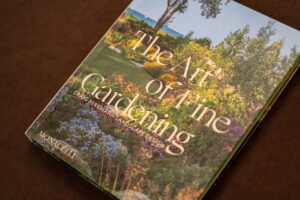
The Art of Fine Gardening: Craig Bergmann Landscape Design
Craig Bergmann and Russell Buvala presented The Art of Fine Gardening, showcasing four decades of landscape design that unites architecture and horticulture. Featuring twenty North Shore gardens—including the historic Gardens at 900—the book blends stunning photography, personal stories, and practical guidance for gardeners and design enthusiasts alike.