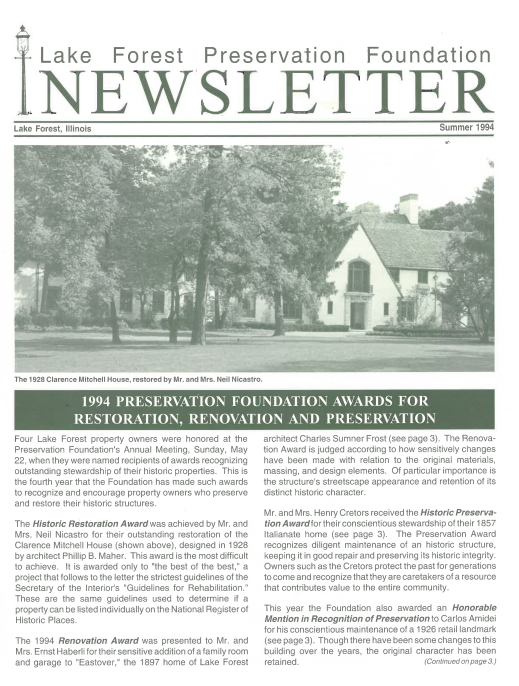
Lake Forest Preservation Foundation NEWSLETTER Lake Forest, Illinois Summer 1994 The 1928 Clarence Mitchell House, restored by Mr. and Mrs. Neil Nicastro, 1994 PRESERVATION FOUNDATION AWARDS FOR RESTORATION, RENOVATION AND PRESERVATION Four Lake Forest property owners were honored at the Preservation Foundation’s Annual Meeting, Sunday, May 22, when they were named recipients of awards recognizing outstanding stewardship of their historic properties, this is the fourth year that the Foundation has made such awards to recognize and encourage property owners who preserve and restore their historic structures, the Historic Restoration Award was achieved by Mr. and Mrs. Neil Nicastro for their outstanding restoration of the Clarence Mitchell House (shown above), designed in 1928 by architect Phillip B. Maher, this award is the most difficult to achieve, it is awarded only to “the best of the best,” a project that follows to the letter the strictest guidelines of the Secretary of the Interior’s “Guidelines for Rehabilitation,” these are the same guidelines used to determine if a property can be listed individually on the National Register of Historic Places, the 1994 Renovation Award was presented to Mr. and Mrs. Ernst Haberli for their sensitive addition of a family room and garage to “Eastover,” the 1897 home of Lake Forest architect Charles Sumner Frost (see page 3), the Renovation Award is judged according to how sensitively changes have been made with relation to the original materials, massing, and design elements, of particular importance is the structure’s streetscape appearance and retention of its distinct historic character, Mr.and Mrs. Henry Cretors received the Historic Preservation Award for their conscientious stewardship of their 1857 Italianate home (see page 3), the Preservation Award recognizes diligent maintenance of an historic structure, keeping it in good repair and preserving its historic integrity, owners such as the Cretors protect the past for generations to come and recognize that they are caretakers of a resource that contributes value to the entire community, this year the Foundation also awarded an Honorable Mention in Recognition of Preservation to Carlos Amidei for his conscientious maintenance of a 1926 retail landmark (see page 3), though there have been some changes to this building over the years, the original character has been retained (Continued on page 3.), PRESERVATION FOUNDATION OFFICERS AND DIRECTORS Officers Pauline M. Mohr-President Susie Tiller-Vice President Priscilla Billington-Vice President Elaine B. Hughes-Secretary Richard J. DuBourdieu – Treasurer Directors Susan Bryant Carol A. Champ Thomas Eckland William H. Emerson C. Lynn Knutson Geoffrey Luce Linda G. Mills David R. Moulton Beatrice Radcliffe Patricia C. Riess Anthony M. Ryerson Christine L. Shaw Linda L. Shields Dan Sutherland Lorraine A. Tweed Sarah Wimmer Honorary Directors Edward H. Bennett, Jr. Herbert Geist Gail T. Hodges Henry P. Wheeler Annual Meeting Update At the Foundation’s 1994 Annual Meeting, outgoing Director Leonard Everson was thanked for his contributions to the Foundation, the Board and members welcomed newly elected Directors Susan Bryant and Christine Shaw, each year, to celebrate National Historic Preservation Week, the Foundation sponsors an essay competition for fourth and fifth graders in connection with their study unit on local history, the Foundation’s Guide to National Register Properties is one of the recommended texts, we’re pleased to present this year’s winners, shown at the Foundation’s 1994 Annual Meeting, as Richard J. DeBourdieu presented the awards, are: (top, left to right) Katy Koob (Second Prize, Fourth Grade);Steven Scott (First Prize, Fourth Grade); Heather Melarkey (First Prize, Fifth Grade); (bottom left) Mark Nicastro (second Prize, Fifth Grade), WILLIAMSBURG, LAKE FOREST, PRESERVATION, AND YOU! Lately, I have been thinking about the preservation movement in terms of its origins, its evolution, and its place on the national scene, Williamsburg comes to mind as one of the first major restoration projects to capture the attention of the American people, when Dr. William Archer became rector of Bruton Church in 1903, he was inspired to begin working to restore the interior of the church to its original colonial appearance, this marked the beginning of his crusade to gain support for the restoration of the whole of Williamsburg, in the following years, he was able to stimulate interest in the project but not the necessary financial support, then, a chance encounter with John D. Rockefeller, Jr., in 1926 resulted in Rockefeller’s commitment to the restoration of Williamsburg with the stipulation that “his support would be for a consolidated entity and not isolated buildings,” the rest is history from which Lake Forest can learn, one of the features in this Newsletter spotlights “The Washington Circle-Wildwood Road-Ryan Place Area: A Neighborhood You Should Know,” too often, when the public thinks of preservation, it is “landmark” buildings, great estates, manor houses, and distinctive public buildings that come to mind, a parallel to the famous people, great deeds, major events view of history, but recent historians have begun to focus on the place of the common man in history as well, and the economic, political, and cultural climates in which he lived and worked, the dwelling places and work places of these citizens, then, take on a particular importance as expressions of the economic, political, and cultural conditions that created them, they serve as a record of the people who built and lived in them, and they are a part of the visual history and character of a community, :Lake Forest has a number of such structures, both vernacular homes and modest commercial buildings, the Foundation refers to them as “little gems,” and believes that many of them are worthy of preservation, not only singly, but also within the context of whole neighborhoods, we will be working toward this goal in the coming years, and invite you to join us in support of this mission, Pauline Mohr, President, Winners of the 1994 “My Favorite Historic Place in Lake Forest” Contest, Foundation Funds Restoration of Everett School Bell, how are an old school bell, a class reunion, and the Preservation Foundation related? the answer lies in tracing the history of Everett School and the life of Gene Seyl, Everett School was built in 1914, it became a part of the Lake Forest School system in 1926 when The City of Lake Forest extended its boundaries westward, the original school building served students from Lake Forest until June 1957, when it was converted into a fire station and the “new” Everett School opened in September 1957, … -� … -� As a child, Gene Seyl attended Everett School, his ties to the school were strong, and he worked as a custodian and bus driver for the school for 25 years, from 1944 until his retirement in 1969, during these years he married Bertha Hook, and their two children, Ronald and Barbara, also attended Everett, when the original school closed in 1957, Mr. Seyl rescued the discarded school bell and kept it in his possession as a reminder of his school days and his early years of work at the old school, at the time of Mr. Seyl’s death, his daughter, Barbara Seyl LaDuke, acquired the bell and displayed it in her front yard, when she moved to Tucson, Arizona, the bell went with her, in 1992, Barbara LaDuke returned to Lake Forest to attend a class reunion, she remarked to Shirley Paddock, a classmate also atteriding the reunion, that she had the bell, Mrs. Paddock, a historian par excellence, asked Mrs. LaDuke if she would be willing to send the bell back to Lake Forest for display as a part of the history of schools in the community and promised that recognition would be given to Gene Seyl in this history, Mrs. LaDuke agreed, and the bell came back by truck to Lake Forest’s Deerpath School, where Mrs. Paddock received it, the bell was intact, but in need of repair and restoration, no funds were available for such work, so Mrs. Paddock contacted the Preservation Foundation, without hesitation, the Foundation Board agreed to finance the restoration of the bell and to finance any costs related to mounting the bell for display when that time came, the restored bell will be displayed at Deerpath School; however, it is the Foundation’s hope that some day the bell will be returned to Everett School for display, thus bringing the story of the traveling bell full circle, stay tuned! Left, the old Everett School bell, as it hung at the original school bell tower, Right, Shirley Paddock and school staff receive the bell at Deerpath School, JoINUS! THE LAKE FOREST FOUNDATION FOR HISTORIC PRESERVATION Box 813, Lake Forest, Illinois 60045 I/We want to help preserve the historic character of Lake Forest, please enroll me/us in the selected membership category (Contributions are tax deductible, please make checks payable to The Preservation Foundation.) Mr./Ms. Mrs. Miss _ O Member–Annual Dues $35 O ·contributing Member–Annual Dues $50 D Sponsor–Annual Dues $100 D Sustaining Member–Annual Dues $250 O Patron–Annual Dues $500 D Life Member–Contribution to the Revolving Fund in the amount of $1,000 or more, no annual dues required, Street _ Telephone – The Preservation Foundation Newsletteris published by The Lake Forest City State • Zip– —– Foundation tor Historic Preservation and distributed without charge to the DI/We would like to work actively with the Foundation, please call me/us to discuss areas of interest, The Preservation Foundation, an Illinois 50I (c)(3) public foundation, is open to all who share its goal of progress through preservation, residents and businesses in the City of Lake Forest, Preservation Awards (Continued) The Clarence Mitchell House, the Mitchell House was completed just in time for the stock market crash of 1929, and the Mitchells had to sell their home before moving in, the Nicastros purchased the property in 1992, to ensure authenticity, they researched its history thoroughly prior to beginning their restoration project, under Kimberly Nicastro’s careful supervision, every detail was executed, from landscaping to roof repair, to hardware, the exterior colors of the house were restored to those shown in a 1931 issue of National Geographic Magazine, three hundred original roof tiles found in the basement were used for restoring the clay tile roof, new lead-coated copper downspouts were made to match the originals, the 1928 heating and bathroom fixtures were restored and reinstalled, the existing original light fixtures were restored, and seventy-six antique fixtures were restored and installed to replace missing originals, all old window glass was saved, and cracked and broken glass was replaced with old glass, in addition to such meticulous restoration throughout the house, the renovated kitchen and family room, designed by architect Paul Janicki, are true to the original architecture, “Eastover, ” the Charles Sumner Frost House, Frost, who designed the First Presbyterian Church in Lake Forest, and with his partner, Alfred Hoyt Granger, designed City Hall and the North Western Station, planned this home (shown top right) for his family, a previous owner had restored many details of the house, but, typical of most families today, Mr. and Mrs. Haberli required the additional living space of a family room and also a garage suited to their needs, much care was taken toprotect the historic streetscape view of the home, by making the addition lower than the original hoase, using brick removed from the original east facade on the connector link, and repeating the brick pattern and coursing detail, a compatible addition was achieved, The Cretors’ 1857 Italianate House, Mr. and Mrs. Cretors know little of the history of 611 East Westminster (shown middle right) or of its original and other previous owners, the fact that the building has survived for nearly 140 years in beautiful condition testifies to the fact that it has been loved dearly by all who cared for it thoughtfully over the years, the house is typical of homes built by Lake Forest’s founders, such as the Holt and Thompson houses across Sheridan Road from Lake Forest College, the Cretors would welcome information about their home, The 1926 Mckinley Road Grocery Store, although the front of this building (shown bottom right) has been revised in small ways, the original character has been retained and the shop is well maintained, Mr. Amidei, who is only the second owner of the building, resisted suggestions several years ago that he “modernize” the street view of his tailor shop, had he dor:ie that, rather than repairing and renovating in keeping with the original character of his building, Lake Forest would have lost an important part of its retail past, “Eastover,” the home of Lake Forest architect Charles Sumner Frost, renovated by Mr. and Mrs. Ernst Haberli, The 1857 Italianate House preserved by Mr. and Mrs. Henry Cretors, The 1926 Grocery Store maintained by Carlos Amidei, with original grocery store shown in 1949, PROPERTY OWNER BENEFITS EASEMENT DONATIONS CAN BE BENEFICIAL TO PROPERTY OWNERS, preservation/conservation easements can benefit the individual property owner and help maintain the historic visual character of Lake Forest, the Preservation Foundation and The City of Lake Forest encourage such easements to help preserve the facades of historic buildings, the character of historic properties, and the open space and landscaping that contribute so much to the distinctive character of our community, the Lake Forest Open Lands Association also encourages conservation easements, given the rising cost of land, the income tax value of conservation easements, particularly, can be substantial and offer an attractive alternative to subdivision and sale, further, the income tax benefit afforded by a facade or conservation easement can free up resources for renovation of an historic home, for an article giving details on this topic, write to: The Preservation Foundation, Box 813, Lake Forest, IL 60045, for further information, contact Charles E. Crook, Director of Community Development, The City of Lake Forest, 110 East Laurel Avenue, Lake Forest, IL 60045, 234-2600, or Stephen Christy, Executive Director, Lake Forest Open Lands Association, 560 North Oakwood Avenue, Lake Forest, IL 60045, 234-3880, • • • •••••••••••••••••••••••••••••••• :Jl&w Mem6ers 1\fception • • •Sunaay, June 26, from 4 to 6 p.m. • ‘Tfiose who nave joinea the \ounaation rece.nt[y are invitee£ to join the ‘Directors • fOT wine ana cheese. • •Invitations nave Geen sent. ‘Watch. your mai{, • WHAT THE PRESERVATION FOUNDATION ACCOMPLISHED DURING 1993-1994 The Lake Forest Preservation Foundation was chartered August 4, 1976, for the purpose of fostering preservation of the sites, structures, and amenities that comprise Lake Forest’s historic visual character, recent activities, in addition to those detailed in this Newsletter, included the following ways in which the Foundation returned its revenue to the community through public service projects: Published The Preservation Foundation Newsletter, mailed to all Lake Forest homes and businesses to inform the public about local historic preservation, homes of historic interest in Lake Forest, and Foundation activities, also prepared and published our unique Guide to National Register Properties, a second edition, including new National Register properties, will be issued this summer, Preparation for establishing a major new National Register District along Green Bay Road, mapping, photography, and research are being done by the Foundation with the cooperation of property owners in the proposed district, Restoration of the historic Manning Plan–the landscape plan conceived in 1906 for Lake Forest University, now Lake Forest College, by Manning and Morris, the restoration was underwritten by a Foundation grant to the college and is displayed permanently in Donnelley Library, Shared funding with The City of Lake Forest for a comprehensive survey to identify and describe all historically significant structures, the survey should be completed during 1994, On-going monitoring of meetings of the City Council, Plan Commission, Building Review Board, and Zoning Board of Appeals, in order to support historic preservation issues through testimony and documentation, Monitoring the Base Realignment and Closure process at Ft. Sheridan in order to encourage plans for the adaptive reuse of the historic district–a National Register District and a National Historic Landmark, Celebration of Preservation Week with a tour of historic homes, WHAT THE PRESERVATION FOUNDATION ACCOMPLISHED DURING 1993-1994 The Lake Forest Preservation Foundation was chartered August 4, 1976, for the purpose of fostering preservation of the sites, structures, and amenities that comprise Lake Forest’s historic visual character, recent activities, in addition to those detailed in this Newsletter, included the following ways in which the Foundation returned its revenue to the community through public service projects: Published The Preservation Foundation Newsletter, mailed to all Lake Forest homes and businesses to inform the public about local historic preservation, homes of historic interest in Lake Forest, and Foundation activities, also prepared and published our unique Guide to National Register Properties, a second edition, including new National Register properties, will be issued this summer, Preparation for establishing a major new National Register District along Green Bay Road, mapping, photography, and research are being done by the Foundation with the cooperation of property owners in the proposed district, Restoration of the historic Manning Plan–the landscape plan conceived in 1906 for Lake Forest University, now Lake Forest College, by Manning and Morris, the restoration was underwritten by a Foundation grant to the college and is displayed permanently in Donnelley Library, Shared funding with The City of Lake Forest for a comprehensive survey to identify and describe all historically significant structures, the survey should be completed during 1994, On-going monitoring of meetings of the City Council, Plan Commission, Building Review Board, and Zoning Board of Appeals, in order to support historic preservation issues through testimony and documentation, Monitoring the Base Realignment and Closure process at Ft. Sheridan in order to encourage plans for the adaptive reuse of the historic district–a National Register District and a National Historic Landmark, Celebration of Preservation Week with a tour of historic homes, ana Ee sure to respona Gy June 221 • Foundation Awards Preservation Grant to Gorton Community Center, Gorton Community Center (shown left) is the recipient of a Preservation Foundation Grant in the amount of $8,170 for the restoration of elements of the south facade of the historic Edward F. Gorton School building, the building, listed on the National Register of Historic Places, has seen many changes since it was built in 1901, in the 1920s, an original second-floor window was removed and a door was cut into the second floor south facade for exit onto a new fire escape, in the 1970s, a window air conditioner was installed on the first floor, and part of an original 1901 window was removed and destroyed, this spring, the Gorton Board renovated the Friends’ Room on the second floor and had the opportunity to remove the now defunct fire escape and restore both windows, the Foundation’s grant enabled Gorton to restore the original windows, exterior and interior walls, masonry, stucco, drains, sills, and soffits of the historic south facade of the original 1901 school building, •••••••••••••••••••••••••••••••• The Washington Circle-Wildwood Road-Ryan Place Area:AN eighborhood You Should Know, tucked away in the southeast corner of Lake Forest is a neighborhood of smaller, Victorian, venacular, and revival-style houses that comprise an interesting part of Lake Forest’s history, home, around the turn of the century, to the tradesmen of Lake Forest and to workers on estates, the neighborhood also grew in attractiveness over the years for families employed at nearby Lake Forest College, today, it is home to many long-time residents and also young families returning to the town where they were raised or establishing first-time roots in Lake Forest, like many of Lake Forest’s established neighborhoods of smaller homes, the area in recent years has become ripe for redevelopment, the character of redevelopment is a concern to present residents, and warrants the consideration of the community as a whole, how can Lake Forest maintain the existing character of such neighborhoods, while accommodating updating to suit present-day lifestyles? city bodies, such as the City Council, the Plan Commission, and Building Review Board, will be considering this issue, and encourage input from residents, please share your thoughts with City officials, NON-PROFIT OR.G. U.S. POSTAGE PAID PERMIT NO. 184 LAKE FOREST, IL 60045 NON-PROFIT OR.G. U.S. POSTAGE PAID PERMIT NO. 184 LAKE FOREST, IL 60045 The Preservation Foundation Box 813, Lake Forest, Illinois 60045 CAR-RT Inside: 1994 Preservation Awards Restoration Grant to Gorton Everett School Bell to Be Restored Membership Information