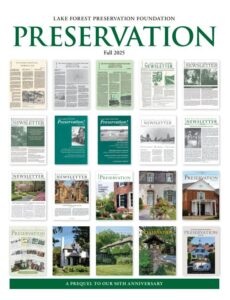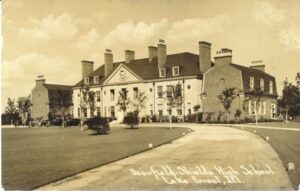
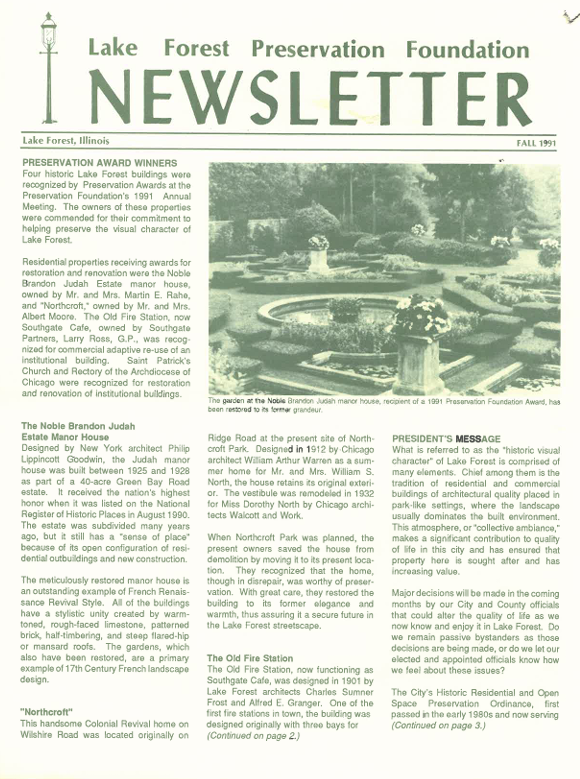
Lake Forest Preservation Foundation NEWSLETTER Lake Forest, Illinois FALL 1991 PRESERVATION AWARD WINNERS Four historic Lake Forest buildings were recognized by Preservation Awards at the Preservation Foundation’s 1991 Annual Meeting, the owners of these properties were commended for their commitment to helping preserve the visual character of Lake Forest, residential properties receiving awards for restoration and renovation were the Noble Brandon Judah Estate manor house, owned by Mr. and Mrs. Martin E. Rahe, and “Northcroft,” owned by Mr. and Mrs. Albert Moore, the Old Fire Station, now Southgate Cafe, owned by Southgate Partners, Larry Ross, G.P., was recognized for commercial adaptive re-use of an institutional building, Saint Patrick’s Church and Rectory of the Archdiocese of Chicago were recognized for restoration and renovation of institutional buildings, The Noble Brandon Judah The garden at the Noble 8rando11 Judah manor house, recipient of a 1991 Preservation Foundation Award, has been restored to its former grandeur, Estate Manor House Designed by New York architect Philip Lippincott Goodwin, the Judah manor house was built between 1925 and 1928 as part of a 40-acre Green Bay Road estate, it received the nation’s highest honor when it was listed on the National Register of Historic Places in August 1990, the estate was subdivided many years ago, but it still has a “sense of place” because of its open configuration of residential outbuildings and new construction, the meticulously restored manor house is an outstanding example of French Renaissance Revival Style, all of the buildings have a stylistic unity created by warm-toned, rough-faced limestone, patterned brick, half-timbering, and steep flared-hip or mansard roofs, the gardens, which also have been restored, are a primary example of 17th Century French landscape design, “Northcroft” This handsome Colonial Revival home on Wilshire Road was located originally on Ridge Road at the present site of Northcroft Park, designed in 1912 by Chicago architect William Arthur Warren as a summer home for Mr. and Mrs. William S. North, the house retains its original exterior, the vestibule was remodeled in 1932 for Miss Dorothy North by Chicago architects Walcott and Work, when Northcroft Park was planned, the present owners saved the house from demolition by moving it to its present location, they recognized that the home, though in disrepair, was worthy of preservation, with great care, they restored the building to its former elegance and warmth, thus assuring it a secure future in the Lake Forest streetscape, The Old Fire Station The Old Fire Station, now functioning as Southgate Cafe, was designed in 1901 by Lake Forest architects Charles Sumner Frost and Alfred E. Granger, one of the first fire stations in town, the building was designed originally with three bays for (Continued on page 2.), PRESIDENT’S MESSAGE What is referred to as the “historic visual character” of Lake Forest is comprised of many elements, chief among them is the tradition of residential and commercial buildings of architectural quality placed in parklike settings, where the landscape usually dominates the built environment, this atmosphere, or “collective ambiance,” makes a significant contribution to quality of life in this city and has ensured that property here is sought after and has increasing value, major decisions will be made in the coming months by our City and County officials that could alter the quality of life as we now know and enjoy it in Lake Forest, do we remain passive bystanders as those decisions are being made, or do we let our elected and appointed officials know how we feel about these issues? the City’s Historic Residential and Open Space Preservation Ordinance, first passed in the early 1980s and now serving (Continued on page 3.), continuous organization in Lake Forest, dating to the mid-1830s, the parish was organized by Irish Catholic pioneers in Deerfield Township, many of these settlers, who had come to work on the Illinois-Michigan Canal, settled in the area of Waukegan Road, which was called The Corduroy Road and was the initial site of Green Bay Road, their first church, called St. Michaels, was located on the west side of Waukegan Road on land donated by Lake Forest pioneer Michael Yore, the church was officially organized as St. Patrick’s in 1844, “Northcraft” had been neglected and might have been demolished; but instead, it was saved by being moved to a new site and restored to its former elegance, the original log church was moved to a site near Everett School and later, in 1853, a new brick church was built on the east side of Waukegan Road near Mellody Road, the old log church became a school, which operated until 1905, in July 1895, lightning struck the brick church, and it was totally destroyed, the present building replaced that church, Old Fire Station (Continued) horse-drawn wagons, at one time, the jail was also located in this building, later, the Lake Forest Recreation Department held classes here, the building is on the National Register of Historic Places as a structure within the Lake Forest National Register Historic District, the present owners recognized the possibilities inherent in the fine old building when the City of Lake Forest offered it for sale with restoration contingencies in the early 1980s, restoring the exterior with great care a·nd carefully adapting the interior for restaurant activities, the owners ensured the building’s viability in the historic Market Square streetscape, all plans had to meet strenuous standards to receive approval of the Illinois Historic Preservation Office for compliance with the Historic Preservation Tax Act then in effect, St. Patrick’s Church and Rectory Buiit in 1910, the Italianate church is the fourth home of the second oldest church in the Chicago Archdiocese and one of the earliest in Illinois, the community represented by St. Patrick’s Parish is the oldest, The 191o church and rectory were extensively and carefully restored in 1986 to closely resemble their original exterior appearance, many interior improvements also were made to update facilities for St. Patrick’s growing parish, included among the aesthetic changes were new Stations of the Cross, commissioned and executed by noted Lake Forest artist Franklin McMahon, St. Patrick’s Church and Rectory will re• main among Lake Forest’s most significant historic structures because of these efforts (Continued on page 3.), The Old Fire Station, now Southgate Cafe, was judged an outstanding example of adaptive use of an institutional building at the 1991 Preservation Foundation Annual Meeting, -·, St. Patrick’s Church has been an Everett Road land- mark since the turn of the century, THE PRESERVATION FOUNDATION IS 15 YEARS OLD! This past July marked the fifteenth anniversary of the founding of the Lake Forest Foundation for Historic Preservation, during those years, broad community support has made possible numerous direct contributions to preserving the historic visual character of Lake Forest, the Foundation’s most obvious contribution is the renovated North Western Station, but much work has been done elsewhere as well, this public service project is just one example of how the Foundation has returned to the community nearly all of its revenues from memberships and special donations, the Preservation Foundation Newsletter, distributed without charge three times a year to all residences and businesses, is another, the renovation of the North Western Station was a Preservation Foundation project completed in the 19808, thousands of hours of volunteer time have been contributed by Foundation directors and other volunteers, contributions have been made to the City of Lake Forest by funding preservation-oriented surveys and studies, volunteer observers reguiarly have attended City meetings to report on and comment on issues relating to preserving Lake Forest’s historic visual character, scores of property owners have been directed to resources for researching and restoring buildings, exploring tax incen tives, and investigating preservation and conservation easements, we’re proud of the work done so far, and invite you to join us in our future projects!, LAKE FOREST FOUNDATION FOR HISTORIC PRESERVATION Box 813, Lake Forest, Illinois 60045 I/We want to help preserve the historic character of Lake Forest, please enroll me/us in the selected membership category, (Contributions are tax deductible. Please make checks payable to the Preservation Foundation.) Mr. Mrs. Miss Telephone, Street, City State Zip _ D I/We would like to actively work with the Foundation, please call me/us to discuss areas of interest, Member – Annual Dues $25.00, Contributing Member — Annual Dues $50.00, Sponsor-Annu.al Dues $100.00, Sustaining Member – Annual Dues $250.00, Patron – Annual Dues $500.00, Life Member — Contribution to the Revolving Fund in the amount of $1,000.00 or more, no annual dues required, The Preservation Foundation is open to ait who share its goal of progress through preservation, St. Patrick’s Church(Continued) The fact that these restored buildings are located in the business district now being developed in the southwest sector of Lake Forest firmly connects this new commercial area with its former role in the pioneer history of the City of Lake Forest, President’s Message (Continued) as a role model for other North Shore communities, is being tested in new ways as requests for new subdivisions accelerate, its intent and content soon will be reviewed, citizen support will be needed to help make the courageous decisions necessary to enforce and strengthen this very important ordinance, what in retrospect are recognized as poor zoning and subdivision decisions of the past should not set the precedent for future growth and development, loopholes that undermine the effectiveness of the ordinance must be closed, difficult decisions that weigh individual property owners’ rights against the City’s chartered obligation to maintain the value of all property–and thus to maintain the historic collective ambiance of Lake Forest–will have to be made, we were all drawn to or chose to stay in Lake Forest for the special place that it is, but do we have a right to make more than a reasonable use or profit from our investments here at a cost to our neighbors and community? do we ask our officials to protect this oasis of architectural character and open space, or do we stand by and allow our city to become simply another “bedroom” suburb? concerns don’t end at the City limits, the future uses of Ft. Sheridan unquestionably will impact the visual environment and the quality of life in Lake Forest, federal, County, and City officials need resident input as they make their recommendations and decisions, how much is traffic through Lake Forest likely to increase, and how will it be controlled? what will be the environmental and aesthetic impact of the various proposals for the site? do we want the green space in our southern back yard at Ft. Sheridan preserved? if the County buys land with our property taxes, would we rather have it be here or on the other side of Lake County? LAKE FOREST 15 A CITY RICH IN HERITAGE…ARE YOU AWARE OF THE BENEFITS OF OWNING A PIECE Of THIS HISTORY? On November 14, 7:30 p.m., at Gorton Community Center, the Preservation Foun-dation will host a question and answer session investigating the following topics: What does it mean to live in the historic district? Can the assessed value of historic property really be frozen if it is renovated? what regulations govern the design or materials that can be used in improvements to an historic property? what might be the tax savings from doing a certified restoration, and how long would they last? what are conservation and preservation easements, and how can they be applied to an historic property? mark your calendar now, and plan to join us, RESOURCES OFFERED BY THE CENTER FOR HISTORIC HOUSES The Center for Historic Houses, an affiliate of the National Trust for Historic Preservation, offers guidance to homeowners in the United States about the stewardship of their old and historic houses, the .Center provides educational programs, resource materials, and networks among and for private homeowners, hands-on workshops and an insurance program offering replacement value for historic residences are among the resources available, National Trust members may use the services of the Center, for information, write to 1785 Massachusetts Avenue, N.W., Washington, DC 20036, or call (202) 673-4025, HOW TO FIND PROFESSIONAL HELP FOR YOUR HISTORIC HOUSE A number of organizations can provide technical advice and suggestions for identifying people and services qualified to help a new owner of an historic house, a local chapter of the American Institute of Architects can identify architects interested in historic preservation, designers experienced with historic interiors can be identified by the Chairman of the Historic Preservation or Significant Interiors Committee of a local chapter of the ASID, the American Society of Landscape Architects State Liaison Officers are contacts for help in restoring historic landscapes, the State Historic Preservation Office in Springfield (Old State Capital, Springfield, IL 62701, [217] 785-4512) is a resource for National Register listing procedures, tax incentives for preservation, and technical advice, the Preservation Committee of the Victorian Society (219 South Sixth Street, Philadelphia PA 19106 [215] 627-4252) offers restoration advice, books such as the Old-House Journal Catalog: An Old House Buyer’s Guide are useful resources for locating professionals and products, other titles worth looking for are: Renovation, Michael Litchfield; Al/ About Old Buildings: The Whole Preservation Catalog, Diane Maddex; Restoring Houses of Brick & Stone, Niegel Hutchins; Preserving and Maintaining the Older Home, Shirley Hanson and Nancy Hubby; The Owner-Builder’s Guide to Stone Masonry, Kern, Magers and Penfield; Retrofit Right: How to Make Your Old House Energy Efficient, Sedway Cooke Assoc. for the City of Oakland Planning Commission, these are but two of many important issues before us in the City and in the County, now is the time to become informed and speak up, Lake Forest, our future is calling us! Linda Shields, planning on restoring a house, saving a landmark, reviving your neighborhood? gain a wealth of experience and help preserve our historic and architectural heritage, join the National Trust for Historic Preservation and support preservation efforts jn your community, make preservation a blueprint for the future, write: National Trust for Historic Preservation Department PA 1785 Massachusetts Ave., N.W. Washington, D.C. 20036, TOOLS FOR PRESERVING LAKE FOREST’S VISUAL CHARACTER On Monday, Septembsr 16, 1991, ths City of Laks Forsst hostsd a ta1< information mssting for rssidsnts, Ownsrs of historic propsrtiss prsssnt found of partic-ular intsrsst ths discussion of conssrvation easements msnts, Richard J. Roddewig, a nationa/ly-rscognizsd sKpsrt in ths fisld of prssl!JfVation and consl!JfVation sassmsnts was part of ths City’s Bl<psrt panBI, ths following ars soms of ths points discusssd, Easements Offer Tax Break Easements designed to preserve historic properties have been in use nationwide for more than 20 years, they are a means to preserve community character while assisting those willing to make the commitment necessary to preserve historic structures and valuable landscapes, that the technique is gaining momentum was reflected by an August 26, 1991, Business Week article entitled “Making Sure They Never Pave Your Paradise.”, an “easement” used for preservation or conservation purposes is an agreement in which a property owner restricts the future use of property to preserve its important features, restrictions may cover future changes in a building and/or its grounds and auxiliary structures, the easement is donated in perpetuity to a municipality or suitable nonprofit organization, and the property owner becomes eligible for federal income-, gift-, and estate-tax benefits based on the value of the easement, the value of the easement must be determined by a qualified appraiser, who calculates the difference between the original value of the property and the value of the property after the restrictions of the easement are imposed, the amount thus determined becomes a charitable deduction on the property owner’s federal Income tax return, in addition, the easement can reduce gift and estate taxes and may reduce real property taxes as well, the provisions for subdivision in Lake Forest’s Residential Historic and Open Space Preservation Ordinance provide a basis for determining the value of open-space or conservation easements that restrict subdivision below the density allowed by the zoning code, for example, if the owner of a 12-acre estate in an area zoned for 1-1/2 acres agreed to restrict subdivision of the property to two 6-acre parcels, the value of the easement would be the difference between the value of the eight 1-1/2 acre properties allowed and the value of the two properties permitted under the restrictions imposed by the easement, given the high cost of land, the value of such an easement can be substantial and thus offer an attractive alternative to subdivision and sale that also can ensure preservation of many important features of a property, further, the income tax benefit afforded by an easement can free up resources for renovation of a property, the easement incentive is available for both buildings and open space for properties listed individually on the National Register of Historic Places, included in a National Register Historic District, or certified as being important in a certified local historic district, the easement incentive ls available with regard solely to open space for other historic properties that are included only in the local Lake Forest Residential Historic Preservation and Open Space District, because the local district and ordinance are not certified, these properties include the Green Bay and Ridge Road estate areas and any other properties within the local district that are located from Green Bay Road west, should other National Register Districts be formed, or should any of these properties become listed individually on the National Register, they would become eligible for easement tax incentives related to their buildings, “Certification” involves meeting criteria of the U.S. Department of the Interior to ensure that the ordinance will “substantially achieve the purpose of preserving and rehabilitating buildings of historic signtti-cance.”, the local ordinance, as presently written, is not certifiable according to the Illinois Department of Conservation, primarily because it is limited to subdivision and special use within the District and does not designate a preservation review board or contain authority or criteria for reviewing proposed alterations to historic buildings, (In fact, however, all actions involving historic district properties are reviewed by the Building Review Board per criteria of City codes.), an expanded easement program in Lake Forest could result in the preservation of vast amounts of the open-space landscaping and architectural character that are so important to the community’s sense of place, as well as provide resources for preservation of architecturally and historically significant buildings, the tradeoff for this aesthetic benefit to the community is the incentive of tax benefits to property owners donating easements, the net result would be a positive contribution to property values throughout the City by ensuring maintenance of the visual character that makes Lake Forest a nationally unique community, Property Tax Abatement Available Jar Rehabilitation The state legislation PA-1023 provides an eight-year property tax freeze in valuation for single-family, owner-occupied, historic homes in Lake Forest that are substantially rehabilitated, tt they qualify under the terms and standards of the Act, forms for certification of a building is well as for certifying its rehabilitation are available from the Illinois Historic Preservation Office, Old State Capital, Springfield, IL 62701, (217) 785-4512, if possible, owners should check their plans with the state historic preservation office before beginning work, the cost of rehabilitation, including architect’s fees, must equal 25% of the fair market value of the house, as determined by an assessor before rehabiti-tation begins, in explaining this program in the September 8, 1991, Chicago Tribune, Ted Hild of the Illinois Historic Preservation Agency noted: “It’s not a giveaway. To benefit from the program, the owner has to put a great deal back into the house. The owner must adhere to a stringent set of design standards set by the State that calls for the entire building to be substantially rehabb-ed….”, Lake Forest supports this program, only a small number of homes may qualify for this incentive, and they represent only a very small fraction of the total tax base, but by ensuring their viability through this incentive, the community’s collective historic ambiance is protected, as a result, all property owners benefit from increased values afforded by preservation of the community’s historic visual character, Additional Resources and References The City of Lake Forest, 234-2600, Charles E. Crook, Director of Planning and Development, The Lake Forest Open Lands Association, 234-3880, Stephen Christy, Executive Director, Historic Preservation, March/April 1982, pp. 32-39, Landmarks Preservation Council of Illinois, “Preservation Easements fn Illinois.”, Richard J. Roddewig and Jared Shlaes, “Appraising the Best Tax Shelter in History,” The Appraisal Journal, January 1982, pp. 25-42, “Robert H. Thayer and Virginia Thayer vs. Commissioner,” decision on fair market value of easements in the U.S. Tax Court, CCH Dec. 34,708 (M)., 3 a� VISlN3MNO o�� �1’009 ·111 ‘153110:i 3)flf1 1’81 ‘ON J1Wl!3d a ntd 3iYv1S0d Sn -!)�O WO!!d·NON �1’009 ·111 ‘153110:i 3)flf1 1’81 ‘ON J1Wl!3d a ntd 3iYv1S0d Sn -!)�O WO!!d·NON(I “.J.t1 !:DI ‘[D.::I,-:-H.1,L Sl1009 S!OU!III ‘JS.lJO:J a’tl’l ‘H8 xog /4 uo!JPpuno::1 uone,uasaJd a41, LAKE FOREST’S FIRST GUIDEBOOK IS HERE! A Preservation Foundation Guide to National Register Properties: Lake Forest, Illinois, published in June by the Preservation Foundation, is the perfect gift for Lake Forest history buffs, family, and friends, the guidebook is available for sale at $12 per copy at Gorton Community Center, Helanders, The Lake Forest Bookstore, and McMasters Pharmacy, Foundation members may obtain one copy for the members’ price of $3 by taking their coupon to Gorton Community Center by September 30 or, for new members, upon receipt, the Guide includes brief descriptions and over 200 photographs of 83 Lake Forest properties listed individually on the National Register of Historic Places or cited for significance in the City’s two National Register Districts, four maps, highlighting the properties illustrated and suggested tours are included, scores of other Lake Forest properties might have been included, but space limited the selection to properties certified individually by the National Register, the Foundation hopes to publish an additional guidebook in the future, proceeds from the sale of the guidebook will be directed to continuing the Foundation’s preservation projects in Lake Forest, past projects have included undertaking the planning and fund-raising for the North Western Station Renovation, the funding of the Historic District Survey for the City’s preservation ordinance, and engineering studies, surveys, and photography for significant buildings and neighborhoods.
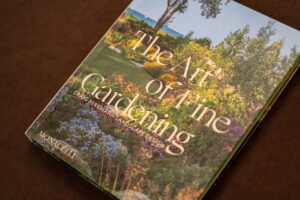
The Art of Fine Gardening: Craig Bergmann Landscape Design
Craig Bergmann and Russell Buvala presented The Art of Fine Gardening, showcasing four decades of landscape design that unites architecture and horticulture. Featuring twenty North Shore gardens—including the historic Gardens at 900—the book blends stunning photography, personal stories, and practical guidance for gardeners and design enthusiasts alike.