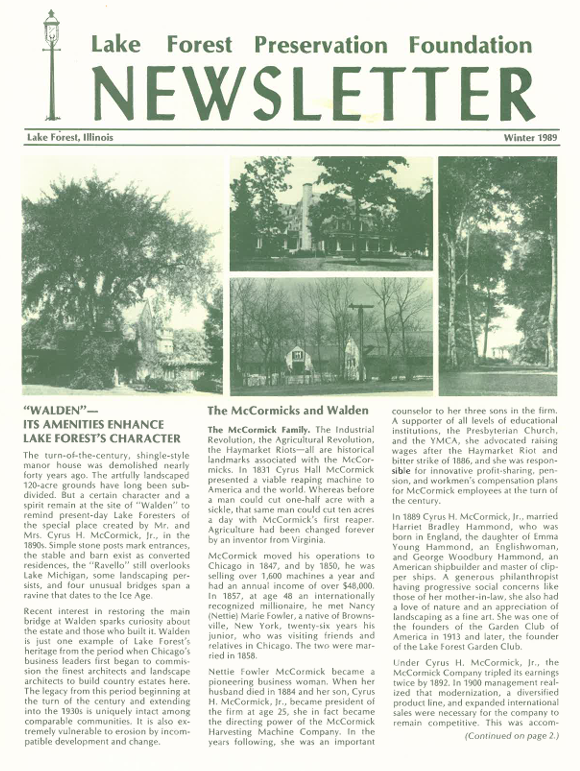
Lake Forest Preservation Foundation NEWSLETTER, Lake F«irest, Illinois, Winter 1989, “WALDEN”–ITS AMENITIES ENHANCE LAKE FOREST’S CHARACTER: The turn-of-the-century, shingle-style manor house was demolished nearly forty years ago and the artfully landscaped 120-acre grounds have long been subdivided, but a certain character and a spirit remain at the site of “Walden” to remind present-day Lake Foresters of the special place created by Mr. and Mrs. Cyrus H. McCormick, Jr., in the 1890s, as simple stone posts mark entrances, the stable and barn exist as converted residences, the “Ravello” still overlooks Lake Michigan, some landscaping persists, and four unusual bridges span a ravine that dates to the Ice Age, and recent interest in restoring the main bridge at Walden sparks curiosity about the estate and those who built it, because Walden is just one example of Lake Forest’s heritage from the period when Chicago’s business leaders first began to commission the finest architects and landscape architects to build country estates here, and the legacy from this period beginning at the turn of the century and extending into the 1930s is uniquely intact among comparable communities, yet extremely vulnerable to erosion by incompatible development and change, and in The McCormicks and Walden, The McCormick Family, the Industrial Revolution, the Agricultural Revolution, the Haymarket Riots—all are historical landmarks associated with the McCormicks, as in 1831 Cyrus Hall McCormick presented a viable reaping machine to America and the world, so whereas before a man could cut one-half acre with a sickle, that same man could cut ten acres a day with McCormick’s first reaper and agriculture had been changed forever by an inventor from Virginia, then McCormick moved his operations to Chicago in 1847 and by 1850 he was selling over 1,600 machines a year and had an annual income of over $48,000, and in 1857, at age 48 an internationally recognized millionaire, he met Nancy (Nettie) Marie Fowler, a native of Brownsville, New York, twenty-six years his junior who was visiting friends and relatives in Chicago, and the two were married in 1858, and Nettie Fowler McCormick became a pioneering business woman so when her husband died in 1884 and her son, Cyrus H. McCormick, Jr., became president of the firm at age 25, she in fact became the directing power of the McCormick Harvesting Machine Company and in the years following she was an important counselor to her three sons in the firm, and as a supporter of all levels of educational institutions, the Presbyterian Church, and the YMCA, she advocated raising wages after the Haymarket Riot and bitter strike of 1886 and she was responsible for innovative profit-sharing, pension, and workmen’s compensation plans for McCormick employees at the turn of the century, and in 1889 Cyrus H. McCormick, Jr., married Harriet Bradley Hammond, who was born in England, the daughter of Emma Young Hammond, an Englishwoman, and George Woodbury Hammond, an American shipbuilder and master of clipper ships, and as a generous philanthropist having progressive social concerns like those of her mother-in-law, she also had a love of nature and an appreciation of landscaping as a fine art, becoming one of the founders of the Garden Club of America in 1913 and later the founder of the Lake Forest Garden Club, and under Cyrus H. McCormick, Jr., the McCormick Company tripled its earnings twice by 1892, and in 1900 management realized that modernization, a diversified product line, and expanded international sales were necessary for the company to remain competitive, which was accomplished in 1902 in a merger with the competing firm of William Deering and with an influx of capital from the House of J.P. Morgan, thus International Harvester was created with Cyrus H. McCormick, Jr., as president, and by 1931, one hundred years after Cyrus Hall McCormick built his first reaper, the firm noted that “one man with a 10-foot tractor-binder can cut and bind 35 acres a day”—one man in 1931 could do the work it had taken 70 men to do in 1831, and Walden: the McCormicks had occupied one of a cluster of family mansions on Rush Street north of the Loop and had summered on the North Shore first at the Price estate in Highland Park and later at “Blair Lodge”1 in Lake Forest, and in the mid-1890s they began plans to build a country estate in Lake Forest during the time of the Columbian Exposition of 1893 when among those who came to Chicago to plan and build the world’s fair were the most noted architects and landscape architects of the day, and though the McCormicks were probably familiar with the work of these professionals from their extensive travels, the Exposition surely afforded them the opportunity for closer acquaintance, and when decisions were made, Jarvis Hunt was chosen as architect2 and Warren H. Manning as landscape architect, and Jarvis Hunt came to Chicago for the Columbian Exposition of 1893 to oversee construction of the Vermont State Building, the nephew of Richard Morris Hunt, the much honored New York architect who was so important in the development of th profession of architecture in the 19th century, and Jarvis Hunt was educated at Harvard and, in architecture, at M.I.T., establishing a Chicago office and completing significant commissions including the Saddle and Cycle Club (1898), the original 39 buildings at the Great Lakes Naval Training Center (1905-1911), and the former 900 North Michigan Avenue building (1927), and landscape architect Warren H. Manning of Boston was a student of Frederick Law Olmstead, Sr., and was the horticultural expert and director of planting of Olmstead’s firm at the time Olmstead planned the arboretum at “Biltmore,” the Vanderbilt estate in Ashville, North Carolina, about 1895, and he was a founder of the American Society of Landscape Architects and designed and planned over 1,600 landscapes, regional plans, parks, and park systems in forty states, and in 1906 he designed a landscape plan for Lake Forest College and was directly involved at Walden from 1894 until the early 1930s, and Hunt and Manning designed the estate to meet the owners’ desire for charm and intimacy, without pretention or affectation, with warmth in its buildings and peace and tranquility in its setting, and in his desire, perhaps, to identify with Thoreau’s Walden, Mr. McCormick had Manning obtain hundreds of willows for reinforcing the beach front from Pratt’s nursery, where Thoreau had chosen plants, and the flat boulders in the Ravello walk came from the “Thoreau region,” other stones came from the Pratt farm near Concord bridge, and one from the remains of Thoreau’s “Rose Hut,” and gardeners at the estate were required to respect the spirit of the site and were sent to study at well-known arboretums, and the estate itself began to function as an arboretum in 1914 while thousands of plants and trees were raised especially for the development of the estate including elms raised at the McCormicks’ Elm Tree farm in Libertyville, and several years Mr. McCormick gave elms as Christmas presents to friends and neighbors, sending his staff to plant the trees as part of the present, and at times Mr. McCormick himself did special trimming in the ravine, and the accompanying photographs3 illustrate how the McCormicks’ objectives were met, and 1HomP of Walter and Emma Scribner Larned: later became part of Schweppe estate, 405 N. Mayflower, and 2Although Stanford White i_,; idenrified as the architec! of Walden in Edward Arpee’s book Lake forest, Illinois, a document by Warren H. Manning in the McCormick col• lection ar the Wisconsin Historical Society and the Lake Forest Residential Historic Preservation District Survey by architectural historian Dr. Paul E. Sprague both name Jarvis Hunt as architect It may be that White was one of che architects who prepared sketches or plans for the estate, but who’-e work was not chosen, and Manning’s note.�indicate that other architects may have submitted plans, citing rejection of an architect’s “gaudy show place type of house,” which did not meet the McCormicks’ desire for a home that blended with its surroundings, and We would apprcriate hearing from th0se who might ,hed further light on the development of Walden, and 1By George Henry High, from Landscape Art, Past and Present by Harriet Hammond McCormick, published in 1923 in her memory and written originally for a meeting of thf’ Friday Club of Chicago in 1899, and The Walden bluff in 1922, after improvements had matured, and stead’s firm at the time Olmstead plan-ned the arboretum at “Biltmore,” the Vanderbilt estate in Ashville, North Carolina, about 1895, and He was a founder of the American Society of Landscape Architects and designed and planned over 1,600 landscapes, regional plans, parks, and park systems in forty states, and In 1906 he designed a landscape plan for Lake Forest College and He was directly involved at Walden from 1894 until the early 1930s, and Hunt and Manning designed the estate to meet the owners’ desire for charm and intimacy, without pretention or af-fectation, with warmth in its buildings and peace and tranquility in its setting, and In his desire, perhaps, to identify with Thoreau’s Walden, Mr. McCormick had Manning obtain hundreds of willows for reinforcing the beach front· from Pratt’s nursery, where Thoreau had chosen plants, and The flat boulders in the Ravello walk came from the “Thoreau region,” other stones came from the Pratt farm near- Concord bridge, and one, from the remains of Thoreau’s “Rose Hut,” and Gardeners at the estate were required to respect the spirit of the site and were sent to study at well-known arboretums, and The estate itself began to function as an arboretum in 1914, and Thousands of plants and trees were raised especially for the development of the estate, including elms raised at the McCormicks’ Elm Tree farm in Libertyville, and Several years, Mr. McCormick gave elms as Christmas pres-ents to friends and neighbors, sending his staff to plant the trees as part of the The Walden bluff in 1895, before planting was under-taken, and The residence, stable, and garage designed by Hunt were supplemented between 1907 and 1931 with several auxiliary structures: a boat and bath house (Lawrence Buck), pergola (Hunt), greenhouses, and dairy and storage buildings (Chester Walcott and Robert Work), and The Ravello was sketched by Hunt at Mrs. McCormick’s request to resemble a lookout in Italy and was constructed in 1914 at the spot where the McCormicks’ daughter Elizabeth, who died at age 12, had been fond of sitting to look out over Lake Michigan, and alterations to the residence were made in 1914 by Schmidt, Garden· & Martin and in 1928 and 1931 by Walcott and Work, and interestingly one of the auxiliary buildings located on the lakefront bore a resemblance to the shelters constructed during Lake Forest’s 1987 lakefront renovation, and Walden was the first of three McCormick estates located in the southeast section of Lake Forest as in 1912 Mr. and Mrs. Harold McCormick built “Villa Turicum,” designed by Charles A. Platt, just to the south across Westleigh Road, and in 1916 to the north between Illinois and Ringwood Roads, Mrs. Emmons Blaine (Anita McCormick) built “House-in-the-Woods,” designed by Dwight Perkins, for her mother, Nettie Fowler McCormick, and today all the McCormick properties have been subdivided so only amenity structures remain from Villa Turicum but the manor house, gate house, garage, and walled garden remain from House-in-the-Woods, and Gail T. Hodges, Editor, PRESIDENT’S MESSAGE: Frequently we are asked what we have done lately and it seems that the Preservation Foundation is often confused with the Historical Society and many people seem not to realize that there are two organizations, each with its own rnembership base and its own important mission, and Membership: founded in 1972, the Historical Society is comprised of citizens from Lake Forest and Lake Bluff and focuses on both communities, fhe Preservation Foundation focuses on Lake Forest only, but its membership is not limited to Lake Forest, and Missions: the Historical Society collects items such as papers, letters, photo-graphs, clothing, and furniture relating to the history of Lake Forest and Lake Bluff, 1t has amassed an interesting col-lection, which is catalogued and is a valuable resource for both communities, while the Preservation Foundation, founded in the Bicentennial year 1976, is actively engaged in many aspects of preservation, including education, but does not collect things, and with a deep respect for Lake Forest’s and Illinois’ past we also have a vital interest in the future—in the way change in buildings or landscapes is or isn’t compatible with the community’s historic visual character, and for this reason we monitor change and try to provide constructive suggestions, sometimes underwriting studies—as with the engineering studies of the Old Rec Center (now Northgate Center) and the North Western station and the architectural survey for the Residential Historic Preservation District, and our most visible undertaking has been the restoration of the North Western station so central to the visual character of downtown and historic Market Square, and we were joined by the City, the railroad, the station tenants, the RTA, and the many interested citizens who contributed to this project, and we maintain an ongoing interest in working with the City and the community to maintain the station as refinements are added periodically and the groundcover was replenished last fall through $6,000 of Foundation underwriting, and both the Foundation and the Historical Society present programs to the public—occasionally jointly—because this is a natural area where our purposes coincide and cooperation is of benefit to both organizations, and both groups enrich the fabric of Lake Forest and we would encourage membership and participation in both, and as you can see from this Newsletter we are focusing our attention on Walden, the Walden Ravine, and the Walden-Bluff’s Edge Bridge and our Board of Directors has voted to commit $15,000 to the City toward the reconstruction and restor- (Continued on page 6), and POINTS TO PONDER: the amenities of Lake Forest contribute greatly to the quality of life here, public amenities like Forest Park, the beach, and Market Square come to mind immediately, but the sum of many smaller bits of architecture, landscaping, and artifacts is what pulls together the special atmosphere that means Lake Forest, and the Walden Ravine and its unique bridge tucked away in a quiet corner of the City comprise part of this atmosphere, as do such amenities as gate posts, lights, remnants of gardens, and architectural details in public and private places—sometimes beautiful, sometimes quaint, sometimes just old, and elements like these are a legacy of which we are all custodians, and caring for this legacy is often difficult or expensive or a nuisance—for a private property owner or a city—so replacing the old with the new and maintenance-free or getting rid of it entirely may seem easier or more effic-ient, but when the legacy that comprises the roots of a community’s quality of life is eroded bit by bit, that quality of life suffers, and just as a community of character like Lake Forest evolves slowly into a unique place over the years, so also it can evolve, often more rapidly, into a place of mediocrity, once lost, many (Continued on page 6), and LAKE FOREST FOUNDATION FOR HISTORIC PRESERVATION, Box 813, Lake Forest, Illinois 60045, I/We want to help preserve the historic character of Lake Forest, Please enroll me/us in the selected-membership category, (Contributions are tax deductible, Please make checks payable to the Preservation Foundation), Mr. Mrs. Miss, Telephone, Street, City, State, Zip, Member — Annual Dues $25.00, Contributing Member — Annual Dues $50.00, D Sponsor — Annual Dues $100.00, Sustaining Member — Annual Dues $250.00, D Patron — Annual Dues $500.00, Life Member — Contribution to the Revolving Fund in the amount of $1,000.00 or more, No annual dues required, D I/We would like to actively work with the Foundation, Please call me/us to discuss areas of interest, ·———— The Preservation Foundation is open to all whoshare its goal of progress throughpre,;crvation. ————————, WALDEN-BLUFF’S EDGE BRIDGE RESTORATION, Lake Forest Foundation for Historic Preservation Box 813 • Lake Forest, Illinois 60045, I/We want to help restore the historic Walden-Bluffs Edge Bridge for future generations, Enclosed is my/our donation of$ _ (Contributions are tax-deductible, Please make checks payable to either The Preservation Foundation or The City of Lake Forest, and mail to the above address, Please indicate that your contribution is for the Walden-Bluff’s Edge Bridge restoration), Mr./Mrs./Miss, Telephone, Address, and Walden Ravine—Part of Lake Forest’s Unique Heritage: The ravines that enter Lake Michigan between Waukegan and Highland Park are a unique part of our natural heritage and are the result of the glacial advance over 10,000 years ago and the erosion process which followed as the glaciers receded and which continues even to the present, and by the time Lake Forest was chartered in 1861 three large ravines traversed the area from the North Western tracks eastward, becoming deeper and more beautiful as they descended to Lake Michigan, with many smaller ravines and natural ponds also existing and together forming a natural drainage system for properties east of Green Bay Road, and the area of Green Bay Road is about 700 feet above sea level and acts as a water-shed (continental divide), so properties west of it drain into the Chicago River, then into the Des Plaines River, the Mississippi Basin, and the Gulf of Mexico, while properties east of Green Bay Road drain through the ravines into Lake Michigan, then down into the St. Lawrence, and on to the Atlantic Ocean, and into the 1880s the ravines were deep in water and a recreational area favored by youthful fishermen and wildflower gatherers, and lady slippers, ferns, trillium, and marsh marigolds abounded amidst shrubs such as witch hazel, elderberry, baneberry, choke cherry, and varieties of dogwood and viburnum, and the understory tree layer contained ironwood, shad- Walden Ravine in spring, 1922, bush, basswood, and ash, while a canopy of sugar maples, oaks, cottonwoods, hickory, and paper birch towered above, and sprinkled throughout the ravines were Jack pines, the only indigenous evergreen of note, and Walden Ravine, considered the third largest of the eleven remaining ravines in Lake Forest, was typically deep-sided and heavily wooded with heavy water-retaining groundcover, attracting wildlife including moose, deer, quail, snakes, and fox, and when Cyrus H. McCormick, Jr., built Walden he had it laced with 30 miles of private roads, bridle paths, and foot paths, and his wife Harriet was attuned to the natural landscape and did little to change the character of the ravine other than to construct a carriage road essentially following the stream bed, and erosion was a recognized problem so some parts of the stream bed were lined with a concrete wall into which large rocks were imbedded, and in consort with her landscape architect Warren H. Manning, Mrs. McCormick had myriads of wildflowers planted so artfully that nature received all the credit, and the ravinescape that Mrs. McCormick once called “a living picture gallery” was equally enjoyable from the four handsome concrete and steel bridges that spanned the ravines, and the McCormicks shared this natural beauty by permitting residents of Lake Forest to use their network of paths and roads, and students of horticulture, botany, and biology and various garden club members were visitors to the estate, and according to Manning up to 2,000 people a year visited the estate and must have been overwhelmed by this natural wonderland, and much of the Walden property bordering the main ravine was eventually acquired by Russell Pester, Jr., a developer who sold his lots but retained a portion of the stream bed carriage path beginning just west of the western Walden Lane bridge and ending several hundred feet west of the Bluffs Edge Drive bridge, and prior to leaving Lake Forest he donated this parcel of carriage path to the Lake Forest Garden Club in 1966, and for a decade the path was enhanced with plantings of ferns and wildflowers and routine maintenance was performed as garden club groups, school children, neighboring property owners, and students of botany, horticulture, geology, and hydrology enjoyed the terrain and learned from it, and much valuable information was accumulated and disbursed to the community about the nature and origins of a ravine, the effects of development and drainage, ravine ecology, and ways of positive stewardship, and Harriet McCormick would have been pleased to know that the garden dub she founded eventually came to the aid of her beloved Walden Ravine and further enabled others to appreciate Lake Forest’s ravines as valuable assets and to better understand how to care for them, and in 1987 a Garden Club member assisted in drafting the City’s Steep Slope Ordinance, and that same year it became evident that managing the effects of natural forces and development on the ravine path was beyond the Lake Forest Garden Club’s control so maintenance efforts were futile since the Club did not own the property upstream nor control drainage systems emptying into it, and after evaluation members felt it prudent to turn the property over to The City of Lake Forest, and today many Lake Foresters live on ravines and many others simply en.ioy their ambiance, but the ravinescape viewed today is much changed from the 1800s because before ravine ecology was fully understood many ponds, small ravines, and shallow western ends of large ravines were filled in as buildings were built, sewers installed, and roads built, and properties were divided many times over, with use of the natural drainage system sustaining much growth, and the toll in increased erosion is obvious as 380 acres—bounded by Lake Michigan on the east, Green Bay Road on the west, approximately the upper tennis courts of the Onwentsia Club on the north, and Timber and Briar Lanes on the south—drain through storm sewers into the Walden Ravine with increased runoff created by development, and the City of Lake Forest has addressed erosion through drainage pipes and in some instances check dams to slow water velocity and prevent further erosion, and the City’s 1987 Steep Slope Ordinance sets guidelines and limitations for building setbacks on ravines and bluffs because too often property owners build too close to the edge encouraging slumping and erosion, and ravines are fragile and prone to thawing and freezing as moisture collects in sandy pockets and moves laterally (Continued on page 4), and Pholo: CNWRR, Photo: Wiss. Jann(·y, E:l�tnN Assoriates, and The main Walden bridge from the ravine stream bed carriage path, circa 1901, when the bridge Understructure of the main Walden bridge during wooden sides, Note the arch of the bridge ?nd the carriage on the path at center of photo, the 1988 structural engineering study, and The Walden Bridges—Historic Amenities: the first bridges at Walden were wooden bridges constructed at four ravine crossings while the estate was being planned and the main buildings built between 1894 and 1898, and some time during this period, according to Warren H. Manning, Cyrus H. McCormick, Jr., submitted to J. H. Gray an unusual bridge design where “the curve of the arch was like the rim of a great wheel” with supports oriented to the arch and roadway at angles, and although Gray had never seen such a design he thought it feasible and proceeded, and the bridge was completed in 1901 with forms made from salvage timbers from the Columbian Exposition, and the design may have had its first use at Walden, and Manning reported McCormick knew of no earlier examples and heard it was later used by others, and the main bridge underwent a number, and the estate originally also included eleven log bridges in the ravine later reduced to five concrete bridges and three long brick culverts, and unfortunately nothing is known about changes from about 1930 to the razing of the Walden manor house in the early 1950s, and in the 1950s the estate was subdivided, the subdivision dedicated in 1957, and the bridge became City property, and in 1972 after a report by R. J. Peterson Associates stated the deck was unsafe the City apparently decided to close the bridge, and a wooden deck for pedestrian and bicycle traffic was built in 1977, and for years there has been interest in restoring the bridge to its original struc-, and Supplement,1ry resedrch for lthe articles on Walden Bridge were Undertaken by Dawn Kimbrel, and Walden Ravine(Continued) through the weathered, porous clay as it encounters layers of impermeable clay and water seeps out sides increasing slumping potential, and an uprooted tree can have similar consequence where pockets of sand exist, and although some ravines have changed greatly Lake Forest still has a special asset in its eleven ravines and we share responsibility for not impacting them more than nature itself.4, and Kay Hill, Guest Contributor, Member of Lake Forest Garden Club and a Director of Lake Forest Open Lands Association, and of changes over the years the estate was active, perhaps the result of greater knowledge of ravine ecology and the need to mitigate erosion, and in 1911 concrete sides replaced the original, and seemed to be insurmountable hurdles, and recently the City commissioned Wiss, Janney, Elstner Associates, Inc., to prepare a structural engineering study and bridge restoration is a high priority for possible inclusion in the City’s FY 1990 capital improvements budget, and use only by cyclists and pedestrians has been rPcommended in the spirit of Walden to share beauty while preserving tranquility, and Peter Shrock, and wooden ones and flower boxes were added for additional height, and over the years drains were adjusted and protective walls were added, and three other concrete and steel bridges were built later at Walden as the east and center bridges were designed by J. H. Gray and constructed in 1909 under supervision of W. H. Griffith, and in 1912 Gray drew sketches for the west bridge and during 1913-1914 he supervised its construction noting he was enchanted and that “a chance to build a bridge in such a place comes only once in a lifetime,” and 41ho<.;p who would fikf’ rnorP information on ravine<;, suC””h a<, thf’ Lake Forest Garden Club’., Ravine Practices (Dos ,rnd fJon’ls) ur plant material lists _hould contact Kay Hill, Box 205, LakeForest 60045, and S�009 ‘111 ‘1S3l!O� 3)1’11″1 �8l “ON 11Wll3d OIYd 3�VlSOd ·s·n -�l!O ll�Ol!d·NON, and President’s Message (Continued): ation of the bridge as an important feature of the past to be saved for future generations and we invite you to join us in contributing (see contribution slip on page 5), and the proposed restoration of the Walden-Bluff’s Edge Bridge is one more step taken to help preserve Lake Forest’s historic visual character, and a most critical recent action was the January 9, 1989 enactment by the City Council of the Building Scale and En-vironment Ordinance and we commend the Council and the Plan Commission for their diligent work, and Sarah Wimmer, and Points to Ponder (Continued): unique elements can never be replaced, Walden for example might not have been subdivided but maintained instead as an arboretum, and there may be opportunities to maintain other unique places or landscapes in the future, and keeping “A Special Place” from becoming “Everywhere Else” will take continued and even greater diligence and commitment, but wouldn’t it be worth it, and Gail T. Hodges, Editor, and EASEMENTS COUNTER INFILL, OFFER TAX BREAK: the Lake Forest Plan Commission has identified “infill”—further development by subdivision of already established neighborhoods—as a serious obstacle to maintaining the visual character of the City and easements are one tool for countering the negative impact of infill, and for several years the Preservation Foundation and the City of Lake Forest have encouraged preservation/conservation easements on properties within the City’s historic districts to help preserve facades, property character, open space, and landscaping, and the Lake Forest Open Lands Association also encourages conservation easements, and given high land costs the income tax value of conservation easements can be substantial and offer an attractive alternative to subdivision and sale while freeing resources for renovation, and for an article giving details write to The Preservation Foundation, Box 813, Lake Forest, IL 60045, and for further information contact Charles E. Crook, Director of Planning and Development, City of Lake Forest, 234-2600, and COLLEGE CONTINUES RENOVATION OF HISTORIC BUILDINGS: North Gymnasium (1890), designed by Henry Ives Cobb, and Arthur Somerville Reid Memorial Library (1899), designed by Frost and Granger, have recently been renovated by Lake Forest College bringing to four the number of National Register buildings updated by the College for state-of-the-art academic use, earlier renovations including Henry C. Durand Art Institute (1891), designed by Henry Ives Cobb, and College Hall (1878, now known as Young Hall), and North Gym now serves the psychology and sociology/anthropology departments and the counseling center with classrooms, offices, conference rooms, and a computer center, and Reid Hall now houses the departments of music, education, and religion with classrooms, music facilities, and a large music and recital hall in Reid Auditorium, once the reference room of the library, and the Preservation Foundation Newsletter is published by the Lake Forest Foundation for Historic Preservation and distributed without charge to the residents and businesses of Lake Forest.
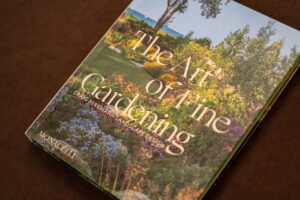
The Art of Fine Gardening: Craig Bergmann Landscape Design
Craig Bergmann and Russell Buvala presented The Art of Fine Gardening, showcasing four decades of landscape design that unites architecture and horticulture. Featuring twenty North Shore gardens—including the historic Gardens at 900—the book blends stunning photography, personal stories, and practical guidance for gardeners and design enthusiasts alike.