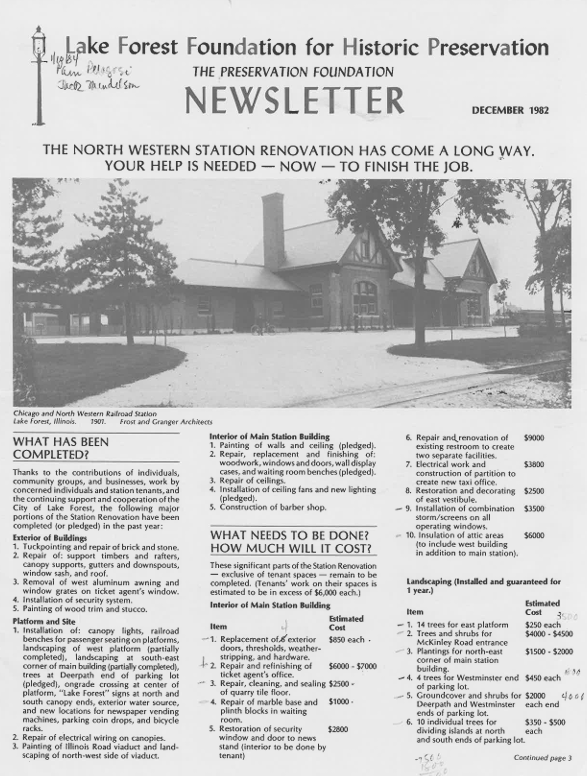
NEWSLETTER DECEMBER 1982 is centered on the message that THE NORTH WESTERN STATION RENOVATION HAS COME A LONG WAY and that YOUR HELP IS NEEDED — NOW — TO FINISH THE JOB, with photos labeled Chicago and North Western Railroad Station, Lake Forest, Illinois, 1901, Frost and Granger Architects, plus views of the Interior of Main Station Building and Interior of platform cover showing renovation and another interior view showing area in need of renovation, then WHAT HAS BEEN COMPLETED? reports that thanks to contributions of individuals, community groups, and businesses, work by concerned individuals and station tenants, and continuing support and cooperation of the City of Lake Forest, major portions of the Station Renovation were completed or pledged in the past year, listing Exterior of Buildings work including tuckpointing and repair of brick and stone, repair of support timbers and rafters, canopy supports, gutters and downspouts, window sash, and roof, removal of the west aluminum awning and window grates on the ticket agent’s window, and installation of a security system, and listing Interior of Main Station Building items including painting of walls and ceiling (pledged), repair, replacement and finishing of woodwork, windows and doors, wall display cases, and waiting room benches (pledged), repair of ceilings, installation of ceiling fans and new lighting (pledged), and construction of a barber shop, then WHAT NEEDS TO BE DONE? HOW MUCH WILL IT COST? states that significant parts of the Station Renovation exclusive of tenant spaces remain to be completed, noting tenants’ work on their spaces is estimated to be in excess of $6,000 each, and then provides itemized remaining work and costs including Interior of Main Station Building needs such as replacement of exterior doors, thresholds, weather-stripping and hardware at $850 each, repair and refinishing of the ticket agent’s office at $6000–$7000, repair, cleaning, and sealing of the quarry tile floor at $2500, repair of marble base and plinth blocks in the waiting room at $1000, restoration of security window and door to the news stand at $2800 with interior to be done by tenant, electrical work and construction of a partition to create a new taxi office at $3800, restoration and decorating of the east vestibule at $2500, installation of combination storm/screens on all operating windows at $3500, and insulation of attic areas at $6000 including the west building in addition to the main station, and it also lists Painting of wood trim and stucco as an estimated item, then for Platform and Site it lists elements such as installation of canopy lights, railroad benches for passenger seating on platforms, landscaping of the west platform partially completed, landscaping at the southeast corner of the main building partially completed, trees at the Deerpath end of the parking lot pledged, an on-grade crossing at the center of the platform, “Lake Forest” signs at the north and south canopy ends, an exterior water source, and new locations for newspaper vending machines, parking coin drops, and bicycle racks, and it also notes repair of electrical wiring on canopies plus painting of the Illinois Road viaduct and landscaping of the northwest side of the viaduct, then under Landscaping (installed and guaranteed for 1 year) it itemizes plantings including 14 trees for the east platform at $250 each, trees and shrubs for the McKinley Road entrance estimated $4000–$4500, plantings for the northeast corner of the main station estimated $1500–$2000, 4 trees for the Westminster end of the parking lot at $450 each, groundcover and shrubs for Deerpath and Westminster ends of the parking lot at $2000 each end, and 10 individual trees for dividing islands at the north and south ends of the parking lot at $350–$500 each, with a note Continued page 3, then PRESIDENT’S MESSAGE by Herbert Geist reflects that if the preservation movement had been popular in the 1950s and 1960s we would still be able to enjoy many irreplaceable architectural treasures lost to the “getting rid of the old” philosophy, that today’s emphasis on preservation and re-use is bringing new life to many structures, and that the Lake Forest North Western Railroad Station restoration is a community effort to retain local architectural character and spirit while recognizing economic realities, noting restoration and maintenance of the station was a low priority item to the RTA and without community action the station might have been razed and replaced by an incongruous shelter like the one at Fort Sheridan, and stating it is fortunate that Lake Forest residents care about the physical appearance of their community and took action to save the station, which is on its way to again becoming a complement to Market Square, helping the city retain unique charm and appeal, and he thanks the City Council for approving the lease arrangement that made renovation possible, explains the City will manage and maintain the station with expenses covered by income from station tenants, and credits City staff cooperation and many hours of work as essential, signed Herbert Geist, then A SHORT HISTORY OF THE CHICAGO AND NORTHWESTERN RAILROAD AND ITS INFLUENCE ON THE CITY OF LAKE FOREST explains that the Chicago and North Western Station has been a landmark since the turn of the century and is the fourth station built in Lake Forest, that as a gift of citizens it has remained relatively unchanged since 1899, describing original features such as a brick platform covered by a long hipped roof canopy, quaint lamp posts, a fireplace warming the ladies’ waiting room at the north end, a park around the station, and a picket fence separating the tracks, and noting the tracks of the North Shore Railroad ran along McKinley Road to the east of the station, then THE RAILROAD AND LAKE FOREST outlines early rail history stating the Illinois Parallel Railroad was incorporated February 17, 1851 to build from Chicago to the Illinois–Wisconsin state line, passengers to Milwaukee changed at the state line to the Milwaukee and Chicago Railroad, in 1963 the two railroads were consolidated and the name changed to the Chicago and Milwaukee Railroad, in 1866 the Chicago and Milwaukee line was leased by the North-Western system and consolidation completed in 1883, the single track was completed to Waukegan in 1854 and extended to Milwaukee the following year, and double tracks were completed to Lake Forest in 1890, describing the railroad as a major factor in opening northern Illinois for settlement and that it brought representatives of the First and Second Presbyterian Churches to examine the area that became Lake Forest, noting that by 1899 there were about 20 trains a day round trip from Chicago to Lake Forest and that the one-way trip took 57 minutes to one hour and 35 minutes, then THE ARCHITECTS describes Frost and Granger’s influence in early Lake Forest and lists their works including the North Western Railroad Station, City Hall, First Presbyterian Church, 880 Elm Tree Road (home of Frost), 907 North Sheridan Road (home of Granger), 600 East Westminster (home of Marvin Hughitt, president and chairman of the North Western Railroad), and several Lake Forest College buildings including Lois Durand Hall, Arthur Somerville Reid Memorial Library, and Lily Reid Memorial Chapel, then provides brief biographies noting Charles Sumner Frost was born in Lewiston, Maine on May 31, 1856, came to Chicago in 1882, formed Cobb and Frost with Henry Ives Cobb, and in 1897 the firm became Frost and Granger with influence until 1910 and that Chicago’s Navy Pier was designed by Frost, that Frost married Mary Hughitt in 1885 and built “Eastover” on Elm Tree Road and died in the late 1920s, and that Alfred Hoyt Granger was born in Zanesville, Ohio on May 31, 1867, graduated from Kenyon College in 1887 and MIT in 1889, studied at the Ecole des Beaux Arts and Atelier Pascal, trained with Shepley Rutan and Coolidge, partnered in firms including Frost and Granger and Granger and Bollenbacher, married Belle Hughitt in 1893, built “Woodleigh” on North Sheridan Road, moved to Philadelphia in 1911, was honored as a Fellow of the AIA, and died in 1939, then THE SUBURBS AND COMMUTERS notes the railroad promoted moving to the suburbs and quotes a 1917 Monthly Bulletin describing suburban territory along the North Western as attractive and train service as faster and more comfortable than living in outlying portions of the city, and it explains the term “commuters” comes from tickets being “commuted” meaning striking a bargain with the railroad, giving a Lake Forest example of Lawrence H. W. Speidel renting $8.00 25-ride tickets for 75 cents a round trip so renters saved 40 cents compared to a $1.15 station-purchased ticket, noting dozens rented these tickets and the practice was common on the North Shore, and it traces the station wagon to depot baggage wagons and later motorized vehicles and notes Henry Ford developed a passenger station wagon in the 1920s and other makers followed and the “woodie” became a 1940s status symbol, then a later section titled WHAT NEEDS TO BE DONE? focuses specifically on Platform and Site with an itemized Estimated Cost list including 16 platform lights at $1000 each and electrical work necessary totaling $27,000 before lights can be installed, brick steps, landing, walk, and parking lot crossing from McKinley Road to the entrance of the main station building at $15,400, 700 linear feet of between-track anodized black aluminum fence installed to replace barbed wire at $17,500, platform restoration and brick paving including removal of old paving at $175,000, electrical heaters for platform canopies at $800 each, and a contingency for new electrical service to update existing service at $3000, and it notes interior benches to be refinished with funds donated by the Deerpath Questers in memory of Mrs. Karl Baughman and platform benches donated by the Lake Forest Woman’s Club, then HOW CAN YOU HELP? invites personal, group, business, organizational commemorative or memorial contributions of specific items such as an area of landscaping, a tree, or the fence, offers ways to support in general by becoming a benefactor, sponsor, or patron of the Station Renovation or a subscriber or contributor to the Station Restoration Fund, and notes donations of materials or service are also welcome, stating contributors of particular items will be recognized by individual recognition plaques while other donors will be recognized on a “contributors’ wall” to be installed in the station when complete, and it provides a contribution form with options for General Fund versus Specific Item(s), giving giving levels Benefactor ($1000 and over), Sponsor ($500–$999), Patron ($250–$499), Subscriber ($100–$249), and Contributor with an amount line, with instructions to mail checks payable to the Preservation Foundation to Box 813, Lake Forest, Illinois 60045 and that contributions will be acknowledged by the Lake Forest Foundation for Historic Preservation (IRS classification 509 a 2), and the newsletter closes with acknowledgements that landscaping by the south-east end of the main building was done with funds donated by the Lake Forest Garden Arts Club and that trees along the platform were donated by the Woodlands Garden Club.
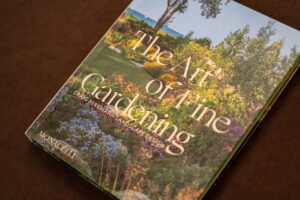
The Art of Fine Gardening: Craig Bergmann Landscape Design
Craig Bergmann and Russell Buvala presented The Art of Fine Gardening, showcasing four decades of landscape design that unites architecture and horticulture. Featuring twenty North Shore gardens—including the historic Gardens at 900—the book blends stunning photography, personal stories, and practical guidance for gardeners and design enthusiasts alike.